Do your genealogy files live in a tangled mess of boxes, folders, and half-labeled digital scans? You’re not alone. Many passionate researchers get so caught up in the thrill of the hunt that Family History Organizing becomes an afterthought.
But imagine this: a week from today, your research will be clean, clear, and confidently cataloged. That’s the power of this 7-Day Family History Organizing Challenge—a step-by-step plan to transform your family archive chaos into order, peace, and purpose.
Whether you’re just beginning or deep into your family tree, this family history organizing challenge is for you. And if you’re looking for a deeper beginner guide, check out our foundational article, Genealogy Research Online: The 1 Ultimate User-Friendly Beginners Guide.
Table of Contents
Day 1: Take Inventory – Know What You Have
Start by setting aside 30–60 minutes to pull together all your family history materials. This includes:
- Paper records (certificates, letters, newspaper clippings)
- Digital files (scanned documents, photos, PDFs)
- Family heirlooms or keepsakes with historical value
- Notes from interviews or online searches
Make a master list—use a notebook, spreadsheet, or note-taking app. This first step is emotional. As you go through your materials, you’ll rediscover forgotten moments, faces, and stories. Let that joy and wonder motivate you to see this through this 7-Day Family History Organizing Challenge.
📝 Tip: Don’t judge your mess. Just take note of everything you have.

Day 2: Sort by Type and Family Line
Today’s goal is to group your materials in a way that makes sense and will remain useful. Sort into broad categories such as:
- Family surnames or branches
- Document type (census, birth records, photos, letters)
- Location (e.g., “Ohio ancestors,” “Swedish line”)
For physical documents, use labeled manila folders or bins. For digital materials, create mirrored folders on your computer or cloud storage. (If you need guidance here, see Cloud Storage for Genealogists: 5 Best Tools to Preserve Your Family Memories.)
📦 Emotional Win: As you sort, you’ll begin to see your ancestors’ stories taking form. Family history organizing, is just that: organizing! ❤️
Day 3: Label Everything—Make It Searchable
Unlabeled materials are the #1 culprit of lost family history organizing. Set aside time to add:
- Full names, dates, and places to all scanned files
- Descriptions of what the item is and why it matters
- Folder or file names that are clear and consistent (e.g., “Smith_James_Birth_Certificate_1902”)
For paper files, use pencil on the back of photos or sticky notes on document sleeves. For digital, include metadata or simply rename files properly.
🧠 Backlink Bonus: For more organization strategies, don’t miss Skillfully Organizing Family History Documents: 7 Step Complete Guide for Genealogists.
Day 4: Go Digital—Scan and Backup
Now it’s time to digitize what you can for your family history organizing challenge. This might mean:
- Using a home scanner or scanning app on your phone
- Saving files in TIFF or high-quality JPEG format
- Organizing folders using your Day 2 sorting system
Once scanned, back everything up:
- External hard drive
- Cloud storage (Google Drive, Dropbox, or a specialized genealogy platform)
- USBs for family members
📁 Real Talk: Digitizing might feel like a chore—but once done, you’ll never fear loss from disaster or time. You can create a fun activity out of this, grab coffee, play music, get your family involved and create a system to make it go quicker!
🌟 Mid-Challenge Fun Quiz 🌟
Let’s test your organizing instincts! Pick your answers and tally your score!
1. You find a mystery photo of a couple. You…
A. Toss it (Who knows who they are?)
B. Keep it in a “To Research” folder
C. Upload it to a family Facebook group for ID help
2. Your scanned documents are labeled…
A. IMG03857_final
B. Grandma’s things
C. Smith_Margaret_Marriage_1898
3. Your family tree software is…
A. Nonexistent
B. Somewhere on your old laptop
C. Up to date with synced files
Scoring (yay!):
- Mostly A’s: 🌀 “The Family Historian in Training” – No shame! You’re on your way.
- Mostly B’s: 📂 “The Archive Enthusiast” – Great job, a little refinement will go a long way.
- Mostly C’s: 🌟 “Genealogy Guru” – You should teach this course!
Day 5: Create a Master Genealogy Binder or Digital Hub
If you love tactile tools, create a 3-ring binder with:
- Tabbed dividers by family line
- Printed documents in sheet protectors
- Summary pages for each person or generation
Prefer digital? Make a master folder titled “Family History Organizing Hub” and include:
- One document per ancestor
- Links to sources and DNA matches
- Family group sheets and timelines
📘 Helpful Idea: Use cloud notes (Evernote, Notion) or Google Docs for family summaries.
Day 6: Share and Collaborate
Genealogy is more rewarding when shared. Reach out to cousins, siblings, or local genealogy groups with:
- A Dropbox link to your files
- A family email newsletter
- Invitations to add photos or stories
You can also share discoveries and family history organizing tips on Instagram or Pinterest:
👥 Community Power: The more people you invite in, the more your family history grows.
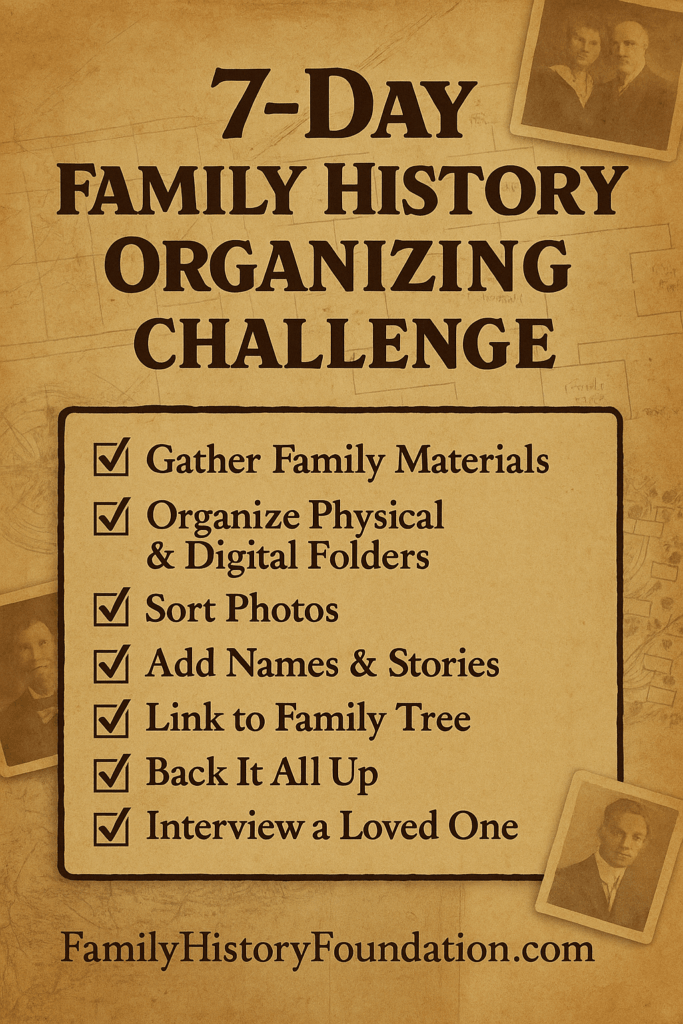
Day 7: Make It a Habit
You’ve done it—your materials are finally organized. Now the key is to maintain it.
Try this:
- Set a monthly “Family History Friday” to review and update.
- Keep a “To Be Filed” folder for new finds.
- Add a journaling habit—include stories, memories, or questions for future research.
And when you hit a wall in your research, we’ve got you covered with strategies from How to Overcome Genealogy Brick Walls: 10 Powerful Strategies to Break Through.
💡 Just remember: Family History Organizing is a living process, not a one-time task. You’re building a legacy.
Ready to Keep the Momentum?
You’ve completed the 7-Day Family History Organizing Challenge—congratulations! Now let’s keep that spirit alive.
🎯 Challenge for You:
In the comments, share a photo or story about your favorite family discovery this week. What surprised or moved you most?
📩 And don’t forget to subscribe to get new guides, templates, and research tools every week!
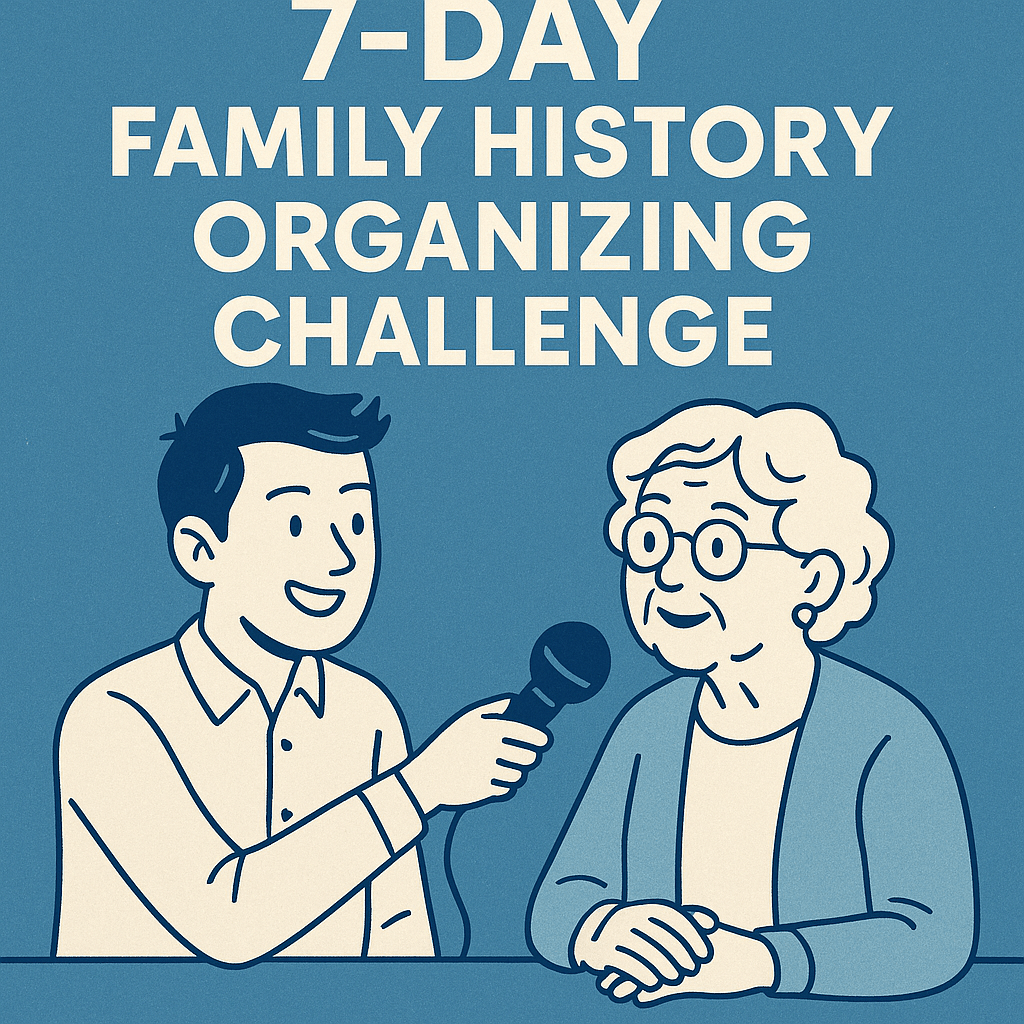
🗣️ Supplemental Challenge: Interview One Family Member This Week
Your family history is more than documents—it’s living stories waiting to be captured. For an unforgettable addition to your Family History Organizing journey, take this bonus challenge:
🎤 Challenge:
Interview one living family member this week. It could be your grandparent, parent, cousin, aunt, or even a sibling. Your goal is to record, transcribe, and incorporate their stories into your organizing system.
Whether it’s a phone call, Zoom chat, or cozy kitchen conversation over tea, this interview could uncover treasures: forgotten ancestors, migration stories, or personal memories that no document could ever reveal.
Once done:
- Save the recording (audio or video) to your digital archive
- Transcribe or summarize the key stories
- Create a new folder or profile for the person you interviewed
- Link their information to relevant photos, documents, or family lines
- Complete the list of each daily activity on the family history organizing list and use your interview to empower your techniques and inspire you to do MORE INTERVIEWS. 😁 😎
🧩 Want help knowing what to ask? Use this interview template below.
🎙️ 10 Insightful Questions to Ask in a Family History Interview (downloadable link!)
- What is your full name, and do you know why it was chosen for you?
- Can you tell me about where you grew up and what it was like?
- Who were your parents, and what do you remember most about them?
- Did you have any special family traditions growing up?
- What was your school experience like? Any favorite teachers or memories?
- Can you tell me about any family members who served in the military or immigrated from another country?
- Do you remember any big historical events during your lifetime (wars, moon landing, etc.)? What was it like?
- Can you describe a favorite family photo and the story behind it?
- What do you hope future generations will remember about our family?
📌 Pro Tip: You can record the conversation using your phone or a free voice recording app. Just remember to ask for permission if you plan to share the stories publicly or online.
Here is your downloadable PDF template for the family history interview:
📄 Download Family History Interview Template (downloadable PDF)
You can share this with your family as a printable or digital worksheet.
Also, feel free to use these questions as a guideline, they are not absolute, so edit, alter, add, so whatever fits best with the person that you plan to interview! When interviewing, make it about them!
Make your subject feel comfortable, bring them something nice to create a space of comfort, chat beforehand and don’t simply rush into the interview, and most of all work off of their visual cues!
That means that if you are interviewing an elder, for example, don’t feel like you have to complete all 10 questions if they are flagging or feeling exhausted. You can always stop the interview, ask how your respondent is feeling and then continue. You can even ask how they like the questions and let them guide the interview! Maybe there is something they are dying to talk about!
YOU GOT THIS!
Here is your downloadable PDF template for the family history interview:
📄 Download Family History Interview Template (downloadable PDF)
You can share this with your family as a printable or digital worksheet.
About the Author
Family History Foundation
I believe every family story matters—and that organizing your legacy should be joyful, not overwhelming. My weekly blog posts offer expert tips, emotional support, and the best tools to empower genealogists of all levels. Follow us on Instagram, Pinterest, and YouTube for more daily inspiration and resources.
📺 You can also watch this video on YouTube! 💡