This article is about Unlocking European Ancient DNA: A Journey Through 10,000 Years of Migration, but most importantly … What They Reveal About Your Ancestors!
Have you ever wondered if your DNA carries echoes of epic journeys across mountains, rivers, and seas? 🌍 European Ancient DNA offers a time capsule, letting us peek into 10,000 years of human migration.
From the resilient hunter-gatherers who survived the Ice Age to the Bronze Age horse-riders who thundered in from the steppes, each of these movements left a genetic imprint that you can still see in today’s DNA tests — yes, even in your own AncestryDNA results!
In this article, we’ll dive deep into the story of European Ancient DNA, tracing the journeys that shaped not only an entire continent but also potentially your own family tree.
Table of Contents
From Hunter-Gatherers to Farmers I: Europe’s First Great Shift
The study of European Ancient DNA has completely changed how we understand prehistory. Think of ancient DNA as a genetic time machine: scientists extract tiny fragments of DNA from ancient bones and teeth, then sequence them to reconstruct the genetic blueprint of individuals who lived thousands of years ago.
These discoveries have revealed that Europe was first peopled by Paleolithic hunter-gatherers, hardy groups who roamed in small bands, surviving on wild game and foraged plants during the Ice Age. 🏹
When you take an AncestryDNA® test today, small segments of your genome might still connect you back to these early Europeans. The genetic footprint they left behind is surprisingly strong in certain regions — especially in Scandinavia and the Baltic states.
The deep ancestral history of Europe is uncovered through the lens of ancient DNA, revealing the incredible migrations that have shaped its population from the Ice Age to the present. This captivating journey through time offers a profound understanding of where modern Europeans truly come from.
By following the threads of European Ancient DNA, we see the continent’s story not as a static past but as a living, evolving tapestry of movement and connection.
When you receive your ethnicity estimates on AncestryDNA, those percentages are built on reference panels derived from the same type of research we explore here. Your “Norway,” “England & Northwestern Europe,” or “Baltics” results are echoes of these 10,000-year-old journeys.
If you’re just getting started with genealogy and genetic research, check out our Beginner’s Guide to Genealogy Research for a helpful introduction to building your family tree.
The Agricultural Revolution
About 8,000 years ago, everything changed. Neolithic farmers arrived from the Fertile Crescent, bringing wheat, goats, and a brand-new way of life. They didn’t just bring new technology — they brought new genes. The DNA evidence shows that these farmers mixed with the local hunter-gatherers, causing Europe’s first major population boom. The genetic diversity of the continent skyrocketed, and modern Europeans today carry a blend of these ancient genetic lineages.
📌 Want to get started with your own research? Check out our guide on Genealogy Research Online to learn how to combine traditional records with DNA results for even richer discoveries.
From Hunter-Gatherers to Farmers II: Agricultural Intensification
The first chapter of the European Ancient DNA story takes us to the last Ice Age, when small groups of hunter-gatherers roamed the tundra and forests. 🏹
These Paleolithic people left behind bones and teeth that have now been sequenced to reveal a unique genetic signature. Archaeologists have sequenced individuals such as “Cheddar Man” from England, whose striking blue eyes and dark skin surprised researchers and reshaped our view of Mesolithic Europeans.
These early Europeans were resilient survivors, adapting to harsh environments and gradually repopulating the continent as glaciers retreated.
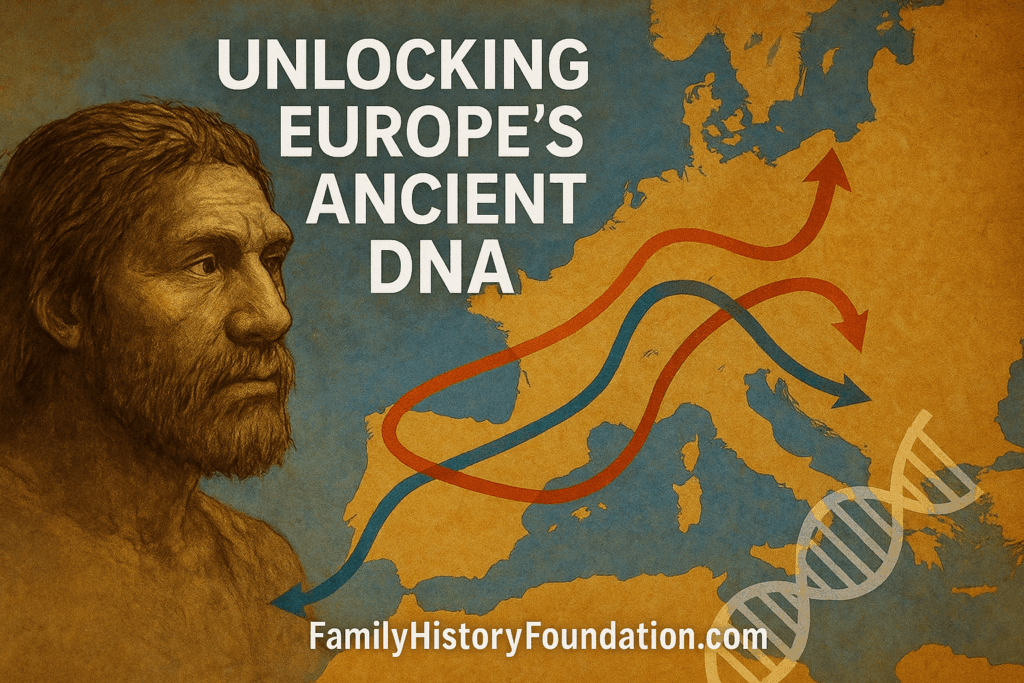
The arrival of agriculture about 8,000 years ago was a turning point. Ancient DNA reveals that Neolithic farmers migrated into Europe from Anatolia (modern-day Turkey), bringing wheat, barley, goats, and sheep. 🌾
This was not just a cultural shift but a biological one—European Ancient DNA shows how the farmers mixed with the hunter-gatherers, triggering a population boom and setting the stage for the first major reshaping of Europe’s genetic landscape.
When you see “Early European Farmer” components in your DNA results on sites like AncestryDNA, you are literally looking at traces of these ancient migrations.
Explore AncestryDNA® today, with my special offer. I use AncestryDNA and love what they have done for my personal family history journey.
For more on organizing your research as you explore these ancient stories, see our post: Skillfully Organizing Family History Documents: 7 Step Complete Guide for Genealogists.
The Yamnaya Enigma: Bronze Age Nomads and the Indo-European Mystery
Fast forward to the Bronze Age, and Europe sees another seismic genetic event. Around 5,000 years ago, the Yamnaya people thundered in from the Pontic-Caspian steppe, bringing not only domesticated horses and advanced metalwork but also a new genetic signature that still dominates much of Europe today. 🐎
This “steppe ancestry” is one of the most significant findings in the study of European Ancient DNA. The Yamnaya contributed genes that are now linked to traits like lactose tolerance and even certain disease resistances.
If you’ve ever looked at your AncestryDNA ethnicity estimate and noticed “Eastern European & Russia” or “Baltic” segments, you may be seeing the legacy of these nomadic herders.
Again, one of the most dramatic revelations in European Ancient DNA research is the appearance of the Yamnaya people around 3000 BCE. These nomadic herders from the Eurasian steppe swept into Europe, bringing with them domesticated horses, wagons, and entirely new cultural practices. 🐎
Their genetic contribution was so significant that they effectively replaced much of the existing population in some regions.
Researchers have studied individuals like the famous “Corded Ware” burials to understand how the Yamnaya spread. This “steppe admixture” is a key to understanding the spread of Indo-European languages, which today form the backbone of most European tongues.
The Yamnaya legacy is still present in the genomes of modern Europeans, linking millions of people to these Bronze Age migrants. If you notice a high percentage of “Northern Europe” or “Baltic States” ancestry in your AncestryDNA results, you may be seeing a genetic echo of these powerful steppe ancestors.
For a deeper look at practical genealogy research habits to save time, you might enjoy 15 Genealogy Research Habits That Save Time.
The Indo-European Language Puzzle
Perhaps even more fascinating is their linguistic legacy. The Yamnaya migrations are closely associated with the spread of Indo-European languages, which would later evolve into English, Spanish, Russian, and many others. European Ancient DNA confirms that this wasn’t just a cultural spread — it was a mass movement of people who reshaped the genetic and linguistic landscape.
The most ancient of all of the Indo-European languages, that is the closest modern-day language which sounds like the original, is Lithuanian!
Make sure to brush up on your Lithuianian history and knowledge 😁 – all written by The Family History Foundation.
- Who Are The Lithuanians? (People, Flag, Geography, Language)
- The Story of the Lithuanian Nation: From Pagans to Kings
- The Founding Of The Lithuanian Nation Under King Mindaugas
- The Baltic Way – Freedom for Lithuania, Latvia, and Estonia
Iron Age & Classical Eras: Empires, Trade, and Enduring Legacies
By the Iron Age, Europe was a patchwork of Celtic, Germanic, and Slavic tribes, each leaving subtle but distinct genetic signatures. Ancient DNA analysis reveals that these groups were remarkably mobile, trading and intermarrying across large distances. This was the period when Europe’s genetic map began to resemble something closer to what we see today.
Genetic data tells us that while populations moved, many regions retained a surprising amount of continuity, suggesting cultural change sometimes outweighed population replacement.
The Roman Empire left an indelible mark on Europe’s history—but its genetic footprint is more nuanced. 🏛️
DNA evidence reveals that while there was extensive migration into Roman cities, many rural areas stayed genetically stable. This discovery challenges the assumption that Roman expansion always meant mass movement of people. It also highlights how European Ancient DNA allows us to separate cultural influence from biological ancestry.
Modern-day Italians and southern Europeans often see genetic traces of North Africa and the Middle East in their AncestryDNA results, a reflection of centuries of Mediterranean trade and Roman expansion.
Explore more fascinating migrations and cultural shifts in our article: How to Overcome Genealogy Brick Walls: 10 Powerful Strategies to Break Through.
The Roman Empire’s Genetic Footprint
When the Roman Empire expanded, it brought an unprecedented flow of people — soldiers from North Africa, traders from the Middle East, slaves from Britain and Gaul. Surprisingly, European Ancient DNA shows that while Roman culture spread widely, many local genetic lineages remained relatively unchanged. This reminds us that cultural influence doesn’t always equal population replacement.
As the saying goes: “all roads lead to Rome!”
Medieval Mixes and Modern Manifestations
The Middle Ages were a genetic whirlwind. Viking raids, Anglo-Saxon migrations, and even the Mongol invasions all left traces in European DNA. If you have Scandinavian ancestry that shows up strongly on your DNA test, you may carry Viking genetic markers — which could explain why you feel drawn to the fjords of Norway on vacation! 🛡️
The medieval era was anything but stagnant for Europe’s genetic makeup. Viking raids and settlements left measurable genetic signatures in Britain, Ireland, and even parts of France. ⚔️
The sequencing of remains from sites like the Salme ship burials in Estonia shows just how widespread Viking contact really was. Anglo-Saxon migrations reshaped the genetic map of England, while the Mongol invasions introduced traces of East Asian ancestry into parts of Eastern Europe.
Over time, all of these movements blended into the distinct genetic clusters we see today. Whether you’re Scandinavian, Mediterranean, or Slavic, your DNA carries the echoes of these centuries of mixing.
European Ancient DNA helps genealogists connect these patterns to their personal family stories. When AncestryDNA updates your ethnicity estimate, it’s often because new discoveries about these medieval mixtures refine the reference panels used for modern DNA matching.
The Rise of Regional Clusters
By the late medieval period, the constant ebb and flow of migrations began to settle into more distinct clusters. European Ancient DNA shows that by the 1500s, regional genetic signatures were firmly established, giving rise to the “ethnicity regions” we see on DNA testing platforms today. Whether you have Iberian, Balkan, or Baltic ancestry, these categories are reflections of this late-medieval genetic stability.
How to Explore European Ancient DNA with Your Own Results
Curious to see how your DNA fits into this grand story? Most major testing companies, including AncestryDNA® allow you to compare your results with reference populations that reflect ancient migrations. You can even download your raw DNA and upload it to third-party tools that break down your ancestry into hunter-gatherer, farmer, and steppe components.
For further reading:
- Cloud Storage for Genealogists: 5 Best Tools to Preserve Your Family Memories – Read here
- 15 Genealogy Research Habits That Save Time – Read here
- Best Free Genealogy Search Engine: The 1 Guide to Tracing Your Roots Without Spending a Dime – Read here
Future of Ancient DNA: Unlocking More Secrets
The story doesn’t end here. As sequencing technology improves, scientists are recovering DNA from smaller and more degraded samples, pushing our understanding further back in time.
Imagine one day being able to pinpoint not just which migrations your ancestors were part of, but even their individual life stories. Researchers are now experimenting with single-cell analysis and new ways to preserve ancient samples.
These advancements promise to unlock the European ancient DNA of populations previously invisible to science, such as groups who lived in wetter climates where bones rarely survive.
Scientists are developing techniques to extract DNA from ever-smaller samples, even sediments left behind in caves. 🔬 New methods such as single-cell analysis promise to reveal details of population structures we could never see before.
Future breakthroughs might answer questions about mysterious groups like the “ghost populations” whose DNA appears in traces but whose cultures are still unknown. They might also refine ethnicity estimates you receive from AncestryDNA, helping you connect with long-lost cousins and rediscover forgotten migrations.
The implications are profound—understanding European Ancient DNA isn’t just about the past. It’s about seeing how interconnected all humans are and appreciating that migration and mixing are the norm, not the exception.
If you want more inspiration for your own research, check out our article: Best Free Genealogy Search Engine: The 1 Guide to Tracing Your Roots Without Spending a Dime.
Your Turn! 🧬
Have you checked your AncestryDNA results recently? Take a look at your ethnicity breakdown and ask yourself: which of these ancient migrations might be part of my story? Share your discoveries in the comments — we’d love to hear if you’ve spotted steppe ancestry, Viking roots, or a connection to Europe’s first farmers.
Challenge for You 💬
Now that you’ve taken this journey through 10,000 years of migrations, I challenge you to explore your own DNA results. Look for clues about hunter-gatherer, farmer, or steppe ancestry and share your findings in the comments below. Do you see traces of Viking, Celtic, or Roman ancestry? 🧬 Compare your results with family members to see how your unique DNA mix has been passed down through generations.
Comment down below! 👇 📣
Follow us for more:
About the Author
Hi, I’m the creator behind Family History Foundation — passionate genealogist, researcher, and storyteller. My mission is to make family history exciting, approachable, and deeply meaningful. Through my blog, I share practical tips, emotional insights, and the latest tools to help you uncover your roots.
I’ve spent years helping families uncover their ancestry, preserve their memories, and create keepsakes that last for generations. Through worksheets, storytelling tips, and hands-on resources, I aim to empower you to become the family historian your relatives will thank one day.
When I’m not writing or researching, you’ll find me exploring archives, designing creative genealogy tools, or sharing ideas with readers like you who are passionate about preserving family legacies.
💌 Thank you for being here—let’s keep making history, “family history,” together!