Ancestry vs 23andMe for Adoptees is the single most critical decision you will make at the start of your search for biological family, and getting it wrong can cost you years of silence.
Welcome to the trenches. I’m Franklin, the “Source Hound,” I’m also an adoptee. I’ll tell you my story in this article. However, if you’re looking for a “one-click” magic button to find your birth parents, you’re in the wrong place. We don’t do halfway research here. We don’t trust “shaky leaves” blindly.
Table of Contents
I certainly believe that everyone has the right to know where they come from, and while adoptees face an especially daunting family history journey, with the advent of DNA and the power of the internet, anything is possible!
I went from having only 1 name on my birth certificate, to actually finding BOTH of my birth parents.
You are here because you have a mystery to solve. You are an adoptee, or you’re helping one, and the sheer volume of marketing noise is deafening. Every company promises “answers.” Every TV commercial shows a tearful reunion in a sunlit meadow.
But I’m here to tell you the truth: Data wins.
In this deep dive, we are going to strip away the marketing veneer. We are going to look at hard numbers, database sizes, and the specific tools that actually break down “brick walls” for adoptees. We are going to answer the question of Ancestry vs 23andMe for Adoptees with the rigor of a forensic investigation.
Buckle up. 🕵️♂️
Ancestry vs 23andMe for Adoptees: The Verdict
The short answer for the impatient (and the casual onlookers):
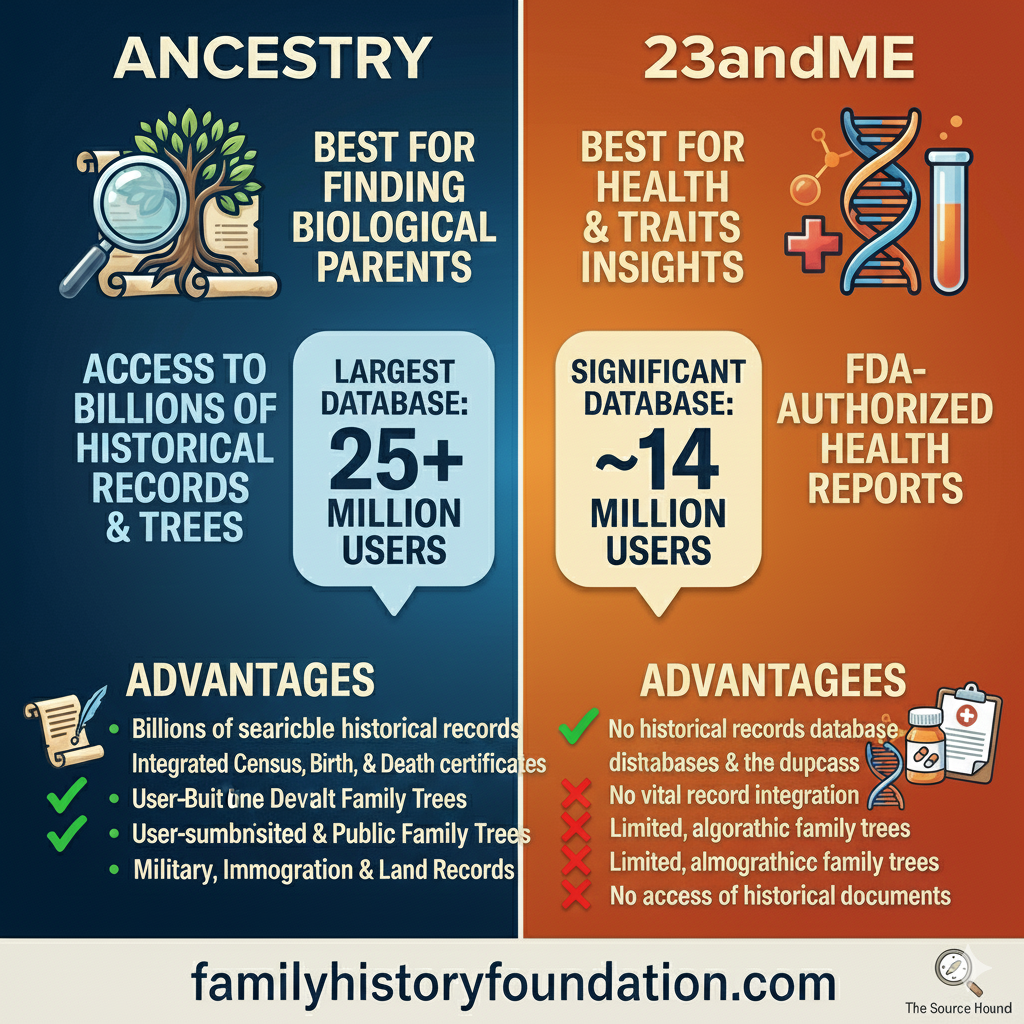
AncestryDNA is the superior choice for adoptees primarily due to its massive database size (25+ million users vs. ~14 million), which statistically maximizes the probability of finding close genetic matches. While 23andMe excels in medical health reports—a crucial gap for many adoptees—Ancestry’s integration of searchable family trees, historical records, and “ThruLines” technology makes it the functional standard for search angels and serious genealogists trying to triangulate biological parents.
The Adoptee Paradox: The “Villain” and “Hero” of Your Search
Before we talk about kits and swab tubes, we need to talk about a subtle enemy. The enemy isn’t the adoption agency (though they often didn’t help – I have my own crazy story on that front). The enemy certainly isn’t your biological parents – goodness no.
The enemy is The Paradox of Information.
Strange as it sounds, this can also be your hero!
For years, you had zero information. Your origin story was a sealed file in a courthouse basement. You lived in a vacuum of history. Now, thanks to the consumer DNA revolution, you may be about to be flooded with too much information—but it’s fragmented, chaotic, and often contradictory.
Let’s take you from zero to hero in your adoption records search in your choice of Ancestry vs 23andMe for Adoptees.
When you search on Ancestry.com, you will see names which may be familiar, you may get search returns that will be overwhelming and invoke “analysis paralysis.” You will get frustrated by imagined spectres of the stories behind who your potential adoptive parents might be and the life they’ve lived.
Believe me, I know and have endured all of those frustrations and more when I searched for both my adoptive mother and father. I went from zero to hero as I eventually found both.
This is why the choice of Ancestry vs 23andMe for Adoptees is not just about “which test is cheaper.” It is about equipping yourself with the weapon that gives you the best odds of cutting through the noise. You need a scalpel, not a butter knife.
Most beginners fail because they treat genealogy like a Google search. They type in a name and expect a result. But real research requires building a foundation. If you haven’t mastered the basics yet, you need to read my guide on Genealogy Research Online before you spend a dime on DNA. You cannot interpret genetic data if you don’t understand how families are documented.
The Golden Nugget: A Tale of Two Tests
Back in 2011 I had finally mustered up enough courage to attempt to complete my mission to find my origins. That is, to find out who my biological parents were.
There is an untold psychological drama that plays out in the heads of adoptees when it comes to undertaking this search. It’s a specific set of micro traumas that, really, only adoptees understand. See the Psychology Of The Search section below.
I had started way back in the 90s when there were only physical sealed court records and in-person dusty agencies who you had to call. It was a very daunting time for me feeling like I had to open up to strangers and constantly explain my situation. You may have felt that.
I didn’t know if my bio parents were alive, deceased, together, apart, rich, poor, destitute, business owners, or vagabonds. The paradox of the adoptee doing research is that not only can it be near impossible to find your biological parents because missing information, the paradox is that you may not be prepared for the answers you find.
I used a variant of Ancestry vs 23andMe for adoptees, in my search. I used Ancestry and FTDNA, both similar in many respects when comparing Ancestry vs 23andMe for adoptees, but I’ll stick with 23andMe as it is the industry leader in genealogical health indicators (although Ancestry has very comprehensive tools they are also developing).
I found my biological mother and maternal roots on Ancestry. Often times, in various states like the state I’m from, an adoptee actually has TWO BIRTH CERTIFICATES.
That’s right, an child will be issued a Certificate of Live Birth and then a subsequent “Official” (take that for whatever its worth along with the implicit irony) Birth Certificate with the names of the adoptive parents listed. The Certificate of Live Birth will have the name, or names, of any parents there at the time of delivery and will replace the name(s) listed on the Certificate of Live Birth.
Adoptees are NOT SUPPOSED TO SEE their Certificate of Live Birth as a rule. I must have been born a Source Hound because I mistakenly found mine as a young child rummaging through family files!
In my case, I only had a mother’s name. Father was “unknown.” Gosh, I’ve just bared my soul to the whole world!
Through Ancestry I was able to find my maternal side; and Through FTDNA and Ancestry I was able to find my paternal side, even though I did not have a name for my biological father!
That’s the power of comparing Ancestry vs 23andMe for adoptees. In fact, “adopting” (every pun intended) both as a strategy is what paid off for me!
After using Ancestry and reaching out to many potential people with my unique surname I met a 4th cousin who is the consummate genealogist (must run in the family!) and who helped me “plug into” our family tree on Ancestry.com.
If you want to know what that feeling was like, think “the quickening” in the film Highlander 😆 😂 ⚡️. I will ever be grateful to this cousin and my bio family for this support and love.
On the family history side, I don’t just publish “how-to” and informative pieces on The Family History Foundation, I also write historical biographies for my own family tree. I am currently writing a comprehensive biography of my immigrant ancestor and his life and times. Check it out!
I found my biological father (paternal side) through DNA testing. In comparing Ancestry vs 23andMe for adoptees, this might be your strongest indicator and path to success. Start with DNA.
HINT: if you don’t know where to start, use the search function on this site and search for the term “DNA” or “genetics.”
Although I used a DNA test to find a match, that was only the first half of the expedition. I ultimately had to confirm that person was my father, and I did that through “Source Hound” factual genealogical research.
Even if you find a match either on AncestryDNA or 23andMe, you still have to follow that up with the paper trail. You must corroborate that person and substantiate the find with corroborated records.
Here’s where GENEALOGY transcends into FAMILY HISTORY. Although I spotted someone who was a centimorgan (cM) match, it wasn’t until my cousin pointed out the fact that this person was a 99% my father that I actually followed up with this lead. It turned out to be true and that’s the power of family history.
That was only the first step. I then went to Ancestry and dug deep into the paper trail and AncestryDNA matches like ThruLines (which was still in its infancy back then) to ensure I had the right person I was identifying as “father.”
Let’s set you up for your journey!
The Comparison: Ancestry vs 23andMe for Adoptees
Let’s get into the weeds. As a professional, I judge tools by their utility, not their packaging. When we analyze Ancestry vs 23andMe for Adoptees, we are looking at five specific vectors: Database Size, Tree Integration, Health Data, Tools, and Cost.
1. Database Size: The Kingmaker
This is the only metric that truly matters for an initial search.
- AncestryDNA: ~25 Million users.
- 23andMe: ~14 Million users.
The Source Hound Analysis:
Think of this like a lottery. If you are looking for a specific needle (your biological parent), do you want to search a haystack that is almost double the size of the other? The gap of ~11 million people is massive. That is 11 million more chances to find a sibling, an aunt, or that critical 2nd cousin who acts as the “Rosetta Stone” for your search.
When evaluating Ancestry vs 23andMe for Adoptees, remember that every single additional user in the database is a potential lead. If you are trying to break through a stubborn blockage in your research, you need volume. Learn more about Breaking Brick Walls with volume strategies, because hoping for a miracle isn’t a strategy.
2. Tree Integration & Records
- AncestryDNA: The gold standard. DNA results are woven directly into their subscription-based genealogy software. You can click a match and instantly see their tree (if public).
- 23andMe: They have a “Family Tree” feature, but it is largely algorithmic and automated. It tries to guess relationships based on DNA, which can be impressive, but it lacks the hard documentation to verify the truth.
The Source Hound Analysis:
DNA tells you that you are related. Trees tell you how. Without a tree, a DNA match is just a username. Ancestry allows you to build a “Mirror Tree”—a shadow tree where you build out the lineage of your matches to find where they intersect. You cannot effectively do this on 23andMe.
Furthermore, verifying these trees requires access to primary sources. You need to be able to confirm that the “John Smith” in your match’s tree is the same one from the 1940 Census. Ancestry links these records directly. If you don’t know how to read these documents, check my guide on Understanding Census Records, because misinterpreting a census is the fastest way to build a false tree.
In this aspect of Ancestry vs 23andMe for adoptees, Ancestry clearly wins – used in compliment with another DNA platform.
3. Health & Medical History
- AncestryDNA: Offers “Traits” and some health insights, but it is clearly a secondary product.
- 23andMe: This is their bread and butter. Their FDA-authorized reports on carrier status (Cystic Fibrosis, etc.) and genetic health risks (BRCA1/BRCA2) are superior.
The Source Hound Analysis:
This is the one area where 23andMe punches back hard in the Ancestry vs 23andMe for Adoptees fight. For an adoptee, you have a “blank slate” medical history. You don’t know if heart disease runs in the family. You don’t know your cancer risks.
If your primary goal is medical peace of mind rather than finding a name, 23andMe wins. However, be warned: genetic health screens are probabilistic, not diagnostic. They tell you risk factors, not certainties.
Ancestry has been updating their “Traits” section and I believe are building out this aspect of their services to compete with 23andMe.
4. The “Tools” of the Trade
- Ancestry:
- SideView: Splits your matches into “Parent 1” and “Parent 2” automatically without needing a parent to test. This is revolutionary for adoptees.
- ThruLines: Suggests common ancestors based on user trees.
- Has a chromosome browser and identifies paternal and maternal sources.
- 23andMe:
- Chromosome Browser: Allows you to see exactly which segments of DNA you share with a match.
- Haplogroups: Detailed maternal (mtDNA) and paternal (Y-DNA) migration lines.
The Source Hound Analysis:
The Chromosome Browser on 23andMe is beloved by hardcore geneticists. It is scientifically fascinating. But for finding a parent? Ancestry’s SideView is more practical. Knowing instantly that a match is on your “paternal” side cuts your work in half.
Actually, if you are a “hardcore” geneticist you will probably be using FTDNA. Just saying.
This is especially helpful if you are trying to trace a maternal line, which is notoriously difficult due to name changes in marriage. If you are struggling with this, read up on Finding Female Ancestors for specific tactics on navigating those surname changes.
5. Cost & Monetization
- Ancestry: The kit is just the entry fee. To really use the power of the trees and records, you need a monthly subscription.
- 23andMe: Generally a one-time fee (higher upfront) for the health/ancestry kit, though they are pushing a “+” subscription now.
The Source Hound Analysis:
Ancestry is a subscription model. 23andMe is a product model. In the debate of Ancestry vs 23andMe for Adoptees, Ancestry will cost you more over time, but that subscription pays for access to billions of records—records you need to verify your matches. There is no question, fees aside, that if you want to find your birth parents then Ancestry is the place to begin.
Side-by-Side Comparison Chart
| Feature | AncestryDNA 🧬 | 23andMe 🔬 | Winner for Adoptees 🏆 |
| Database Size | ~25 Million | ~14 Million | Ancestry (By a mile) |
| Family Trees | User-generated, massive | Automated, limited | Ancestry |
| Health Data | Basic Traits | FDA-Authorized, Deep | 23andMe |
| Adoptee Tools | SideView (Parent sorting) | Chromosome Browser | Ancestry |
| One-Time Cost | Lower (usually) | Higher (for Health) | Ancestry |
| Hidden Costs | Requires Subscription | Generally One-Time | 23andMe |
The “Hidden Gem”: The Psychology of the Search
We need to pause the technical talk for a moment.
When we discuss Ancestry vs 23andMe for Adoptees, we often forget the human element. The search is not just a data mining operation; it is a psychological gauntlet.
The Fear Factor:
Many adoptees I mentor hesitate to test because they are afraid of what they will find. Rejection is a real possibility. But there is another fear: The Silence.
One of the stories that initially stymied my search for my birth parents was a case where an adoptee actually had made contact with their birth mother, only for that person to tell the poor person that she wasn’t her mother when, in fact, she was!
That mother chose the retention of her privacy over the empathy towards her child’s search. That person could well have been searching in vain for the next 30 years not knowing that she had actually found her mother.
Reading that scared the life out of me, I have to be honest. However, it didn’t deter me and only made my resolve stronger and to keep my eyes open to all facts.
Testing on a platform with a smaller database (like 23andMe) increases the risk of silence—of getting results that say “Estimate: 4th Cousin” and nothing else. That silence can feel like a second abandonment.
I’ve had the silence! I’ve encountered it at several stages along the way in my search. Even though I have been successful in finding both biological parents, I have encountered the wall of silence. If this is you, don’t be discouraged!
The Strategy of “The Angel”:
If you are working with a “Search Angel” (a volunteer who helps adoptees for free), 99% of them will ask you to test on Ancestry first. Why? Because Search Angels need trees to work their magic. They are genealogists, not magicians. They need to see that your 2nd cousin matches the “Smith” family in Tennessee so they can start digging through 1940 Census records.
This requires rigorous organization. You will be collecting names, dates, and theories. If you are messy, you will miss the clue. Review my protocol on Organizing Your Research to ensure you don’t lose that one critical post-it note.
The “Ready” Factor:
DNA testing breaks the seal. Once you submit your swab in that tube, you cannot unknow what you find. You might find that your biological parents have passed away. You might find half-siblings who didn’t know you existed. Ancestry’s platform, because it is linked to records, often reveals these truths faster.
But you can’t beat the accuracy of DNA. You see, DNA overcomes and trumps both silence and refusal to acknowledge!
Are you ready to see a death certificate? Are you ready to see a yearbook photo? Or a marriage license that proves your father was married to someone else when you were born? Ancestry vs 23andMe for Adoptees can help you understand what you are looking at, but it can’t prepare you for how it feels.
23andMe is more sterile. It feels more like a medical test. Ancestry feels like a library of human lives. Choose the environment where you feel most comfortable processing complex emotions.
Interactive Quiz: Are You Ready to Search? 📝
Let’s test your “Source Hound” instincts. How would you handle these common scenarios in the Ancestry vs 23andMe for Adoptees debate?
Scenario 1: The Ghost Match
You get a “Close Family” match on Ancestry (likely a 1st cousin), but they have no tree and a username like “J_Doe_1985”. They haven’t logged in for a year.
- A) Send them 5 messages begging for help.
- B) Google their username to see if they use it on other social media, then screen-shot their profile before they go private.
- C) Ignore them and wait for a better match.
Franklin’s Verdict: B is the winner. Matches often spook and go private when an adoptee contacts them. Capture the data first. Verify later.
Scenario 2: The Double Dip
You have the budget for only one test right now. You have zero medical history.
- A) Buy 23andMe for the health info.
- B) Buy Ancestry to find the biological parents, then ask them for medical history later.
- C) Buy a generic drug store paternity test.
Franklin’s Verdict: B is the strategic play. If you find your biological family via Ancestry, you can get the real medical history (which is far superior to genetic probabilities). If you fail to find them, you can save up for 23andMe later.
Scenario 3: The Mirror
You have a cluster of 3rd cousins on Ancestry who all descend from a couple in Kentucky.
- A) Message all of them asking if they know about an adoption.
- B) Build a private “Mirror Tree” of their family to see where your unknown parent might fit in the gaps.
- C) Wait for a closer match.
Franklin’s Verdict: B is the pro move. Never ask a question you can answer yourself with research. Build the tree, find the missing son or daughter in that family line, then reach out with a specific theory.
The Strategy: How to actually WIN.
If you are serious about this search, you shouldn’t actually be choosing between Ancestry vs 23andMe for Adoptees. You should be prioritizing the order of operations.
Here is the Source Hound Protocol:
- Step One: Test with AncestryDNA first (sponsored link). This is non-negotiable. It is the biggest pond. It gives you the trees. It gives you the “Parent 1 / Parent 2” split.
- Step Two: Download your “Raw DNA Data” from Ancestry.
- Step Three: Upload that raw data to MyHeritage and FamilyTreeDNA (for a small fee). This gets you into two other databases without buying new kits. (Note: You cannot upload to Ancestry or 23andMe, you can only test directly with them).
- Step Four: If—and only if—you strike out on Ancestry, or if you have specific medical concerns, buy a 23andMe kit. Treat this as your “Plan B” for matches and your “Plan A” for health.
- Step Five: Verify your findings and matches through comprehensive and thorough genealogy research. Reach out and connect with other living relatives to help you if they are willing.
Why this order?
Because Ancestry vs 23andMe for Adoptees isn’t a fair fight when it comes to genealogy. Ancestry is the heavyweight. You don’t bring a knife to a gunfight, and you don’t bring a health test to a genealogy mystery.
Once you have your matches, the real work begins. You will need to start confirming locations and movements of your potential ancestors. Sometimes this requires digging into Archive Records to place a person in a specific county at the time of your conception. It’s tedious, but it’s proof.
And if you were adopted internationally? The strategy changes slightly. You might need to rely more heavily on naturalization papers. My guide on Immigration & Naturalization records can help you trace those lines back to the old country, where records might be scarce.
Eventually, you will reach the point where you need to speak to living people. This is the most terrifying part. You need to know how to ask the right questions without scaring them off. Brush up on your soft skills with Interviewing Relatives—it’s a different game when the “relative” is a stranger who holds the key to your identity.
Questions & Next Steps
Look, I get it. This is overwhelming. You are staring at a screen filled with centimorgans and confusing user interfaces.
If you have hit a brick wall, sometimes you need the right tools to crack the safe.
1. The Redundancy Tool:
If you haven’t bought your kit yet, stop overthinking it. Grab the AncestryDNA Kit here. It is the industry standard for a reason. If the paper trail was burned, or the records were sealed, your DNA is the only document that cannot be redacted.
Or, read my article on Research Redundancy on this blog. “Genealogy Research Redundancy – Tips To Organize Genealogy!“
2. The Template Tracker:
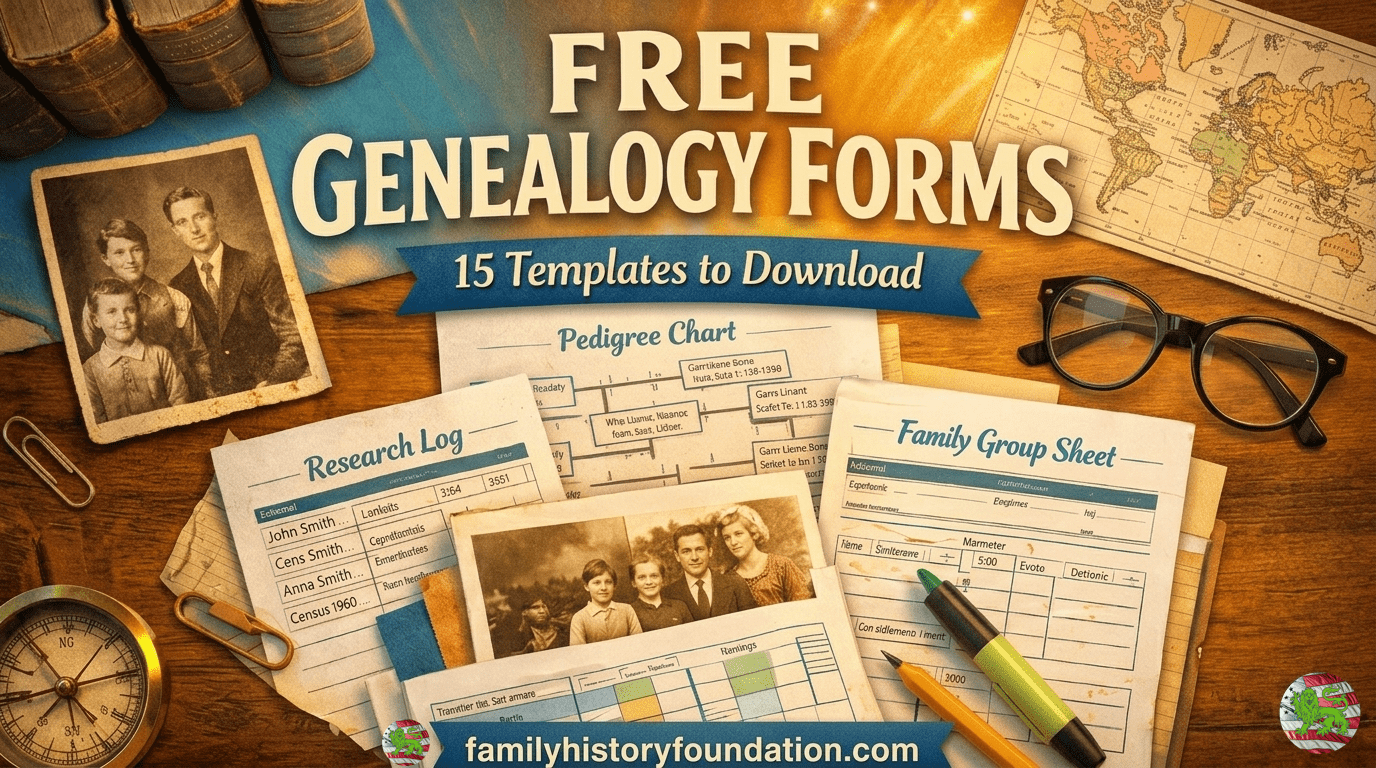
If you are already on Ancestry and drowning in search results, you are probably missing the “hidden” record sets that aren’t indexed well or overwhelmed with all of the results you are getting. Use my “10 Free Family History Templates to Download: Organize, Share, and Display Your Tree” to help you organize your research!
This will level up your Ancestry vs 23andMe for Adoptees organization skills!
FAQ: Ancestry vs 23andMe for Adoptees
Q: Can I just upload my Ancestry data to 23andMe?
A: No. 23andMe is a “walled garden.” They do not accept uploads from other companies. You must buy their kit to get into their database. This is a major factor in the Ancestry vs 23andMe for Adoptees cost analysis.
Q: Which test is better for international adoptees?
A: It depends on the region. Ancestry has a massive footprint in the UK, USA, Canada, and Australia. MyHeritage is often stronger in continental Europe. 23andMe has decent international reach, but for pure genealogy, I still recommend starting with Ancestry and then uploading that file to MyHeritage.
Q: Will the test tell me if I’m adopted?
A: Not explicitly. It won’t flash a red light saying “ADOPTED.” However, if your “Parent 1” and “Parent 2” ethnicities don’t match your known parents, or if you match with a “1st Cousin” you don’t recognize, the math will make it obvious very quickly. The DNA doesn’t lie, unlike people.
Q: What if I find a parent who doesn’t want to be found?
A: This is the hard part. The platforms (Ancestry vs 23andMe for Adoptees) are just tools; they don’t manage ethics. If you find a parent and they reject contact, you must respect their boundaries. However, you have a right to your own genetic truth and medical history.
Q: Does Ancestry or 23andMe have better privacy?
A: Both companies have robust privacy controls, but remember: once you opt into “matching” to find relatives, you are visible. You cannot find people without being found. In the context of Ancestry vs 23andMe for Adoptees, both allow you to use initials or a pseudonym, but Ancestry’s ability to link a private tree gives you slightly more control over what data you share while still researching.
Q: How long does it take to get results?
A: Usually 6-8 weeks for both. However, the research can take much longer. Do not expect instant gratification.
Join the Source Hound Community 🕵️♂️
You don’t have to do this alone. The Internet can be full of bad advice, but my community is built on verification and support. I share weekly tips, visual guides, and constant support of your family history journey.
- 📺 Watch on YouTube: I break down complex search strategies into video tutorials. Want to see exactly how to use the “Source Hound Method” or how to navigate the Ancestry interface? The videos are the best way to learn visually.
- 📌 Pin this on Pinterest: My Pinterest boards are curated specifically for “Brainy Beginners.” I have cheat sheets for census years, DNA comparison charts, and “Brick Wall” breaker infographics that you can save for your next late-night research session.
About the Author
Hi there, my name is Franklin, the founder and author of The Family History Foundation.
Our family stories are disappearing every day and it’s crucially important that the next generation is able to learn and appreciate their family history. It is up to you to take up the mantle of responsibility to ensure that how you research today will be passed on tomorrow with the highest standards possible.
I believe that genealogy is not just about names and dates, it’s about your stories and how those stories inform your identity.
With a penchant for storytelling and a background in research, the insights and techniques you learn on The Family History Foundation will help you uncover the incredible stories and identities hidden within the tapestry of your ancestry.
My mission is “Let’s make Family History a household word.”
My motto is “The Past ‘Relative’ to the Future.”
Keep digging. The truth is out there. 🕵️♂️
The Source Hound’s Newsletter
Still Hitting Dead Ends In Your Research?
Join 500+ family historians getting the Source Hound’s weekly research breakthroughs — real case studies, source hacks, and the exact strategies that turn brick walls into discoveries.
Free. No fluff. Straight from the Source Hound’s desk to yours.
Your privacy is sacred — almost as sacred as a primary source. Read our Privacy Policy.