⏱️ Read Time: 10 minutes
The 1820 Census introduced occupation and industry data for the first time in American federal enumeration—the story of this census is “categorically” interesting. Since the first US federal Census was in 1790, this makes the 1820 census our fourth US census.
Whether or not you’ve found an ancestor on the 1820 census or further back, there is still something compelling in learning about each of the US Federal Censuses. Each of them are unique; however, together they weave a family history narrative about birth, growing up, marriage, moving, working, aging, and repeating the cycle over successive generations.
Table of Contents
Here’s what is most important: the 1820 federal census records whether households engaged in agriculture, commerce, or manufacturing—the first time the U.S. government tracked economic activity at the family level.
This matters when you’re trying to determine if your ancestor was a farmer, merchant, or craftsman. It helps explain migration patterns (farmers moved west, manufacturers stayed in cities), wealth accumulation, and social standing in the community.
Hi there! I’m Franklin, the “Source Hound” behind The Family History Foundation. After finding both my biological parents as an adoptee, I’ve learned that the small details in genealogy records often unlock bigger research breakthroughs.
The 1820 census sits at a unique historical moment: post-War of 1812 industrial expansion, westward migration into Missouri and beyond, and the first federal attempt to track what Americans actually did for work.
For complete context on all census years from 1790-1950, see our US Federal Census comprehensive guide. This post focuses specifically on the 1820 enumeration’s unique features and how to leverage occupation data.
Crazy Facts About How The Censuses Were Enumerated
Let’s chew on some staggeringly interesting facts about how the original Censuses were enumerated, including our 1820 Census.
- FACT: The US Marshals Service was created in 1789 and barely a year later enumerated the first US Census in August of 1790!
- FACT: The US Marshals Service numerated the all of the Federal censuses from 1790 all the way until 1870!
- FACT: Beginning in 1880, the Congress replaced the Marshals as enumerators with specially-trained collection agents – I bet they weren’t too upset by this decision!
- FACT: Do the math! In 1790, 650 Deputy Marshals enumerated 3,929,214 citizens! “What The F*orm?” That’s over 6,000 people each!
- FACT: Do the math! in 1820, 1,188 Deputy Marshals enumerated 9,638,453 citizens! That’s over 8,000 people each!
Why the 1820 Census Matters for Genealogy
The 1820 Census captures America at a crossroads between agrarian past and industrial future. The census was enumerated on August 7th, 1820 and was enforced by an Act passed by Congress on May 14th, 1820. James Monroe was President of the United States.
By 1820, the United States had survived the War of 1812, admitted five new states since 1810 (Louisiana, Indiana, Mississippi, Illinois, Alabama), and was pushing into the Missouri territory.
HISTORICAL NOTE: One of the most fascinating moments of the War of 1812, was the infamous Battle of New Orleans. My 4th Great Grandfather fought in that battle, read about it here for a break down of the battle, the rag-tag American army that defeated the British, and, why the battle didn’t even need to be fought!
The Industrial Revolution was transforming New England while the South remained agricultural. Understanding whether your ancestor farmed, traded, or manufactured provides economic and social context no earlier census offered.
Here’s what the 1820 federal census reveals:
🏭 First occupation data – Agriculture, Commerce, or Manufactures for each household
🎖️ Military age males tracked – Special 16-18 bracket identifies draft-eligible young men
🌍 Immigration status – “Foreigners not naturalized” column separates immigrants from citizens
👥 “Free Colored Persons” category – First age breakdowns for free Black Americans
📊 “Slave” age data – First time enslaved people counted by age categories
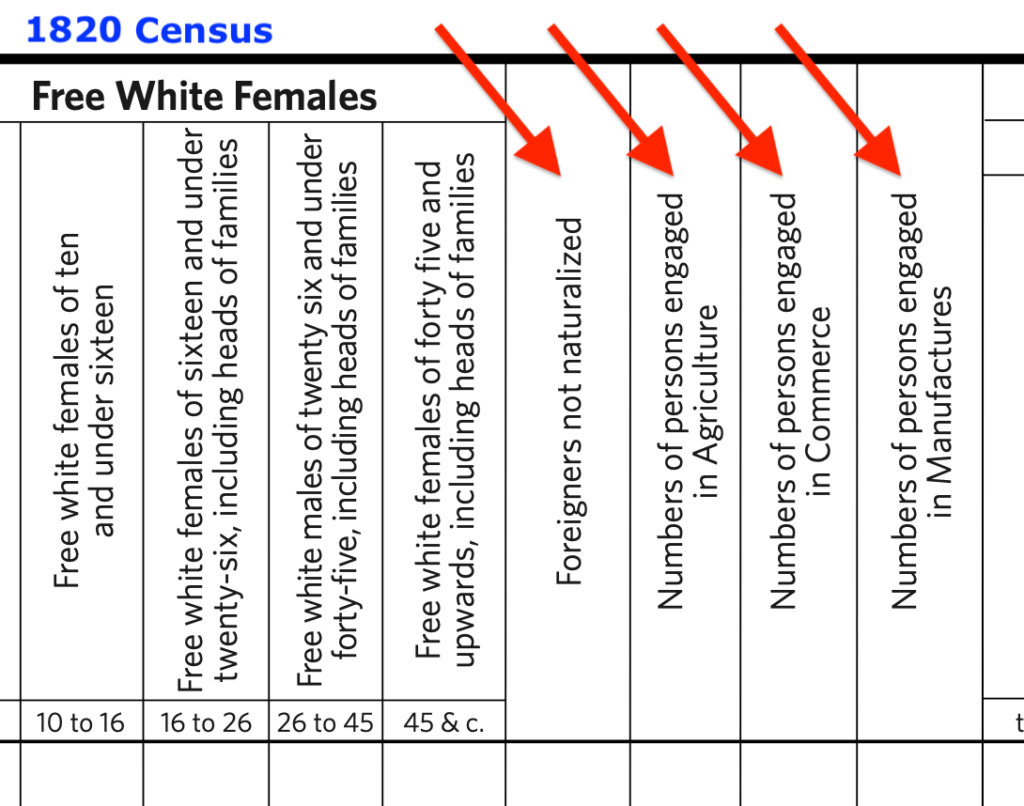
The 1820 census records won’t tell you specific job titles, but they establish economic category—and that category correlates with wealth, property ownership, migration patterns, and social networks you can trace through other records.
Source Hound strategy: Use the occupation column to direct your next research steps. Farmers → search land records. Manufacturers → search city directories and business records. Commerce → search port records and merchant licenses.
CRITICAL: Understanding 1820 Census Form Variations
Before diving into the 1820 Census, you need to know that different versions of the form exist—and they show DIFFERENT age brackets. Yes, this is befuddling, but Ancestry has the wrong dates on their forms – I’ll show you where to get the correct ones.
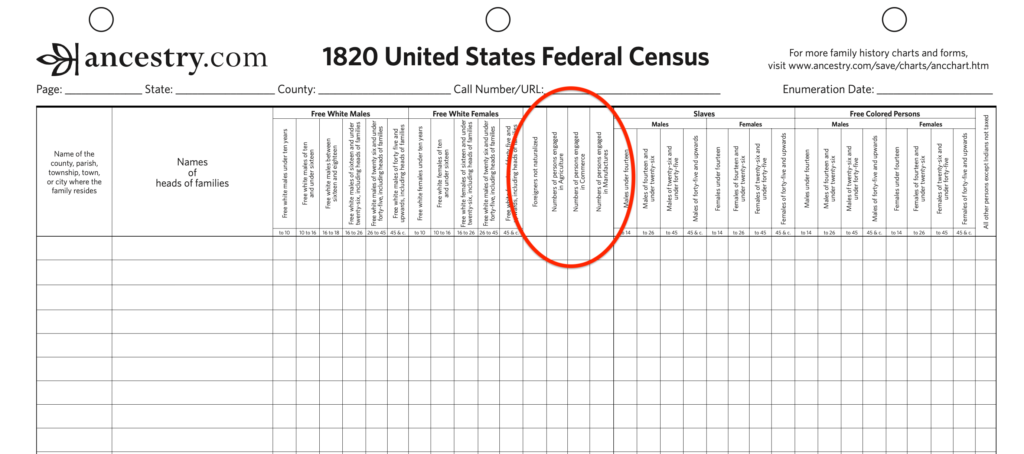
The Form Discrepancy Problem
Some published forms (including some on Ancestry) show:
- Males
10 to 16, 16 to 26, 26 to 45– these are incorrect.
The National Archives official form shows:
- Males 10 to 15, 16 to 25, 26 to 44 – these are correct.
Why this matters: If you use the wrong brackets, every birth year calculation will be off by one year. Someone in the “26 to 44” bracket was born 1776-1794, NOT 1775-1794. That one-year difference can send you searching the wrong decade of birth records.
Either way, you should be a savvy enough researcher to not let a single category throw your research off! If you need help with this, read my How To Research Genealogy Online – All You Need To Know post. It’s the “Ultimate Guide.”
Which Form Is Correct?
Always use the National Archives version because the column headers match the full descriptive text “… of age AND UNDER,” which categorically excludes the upper example age written in the age range description.
✅ “10 to 15” aligns with “of ten and under sixteen”
✅ “16 to 25” aligns with “of sixteen and under twenty-six”
✅ “26 to 44” aligns with “of twenty six and under forty-five”
For example, the description on the 1820 Census form which reads: “Free white females of sixteen and under twenty-six, including heads of families,” this INCLUDES age of 16 and EXCLUDES the age of 26. The range is 16-25. Make sense?
NOTE: I have a degree is in Linguistics and I’ve studied Semantics, which includes Propositional Logic. Also, refer to basic algebra, specifically PIE (Principle of Inclusion-Exclusion) and basic Set-Builder Notation.
The Ancestry form’s abbreviated headers (10-16, 16-26, 26-45) don’t match the actual legal language of the census act.
Bottom line: When researching the 1820 federal census, verify age brackets against the National Archives official form. Don’t trust secondary sources or abbreviated worksheets without checking the full column descriptions.
Watch: Searching the 1820 Census on Ancestry
Before we explore the details, watch this complete walkthrough of searching the 1820 census, reading occupation columns, and tracking 30-year family changes:
Subscribe to Family History Foundation on YouTube for the complete US Census series—new tutorial every Friday!
What the 1820 Census Contains
The 1820 Census expanded significantly from 1810, adding economic and demographic categories that transform genealogical research. There were 6 major categories and 34 total categories!
1. Free White Males Categories
Age brackets:
- Under 10 years (To 10)
- 10 to 15 years
- 16 to 18 years (NEW – military draft age)
- 16 to 25 years
- 26 to 44 years
- 45 and upwards
Why 16-18 matters: This special bracket tracked military-age males after the War of 1812. If you see a male in the 16-18 category, he was born 1802-1804 and would have been eligible for militia service.
2. Free White Females Categories
Age brackets:
- Under 10 years
- 10 to 15 years
- 16 to 25 years
- 26 to 44 years
- 45 and upwards
No 16-18 bracket for females – the military age tracking was male-only.
3. “Free Colored Persons” (First Time!)
The 1820 federal census is the FIRST to break down free people of color by age and gender:
Males and Females separately counted:
- Under 14 years
- 14 to 25 years
- 26 to 44 years
- 45 and upwards
Genealogical significance: If you’re researching free AA ancestors, the 1820 census is where age tracking begins. Before 1820, free persons were tallied as a single number with no age or gender breakdown.
4. Slaves (First Age Breakdown!)
For the first time, enslaved people were counted by age and gender categories:
Males and Females separately:
- Under 14 years
- 14 to 25 years
- 26 to 44 years
- 45 and upwards
5. Occupation & Industry Data (NEW!)
The 1820 census asked households to identify economic activity:
📊 Number of persons engaged in Agriculture
📊 Number of persons engaged in Commerce
📊 Number of persons engaged in Manufactures
How it works: The enumerator tallied how many household members worked in each category. A farmer with three adult sons working the farm might show “4” in Agriculture. A merchant household might show “1” in Commerce.
What’s missing: Specific job titles, income, employer names, property values. It was a simple, broad-brushed metric commensurate to the time.
6. Foreigners Not Naturalized
This column counted immigrants who hadn’t completed naturalization. This is something you might want to pay attention to – I have a particular ancestor who emigrated from England and ended up in North Carolina around this time, I might need to check his census data now that I’m thinking about this!
Genealogical value: If you see a number here, your ancestor was foreign-born but not yet a U.S. citizen. This narrows your search for naturalization records and immigrant origins.
How to Use Occupation Data for Research
The occupation categories in the 1820 Census open entirely new research paths.
Agriculture: The Farming Majority
What “engaged in Agriculture” could mean:
- Farmers (landowners)
- Farm laborers
- Tenant farmers
- Children working family farms
- Farm managers/overseers
Research implications:
If your ancestor’s household shows numbers in Agriculture:
🔍 Search land records: Deeds, grants, tax lists showing farm property
🔍 Check agricultural censuses: Some states conducted farm censuses in the 1820s
🔍 Find estate records: Probate inventories listing farm equipment, livestock, crops, and wills and deeds!
🔍 Look for migration west: Farmers moved to cheaper land in Ohio, Indiana, Missouri
Example: John Miller’s 1820 household shows 4 persons in Agriculture (John + 3 adult sons). Search for land deeds 1815-1825 showing property purchases. Check 1830 census—did sons establish farms nearby or migrate west?
Commerce: Merchants and Traders
What “engaged in Commerce” could mean:
- Merchants (general stores, specialized goods)
- Traders (import/export)
- Tavern/inn keepers
- Auctioneers
- Clerks in commercial establishments
Research implications:
If your ancestor’s household shows Commerce:
🔍 Search city directories: Urban merchants appear in business listings
🔍 Find business licenses: Many cities required merchant licenses
🔍 Check port records: Importers appear in customs house records
🔍 Look for newspaper ads: Merchants advertised goods, services
Example: Samuel Brown’s 1820 household shows 2 persons in Commerce. Search city directories 1815-1825 for “Samuel Brown, merchant.” Check newspaper archives for business advertisements.
Manufactures: Early Industrial Workers
What “engaged in Manufactures” could mean:
- Textile mill workers
- Ironworkers, blacksmiths
- Craftsmen (coopers, weavers, tailors)
- Factory laborers
- Apprentices learning trades
Research implications:
If your ancestor’s household shows Manufactures:
🔍 Search factory records: Some mills kept employee lists
🔍 Check apprenticeship records: Trades required formal apprenticeships
🔍 Find guild/association records: Craftsmen joined trade organizations
🔍 Look in industrial cities: Manufacturing concentrated in New England, Philadelphia
Example: Thomas Wright’s 1820 household shows 3 persons in Manufactures. Check Rhode Island textile mill records 1815-1825. Search apprenticeship bonds for sons learning trades.
Cross-Referencing Occupation with Age Data
The real power comes from combining occupation with household age structure.
Scenario: 1820 census shows:
- Males 16-25: 3
- Males 26-44: 1 (head)
- Agriculture: 4
Analysis: Father (26-44) + three young adult sons (16-25) all working the farm. Expect to find land records showing large enough property to support four workers. Check 1830 census—did sons inherit portions or move to new land? Check the 1810 Census for the size of household and track if the family was in the same county. Check marriage records to boot!
This genealogical research technique of matching household composition to economic activity reveals family strategies: keeping sons home to work farms, sending daughters into service, apprenticing boys to trades.
Tracking Families from 1790-1820: The 30-Year View
The 1820 Census gives you a third data point for tracking families across three decades. If you can, track from 1790 – 1830. It’s just family history best practice to research any time period preceding and following a particular genealogical event.
The Power of Three-Decade Comparison
Comparing 1790 → 1800 → 1810 → 1820 reveals:
👶 Four generations of births
💍 Multiple marriage cycles
🏡 Property acquisition patterns
🚶 Migration decisions
💼 Occupational shifts
Example: The Johnson Family Across 30 Years
1790 (Virginia):
- Males under 16: 2
- Males 16+: 1
- Females: 2
1800 (Virginia):
- Males under 10: 1
- Males 10-15: 1
- Males 16-25: 1
- Males 26-44: 1
- Females under 10: 2
- Females 10-15: 0
- Females 16-25: 1
- Females 26-44: 1
1810 (Virginia):
- Males under 10: 2
- Males 10-15: 0
- Males 16-25: 2
- Males 26-44: 1
- Females under 10: 1
- Females 10-15: 2
- Females 16-25: 0
- Females 26-44: 1
1820 (Tennessee!):
- Males under 10: 3
- Males 16-18: 0
- Males 16-25: 0
- Males 26-44: 1
- Agriculture: 4
- Foreigners not naturalized: 0
What happened: Original two boys from 1790 grew up, married, and left (1800-1810). The family had new children 1800-1820. Around 1815-1820, they migrated from Virginia to Tennessee as farmers. By 1820, younger children are growing up on the Tennessee farm.
This progression tells a complete story: Virginia roots → established family → westward migration for cheaper farmland → agricultural life in frontier Tennessee. Maybe they found a good holler to make some profitable ‘shine, who knows? 😀
NOTE: don’t go overboard on this theory without corroborating your records first. Check extant BMD dates, marriage records, and always research collateral lines.
How to Search the 1820 Census on Ancestry
Ancestry.com hosts the complete 1820 Census collection with searchable indexes—but requires strategic searching.
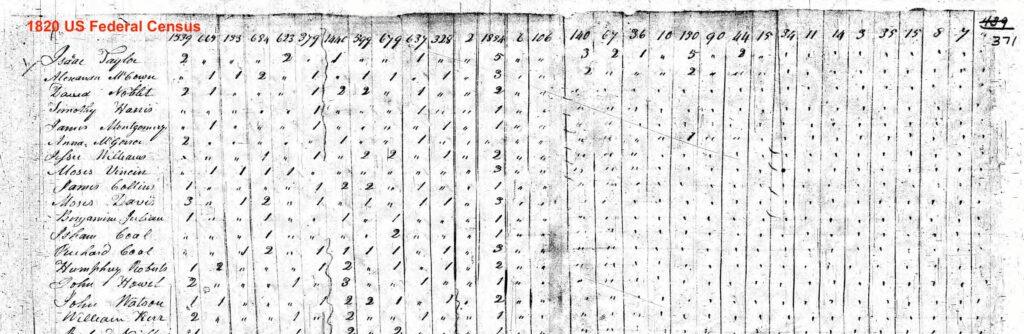
Step 1: Access the Collection
Navigate to: Search → Census & Voter Lists → 1820 United States Federal Census
The collection includes all states and territories enumerated in 1820, including Missouri Territory (not yet a state).
Step 2: Use Targeted Search Fields
Start with:
- Name (use phonetic/Soundex for spelling variations)
- Location (state + county if known)
- Approximate birth year (calculate from expected age bracket)
Don’t use:
- Occupation fields (the census doesn’t list titles, just categories)
- Exact birth years (age ranges make this imprecise)
Step 3: Verify with Original Images
The 1820 federal census has complex column layouts. Always view the actual image to verify:
✅ Correct age bracket boundaries (10-15 not 10-16)
✅ Occupation column numbers
✅ Military age 16-18 bracket if applicable
✅ Foreigners not naturalized notation
Never trust transcriptions alone. The 1820 form complexity leads to frequent indexing errors. Always scan up and down the page for possible collateral names, you just never know what (or who) you’ll see! 👀
Step 4: Document ALL Columns
Create a research log recording:
- Every age bracket’s numbers (males and females separately)
- Occupation data (Agriculture/Commerce/Manufactures)
- Foreigners not naturalized count
- Free colored persons age breakdowns
- Slave age breakdowns (if applicable)
This complete documentation enables comparison with 1810 and 1830 censuses to track changes. Use a line or ruler to make sure you are reading the same column across the page – it’s hard sometimes even for me!
Common 1820 Census Research Problems
The 1820 federal census presents unique challenges beyond earlier enumerations.
Problem 1: “The age brackets don’t match what I expected”
You calculated birth years using 10-16, 16-26, 26-45 brackets, but the family doesn’t align.
Solution: Recalculate using the CORRECT National Archives brackets:
- 10 to 15 (not 16)
- 16 to 25 (not 26)
- 26 to 44 (not 45)
One year makes a difference. Someone age 44 in 1820 was born 1776, NOT 1775.
Problem 2: “The occupation column seems wrong”
Your ancestor was a known merchant, but the 1820 census shows Agriculture.
Possible explanations:
✓ He shifted from commerce to farming between 1815-1820
✓ The household included farm workers/tenants the enumerator counted
✓ He did both (merchant who also owned farmland—counted as Agriculture)
✓ Enumerator made an error
✓ You’re tracking the wrong person
Solution: Cross-reference with city directories, tax lists, and land records from 1815-1825 to verify actual occupation. Don’t assume the census is definitive—it’s household-level, not individual-level data. If you’re kind of sure, just save the record in your shoebox or make a notation for this record.
You can also use Ancestry’s new NETWORKS TOOL to create a new network and store this record/
Problem 3: “I can’t tell which males are 16-18 vs 16-25”
The 1820 census has overlapping brackets for males: both 16-18 AND 16-25 exist.
How it works:
- Count males 16-18 first (separate column)
- Count males 16-25 second (includes the 16-18 group PLUS males 19-25)
Example:
- Males 16-18: 1 (one son age 17)
- Males 16-25: 3 (the same 17-year-old PLUS two sons ages 20 and 23)
The 16-18 column is SUBSET of the 16-25 column. Don’t add them together—subtract to find males 19-25.

FAQ: Your 1820 Census Questions Answered
Q: Why are there two different brackets that include 16-year-olds for males?

A: The 1820 census tracks males 16-18 separately (military draft age) AND as part of the broader 16-25 category.
Think of it as nested categories:
16-18 bracket = military-age young men specifically
16-25 bracket = all young adult males (including the 16-18 group)
When analyzing household composition, the 16-18 number is ALREADY INCLUDED in the 16-25 number. Don’t add them together. To find males ages 19-25, subtract the 16-18 count from the 16-25 count.
Example: Males 16-18: 1 / Males 16-25: 4 means there’s 1 male aged 16-18 and 3 more males aged 19-25 (total 4 in the 16-25 bracket).
Q: Can I use the 1820 occupation data to prove someone’s specific job?
A: No. The occupation categories are too broad to prove specific jobs.
“Engaged in Manufactures” could mean textile mill worker, blacksmith, cooper, weaver, or dozens of other trades. “Commerce” could be a general store owner or an import/export merchant.
Use the 1820 federal census occupation data as a starting point:
Commerce → search city directories for merchant listings
Manufactures → search apprenticeship records, guild memberships
Agriculture → search land deeds, tax lists
The census tells you the economic SECTOR—other records tell you the specific OCCUPATION.
Q: Why do some 1820 census pages show different age brackets than others?
A: Different published versions and transcriptions use inconsistent abbreviations.
The LEGAL language in the 1820 census act specifies:
“of ten and under sixteen” (10-15)
“of sixteen and under twenty-six” (16-25)
“of twenty six and under forty-five” (26-44)
Some published forms abbreviate this as “10-16” or “16-26” which is INCORRECT and creates off-by-one errors in birth year calculations.
Always use the National Archives official form which matches the legal language: 10 to 15, 16 to 25, 26 to 44.
Q: What does “Foreigners not naturalized” mean, and how do I use it?
A: This column counts household members who were foreign-born but hadn’t completed U.S. naturalization.
What it tells you:
Your ancestor immigrated to the U.S.
By 1820, they hadn’t naturalized (or hadn’t completed the process)
They were likely recent immigrants (arrived 1800-1820)
How to use it:
If your ancestor’s household shows a number in this column:
Search naturalization records 1820-1840 (they may have naturalized after the census)
Search passenger lists and port records for arrival
Check 1830 census—is the “foreigner” notation still there or did they naturalize?
Look for land records (some required citizenship for purchase)
The absence of a number doesn’t prove native birth—it just means everyone in the household was either U.S.-born OR already naturalized.
Next Steps: Building Your 1820 Census Research Strategy
You now understand what the 1820 Census contains, how to use occupation data, and how to navigate age bracket complexities. So, that’s been a lot of census breakdown, right? If you need a step-by-step plan to begin your research, you can use the action plan below.
Here’s your action plan:
✅ Find your ancestor in the 1820 federal census using Ancestry
✅ Verify age brackets against National Archives form (not Ancestry abbreviations)
✅ Document occupation data (Agriculture/Commerce/Manufactures)
✅ Note foreigners not naturalized if applicable
✅ Search wills and marriage records for your direct and collateral ancestors
✅ Compare to 1810 and 1830 to track 30-year progression
✅ Use occupation to direct next research: land records, city directories, apprenticeships
Your first action: Locate one ancestor in the 1820 census. Document their occupation category. Then search the corresponding records—land deeds for farmers, city directories for merchants, mill records for manufacturers.
Within your next research session, you’ll have moved beyond simple household tallies into economic and social context that explains migration, wealth accumulation, and family strategies.
The 1820 federal census is most powerful when viewed as the fourth data point in a four-decade story (1790-1800-1810-1820). Combined with the new occupation data, you can track not just WHO your ancestors were, but WHAT THEY DID and HOW THEY LIVED.
For detailed guides on every census year through 1950, including the revolutionary changes in 1850 when individual names finally appear, see our complete US Federal Census guide.
Your early American ancestors’ economic lives deserve accurate reconstruction. Your family deserves to know not just who they were, but what they did and how they built their lives. ❤️
Join the Source Hound Community 🕵️♂️
Tracking families through early American census records requires patience, attention to detail, and a community that understands the unique challenges of head-of-household enumeration and evolving categories.
📺 Subscribe on YouTube
Watch my complete 1820 Census tutorial showing real Ancestry searches, occupation data interpretation, and strategies for tracking 30-year family progressions on the Family History Foundation YouTube channel. New census tutorial every Friday at 6am EST!
📌 Follow on Pinterest
Save 1820 census research worksheets, occupation category guides, and age bracket comparison charts on Pinterest—perfect for quick reference while researching.
💬 Let’s Talk in the Comments
Have you used the 1820 occupation data to unlock land records or city directories? What economic patterns surprised you in your family? Drop a comment below—I read and respond to every one!

About the Author ✍️
Hi, I’m the founder of Family History Foundation—a one-person blog built from love, legacy, and lengthy research sessions. With a passion for helping others uncover their roots, I write detailed and compelling practical guides for professional family historians and weekend genealogists alike. This site is a space dedicated to making genealogy accessible, emotional, and empowering.
With a penchant for storytelling and a background in research, I help others uncover the lives and legacies of those who came before.
From organizing DNA matches to solving adoptee mysteries to exploring immigrant ancestors, my mission is to make family history a household word.
If you are ready to stop guessing and start knowing, stick around. We have a lot of digging to do. 🕵️♂️📚
I’m here for you, so let’s connect generations, one record at a time. ❤️
📧 Never Miss a Post
Subscribe to the newsletter for weekly census research strategies, early American genealogy guides, and methodology tips. No spam, just genealogical gold every Friday.