If you’ve ever gotten lost in the fascinating world of genealogy, you may have come across something puzzling: the ancestor paradox. 🤔 On the surface, your family tree should grow exponentially the farther back you go — doubling every generation — but in reality, it doesn’t work that way. Historians, mathematicians, and genealogists alike have wrestled with this strange truth for decades.
The ancestor paradox is a reminder that while math suggests we should have millions of unique ancestors after just a few hundred years, many of those lines overlap. This isn’t just theory — it affects real genealogy research and the way we interpret our family history.
In this article, we’ll explore this mystery together, break down its emotional and historical impact, and share some practical steps you can take to keep your research moving forward despite the ancestor paradox. By the end, you’ll see that what looks like a research obstacle is actually an opportunity for discovery, creativity, and connection with others who share your story.
Table of Contents
The Disappearing Family Tree Phenomenon
Most of us begin genealogy research with a sense of excitement — we’re on a quest to uncover the people who made us who we are. 🌳 It’s incredibly motivating to imagine a tree full of names and stories stretching back through time. But sooner or later, we hit what feels like an invisible wall. This is where the ancestor paradox comes into play.
Mathematically, if you trace back 10 generations, you should theoretically have 1,024 ancestors. Keep going another 10 generations, and you’d expect over 1 million distinct ancestors! But that’s not what happens. Many lines stop cold, records vanish, and the numbers don’t add up. The result is a tree with far fewer branches than math would predict. Genealogists call this pedigree collapse, and it is at the heart of the ancestor paradox.
Using this chart to decipher the formula x=2n, x represents the total number of ancestors in a specific generation and n (as an exponent of 2) is where you input the number of generations back you would like to go. If you want to convert this to logarithmic form the it would be log2 (x) = n. 🤓
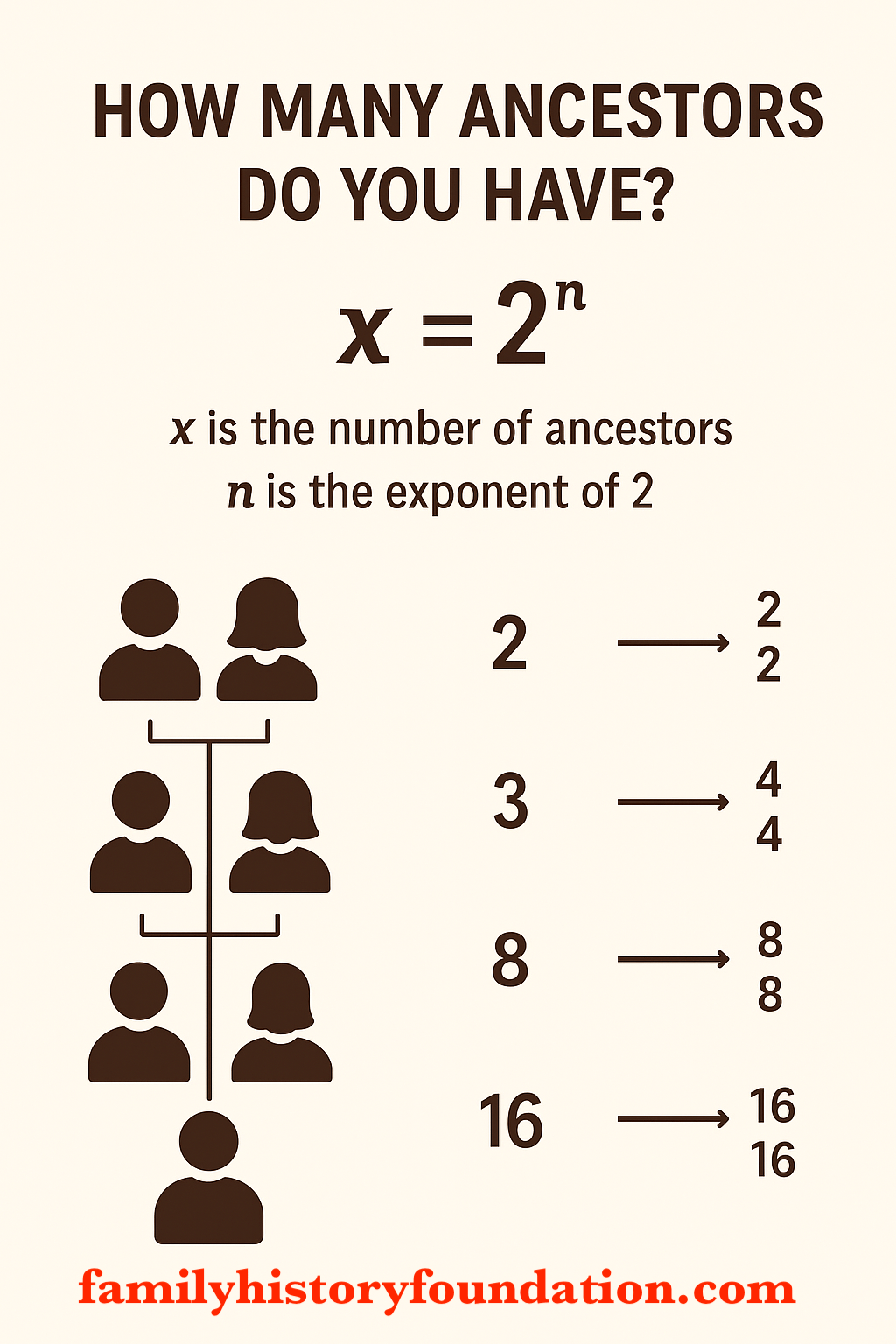
And here’s the real kicker — this isn’t just a research problem, it’s a universal human phenomenon. Everyone’s family tree eventually overlaps, which means you share many ancestors with distant cousins you’ve never met. Why isn’t this discussed more often in genealogy circles? Possibly because it challenges our idea of a perfectly traceable past. But understanding this is the first step toward embracing a more realistic and fulfilling family history journey.
The Historical Black Hole Explained
The ancestor paradox isn’t just about math — it’s about history. Records disappear for many reasons: fires 🔥, floods 🌊, wars ⚔️, and the fact that most of humanity simply didn’t keep meticulous track of births, marriages, and deaths until fairly recently. These missing pieces create what feels like a black hole in your family tree, a point where information falls away and leaves you searching.
The “Common Ancestor” Problem
Geneticists refer to this as pedigree collapse — the point where two people from different branches of your family tree turn out to be the same person. Over time, this means your family tree becomes more of a network than a simple branching tree. Instead of doubling every generation forever, your ancestor count overlaps more and more, which deepens the ancestor paradox. This is why most people alive today can trace some of their lineage back to the same medieval individuals.
Context Matters
In 17th-century Europe, record-keeping was often restricted to church books, and even those could be incomplete. Compare that with modern U.S. census data, which is updated every 10 years and systematically archived. When we understand this context, the ancestor paradox stops feeling like a personal failure and starts looking like an inevitable part of human history. Our challenge isn’t just to find names but to reconstruct entire lives from bits of information that survived.
For a deeper guide on where to start with historical research, check out my post Genealogy Research Online: The 1 Ultimate User-Friendly Beginners Guide.
The Elusive Fourth Generation
For many researchers, great-grandparents are where the trail starts to go cold. This “fourth generation wall” is one of the most common genealogy frustrations. 😩 It’s partly due to what genealogists call information decay — the simple fact that fewer living relatives can remember the details of that era. Documents from the late 1800s and early 1900s are sometimes missing, illegible, or inconsistent.
This is often the first point where the ancestor paradox becomes painfully real: your family tree, which looked so full and promising, suddenly shrinks as branches vanish into uncertainty. It’s completely normal to feel discouraged when you hit this barrier, but it’s also the perfect moment to regroup and try new techniques.
The good news? There are powerful ways to push past this genealogical dead end — and the satisfaction of finding one more generation can be absolutely thrilling. 🌟
Beyond the Brick Wall: What Happens Next?
Hitting the ancestor paradox can stir up a surprising amount of emotion. Some people feel frustrated 😫 or even defeated, while others find themselves more curious than ever. The experience often forces us to ask deeper questions: Who am I if I can’t trace every generation back to the beginning?
Does my identity depend on proving each connection? These questions can feel heavy, but they can also deepen your appreciation for the history you do uncover.
Emotional and Philosophical Impact
For some, these dead ends create an identity crisis. For others, it sparks a deeper sense of wonder about humanity’s shared history. When you realize that your 14th-great-grandparents might be the same as your neighbor’s, it shifts genealogy from a solitary pursuit to a shared story of connection. The ancestor paradox becomes not a problem but an invitation to see yourself as part of something much bigger.
Unexpected Connections
The ancestor paradox also means that lines you thought were unrelated may actually converge. That discovery can feel magical ✨ — turning distant strangers into newfound cousins. It’s one of the most rewarding moments in family history research, reminding us that we are all linked in surprising and beautiful ways.
Fun Quiz: How Far Back Can You Go?
Let’s put this into perspective! Take this quick quiz to see where you stand:
- How many generations back can you trace at least one family line?
a) 3 generations
b) 5 generations
c) 10+ generations - Do you know the birthplaces of all your great-grandparents?
a) Yes, all of them
b) Some of them
c) Not yet! - Have you discovered any overlapping ancestors (pedigree collapse) in your tree?
a) Yes, more than once
b) I think so, maybe
c) No idea — but I’m intrigued!
If you answered mostly C’s, congratulations — you’re on the edge of discovery! 🎉 The ancestor paradox might be your next big breakthrough and could lead you to some of your most exciting family history finds.
Cracking the Code: The “Reverse Research” Method
One of the best strategies for breaking through the ancestor paradox is what I call reverse research — working from what you know and expanding outward. Instead of going straight back in time, focus on building a rich picture of your grandparents’ and great-grandparents’ lives.
Document their siblings, neighbors, and friends. Often, a brother’s marriage record or a sister’s obituary can reveal parents’ names that were missing from your direct line. Obituaries and gravestones, especially, are hidden gems — they frequently list entire networks of relatives and even original hometowns.
🪦 By mapping these connections, you create a stronger foundation for your next leap backward in time, transforming the ancestor paradox into a solvable puzzle rather than a roadblock.
Digital Digging: Using Ancestry.com
When it comes to filling in missing branches, online tools like Ancestry.com can be game-changers. Their hint system connects historical records — censuses, draft cards, passenger lists — directly to individuals in your tree, saving hours of manual searching.
More importantly, their DNA testing and match list can help triangulate where your family lines overlap, shining light on pedigree collapse and resolving ancestor paradox mysteries. Use Ancestry’s “shared matches” feature to group DNA cousins, and check the “ThruLines” tool to generate hypotheses for connecting missing ancestors. Combine these tools with old-fashioned record checking to verify accuracy.
Find an exclusive offer to join Ancestry’s World Explorer package! It’s the same package that I use for my research, discount is on me!
Digital digging is about persistence: follow every lead, evaluate each source carefully, and document your findings so you don’t duplicate work later.
Breaking Through: The Satisfaction of Discovery
Few feelings compare to the moment when you finally break through a genealogical brick wall. Whether it’s discovering a great-grandparent’s marriage record after years of searching or confirming an ancestor through DNA matches, the rush of excitement can renew your motivation for months.
🏆 These moments remind us why we chase answers in the first place. Real-life success stories — like researchers who identified immigrant ships or rediscovered long-lost family homesteads — show that the ancestor paradox doesn’t have to win. Once you’ve made a discovery, take time to organize your notes and update your tree so the next generation can build on your work.
Finally, share your victories! Post them in the comments, swap tips with fellow genealogists, and celebrate your progress. Your breakthrough story might just inspire someone else to keep going.
Modern Solutions and Unconventional Paths
Thankfully, the ancestor paradox isn’t a dead end — it’s an invitation to get creative and stretch your research skills.
DNA Testing to the Rescue
Using tools like AncestryDNA, MyHeritage, or 23andMe, you can identify distant cousins who may hold clues to your shared past. DNA matching technology has helped countless researchers break through their brick walls and solve mysteries that traditional paper records couldn’t.
Crowdsourcing Genealogy
Sites like WikiTree and FamilySearch allow genealogists worldwide to share their research, building collaborative family trees. When you can’t find a record yourself, chances are someone else has already found it. Collaborative genealogy is one of the most powerful responses to the ancestor paradox because it allows many people to pool their knowledge.
Creative Historical Sleuthing
Think beyond census records: land deeds, wills, church registers, and migration patterns can provide missing links. Even old city directories can be invaluable (see my post How to Read Old City Directories (1822–1995) for Satisfying Genealogy Research). By combining different types of evidence, you can fill in the gaps left by missing vital records and keep pushing past the paradox.
For more time-saving tips, read 15 Genealogy Research Habits That Save Time.
Embracing the Mystery: The Beauty of the Unknowable
At some point, we have to make peace with the fact that not every answer can be found. That’s not a failure — it’s a beautiful reminder that history is bigger than we are.
🌌 The ancestor paradox teaches us to balance persistence with acceptance, to chase every clue but also to enjoy the mystery itself.
Instead of seeing the ancestor paradox as an obstacle, see it as a doorway to curiosity. You may never find the name of your 12th-great-grandmother, but you can still learn about the time, place, and culture in which she lived — and that is meaningful in its own right.
The Bigger Picture
Every gap in your family tree is an opportunity to dive into broader historical narratives. Research local history, study the migration patterns of your ancestral region, or explore historical maps to imagine what life was like for your ancestors. This reframes the ancestor paradox as a source of inspiration rather than frustration.
For more inspiration, check out Top 5 Sites for Free Genealogy Research.
Your Challenge 🌟
Now it’s your turn! Take a fresh look at your family tree this week and identify one spot where the ancestor paradox shows up. Share what you found — or what mystery still eludes you — in the comments below. Let’s turn this puzzle into a conversation that inspires others.
And don’t forget to subscribe to get more genealogy tips, tools, and inspiration delivered straight to your inbox. There’s tons of videos on my YouTube channel too!
Follow Me for More Family History Fun
📌 Pinterest: https://www.pinterest.com/familyhistoryfoundation/
▶️ YouTube: https://www.youtube.com/@familyhistoryfoundation
📷 Instagram: https://www.instagram.com/family_history_foundation/
About the Author
Hi, I’m the creator behind Family History Foundation — a passionate genealogist dedicated to helping people uncover their roots, connect with their ancestors, and preserve their family stories for future generations. Whether you’re just starting out or have been researching for years, I share practical tips, emotional encouragement, and plenty of inspiration to keep your genealogy journey moving forward. You can find me on Pinterest, YouTube, and Instagram where I share daily insights and family history projects you can try at home.
📺 🌳 ➡️ You can also Watch This Video on YouTube! 🌎 🎓 📚