Welcome, fellow history sleuths and family tree enthusiasts! Today, we’re diving deep into the often-murky waters of Ancestry family tree mistakes – those common pitfalls that can send your genealogical research spiraling in the wrong direction.
You are not alone! These are the errors that cost researchers hundreds of hours and are often the subject of the most popular genealogy content online, demonstrating just how widespread these issues are. Avoiding these errors is critical.
Table of Contents
While Ancestry.com offers an unparalleled treasure trove of records and tools, its very richness can sometimes lead us astray. From novice researchers just starting their journey to seasoned genealogists, everyone can fall victim to these subtle yet significant errors.
But don’t worry! This isn’t just about pointing out problems; it’s about empowering you with practical, actionable solutions to correct your course and build a more accurate, robust, and truly reliable family tree. 🌳 Let’s transform those “oops” moments into “aha!” breakthroughs and eliminate these persistent Ancestry family tree mistakes!
Why Accuracy Matters: Building a Foundation Against Ancestry Family Tree Mistakes
Before we jump into the specific Ancestry family tree mistakes, let’s briefly touch upon why accuracy is paramount. A family tree isn’t just a collection of names and dates; it’s a narrative, a legacy, and a foundation for future generations.
Incorrect information, once embedded, can proliferate rapidly, leading to wasted time, frustration, and a distorted view of your heritage. Imagine building a house on a shaky foundation – it simply won’t stand the test of time.
Your family tree deserves the strongest, most meticulously researched foundation possible. By understanding and avoiding these common Ancestry family tree mistakes, you not only preserve your own research integrity but also contribute to a more accurate global genealogical record. Let’s get started on building that solid foundation!
Mistake #1: Ignoring Source Hierarchy and Taking Everything at Face Value 📝
This is arguably the granddaddy of all Ancestry family tree mistakes. It’s astonishing how often researchers, in their excitement to add new ancestors, neglect the crucial step of citing where that information came from.
Ancestry.com makes it incredibly easy to attach records, hints, and even other people’s trees. But simply attaching a record isn’t always enough; you must also evaluate the quality of the record itself.
The Problem:
Imagine finding a death date for your great-grandmother. You see a hint from a census record and quickly add it to her profile.
But what if that census record actually showed her living in the household of her daughter and the age listed was for someone else entirely? Or what if you accepted a “shaky leaf” hint from another user’s tree without verifying the underlying sources?
Without a clear citation that specifies the exact record, page number, and even the image or transcription details, you’re building your tree on assumptions rather than facts. This is a common Ancestry family tree mistake that undermines the entire research process.
Future researchers (or even your future self!) will struggle to trust your work if the provenance of each fact is ambiguous. Furthermore, many users make the error of treating all sources as equal, regardless of where the information originated. This specific type of Ancestry family tree mistake involving poor source verification is rampant.
Strengthening Your Source Criticism:
To avoid one of the most fundamental Ancestry family tree mistakes, you must understand the hierarchy of evidence:
- Primary Source: A record created at or near the time of the event by someone with firsthand knowledge (e.g., a birth certificate signed by the attending doctor). This is the highest level of proof.
- Secondary Source: A record created after the event by someone without firsthand knowledge, often compiled from primary sources (e.g., a published local history book).
- Derivative/Index: A simple copy, transcription, or abstract of an original record (e.g., an indexed database entry on Ancestry.com or an unverified public tree).
Many Ancestry family tree mistakes occur when users treat a derivative or secondary source (like another user’s public tree) as if it were a primary source. Always strive for the highest quality evidence.
The Fix:
- Always Attach Sources Directly: Whenever you add a fact, link it to the specific record on Ancestry.com. Don’t just type in the date; go through the “add source” process.
- Review Source Details: When attaching a hint, always click “Review Details” and carefully compare the information in the record to your ancestor’s profile. Verify that the person in the record is indeed your ancestor.
- Add Custom Notes: Use the “Source Details” section or the “Notes” field for the fact to add specific information: “Page 3, Line 17,” or “Age appears to be misrecorded.” This extra context is invaluable and helps prevent an Ancestry family tree mistake later.
- Transcribe Key Information: For particularly important records, consider transcribing relevant sections into the notes or a research log. This forces a closer look at the details.
- Don’t Trust Other Trees Blindly: Treat other public trees as clues, not gospel. Never copy information from them without verifying every single fact with primary or reliable secondary sources. Remember that many public trees contain the very Ancestry family tree mistakes you’re trying to avoid.
Mistake #2: Ignoring Locality and Chronology 🗺️⏳
Genealogy is deeply rooted in time and place. Overlooking these fundamental elements is another significant Ancestry family tree mistake that can lead to wild goose chases and incorrect linkages.
The Problem:
It’s easy to get excited when you find a record with a familiar name. “John Smith, born 1850!” you exclaim, and quickly add him to your tree.
But if your John Smith was born in Massachusetts, and this record is for a John Smith born in California, you’ve likely made an error.
Similarly, ignoring the timeline can be disastrous. If your ancestor supposedly married in 1880, but the census record you just attached shows them as a child of 5 in 1880, something is clearly wrong.
An example of an Ancestry family tree mistake here would be confusing two individuals with the same name. Family names were often repeated across generations, and identical names can appear in different geographic locations or even the same location at slightly different times.
Without carefully considering the context of time and place, you might inadvertently merge two distinct individuals into one, or attach a record belonging to someone else entirely. Ignoring geography also means missing crucial contextual clues about migration patterns, border changes, and the availability of specific records. This is a common and easy-to-make Ancestry family tree mistake.
The Fix:
- Create Timelines: For each individual, create a mental timeline of their life events. Do the dates and locations make sense chronologically? Do the events follow a logical progression, or are there impossible gaps or overlaps?
- Map It Out: Use tools like Google Maps or historical gazetteers to understand the geography. Was it physically possible for your ancestor to travel between locations where records place them? Did county boundaries change? An Ancestry family tree mistake is often rooted in not understanding the historical location.
- Check Against Siblings/Spouse: Do the locations and dates for other family members (spouses, children, siblings) align with the individual you’re researching? Discrepancies here are major red flags that you may be linking to the wrong person.
- Consider Name Variations & Age Inconsistencies: Be aware of how names were spelled and ages reported. Census records often have varying ages year to year. This careful verification helps prevent common Ancestry family tree mistakes.
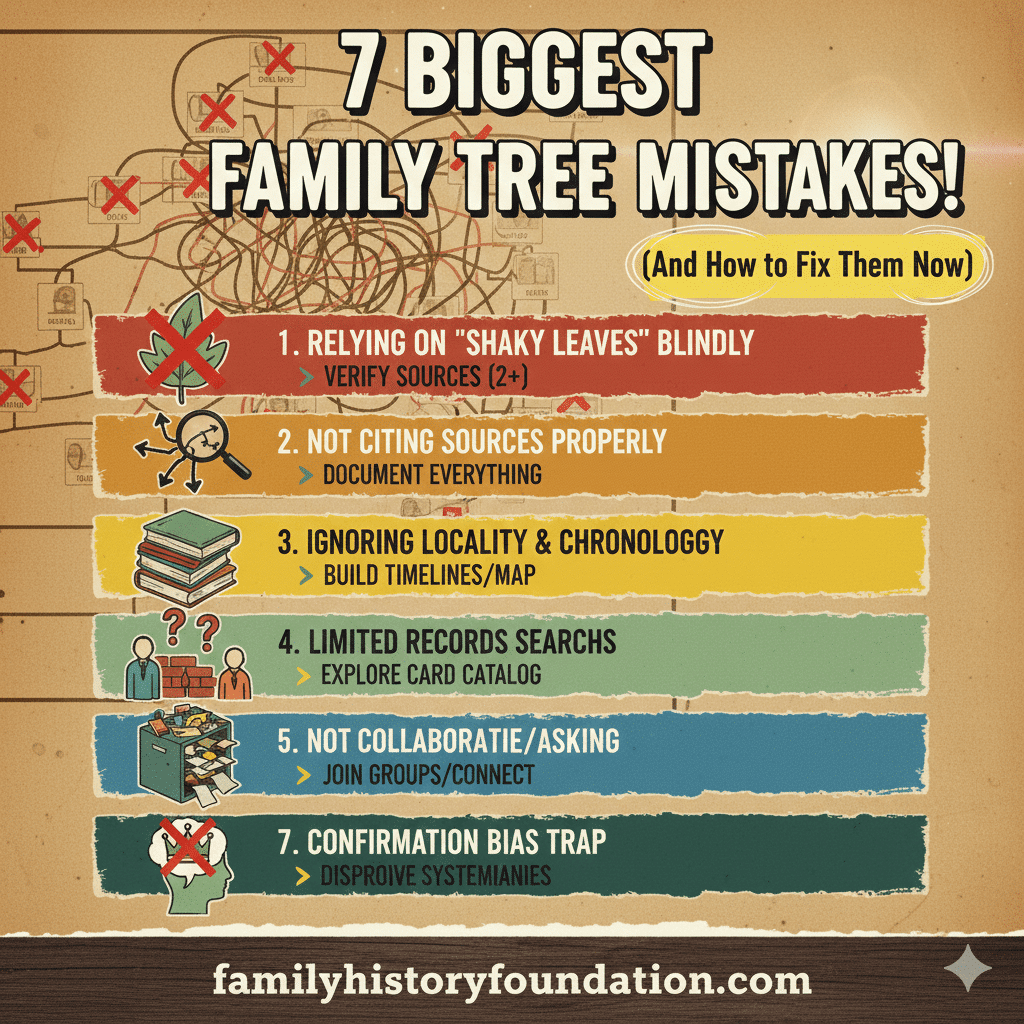
Mistake #3: Relying on “Shaky Leaf” Hints and The Urge to Rush Lineage 🍃💨
Many new researchers fall into the trap of letting the platform dictate their speed. One of the most common Ancestry family tree mistakes is allowing the excitement of discovery to override the necessity of verification, often fueled by the ubiquitous “shaky leaf” hints.
The Problem:
The algorithm that generates “shaky leaf” hints is powerful, but it’s an algorithm, not a genealogist. It matches names, dates, and places, but it can’t always account for context, unique family situations, or outright errors in original records.
Accepting every hint without critical evaluation can quickly populate your tree with incorrect information. You might connect to the wrong family, add incorrect spouses, or even jump generations due to similar names or approximate dates.
This particular Ancestry family tree mistake can create a tangled web that’s incredibly difficult to unravel later. The pressure to “grow” your tree quickly is a major driver of poor methodology and the need to rectify Ancestry family tree mistakes later.
The “Quick Fix” Trap: Why Speed Kills Accuracy
Genealogy is a marathon, not a sprint. The “quick fix” approach of rapidly accepting hints is a major contributor to Ancestry family tree mistakes.
Adding 50 ancestors quickly is less valuable than adding 5 thoroughly sourced individuals. A rushed tree is a fragile tree. You must slow down and treat every new piece of information as a lead that requires methodical verification, not a fact to be instantly adopted.
The Fix:
- Think of Hints as Clues, Not Facts: A hint means “there might be something here,” not “this is your ancestor.” Treat public tree hints with extreme caution.
- Always Click “Review Details”: This is where you compare the suggested record to your existing information. Look for multiple corroborating facts—not just a matching name.
- Verify with Multiple Sources: If a hint leads you to a new piece of information, try to find at least one (preferably two or more) additional, independent sources that confirm that information. For more on this, check out our guide on Genealogy Research Online. This cross-referencing is crucial to avoid Ancestry family tree mistakes.
Mistake #4: Not Maximizing Every Record and Limiting Your Search Depth 📚
Many users tend to stick to the most common record types: census, birth, marriage, death. While these are invaluable, limiting your search to them and failing to exhaust the details within existing records is a significant Ancestry family tree mistake.
The Problem:
Your ancestors lived full, complex lives that extended beyond these core life events. Focusing solely on a narrow set of records means you’re missing out on rich details and corroborating evidence.
For example, if your ancestor vanished between two census records, a will, land record, or court document might reveal their fate. If you’re struggling to find a female ancestor’s maiden name, looking at church records, obituaries of her children, or even local histories might provide the clue.
This Ancestry family tree mistake means you’re leaving valuable pieces of the puzzle unassembled. Furthermore, once you find a record, are you truly examining every field, every signature, and every neighbor listed? Most often, the answer is no. This oversight is a prime source of Ancestry family tree mistakes.
Get on Ancestry.com today and explore their packages and subscription levels. Have a peek and jump in and level up your research today. I use the All Access package! You don’t have to, just use what suits you best.
The 5-Step Ancestor Deep Dive Before You Hit Search
To maximize your search and prevent Ancestry family tree mistakes, perform this deep dive on every known ancestor before looking for new records:
- List Every Known Fact and Source: Create a comprehensive inventory of all verified dates, places, names, and the exact source for each.
- Identify Unknown Facts and Research Questions: Clearly state what you don’t know (e.g., “Where was John Smith born in 1865?” or “What was his mother’s maiden name?”).
- Create a Timeline to Spot Inconsistencies: Map all events chronologically to expose impossible gaps, conflicting ages, or overlapping residencies that signal an existing Ancestry family tree mistake.
- Analyze the Locality: Research the specific town/county/state: What records existed there at that time?
- Formulate a New Hypothesis: Based only on the evidence you have, formulate a precise research plan for the next step.
The Fix:
- Explore the Card Catalog: Ancestry.com has a comprehensive Card Catalog that allows you to browse specific collections.1 Filter by location, record type, and keywords.
- Look for Less Common Records: Seek out Probate Records, Land Records, Court Records, Military Records, and Newspapers. These are goldmines often overlooked by researchers who stick to BMDs, perpetuating a major Ancestry family tree mistake.
- Think About Your Ancestor’s Life: What might they have done? This critical thinking leads you to new record types. You can learn more about specific research strategies in our post about breaking through brick walls in your family tree.
Mistake #5: Falling into Research Ruts and Not Collaborating 🤝
Genealogy doesn’t have to be a solitary endeavor. One of the most common Ancestry family tree mistakes is trying to do everything on your own, especially when hitting a brick wall or when you’ve fallen into a repetitive rut in your search patterns.
The Problem:
Everyone encounters brick walls – those frustrating points where your research grinds to a halt. Trying to bash your head against the same problem repeatedly without seeking fresh perspectives can lead to burnout and missed opportunities.
Other researchers might have expertise in a specific region, a particular ethnic group, or simply have a different approach that can unlock new avenues for you.
Furthermore, not connecting with living relatives is a huge missed opportunity for oral histories and family documents. This Ancestry family tree mistake deprives you of invaluable human connections and resources and keeps you stuck in the same search rut. The most difficult Ancestry family tree mistakes often require outside input to solve.
The Fix:
- Connect with Relatives: Talk to older family members! They hold a wealth of knowledge, stories, photos, and documents that may not be digitized.
- Join Ancestry.com DNA Circles/Communities: If you’ve done a DNA test, these groups can connect you with genetic relatives who are also researching your shared lines.
- Participate in Forums and Facebook Groups: Post your brick walls; you’d be amazed at the generosity and expertise of the genealogy community. Be ready to share your documentation to get the best advice.
- Attend Local Genealogy Society Meetings: Many local societies offer help sessions, lectures, and a chance to network with experienced researchers in your area of interest. For more ways to connect with others, check out our recent post on using social media for genealogy.
- Consider a Professional Genealogist: For truly stubborn brick walls, a professional genealogist might be a worthwhile investment. This isn’t a sign of failure, but a strategic move to correct Ancestry family tree mistakes quickly.
Find unique opportunities to test with Ancestry DNA. I have tested with them and find Ancestry to be a superb testing and research site!
Fun Genealogy Quiz: Are You an Ancestry Ace or a Rookie Researcher? 🤔
Test your knowledge of common Ancestry family tree mistakes!
Instructions: Choose the best answer for each question.
- What is the BEST approach to a “shaky leaf” hint on Ancestry.com?a) Accept it immediately and add to your tree – Ancestry is always right!b) Ignore it completely, they’re rarely helpful.c) Review the details, compare to your existing data, and seek additional sources for verification.d) Only accept hints if they come from other public trees.
- You find a birth record for “Mary Johnson” in New York in 1885. Your ancestor “Mary Johnson” was born in Ohio in 1885. What should you do?a) Add the New York birth record, assuming it’s a mistake in your existing data.b) Add the New York record, figuring she must have moved very quickly after birth.c) Recognize the locality discrepancy and determine this is likely a different person, seeking a record specific to Ohio.d) Change your ancestor’s birth state to New York.
- Why is citing sources properly considered a critical practice in genealogy?a) It makes your tree look more professional.b) It allows you and others to verify information and retrace steps.c) Ancestry.com requires it for “hints” to work.d) It primarily helps you avoid copyright infringement.
- Which of these is NOT an “obvious” record type but can be incredibly valuable for genealogical research?a) Census recordsb) Birth, Marriage, Death (BMD) recordsc) Probate records (wills, administrations)d) Ship passenger lists
- When you hit a “brick wall” in your research, what is the LEAST effective strategy?a) Re-examining all your existing sources for overlooked clues.b) Asking for help in a genealogy forum or consulting a professional.c) Taking a break and coming back to the problem with fresh eyes.d) Continually searching the same databases with the exact same search terms expecting different results.
Quiz Answers: 1. c, 2. c, 3. b, 4. c, 5. d
How did you do? If you got most of them right, you’re on your way to becoming an Ancestry ace! If not, don’t worry – that’s why we’re here to help you conquer those Ancestry family tree mistakes!
Mistake #6: Not Organizing Your Research 🗃️
This might not seem like a direct research error, but disorganization is a stealthy Ancestry family tree mistake that can cripple your progress. The ability to quickly and accurately retrieve information is foundational to sound research.
The Problem:
As you gather more and more information, it’s easy for digital files, printouts, notes, and photos to become a chaotic mess.
You might download the same record multiple times, forget which facts you’ve already verified, or lose track of leads you intended to follow up on.
This leads to wasted time, duplicated efforts, and the risk of overlooking crucial details simply because they’re buried in digital clutter.
Without a system, the sheer volume of information can become overwhelming, making it hard to see the forest for the trees. This particular Ancestry family tree mistake can cause significant frustration and delay. A disorganized researcher is almost guaranteed to repeat previous errors or miss the critical link hidden in plain sight, making the solution to Ancestry family tree mistakes harder to find.
The Fix:
- Establish a Naming Convention: For downloaded files, use a consistent naming convention:
Surname_GivenName_Event_Date_Location_Source.pdf. - Create a Digital Filing System: Use folders on your computer organized by surname or geographical location.
- Maintain a Research Log: This is a crucial tool! A research log tracks: Date, Objective, Source, Results, and Next Steps. This prevents you from repeating searches and keeps your research focused, helping you avoid a massive Ancestry family tree mistake of repetition.
- Utilize Ancestry’s Tools: Use Ancestry’s “comments” feature on profiles, “tasks,” and “notes” to keep track of ideas, questions, and theories directly within your tree.2
- Review and Consolidate Regularly: Periodically go through your research to organize, delete duplicates, and update your research log. Our post on how to organize your genealogy research offers even more tips! Fixing Ancestry family tree mistakes is easier with a clean system.
Mistake #7: The Confirmation Bias Trap (And Avoiding Permanent Ancestry Family Tree Mistakes) 🕵️♀️
This might be the most challenging Ancestry family tree mistake to overcome because it touches on human nature and our desire for a compelling narrative. We often go into research with a hypothesis, but a good genealogist must be willing to let that hypothesis go if the evidence doesn’t support it.
The Problem:
It’s exciting to connect with a famous ancestor or prove a long-held family legend. This excitement can sometimes lead to confirmation bias – unconsciously looking only for evidence that supports our existing theories.
This is a subtle but powerful Ancestry family tree mistake. You might stretch the interpretation of a record, ignore conflicting dates, or dismiss a challenging piece of evidence, all in an effort to make the puzzle pieces fit your desired outcome.
This leads to an inaccurate tree and a distorted family history. It’s the equivalent of forcing a square peg into a round hole, simply because you want it to fit. This error often results in permanent, difficult-to-spot Ancestry family tree mistakes that are passed down to future generations. You must commit to intellectual honesty to avoid this Ancestry family tree mistake.
The Fix:
- Approach Research with an Open Mind: Start with questions, not answers. Be prepared for your theories to be challenged or disproven.
- Actively Seek Contradictory Evidence: When you find a piece of information, consider what might disprove it. Are there other records that suggest a different parent, spouse, or birth year? This is a crucial step to avoid Ancestry family tree mistakes.
- “Negative Evidence” is Still Evidence: The absence of a record can sometimes be just as telling as its presence.
- Formulate Your Hypotheses Clearly: Write down your theories and the evidence that supports them. Then, actively look for evidence that would refute them. This scientific approach strengthens your findings.
- Don’t Be Afraid to Delete or Correct: It takes courage to admit you were wrong and correct a long-held piece of information in your tree. Our post on evaluating online genealogy sources provides more guidance here. For those looking to learn even more about advanced research, our recent post on advanced strategies for census records might be helpful.
The Power of Persistence and Learning 🚀
Overcoming these Ancestry family tree mistakes isn’t about being perfect; it’s about being persistent, methodical, and continually learning. Every error is a learning opportunity, a chance to refine your skills and strengthen your research.
Ancestry.com, with its vast resources, is an incredible tool, and by using it wisely and avoiding these common missteps, you can unlock incredible stories and build a truly robust and reliable family tree that will be a source of pride for generations to come. The effort you put into meticulous sourcing and verification today will pay dividends for decades. We are here to help you fix any Ancestry family tree mistakes you discover.
Remember, genealogy is a journey, not a race. Take your time, verify your facts, and enjoy the incredible process of discovery. We hope these insights help you on your quest to uncover your family’s unique history! For additional tips and tricks to enhance your research, consider exploring our post on essential genealogy tools and resources.
Frequently Asked Questions (FAQ) about Ancestry Family Tree Mistakes
Q1: How can I tell if a “shaky leaf” hint is reliable?
A1: A shaky leaf hint is reliable only after you have thoroughly reviewed the source attached to it, confirmed that the individuals in the record match your ancestors, and ideally, cross-referenced the information with at least one other independent source. Never accept a hint without critical evaluation. The presence of Ancestry family tree mistakes in other public trees means hints derived from them need extra scrutiny.
Q2: What’s the best way to get started with citing sources on Ancestry?
A2: Ancestry.com has built-in features that make citing easy. When you attach a record from an Ancestry collection, it automatically creates a basic citation. Your best practice is to always click “Review Details” when accepting hints and then use the “Source Details” field for each fact to add your own notes, page numbers, or specific comments. This level of detail helps prevent future Ancestry family tree mistakes.
Q3: My family tree on Ancestry.com is a mess of incorrect information. Should I delete it and start over?
A3: Not necessarily! While tempting, deleting and starting over can mean losing valuable, correctly-cited information. Instead, focus on correcting the existing errors systematically. Start with a core ancestor and work outwards, verifying each fact and source. This can be a significant undertaking if you have many Ancestry family tree mistakes, but it’s worth the effort.
Q4: How do I deal with conflicting information I find in different records?
A4: Conflicting information is common in genealogy! The key is not to ignore it but to evaluate it. Consider the source type, who provided the information, and how close in time the record was created to the actual event. Weigh the evidence and form a conclusion, but always note the conflicting data. This demonstrates thorough research and awareness of potential Ancestry family tree mistakes.
Q5: Can DNA help me fix my family tree mistakes?
A5: Absolutely! DNA evidence can be a powerful tool to confirm or challenge your documented pedigree. If your traditional research indicates a certain ancestral line, but your DNA matches don’t align, it’s a strong indicator that there might be a significant Ancestry family tree mistake in your paper trail. Use DNA matches to verify relationships, connect with unknown relatives, and break through stubborn brick walls. AncestryDNA, for example, integrates directly with your family tree, providing additional insights.3
About the Author: The Family History Foundation
The Family History Foundation is more than just a blog; it’s a passion project brought to life by a team of dedicated genealogists and storytellers, spearheaded by [Your Name/Founding Genealogist’s Name]. With decades of combined experience delving into dusty archives, deciphering faded script, and navigating the complexities of online databases, our mission is simple: to empower you on your own journey of discovery.
We believe that everyone has a unique and fascinating story etched into their ancestry, and we’re here to provide the tools, tips, and inspiration to help you uncover it.
Our philosophy is built on the principles of meticulous research, accurate sourcing, and a deep respect for the individuals who came before us. We understand the thrill of a new discovery and the frustration of a brick wall, and we strive to offer practical, actionable advice that helps both novice and experienced genealogists alike.
We are committed to fostering a vibrant community where shared knowledge and mutual support flourish. We know that avoiding Ancestry family tree mistakes requires commitment and we are here to support you every step of the way.
At Family History Foundation, we’re not just writing about history; we’re helping you connect with your history, one ancestor at a time. Join our growing community of passionate researchers and let’s unlock the past together.
We invite you to explore our extensive library of articles, engage with us on social media via our YouTube channel and Pinterest page, and share your own discoveries. Your family’s story is waiting to be told, and we’re honored to be a part of your journey.