
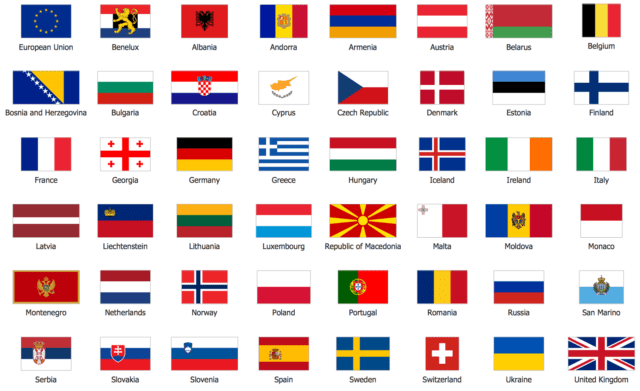
How many flags of Europe are there? There are 50 recognized countries, 28 of whom belong to the European Union (EU). Each country’s flag is an iconographic representation of its history and culture and is often an indicator of a secretive relationship to another nation with whom there is a shared past. You just have to know what to look for. The flags of Europe and their designs are a study in hidden meanings and symbolic code.
For example, have you ever noticed that certain flags are horizontally striped while others are vertically striped? How about the fact that other flags look almost identical to one another? There are also flags that are square while others are rectangular while others still are oblong. We are about to explore all of this and make sense of the flags of Europe and their design similarities in one go.
FLAGS OF NORTHERN EUROPE
Let’s start with the so-called Nordic Cross flags! Look at the map below and see how many flags you can find with crosses offset to the ‘hoist’ side of the flag (the side that attaches to a flag pole).

You should have counted 6 on this map. Although there are 6 ‘Nordic Cross’ flags on the map, only 5 are actual European countries: Iceland 🇮🇸, Denmark 🇩🇰, Norway 🇳🇴, Sweden 🇸🇪, and Finland 🇫🇮. The white flag with the red cross bordered with blue is a flag of the Faroe Islands 🇫🇴, a dependent of Denmark. There’s one group of European flags already explained!
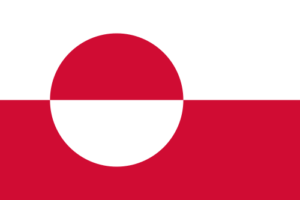
FUN FLAG FACT: Although part of northern Europe and a Nordic region, the flag of Greenland (the largest island in the world) has a completely non-Nordic Cross flag. Greenland is another territory of Denmark, just think Viking history!
FLAGS OF WESTERN EUROPE
It’s easy to make sense of the flags of Europe if we divide it into Northern, Western, Eastern, and Transcontinental. Western Europe is generally everything to the left of the green line (see map below) from Germany, Austria 🇦🇹, and Italy towards the Atlantic. Western Europe can include Northern Europe or not, depending on your level of definition; Northern Europe being all of the “Nordic Cross” countries.
This is also tricky because there are some that consider the Baltic Nations of Estonia 🇪🇪, Latvia 🇱🇻, and Lithuania 🇱🇹 to be Northern European; however, that is a hotly contested debate. The Baltic Nations have increasingly sought to distance themselves from being considered Eastern European politically so I just label them “Baltic Nations,” “Baltic Countries,” or “Baltic” as a reference. The Baltics are beautiful!!!
Western European flags are, for the most part, easily identifiable as they contain the some of the most familiar and well-known countries such as the United Kingdom 🇬🇧, France 🇫🇷, Spain 🇪🇸, Germany 🇩🇪, and Italy 🇮🇹. Switzerland 🇨🇭, Portugal 🇵🇹, and Ireland 🇮🇪 are also among these notables.
Take a look at the flags of Western Europe and see which ones you don’t know. Besides the big boys, there should be between 7 and 9 lesser known flags. Can you find them?
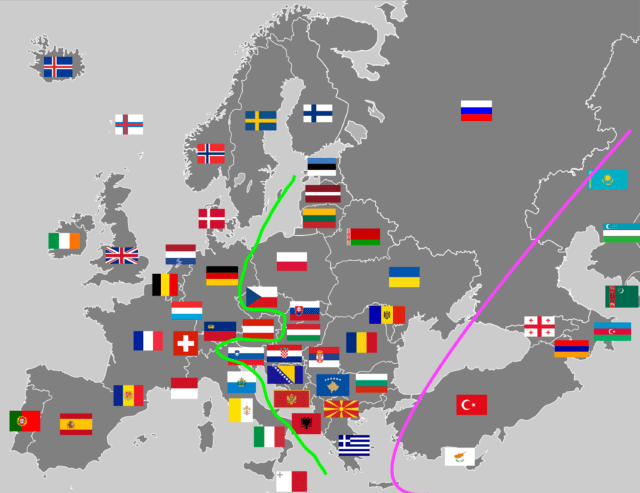
Out of these lesser known flags, if you’re not into vexillology (the study of flags), you may have been able to identify the Netherlands 🇳🇱 and Belgium 🇧🇪. However, the other 7 are unique in that they range from very small countries to city states!
Let’s begin with Italy. There are 3 other flags surrounding the famous Italian flag 🇮🇹 on the peninsula there. The one to the very bottom is actually its own country, Malta 🇲🇹. The other 2 represent the Vatican 🇻🇦 and San Marino 🇸🇲. San Marino is basically a landlocked microstate smack dab in the southern corner of the Emilia-Romagna region with a population of only 33,000 people.
When you think of city-states think of the Vatican, San Marino, and also Monaco 🇲🇨! Monaco is less than 10 miles from the Italian border in the south of France. Its flag is interesting in that it is very similar to the flag of Poland 🇵🇱 and Indonesia 🇮🇩. Can you tell the difference?
In reality, the flag of Monaco and Indonesia both have red on top and white on the bottom while the Polish flag has white on top and red on the bottom. The difference ultimately can be found in their proportions. The Indonesian flag has a ratio of 2:3 while the flag of Monaco has a ratio of 4:5 which basically just makes it taller and fatter! The flag of Poland is 5:8 in ratio. These are basically indistinguishable using emojis, but you can see it on the map if you look closely.
FUN FLAG FACT: By contrast the flag of the United Kingdom is 1:2 and the flag of the United States is officially 10:19. So if you blew the UK flag up to be 10 feet high, it would just be a foot longer than the US flag. Someone was feeling persnickety that day!
The other remaining 3 small Western European nations with independent flags are Andorra 🇦🇩, Liechtenstein 🇱🇮, and Luxembourg 🇱🇺. Andorra sits between Spain and France and is a tiny nation of just 77,000 people who have been independent since medieval times. Liechtenstein 🇱🇮 is a Germanic nation whose flag looks very similar to the flag of Haiti 🇭🇹 and as the story goes both changed their flags after the 1936 Olympics when they inadvertently realized they had identical national symbols: blue on top, red on bottom. I ‘Haiti’ it when that happens!
The flag of Luxembourg looks similar to the Netherlands except it has lighter shades of red and blue! Netherlands 🇳🇱 vs. Luxembourg 🇱🇺. Spooky yeah?!?
If you think that’s spooky compare Andorra 🇦🇩 to Moldova 🇲🇩 and Romania 🇷🇴. Actually there’s quite a few like this throughout Europe and the world which makes it hard to memorize flags in general, which is why I am attempting this tutorial. I’ve covered similar designs side-by-side in another post: “Flags of European Countries and Their Look-Alikes”.
FLAGS OF EASTERN EUROPE
Let’s look at Eastern Europe which lies between the green line and the purple line. Discounting the Baltic Countries of Estonia, Latvia, and Lithuania, that leaves us 19 Eastern European countries: Russia 🇷🇺, Belarus 🇧🇾, Ukraine 🇺🇦, Poland 🇵🇱, The Czech Republic (Czechia) 🇨🇿, Slovakia 🇸🇰, Hungary 🇭🇺, Slovenia 🇸🇮, Croatia 🇭🇷, Serbia 🇷🇸, Bosnia & Herzegovina 🇧🇦, Montenegro 🇲🇪, Kosovo 🇽🇰, Macedonia 🇲🇰, Albania 🇦🇱, Greece 🇬🇷, Bulgaria 🇧🇬, Romania 🇷🇴, and Moldova 🇲🇩.
The 2 wild cards are Kosovo and Hungary. Kosovo’s status is currently in contention in the international community; however many include its flag in the compliment of European nations as I do. Kosovo was a part of the Yugoslavian dismemberment in the 1990s. Hungary can be considered a part of Western Europe via its connection to Austria.
Eastern Europe is hard to decipher for most people only because they may not be familiar with its geography or history. Correct or not, accurate or inaccurate, politically correct or not here’s how I carve this region up according to flags. This will help you learn information in ‘blocs,’ no pun intended. Refer to the map above.
- You have the 3 Fatties on Top: Poland, Belarus, and Ukraine. Each are huge nations and have very distinct flags: Poland’s white and red 🇵🇱; Belarus’ knit flag 🇧🇾; and Ukraine’s pretty blue and yellow 🇺🇦.
- You have the Russian-Style Slavic Stripes: Czechia, Slovakia, Slovenia, Croatia, and Serbia. Each of these mimics the Russian white, blue, and red flag 🇷🇺. Czechia 🇨🇿 basically took the blue stripe and made it a triangle, and the rest put a coat of arms on the flag and/or changed the order of the colors 🇸🇰 🇸🇮 🇭🇷 🇷🇸.
- You have the Balkan Banner Brothers: Bosnia & Herzegovina, Montenegro, Albania, Kosovo, Macedonia, and Greece. This whole lower neck of the Balkan peninsula just didn’t want the same old striped flag, they all had to be original didn’t they? 🇧🇦 🇲🇪 🇽🇰 🇲🇰 🇦🇱 I guess being so close to Greece they had to take a lesson from them in innovation (these 5 flags are all unique). Greece’s flag is simply iconic 🇬🇷.
- You have the Copy Right Infringers: Bulgaria, Romania, and Moldova. I call them the “copy right infringers” because they are all situated on the RIGHT side border of Eastern Europe and they all seemed to have COPIED the flags of other nations. Bulgaria’s flag 🇧🇬 looks freakishly similar to Hungary 🇭🇺 and, well we’ve talked about Romania 🇷🇴 and Moldova 🇲🇩 already in relationship to Andorra.
That’s it, those are the flags of Europe and their design similarities as a tutorial. If you apportion Europe according to regions it’s much easier to process all of her FLAGS. But wait? What about the Isle of Man or Wales or Scotland or the Basque people? Don’t these places have flags too? Well, yes they do! And what about Transcontinental Europe? I’ll continue on the importance of those regions and isolates in relationship to the makeup of European flags as a whole in a subsequent post. I’ll leave you with a few of my personal favourite European flag designs: 🇱🇹 🇺🇦 🇬🇧 🇳🇴 🇵🇹 🇮🇹. Do you recognize these flags? What are your favourite European flags?
WE’D LOVE TO HEAR FROM YOU – MAKE SURE YOU LEAVE A COMMENT BELOW


Visitor Rating: 5 Stars
Visitor Rating: 5 Stars
Visitor Rating: 5 Stars