Every experienced family historian knows the moment: you’ve followed a direct line back decades, only to hit a crushing wall where a marriage record is missing the wife’s last name. The failure to find the wife’s maiden name isn’t just a hurdle; it’s a terrifying genealogical obstacle known as The Maiden Name Dead End that stops an entire branch of your tree.
You’ve searched direct records—census, marriage, birth—to no avail, staring blankly at a husband’s name while the identity of his partner and the key to her ancestral line remains frustratingly elusive. This is perhaps the most common and discouraging brick wall in all of genealogy, but it is not unbreakable.
Table of Contents
If you’re ready to move past the frustration and finally solve your family mystery, it’s time to stop looking backward and start looking sideways at the family’s associates, legal documents, and neighbors.
The classic, linear approach to genealogy—moving directly from child to parent—often fails when key vital records are missing or simply non-existent. Overcoming this requires a paradigm shift, moving from direct research to what is called lateral research.
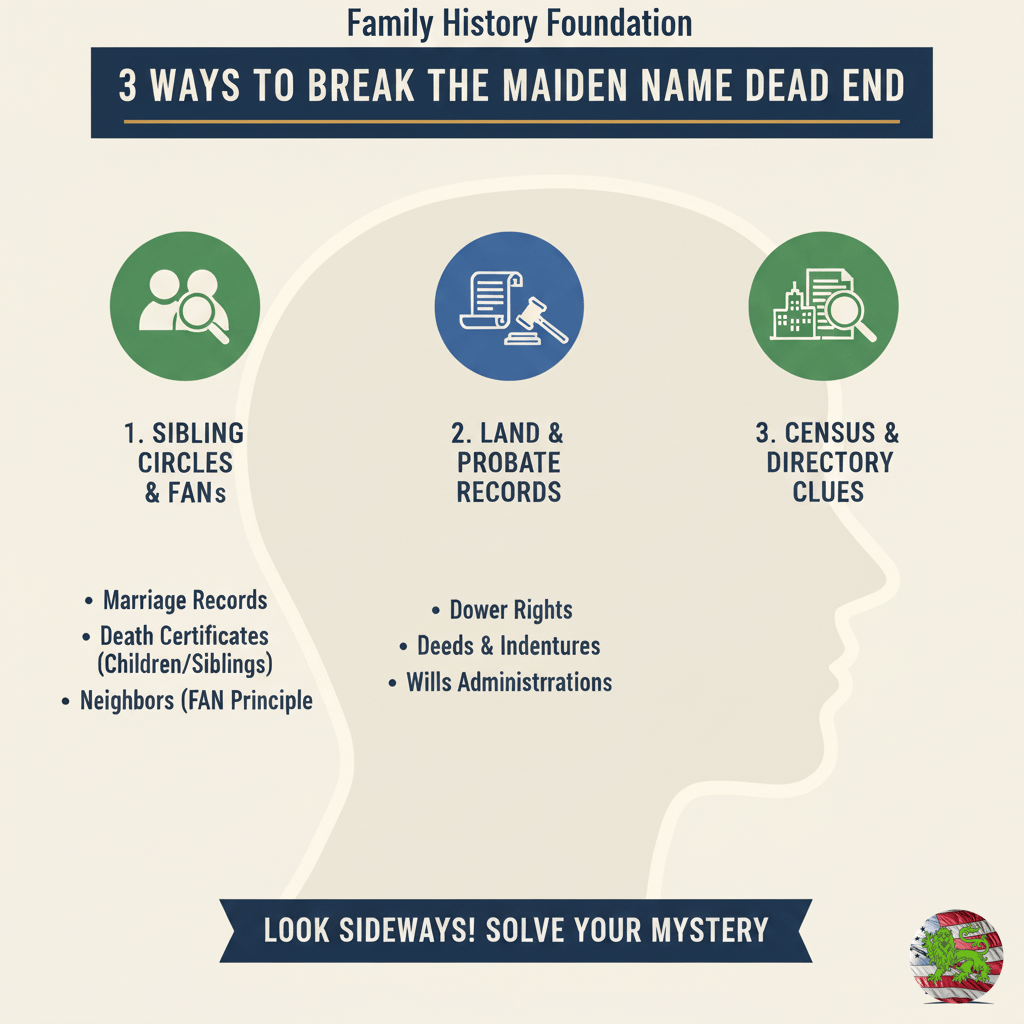
Lateral research involves studying the entire family unit—siblings, children, cousins, neighbors, and close associates—to find a record that names your elusive matriarch’s parents or family connections. The records that name the father of the wife are usually found within the context of her extended kin, not in documents that directly follow her own marriage.
This article will unveil three hidden, proven ways to leverage this lateral approach, transforming the paralyzing frustration of The Maiden Name Dead End into a thrilling breakthrough.
1. The Power of Sibling Circles: Lateral Research is the Key 🔑
The most fundamental shift in solving The Maiden Name Dead End comes from understanding that the information you seek might not be about your direct ancestor at all—it’s about her brothers, sisters, and children. In earlier generations, the family unit was often a close, legally intertwined, and geographically concentrated entity.
When one sibling moved, often the others followed, and their documents often contain the clues you need. This technique, lateral research, is the secret weapon of professional genealogists.
Following the Siblings: The Low-Hanging Fruit 🍎
When your ancestor’s marriage record fails to name her parents, immediately pivot to finding the records for her known siblings. Why? Because the sister’s marriage record might be indexed better, or it might have been recorded in a different jurisdiction with a more detailed form.
For instance, in one county, a marriage license might simply list the groom and bride; in an adjacent county, a nearly identical license may require the names of both the bride’s parents, including the mother’s maiden name, solving The Maiden Name Dead End instantly.
Similarly, search for the death certificates of all her children. Before the 1940s, it was common for an elderly relative (often the spouse, but sometimes a child) to provide information for a death certificate.
A mother’s maiden name is frequently recorded on her child’s death certificate, information that might be absent from her own. While death records can sometimes contain inaccuracies, they provide a strong starting point and can turn The Maiden Name Dead End into a solid lead.
Cluster Research: The FAN Principle and Neighborhood Clues 🏘️
A critical component of solving The Maiden Name Dead End is the FAN Principle: looking at Family, Associates, and Neighbors. Your ancestor’s family didn’t exist in a vacuum. On census records from 1850 onward, examine the dwelling numbers and household groupings. Who lived immediately next door?
- Neighbors: People living immediately next to your ancestor in the census, especially in rural areas, were often relatives—a married sister, a cousin, or even a parent. If you find a neighboring household whose surname matches the potential maiden name of your ancestor’s children’s spouses or a name you’ve seen as a witness, that could be the family unit that caused The Maiden Name Dead End. This technique often leads to finding the head of the neighboring household, whose probate record (see below) or death certificate may provide the crucial link.
- Associates (Witnesses): Go back to the original documents you already have—the marriage record, the baptismal record for children, or even the ancestor’s naturalization papers. Who were the witnesses, godparents, or bondsmen? These individuals were almost always close family members or trusted associates. A bondsman on a marriage record was frequently the bride’s father or brother. Following the life of that bondsman often leads directly to the family that created The Maiden Name Dead End. For a deeper dive into effective online research strategies, consult our guide on Genealogy Research Online: The 1 Ultimate User-Friendly Beginners Guide.
The Census and Naming Patterns: Beyond the Head of Household 🧐
While the census might seem like a direct record, it holds immense lateral power. Track the family through every available census, looking for The Maiden Name Dead End clue. Note the names of the children. Did they follow a traditional naming pattern, where the first son was named after the paternal grandfather and the second son after the maternal grandfather?
Did a later child bear a peculiar middle name that corresponds to a surname in the area? These subtle clues are often the only breadcrumbs left. We explore other lateral research techniques in our post on the Once Removed Cousin Chart: The 1 Comprehensive Guide You Need.
🛑 Quick Genealogy Quiz: Can You Solve The Maiden Name Dead End?
Before we dive into the next two hidden records, test your lateral research knowledge!
Question 1: You are searching for the maiden name of Martha, married in 1845. The marriage record is a Maiden Name Dead End. Which record is most likely to name her father directly?
A) Martha’s 1870 Census Record.
B) The 1905 Death Certificate of Martha’s oldest son.
C) The 1855 Probate Record (Will) of a man named John Smith, who owned property adjacent to Martha and her husband, witnessed by Martha’s brother.
Question 2: Why is focusing on a sibling’s death certificate often a more successful strategy than focusing on your ancestor’s own death certificate to break The Maiden Name Dead End?
A) Sibling records are simply easier to find online.
B) The sibling’s informant (the person providing the data) might have had closer knowledge of the parents’ names.
C) The sibling’s death certificate is required by law to name the mother’s maiden name, unlike the ancestor’s.
Question 3: What is “Dower Right” research, and how does it relate to solving The Maiden Name Dead End?
A) It’s a specialized term for searching ship passenger lists for a woman’s travel date.
B) It’s a land record that documents a widow’s right to use a portion of her deceased husband’s land, but it never names her family.
C) It’s a land record that forces the wife (the person with the missing maiden name) to release her legal interest in a property sale, often requiring her father or former guardians to sign off on the transaction.
Quiz Answers: 1. C | 2. B | 3. C
2. The Power of Paper Trails: Land Records and Probate 📜
If lateral family research doesn’t yield immediate results, the next most powerful solution for The Maiden Name Dead End lies in the dusty, complex, and often overlooked world of land and probate records.
These court and legal documents were meticulous because land and inheritance were the most valuable assets, and they were often recorded in such a way that eliminated the risk of The Maiden Name Dead End from a legal standpoint.
Dower Rights and Property Deeds 💰
Prior to the 20th century, a married woman possessed a legal interest in her husband’s land called a “dower right” (or, in some regions, “thirds”).
This meant that if the husband died, the wife had a lifetime interest in one-third of his property. If the husband wanted to sell land while he was alive, the wife had to officially relinquish her dower right to ensure the title was clear for the new buyer.
The key to solving The Maiden Name Dead End here is the specific process of relinquishing that dower. Because a woman was not legally considered a fully independent entity, her legal agreement often required the involvement of her family.
Search the grantor (seller) index for your ancestor’s husband. Look for any deeds where he sold land. In the margin, or within the body of the text, you might find a document where:
- The Wife is Named: The deed will name the wife (the person with the missing maiden name) and require her to sign.
- Parental Consent: In some states, particularly for younger brides, the release of the dower right had to be witnessed or consented to by the bride’s father or a close male relative.
- Prior Marriage Clues: Sometimes, the deed will mention that the land was inherited from the wife’s former husband, or even more critically, the deed may specify that the wife inherited the land from her father, effectively providing the maiden name and the father’s name in one record. This kind of detail can instantly break The Maiden Name Dead End that has plagued your research for years.
Probate Records: The Will and the Missing Daughter 📝
Probate records (wills, administrations, inventories) are arguably the most powerful resource for solving The Maiden Name Dead End. When a man wrote his will, he had to clearly identify his children to ensure his estate was distributed correctly.
- Identifying the Married Daughter: When a father leaves property to his married daughter, he will almost always refer to her by her married name to prevent confusion. However, he will sometimes use a phrase like “my daughter Martha, wife of John Brown” or, occasionally, “my daughter Martha Brown (née Smith).”
- The Widow’s Claim: If the woman with the missing maiden name is listed as a daughter in the will of a man with a matching surname, this is usually proof positive. To confirm, check the estate’s distribution records to see if the husband’s name appears as the recipient of the daughter’s portion. This legal paper trail is often the only way out of The Maiden Name Dead End.
The comprehensive nature of land and probate documents, which often span decades and involve multiple family members, means they contain exactly the lateral clues needed to find the wife’s birth family. This deep dive into records is essential, and often requires a subscription to a service like Ancestry.com or accessing the free digitized collections on FamilySearch.org.
If you’re strategic, you can learn how to maximize your time with platforms like Ancestry by exploring our guide, Why Ancestry.com Is the Number 1 Genealogy Website for Boldly Building Your Forever Family Tree.
3. The Unsung Heroes: Census and City Directory Details 🔎
While we mentioned the census earlier, its role in solving The Maiden Name Dead End through lateral analysis is so crucial it deserves its own deep dive. Furthermore, the combination of census records with often-neglected city directories provides a one-two punch that can dismantle the toughest Maiden Name Dead End.
The Census and the ‘Mother’s Name’ Clue 💡
If your search takes you back to 1880, 1900, 1910, or 1920 US Federal Censuses, you have a powerful tool at your fingertips that many overlook: the columns for “Place of Birth of Father” and “Place of Birth of Mother.” While these don’t provide the maiden name, they provide an essential geographical clue that helps solve The Maiden Name Dead End.
- The Birthplace Trail: If your ancestor was born in State A, but her parents were born in State B, you have just narrowed your search field dramatically. Now, pivot to State B’s records, where the marriage (and thus the maiden name) is likely recorded.
- Foreign-Born Ancestors: For immigrants, these columns are priceless. They tell you the specific country (e.g., Prussia, Bavaria, not just ‘Germany’), which is a massive lateral clue. More importantly, the 1900 and 1910 censuses asked for the number of children born and the number living, giving you an idea of her reproductive life, which can be cross-referenced with local birth indexes to find a child’s birth record, which might list the mother’s maiden name. Always cross-reference your findings with other free tools, as outlined in our guide Best Free Genealogy Search Engine: The 1 Guide to Tracing Your Roots Without Spending a Dime.
City Directories: The Widowed Name Clue 🕰️
City directories, published annually in most urban areas, are highly granular lateral research tools that can break a seemingly impenetrable Maiden Name Dead End.
When a husband died, the widow’s listing in the city directory often changed dramatically. If the widow with the elusive maiden name lived in the city after her husband’s death, the directory might list her as: “Smith, Mary, wid. John.”
Crucially, genealogists often forget that the widowed mother may have moved in with one of her married children (her daughter, for example). If your brick-wall ancestor (let’s call her Elizabeth) lived with her mother (Mary Smith, widow of John) after 1900, Mary’s obituary or death notice will likely name her surviving children, including “daughter Elizabeth, wife of Samuel Jones.”
This confirms the identity of the mother, and the mother’s obituary might just name her own parents, thus solving the puzzle of The Maiden Name Dead End two generations at once. If your ancestors lived in an urban area, mastering these records is non-negotiable. Learn more about how to maximize these records in our guide, How to Read Old City Directories (1822-1995) for Satisfying Genealogy Research.
The Census and Relatives: The ‘R’ for Relative 👨👩👧👦
For the 1880, 1900, 1910, and 1920 US Censuses, always look at Column B, which notes the relationship of each person to the head of the household. If your ancestor (the husband) has a person listed as a “mother-in-law” or “sister-in-law” living in his household, you have just found a member of your wife’s birth family!
- Mother-in-Law: If the mother-in-law is listed, you have her surname—the missing maiden name—and her first name. You can then search for her death certificate or probate record to find her parents, moving past The Maiden Name Dead End.
- Sister-in-Law: A sister-in-law is the wife’s sister. Her entry will confirm her own maiden name (which is your ancestor’s maiden name) and give you a new family member to track laterally through records. Focusing on the sister-in-law’s subsequent marriage or death records is another fantastic method to overcome The Maiden Name Dead End successfully.
Conclusion: Turning Your Dead End into a Family Line 🥳
The journey into family history is not always a straight line; sometimes, the most challenging moments, like facing The Maiden Name Dead End, demand the most creative solutions. By shifting your perspective and embracing lateral research, you unlock powerful records that contain the critical details that direct research simply could not provide.
Whether you’re sifting through dower releases, dissecting a long-forgotten will, or cross-referencing neighbors in a city directory, you are utilizing the advanced, proven techniques that transform frustration into discovery.
Remember, a family tree is a network, not just a ladder. The relationships your ancestor had with their siblings, children, and neighbors were documented in records that survive today, and those documents often hold the key to the entire Maiden Name Dead End puzzle.
Don’t be discouraged by a missing record; instead, be energized by the wealth of other records waiting to be found. By focusing on these three hidden ways—siblings and FANs, legal and land documents, and granular census/directory data—you will have the tools to break The Maiden Name Dead End forever and confidently add generations to your family tree.
For those with European ancestry, expanding your toolkit to include DNA research and historical context can provide further lateral clues, as detailed in Unlocking European Ancient DNA: A Fun Journey Through 10,000 Years of Migration. Now go forth, and look sideways!
Frequently Asked Questions (FAQ)
Q1: Is the “The Maiden Name Dead End” always caused by missing marriage records?
Not always, but most often. The Maiden Name Dead End is defined by the inability to find the name of a wife’s father. While a missing marriage record is the primary culprit, it can also be caused by an early marriage where the record only listed the husband’s details, or by a record destroyed in a courthouse fire.
However, the solution remains the same: pivot to lateral records like probate and siblings’ documents. Overcoming The Maiden Name Dead End requires flexibility and a willingness to explore non-traditional sources.
Q2: If I find a potential maiden name through a census or will, how do I confirm it?
Confirmation is vital to a successful genealogical process. Never assume you’ve solved The Maiden Name Dead End with a single document. To confirm a new maiden name (e.g., Smith), you must find a direct record linking the wife to a member of the Smith family. Look for:
1. A will of the potential father (John Smith) that names her as a daughter.
2. A census record showing her (as a child) living with the potential parents (John and Mary Smith).
3. A marriage record for a sibling that names the parents.
4. A birth certificate for one of her children that definitively names the mother’s maiden name as Smith. Once you find a second, high-quality primary source, you can confidently state that you have broken The Maiden Name Dead End.
Q3: How far back can I successfully use “dower right” research to solve The Maiden Name Dead End?
Dower rights are based on English common law and were prevalent in the United States from colonial times well into the late 19th and sometimes early 20th century. The specific laws varied by state, but as a rule, if your ancestor owned land before 1900, there is a very good chance that dower was a factor.
This makes dower research an exceptionally powerful tool for solving The Maiden Name Dead End in the 1700s and 1800s.
Q4: What if I don’t have access to paid sites like Ancestry.com for my research?
While paid services offer convenience and scale, all three methods we discussed to conquer The Maiden Name Dead End rely primarily on original public records, many of which are now free. FamilySearch.org has massive collections of free land and probate records.
Local county courthouses and archives are the official keepers of these records and can often be searched online or in person. Furthermore, you can often access premium subscription sites for free at your local library, which is an excellent way to break The Maiden Name Dead End without paying for it.
Q5: My ancestor was an immigrant. How does lateral research help solve The Maiden Name Dead End in their home country?
Lateral research, focusing on siblings, associates, and godparents, is even more critical for immigrant research. Many European records—church registers, in particular—are incredibly detailed, often listing the names and residences of all four parents for both the bride and the groom.
If your ancestor’s marriage record is missing, track the marriages and baptisms of all their siblings and known associates in the old country. A sibling’s record, even a cousin’s, might hold the key to breaking The Maiden Name Dead End because it was simply recorded in a clearer way.
Join the Conversation!
Have you ever been completely blocked by The Maiden Name Dead End? What unconventional record finally provided the breakthrough? Share your success story or your most challenging brick wall in the comments below!
🔗 Find More Tips: We encourage you to subscribe to our YouTube channel for weekly DIY genealogy tips and tutorials: Family History Foundation YouTube.
📌 Pin this Article: Don’t lose these three hidden ways! Pin this article for later reference: Family History Foundation Pinterest.
About the Author
The Family History Foundation is dedicated to transforming complex genealogical research into actionable, straightforward steps for historians of all levels. Founded on the principle that every family story deserves to be found, I have spent decades researching obscure, difficult-to-access records—from 17th-century probate files to mid-20th-century city directories.
I am committed to providing you with the authoritative, practical, and in-depth advice needed to unlock your own family mystery, ensuring the rich tapestry of your ancestors’ lives is preserved for future generations. My blog is where you find the gold standard of genealogy and family history information!
My methodology emphasizes lateral and cluster research, leveraging legal documents like dower rights and inheritance records to bypass the common brick walls that plague most researchers. I believe that with the right approach and the right tools, no Maiden Name Dead End is truly insurmountable.