You’ve finally received that long-awaited email from AncestryDNA. 🎉 You click in, and there it is—your ethnicity estimate, colorful regional maps, and a list of DNA matches who might be distant cousins… or the key to unlocking generations of mystery. But the excitement quickly turns to overwhelm. What now?
In this guide, we’ll show you what to do after getting AncestryDNA results, step by step. Whether you’re brand new to family history or already knee-deep in clues, you’ll learn how to make sense of your matches and build a powerful family tree using all of Ancestry’s best tools.
Let’s turn your DNA into a legacy. 🧬💛
Table of Contents
🧬 Step 1: Understand Your Ethnicity Estimate
Your DNA results include an ethnicity estimate—a breakdown of your genetic heritage across global regions. While it’s not a crystal ball, it’s a fascinating glimpse into your ancestral roots.
First of all, you must log in or create an account on Ancestry.com! Go and do that now if you have not done so already. The only way to find out what to do after getting AncestryDNA results, is to create an account, it’s free!
Also, I need to mention that to solve the riddle of what to do after getting AncestryDNA results also predicates you having done a DNA test at Ancestry!
So, that being said, your DNA results will show information such as:
- Percentages: These reflect your DNA’s similarity to people in reference populations around the world.
- Ethnicity Inheritance: See how much you inherited from each parent.
- DNA Communities: These are clusters that suggest where recent ancestors may have lived (e.g., “Ulster Irish in Pennsylvania”).
🔍 Using the screenshot guide below, you can get an idea of the several options when viewing your results. You can choose the SUMMARY, ORIGINS, MATCHES, THRULINES or TRAITS, all useful when exploring what to do after getting AncestryDNA results. You are on your way!
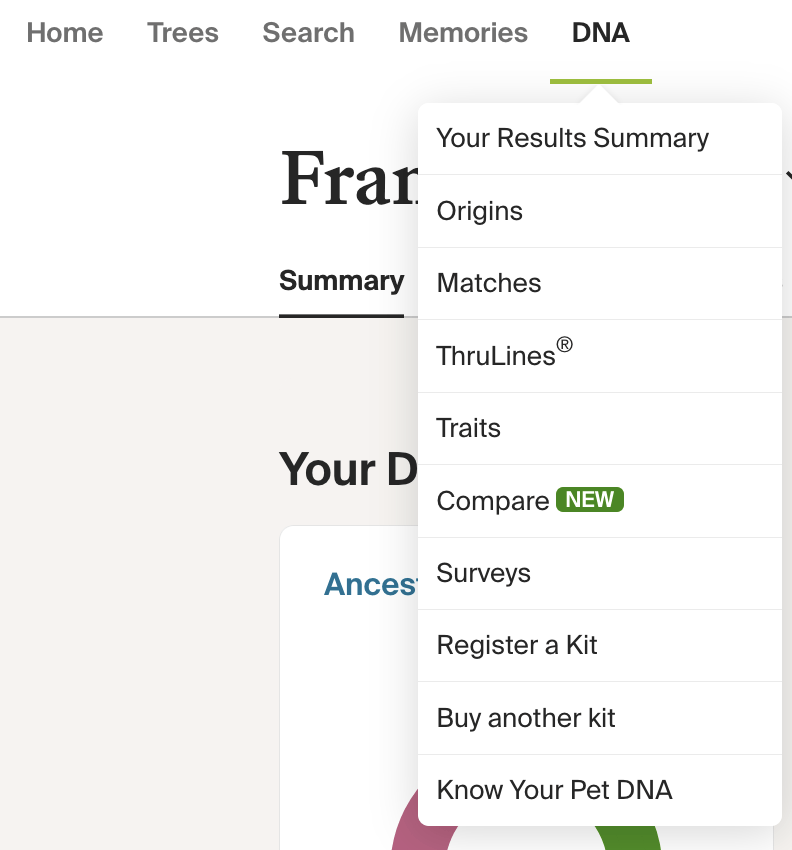
💡 Pro Tip: Ethnicity estimates update over time, so check back occasionally for new insights. This is a big deal and I actually screen shot each update, and believe it or not I have updates going back about 10 years! As technology advances, so should the accuracy of your estimates so keep track of them.
🧭 Step 2: Dive Into Your DNA Matches
Here’s where the real adventure begins when thinking about what to do after getting AncestryDNA results! Ancestry’s DNA match list shows users who share genetic material with you. These could be unknown cousins—or even missing links to a family mystery.
Once you are in the MATCHES section, you can search and explore by a bunch of categories which is really fun! There is a lot to explore here. The main menu header lets you cluster your results by ALL MATCHES, BY PARENT, BY ANCESTOR, BY CLUSTER, and BY LOCATION. Sweet! (See screenshot below)
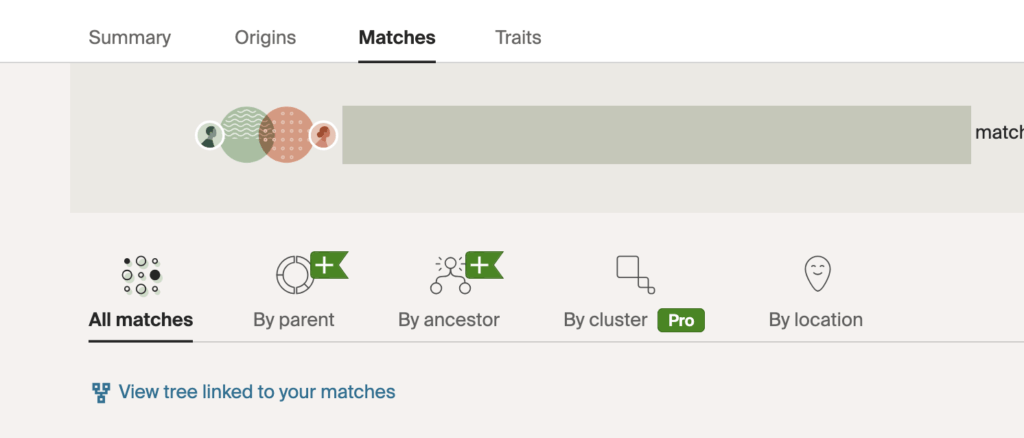
There are also a few more goodies within each search function, including the following sorting options! HINT: It can be kind of ‘labyrinthy’ so the only way you’ll get to know how to fish through your results is to actually just get in there and make sense of it as you go.
Sort by:
- Close relatives (1st–2nd cousins) are your best bets for identifying shared ancestors.
- Shared Matches help confirm which side of your family a DNA match belongs to.
- “Notes” allow you to track clues as you research each match.
🧬 How to Use AncestryDNA Matches:
- Click on a match → View their tree (if public)
- Look for shared surnames or locations
- Use shared matches to create clusters of relatives
🧠 Honestly, when it comes to what to do after getting AncestryDNA results, you basically just have to explore and have fun with this! Follow the menus and learn more about how to interpret your results.
🎥 Want a visual breakdown of family history topics? Watch our videos on YouTube!
🗺️ Step 3: Use Maps, Communities & Birth Locations
Your AncestryDNA dashboard includes powerful geographical tools:
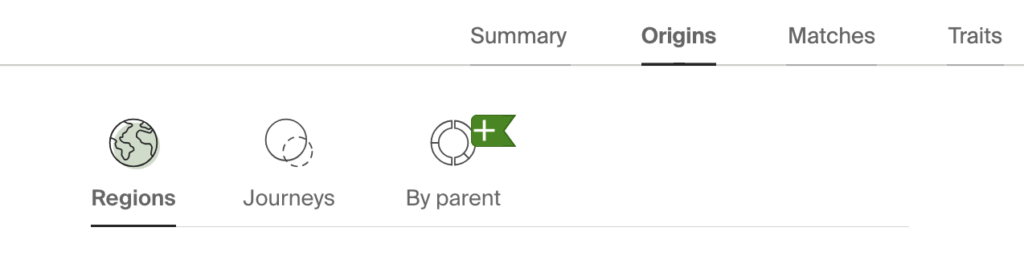
- Ethnicity Map: Shows regions tied to your genetic ancestry (REGIONS)
- Communities: Tracks migration paths of groups you descend from (JOURNEYS)
- Birth Locations: Found in trees of your DNA matches
🌍 EVERY DAY Ancestry is adding new features so stay on the lookout for ever-evolving options! It really is fun knowing what to do after getting AncestryDNA results is going to be a family history adventure that lasts a lifetime!
Try comparing your DNA communities to those of your matches. Overlapping communities often point to a shared ancestor in that region.
🌟 Related reading: Free Genealogy Research: Ultimate Top 20 Websites
🧩 Step 4 (Optional): Segment Mapping & Chromosome Tools
AncestryDNA only recently started to offer a chromosome browser, however you can still export your raw DNA and use tools from FTDNA or MyHeritage. You can use Ancestry’s consistent upgrades to track specific DNA markers and use the COMPARE tool to actually see how you measure up against other matches – mostly in terms of ethnicity overlap.
These allow you to map shared DNA segments and confirm relationships.
⚠️ Advanced users only! Use caution and verify with multiple sources. I say that because while exploring DNA matches can be fruitful, it can get overwhelming! You may notice only a few close matches, but you will undoubtedly get thousands of 3rd and beyond cousins and more!
This guide on what to do after getting AncestryDNA results, is really just the tip of the iceberg. The next phase is your learning experience which begins by starting your Ancestry tree!
🌳 Part 2: Build Your Tree on Ancestry
Now that you’ve explored your matches, let’s build your family tree and start connecting the dots. Again, using AncestryDNA is great and should be used to supplement actual, methodical genealogical work and research.
You’ll not hear me tout the “easy way” to genealogy research on this site! Tut tut! I say that to protect you because erroneous research leads to false assumptions and systemic misinformation. OK, you’ve been properly advised 😊 😁.
Now read on . . . what to do after getting AncestryDNA results! Don’t worry, I have plenty of research methodology suggestions in this next section 🎁 📚.
🌿 Step 5: Create Your Ancestry Tree (Free!)
Go to the Trees tab → Create & Manage Trees → “Start a New Tree”
Start with you, then your parents, grandparents, etc. Use approximate dates and places if needed.
📘 Related internal link: Genealogy Research Online: The 1 Ultimate User-Friendly Beginners Guide
📍 Supporting Thought: which branch of the family do I use to start an Ancestry tree?
🔗 Step 6: Link DNA Matches to Tree Profiles
When you recognize a match’s name or tree line:
- Click “Add to Tree” or “Link to Person”
- Assign them to the correct person in your tree
- Add notes, tag them, and track possible connections
This helps Ancestry refine your Thrulines and give more accurate hints.
🧠 Supporting Thought: use DNA matches in your Ancestry tree as corroboration to actual records research.
🧭 Step 7: Use Hints & Records to Expand Your Tree
As you build, Ancestry will provide green leaf hints. These may include:
- Census records
- Birth and marriage certificates
- Immigration and naturalization forms
Click “Review” → Confirm or reject → Add details to your ancestor’s profile.
You will need some sort of Ancestry subscription by this point. There are multiple options, you can explore them in my article Why Ancestry.com Is the Number 1 Genealogy Website for Boldly Building Your Forever Family Tree. Read this article to explore what they have to offer, or just head on over to Ancestry.com and check out what is currently available. I also have an offer below you can use!
🏆 🎉 🌎 AncestryDNA® + World Explorer 3-month membership ☕️ 📚 😍
💡 Always cross-reference with more than one source. Hints are just that—hints, not facts.
📖 Supporting Thought: read all of my Ancestry tree builder tutorials and general best practices for research right here on the Family History Foundation!!! There’s no better starting point for “what to do after getting AncestryDNA results.”
🎉 QUIZ TIME! What Kind of DNA Detective Are You?
Take this quick 3-question quiz to discover your genealogy style:
- When you get your DNA results, what do you look at first?
- A) Ethnicity estimate 🌍
- B) DNA matches 👥
- C) Tree building tools 🌳
- Your ideal family history Saturday looks like:
- A) Reading historical newspapers 🗞️
- B) Exploring maps & locations 📍
- C) Interviewing relatives 🗣️
- You find a new 2nd cousin match. You:
- A) Email them with excitement 📧
- B) Compare shared matches 📊
- C) Add them to your cluster list 🧩
Mostly A’s: The Explorer — Driven by curiosity Mostly B’s: The Analyst — Loves patterns and proof Mostly C’s: The Archivist — Lives for documentation
Post your result in the comments below! ⬇️
📜 Step 8: Avoid False Hints & Dead Ends
As tempting as it is to accept every hint, keep a skeptical mindset:
- Is the timeline realistic?
- Are names, locations, and dates consistent?
- Does this ancestor appear in multiple records?
If unsure, create an unlinked tree or a research branch. Revisit once you gather more evidence. I have my main branch that I use in collaboration with other serious family researchers, I also have a separate tree just for DNA results with a limited number of people in that tree. It comes down to how much you want to share.
📘 Related reading: 15 Genealogy Research Habits That Save Time
📎 BONUS: Use DNA to Break Brick Walls
One of the most powerful uses of DNA is solving long-standing family mysteries:
- Unknown parentage or adoptions
- Missing maiden names
- Identifying biological grandparents
Match triangulation and clustering strategies can reveal surprising results.
🧱 Read next: How to Overcome Genealogy Brick Walls
📌 Social Media & Resources
Follow along for tutorials, updates, and inspiration:
- Pinterest: Family History Foundation
- YouTube: @FamilyHistoryFoundation
- Instagram: @family_history_foundation
📺 🌳 ➡️ You can also Watch This Video on YouTube! 🌎 🎓 📚
💬 Your Challenge This Week
Pick one DNA match from your Ancestry list and try to:
- Identify your most recent common ancestor
- Link them to a person in your tree
- Leave a note about what you discovered!
Then share your story in the comments and subscribe for more family history goodness. 🧡
🦁 About the Author ✍️
Hi, I’m the founder of Family History Foundation—a one-person blog built from love, legacy, and late-night research sessions. With a passion for helping others uncover their roots, I write emotionally-driven, practical guides for today’s family historians.
From organizing DNA matches to exploring immigrant ancestors, I believe everyone deserves to know where they come from—and how their story fits into something bigger.
Let’s connect generations, one record at a time. ❤️