
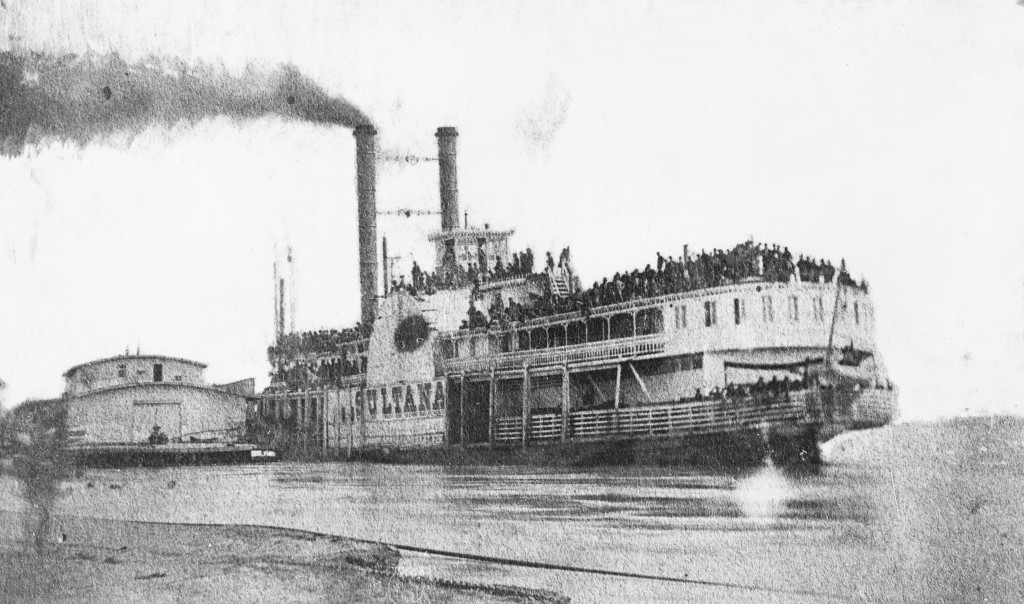
This is the story of Joseph Henry Collins (1817-1865) and his eldest son James Robert Collins (1844-1919). The bio of Joseph Henry Collins below was written by The Family History Foundation and is reproduced, in its entirety with permission, on the following Find A Grave memorial. It is also the story of the Steamer Sultana, the worst maritime disaster in U.S. History which occurred on 27 Apr 1865 – it was greater than even the Titanic!
“Joseph Henry Collins’ origins are as enigmatic as his death was heroic.
The Legacy of the Steamer Sultana
Joseph Henry Collins was born around 1817 in North Carolina, exact county unknown. His parents, at least according to this researcher’s standards, are unable to be documented at this time. On 5 December 1843 in Haywood County, NC, Joseph Henry married Sarah Sherrill and over the next 19 years they would have 11 children together, the eldest of whom, James Robert Collins, survived his father in the Sultana disaster.
By 1850 Joseph Henry Collins and his family moved west to Cherokee County, NC, which sits adjacent to the eastern border of Tennessee and by 1860, a year before the Civil War began, they were living in Bradley County, Tennessee. Some of the children of Joseph Henry Collins and Sarah Sherrill stayed in Tennessee, others moved and resettled in surrounding states; for example, middle son Benjamin Franklin Collins (my ancestor) moved just north to adjoining Meigs County, Tennessee and then on to Texas.
On 29 July 1863, at the age of 45, Joseph Henry Collins enlisted with the Tennessee Third Regiment Cavalry, Company G. According to military records, he was captured in action on 25 September 1864 and subsequently placed in the infamous Cahaba Prison in Alabama where he remained for approximately six months until 18 March 1865. It is at this point that Joseph Henry Collins’ story connects with that of the steamer Sultana, the worst maritime disaster in U.S. history.
The names JH Collins and JR Collins both appear on the Sultana Memorial located in Knoxville, Tennessee. “JH Collins” being Joseph Henry Collins and “JR Collins” being his eldest son James Robert Collins who survived his father in this tragic disaster. Books, websites, and memorials surrounding this event have been created in an effort to render comprehensible events and decisions that in hindsight seem nearly incomprehensible, if not reprehensible.
I have found that the words most apt to describe the egregious events of the Sultana disaster and the death of Joseph Henry Collins to be none other than the words of his son James Robert Collins who wrote an article that appeared in the *Plainville Times [Kansas] on 28 May 1908 detailing his first-hand account of the war inclusive of the Sultana disaster entitled “Civil War Reminiscence.” This posthumous account of the last hours of Joseph Henry Collins is an appropriate epitaph for his courageous and heroic life. A copy of this article appears on the memorial page of James Robert Collins: http://www.findagrave.com/cgi-bin/fg.cgi?page=gr&GRid=39704555.
I have read, and recommend, the following books on the subject of the Sultana disaster, from which some facts might help to elucidate the scale of this tragedy.
Author Alan Huffman states:
“The Sultana was licensed to carry three hundred seventy-six passengers and already had about one hundred eighty private passengers and crew on board, all of whom no doubt watched in dismay as more than two thousand additional passengers – the paroled prisoners, their Union Army guards, a few Rebel soldiers headed home, and members of the US Sanitary Commission – snaked from the gangplank along the waterfront” – (Huffman 2010: 176)
“The Sultana was licensed to carry three hundred seventy-six passengers and already had about one hundred eighty private passengers and crew on board, all of whom no doubt watched in dismay as more than two thousand additional passengers – the paroled prisoners, their Union Army guards, a few Rebel soldiers headed home, and members of the US Sanitary Commission – snaked from the gangplank along the waterfront” – (Huffman 2010: 176)
Author Jerry Potter highlights the fact that the Sultana tragedy was quantitatively worse than the legendary Titanic:
“The boat involved in this prior disaster [27 years before the Titanic] was a 260-foot wooden-hulled steamboat, small in comparison to the gigantic Titanic. At 2:00 A.M. on April 27, 1865, the steamer Sultana exploded on the Mississippi River near Memphis, Tennessee. The incredible fact of this disaster is that at the time of the explosion, the Sultana carried more passengers than were aboard the Titanic. The Titanic had 2,227 passengers; the Sultana, over 2,400. This number was more than six times the Sultana’s legal carrying capacity of 376. As a result, more lives were lost on the Sultana than were lost on the Titanic. The number of deaths on the Titanic totaled 1,522 as compared to approximately 1,800 on the Sultana. The Sultana disaster still stands as the worst marine tragedy in American history and one of the worst in world history” – (Potter 1992: ix-x)
“The boat involved in this prior disaster [27 years before the Titanic] was a 260-foot wooden-hulled steamboat, small in comparison to the gigantic Titanic. At 2:00 A.M. on April 27, 1865, the steamer Sultana exploded on the Mississippi River near Memphis, Tennessee. The incredible fact of this disaster is that at the time of the explosion, the Sultana carried more passengers than were aboard the Titanic. The Titanic had 2,227 passengers; the Sultana, over 2,400. This number was more than six times the Sultana’s legal carrying capacity of 376. As a result, more lives were lost on the Sultana than were lost on the Titanic. The number of deaths on the Titanic totaled 1,522 as compared to approximately 1,800 on the Sultana. The Sultana disaster still stands as the worst marine tragedy in American history and one of the worst in world history” – (Potter 1992: ix-x)
Sources:
Potter, Jerry O. 1992. The Sultana Tragedy: America’s Greatest Maritime Disaster. Gretna: Pelican Publishing.
Huffman, Alan. 2010. Sultana: Surviving the Civil War, Prison, and the Worst Maritime Disaster in American History. New York: Harper Collins.
I’ve also compiled a list of EVERY Sultana Disaster book EVER Written, right here on the Family History Foundation.
*Read the FULL article written by James Robert Collins entitled “Civil War Reminiscence” which is his first-hand account of the Civil War and the sinking of the Steamer Sultana (published in the Plainville Times, Kansas, on 28 May, 1908).
Join The Family History Foundation Community 🏡
You have the map of Virginia Colony history. Now come get the case studies, the challenges, and the occasional research rabbit hole worth falling into.
🎥 Subscribe on YouTube — every Friday, a video companion to the week’s article. Colonial records, walked through on screen.
📌 Follow on Pinterest — research charts, printable forms, and visual guides for your next session.
📬 Subscribe to the Newsletter — tips, challenges, and deep-dive case studies, with more Virginia Colony history to come as this series expands.
Let’s make Family History a household word. 🏠

The Family History Foundation Newsletter
Our Family History Is Disappearing Every Day!
Join the quest with 500+ family historians getting Franklin’s Source Hound weekly research breakthroughs — real case studies, source hacks, and the exact strategies that turn brick walls into discoveries.
Free. No fluff. Straight from the Source Hound’s desk to yours.
Your privacy is sacred — almost as sacred as a primary source. Read our Privacy Policy.
Shop Premium Genealogy Forms



About the Author
Hi there, my name is Franklin, the founder and author of The Family History Foundation.
Our family stories are disappearing every day and it’s crucially important that the next generation is able to learn and appreciate their family history. It is up to you to take up the mantle of responsibility to ensure that how you research today will be passed on tomorrow with the highest standards possible.
I believe that genealogy is not just about names and dates, it’s about your stories and how those stories inform your identity.
With a penchant for storytelling and a background in research, the insights and techniques you learn on The Family History Foundation will help you uncover the incredible stories and identities hidden within the tapestry of your ancestry.
My mission is “Let’s make Family History a household word.”
My motto is “The Past ‘Relative’ to the Future.”



Visitor Rating: 5 Stars
Visitor Rating: 5 Stars