Virginia Colony history forms the foundational narrative of English colonization in North America, spanning nearly 170 years from the founding of Jamestown in 1607 to the signing of the Declaration of Independence in 1776. Established as a joint-stock business venture by the Virginia Company of London, the colony evolved through catastrophic drought, conflicts with the Powhatan paramount chiefdom, the rapid boom of a tobacco-based economy, and the legal codification of various labor systems.
Understanding Virginia’s colonial development requires examining both the macro-level political shifts—from corporate charter to Crown Colony and eventually an independent Commonwealth—and the micro-level documentary footprint preserved in land patents, court records, and tax rolls. This comprehensive guide explores the complete historical timeline of the Virginia Colony while providing actionable archival strategies for researching colonial ancestors.
Executive Summary (TL;DR)
- Scope and Timeline: Covers the complete history of the Virginia Colony from its initial chartering in 1606 and the May 1607 founding of Jamestown through its political transition to an independent Commonwealth in 1776.
- Economic and Social Shifts: Details Virginia’s transformation from a corporate joint-stock venture into an agrarian tobacco economy powered initially by indentured servitude and later formalized into a slave economy via the 1705 Slave Codes.
- Governance Milestones: Highlights major political shifts, including the 1619 creation of the House of Burgesses, the transition to a Royal Crown Colony in 1624, the 1676 uprising of Bacon’s Rebellion, and the capital relocation to Williamsburg in 1699.
- Genealogical Methodology: Provides practical archival strategies for navigating “burned counties,” leveraging the 1624/25 Muster, abstracting central headright land patents, and accessing substitute records at the Library of Virginia.
Table of Contents
At a Glance: Virginia Colony Key Milestones
The Colony of Virginia was England’s first permanent settlement in North America, spanning from its initial chartering in 1606 and the founding of Jamestown in 1607 through its transition into an independent Commonwealth in 1776. Over nearly 170 years, Virginia evolved from a corporate joint-stock venture into an agrarian colony driven by tobacco production, representative assembly, and racialized labor systems.
| Era or Date | Key Historical Event | Primary Significance |
| 1584–1590 | Roanoke Colony Voyages | Early private ventures under Sir Walter Raleigh highlighting colonial supply vulnerabilities. |
| May 1607 | Founding of Jamestown | Establishment of the first permanent English settlement in North America. |
| 1612–1614 | Cultivation of Nicotiana tabacum | John Rolfe introduces Caribbean tobacco, establishing Virginia’s primary export crop. |
| July–August 1619 | Burgesses and First Africans | General Assembly convenes; arrival of the White Lion carrying captive Africans. |
| 1624 | Transition to Royal Crown Colony | King James I revokes the Virginia Company charter following military and financial strain. |
| 1676 | Bacon’s Rebellion | Armed uprising against royal authority that accelerates changes in class and labor laws. |
| 1699 | Capital Relocation to Williamsburg | Administrative hub moves inland from Jamestown following severe structural fires. |
| 1705 | Codification of Virginia Slave Codes | House of Burgesses formalizes legal statutes creating systemic slavery. |
| 1754–1763 | French and Indian War | Frontier conflicts shape military leadership and intensify colonial-British tax tensions. |
| 1776 | Fifth Virginia Convention and Independence | Colonial leadership sever ties with Great Britain, establishing the Commonwealth of Virginia. |
Part I: Commercial Origins and Early Survival (1584–1624)
Raleigh, Roanoke, Champlain, and the Business of Royal Charters
Early English expansion began with private patent ventures under Sir Walter Raleigh before transitioning to corporate funding under the Virginia Company of London. The failure of private wealth at Roanoke established the necessity of joint-stock financing and explicit legal charters for permanent colonial settlement.
English attempts to establish North American outposts began in 1584 when Queen Elizabeth I granted a patent to Sir Walter Raleigh. Raleigh named the territory “Virginia” in honor of the unmarried queen, launching reconnaissance voyages under Philip Amadas and Arthur Barlowe.
Sir Walter Raleigh was epically lampooned by Sir Edmund Blackadder, played by Rowan Atkinson, in the episode "Potato" -- one of my all time favourite Blackadder episodes. The Blackadder, having a go at Sir Walter, refers to him as "Sir Walter, 'ooh what a big ship I've got,' Raleigh." 😂
Raleigh was not working alone. Raleigh’s half-brother Sir Humphrey Gilbert claimed Newfoundland in 1583 and drowned sailing home. Although their adventures were not necessarily successful in seeding an economic foothold on the Americas, they were ultimately successful in validating that the adventure could eventually work. They brought back valuable intel, both human and cartographic.
All this was happening while Samuel de Champlain mapped the St. Lawrence for France and founded Quebec in 1608. Virginia Colony history is the English chapter of a much larger race. That land race also included the Spanish who were scouting down in the Caribbean, and the southeastern stretch of America from Florida to the Mississippi river.
If you want to read a great book on Samuel de Champlain, check out my David Hackett Fischer book list. I tell you what, “Champlain’s Dream” is one of my all time favourite books. For a Virginia book list, read on!
Settlers landed on Roanoke Island in 1585 and 1587, where Virginia Dare became the first English child born in North America. However, supply disruptions caused by war with Spain left Governor John White stranded in England. When he returned in 1590, the settlement was abandoned, leaving only the word “CROATOAN” carved into a post.
The failure of Roanoke proved that private fortunes could not sustain transatlantic colonies. On April 10, 1606, King James I chartered the Virginia Company, a joint-stock business whose shareholders expected financial returns from gold, trade, and exportable commodities.
| Charter | Key Provisions and Boundaries | Governance Structure |
| First Charter (1606) | Authorized land grants between 34° and 41° N latitude to London and Plymouth ventures. | Dual council system with primary administrative control remaining in London. |
| Second Charter (1609) | Expanded land claims “from sea to sea” and authorized public stock sales. | Installed a single Royal Governor exercising martial law authority on-site. |
| Third Charter (1612) | Extended oceanic boundaries to include Bermuda and authorized national lotteries. | Expanded corporate governance powers for the Virginia Company shareholders. |
Roanoke and Virginia Dare: The Drake Connection 🌑
Then came the failure everyone remembers, yet we still don’t fully understand. Settlers landed at Roanoke Island in 1585 and again in 1587. This is the same time period in which Raleigh, Gilbert, and Sir Francis Drake were mucking about the Atlantic looking for privateering opportunities.
Actually, Sir Francis Drake was the first Englishman to circumnavigate the world between 1577-1580. Another interesting fact is that Drake and Raleigh were also related, although distantly. All about the connections, innit!
But it gets juicier than this as both Sir Walter Raleigh and Sir Francis Drake were involved in the Roanoke settlement. The planning and vision sold to Queen Elizabeth I was all Raleigh. When the first colony in 1586 was abandoned due to food shortage and bad settlement conditions, it was Sir Francis Drake who rescued them!
He was raiding Spanish fleets in the Caribbean when he popped over to Roanoke for a ‘cuppa and found the whole colony in such a dire state, he loaded them all up and sailed back to England.
Then came the 2nd Roanoke Colony attempt in 1787! On 18 August 1587 a child named Virginia Dare was born on Roanoke — the first English child born in the Americas.
Her grandfather, Governor John White, sailed for supplies. War with Spain kept him away three years. He returned in 1590 to an empty site, dismantled rather than destroyed, one word carved into a post: CROATOAN.
No graves. No answer, then or since. But it taught the crown a lesson that shaped all of Virginia Colony history afterward: a venture funded by one nobleman’s fortune could not survive a supply gap. 📜
Actually, the fault of the first Roanoke should be squarely shouldered on a man named Simon Fernandez! He was the captain of the ship which transported the 2nd wave of colonists, not to their intended destination in the Chesapeake, but to Roanoke. He will live in infamy as the captain who, out of self interest, refused to take 118 Englishmen and women to their destination and forced them out in the Outer Banks.
As Edmund Blackadder once famously said: “you utter creep!”
Tsenacommacah and the Encounter at Jamestown
When English settlers established Jamestown in May 1607, they settled inside Tsenacommacah, a paramount chiefdom of 15,000 Algonquian-speaking Native Americans under Wahunsenacawh (Powhatan). Survival depended on indigenous trade and John Smith’s leadership during catastrophic drought and winter starvation.
Three ships—the Susan Constant, Godspeed, and Discovery—landed at Cape Henry on April 26, 1607, carrying approximately 104 men and boys. On May 14, 1607, expedition commander Christopher Newport selected a marshy peninsula on the James River for its defensible anchorage. The site suffered from brackish water and severe disease, leading to heavy mortality during the first year.
Leadership stabilized under Captain John Smith, who instituted strict labor discipline and negotiated food purchases with Tsenacommacah. Relations deteriorated following Smith’s injury and departure in 1609, culminating in the “Starving Time” winter of 1609–1610, which reduced the population from roughly 500 to 60 survivors. The colony was on the verge of total abandonment when Lord De La Warr’s relief fleet arrived in June 1610.
The Colony as a Business Deal 💰
Here is the part of Virginia Colony history that schoolbooks conflate. Jamestown was not founded by people seeking religious freedom. It was founded by a joint-stock company seeking a return on investment.
In April 1606, James I chartered the Virginia Company of London. Shareholders bought in; the settlers were the shareholders. The instructions were explicit: find gold, find a passage to the Pacific, find the Roanoke survivors, turn a profit.
Truth be told, the instructions weren’t all that specific because no one knew who was going to be the leader of the colony until they got there. Yes, that’s right. The instructions were sealed by the king with the command to open it upon arrival.
Well, of course the elite were put in charge. It’s a decision everyone would soon regret as they did no know how to plant, build, and negotiate with the Native Americans.
I say that with mixed family history perspective as I am related to 2 of the founders of the Virginia Colony, Sir Edward Mariah Wingfield and Bartholomew Gosnold’s brother Anthony Gosnold.
Two later charters reshaped it. The Charter of 1609 installed a governor and extended Virginia’s claim from sea to sea, fueling land disputes for two centuries. The Charter of 1612 added Bermuda and authorized a national lottery, because no gold had materialized and the company needed cash. Those three documents are the legal spine of Virginia Colony history. 🎟️
That commercial spine is the most useful correction most readers can make to their picture of Virginia Colony history. Your ancestor did not sail for liberty. He sailed because someone was paying, or because someone owned his labor for seven years.
Wingfield, Gosnold, and Three Small Ships ⛵
Bartholomew Gosnold had crossed the Atlantic in 1602, naming Cape Cod and Martha’s Vineyard on the way; contemporaries called him the prime mover behind the project. Edward Maria[h] Wingfield — a shareholder whose middle name honored a royal godmother — recruited investors and became first council president.
The very plans for the Virginia Colony were drawn up over successive meetings on the Gosnold estate at Otley Hall in Ipswich, England. My distant relatives planned this, how cool is that?
The two were kin as well as partners, linked through the Golding family. That overlap of blood and business runs right through Virginia Colony history: early Virginia was built by cousins.
Both Edward Wingfield and Bartholomew Gosnold‘s names are listed in the original Jamestown church plaque.
Three ships sailed on 20 December 1606 — the vessels every account of Virginia Colony history begins with:
- 🚢 Susan Constant — Captain Christopher Newport, expedition commander
- 🚢 Godspeed — Captain Bartholomew Gosnold
- 🚢 Discovery — Captain John Ratcliffe
They carried roughly 104 men and boys. Not one woman. That decision shaped the first years of Virginia Colony history more than any other: no families, no domestic economy, no reason to treat the place as permanent. It was a work camp with a fort around it.
Before you ever opened a record, what place did your family say they came from? Not what you have proven — what you were told.
Cape Henry, Jamestown Island, and John Smith 🏰
They landed at Cape Henry on 26 April 1607 and spent two weeks hunting a defensible site. In mid-May they chose a marshy peninsula in the James River — deep water close to shore, safe from Spanish ships, catastrophically unhealthy. Brackish water, relentless mosquitoes, and roughly half the party dead within a year.
Then a sealed box was opened naming the council London had chosen. Among them was a twenty-seven-year-old soldier of fortune, John Smith, who had spent the voyage under arrest.
Smith is the most argued-over figure in Virginia Colony history, and both the hero version and the debunked version miss the point. He was a self-promoter whose accounts grew with each retelling — and the one man who traded successfully with the Powhatan, mapped the Chesapeake accurately, and imposed the rule that kept the fort alive: he that will not work shall not eat. 🗡️
Want more on Captain John Smith? He left a journal full of notes and all kinds of goodies you can read about and it has all been handily updated for modern English by one of the most esteemed, yet unknown historians, James Horn.
Check out my post on 5 Books To Read By Author James Horn, you will find John Smith’s journal in there. I purchased my copy while I was at Jamestown.
To see where Virginia Colony history actually happened, our 30 pictures from a visit to Jamestown, Virginia walks the site as it stands today — fort line, church tower, and the river that decided everything.
The Powhatan World 🪶
No account of Virginia Colony history works without this: the English did not arrive in an empty country. They arrived inside Tsenacommacah, a paramount chiefdom of roughly thirty Algonquian-speaking communities under Wahunsenacawh, whom the colonists called Powhatan — fourteen to twenty-one thousand people.
The fort held about a hundred men. For several years the settlement survived on Powhatan corn, and everyone knew it.
His daughter Amonute, called Pocahontas, persists over four centuries of romance. The documented facts are harder: captured and ransomed in 1613, converted, married to the planter John Rolfe in 1614, sent to England as a living advertisement for the colony, dead at Gravesend in 1617, aged around twenty-one. 🕯️
The Winter That Nearly Ended It ❄️
The winter of 1609–10 is the hinge of the whole story. Smith had been burned by gunpowder and shipped home, the supply fleet had scattered in a hurricane with its flagship wrecked on Bermuda, and relations with the Powhatan had collapsed into siege.
Of roughly five hundred people at Jamestown that autumn, about sixty were alive by spring. The archaeology of the fort is unambiguous about how some of them lasted.
In June 1610 the survivors abandoned the site and sailed downriver — and met Lord De La Warr’s relief fleet coming up. It is the closest call in all of Virginia Colony history. They turned around. Virginia Colony history came within one tide of ending in 1610, and every American line tracing to the seventeenth-century Chesapeake exists because of that timing.
Tobacco Changes Everything 🌿
In 1612 John Rolfe planted seed from a sweeter Caribbean variety, Nicotiana tabacum, in Virginia soil. The first shipment reached London in 1614 and sold. Within a decade the colony was exporting hundreds of thousands of pounds a year.
Tobacco solved the company’s problem and created every later one. It exhausted soil, pushing settlement inland onto Powhatan land. It was labor-hungry, creating an appetite for workers that shaped two centuries.
It was tobacco that was its saving grace! Called the “jovial weed,” the “bewitching vegetable,” the “chopping herb of hell” (Dabney 1971: 24) among other monikers, tobacco is what gave Virginia its economic foothold in the new world.
Although very lucrative, tobacco is a very resource-extractive and damaging to the soil. It needs to be planted and then fallowed, not very efficient. The amount of land which tobacco demands led to larger and larger resource requirements for the colony to thrive economically
What made the Virginia Colony thrive is that tobacco grew best on scattered riverfront plantations rather than in towns. You didn’t need to pack and ship all of the tobacco harvest to a city, you simply sent it off down river which enhanced production efficiency dramatically — which is precisely why no crop marked Virginia Colony history more deeply. 📦
1619: The Massive Economic Shift 📅
Three things happened within months of each other in 1619, and each still echoes today. 1619 marks a pivotal year in Virginia’s history, but not in the way you might think.
July 1619 — the first General Assembly met in the Jamestown church. Twenty-two burgesses, elected by the settlements: the oldest continuous representative legislature in the Americas.
August 1619 — the privateer White Lion landed at Point Comfort and traded approximately twenty captive Africans sold by other Africans and merchant traders. They were taken from a Portuguese slave ship, for provisions. This was not the beginning of the transatlantic slave trade in the Americas, yet this trade would continue to reshape American history.
1619–21 — the company recruited and shipped some ninety young Englishwomen as prospective wives, their passage recoverable in tobacco. Although the colony did have families from around 1608, they were not sustainable in numbers.
After 1619, thirteen years in, Virginia finally had a sustainable stock of families – this is the most pivotal event in 1619, for without this, the colony would never have survived. 👨👩👧
Indenture and the Headright System 📄
Most people who came to seventeenth-century Virginia did not pay their own way. They contracted four to seven years of labor for passage, and many died before earning their freedom dues. However, this system offered opportunities for English overpopulation as well as labor opportunities for the large investment landowners in Virginia.
The funding mechanism matters more than anything else in early Virginia records. Under the headright system, anyone who paid to transport a person could claim fifty acres per head, then filed a patent — and the patent named everyone whose passage was claimed.
Read that twice, because it is the whole game. Virginia Colony history left you a land record that doubles as a passenger list. 🗝️
Read the story of my 8x great-grandfather who arrived in the Virginia Colony in 1651!
Part II: Royal Control, Rebellion, and Social Evolution (1624–1705)
The Massacre, the Crown, and the Cavaliers ⚔️
On 22 March 1622, Opechancanough — Wahunsenacawh’s successor — attacked across the settlements. Roughly 347 colonists died in a morning, about a quarter of the English population. The Virginia Company never recovered, and in 1624 the crown dissolved it. Virginia became a royal colony.
It was at this point that all trust between the Virginia Colonists and the surrounding Native American tribes dissolves. No more trust, no more munitions after this brutal and senseless slaughter.
Which king sat in London mattered enormously to who came next, so this table is worth keeping beside any reading you do in Virginia Colony history:
| Monarch | Reign | What it meant for Virginia |
|---|---|---|
| Elizabeth I | 1558–1603 | Raleigh’s patents; the colony gets its name |
| James I | 1603–1625 | Charters of 1606, 1609, 1612; royal colony 1624 |
| Charles I | 1625–1649 | Civil War; defeated Royalists need somewhere to go |
| Charles II | 1660–1685 | Restoration; Virginia dubbed the “Old Dominion” |
When Charles I lost the Civil War, his head Governor William Berkeley recruited defeated Royalists — who became known as Cavaliers. Younger sons of gentry families arrived through the 1640s and 1650s with money, connections, and no inheritance at home. They took river land and became the planter elite whose surnames still dominate Virginia genealogy.
I cover this period in my historical biography of my 8th great-grandfather James Toone of Virginia in the section on Cavaliers and the English Civil War. It’s just extensive enough to immerse you into the politics of this time period as a backdrop to your family history.
Loyalty to the exiled Stuarts is why Charles II supposedly called Virginia the Old Dominion. Our photo essay on historic Dameron Marsh in Virginia shows the Northern Neck country where many of those families settled. 🏞️
During the English Civil War (1642–1651), Royal Governor Sir William Berkeley maintained allegiance to King Charles I. Defeated royalists—known as “Cavaliers”—migrated to Virginia in significant numbers. Younger sons of English gentry acquired extensive tracts in the Northern Neck and Tidewater regions, establishing prominent families that dominated colonial politics and land ownership.
Bacon’s Rebellion (1676) and Social Realignment
Bacon’s Rebellion in 1676 was an armed uprising of frontier settlers, indentured servants, and enslaved laborers against Governor William Berkeley over frontier defense and political power. The rebellion burned Jamestown and accelerated elite efforts to legally divide poor whites from Black laborers.
Tensions erupted in 1675 between frontier settlers and Native American tribes along the western border. Smallholders and former indentured servants accused Governor Berkeley of favoring the Tidewater elite and failing to provide military defense. Led by Nathaniel Bacon, a rebel coalition burned Jamestown in September 1676 and forced Berkeley to flee.
Bacon died of dysentery shortly thereafter, allowing Berkeley to suppress the remaining forces and execute the ringleaders. However, the alliance between poor white laborers and enslaved Africans alarmed the ruling planter class. To prevent future rebellions, colonial authorities systematically reformed labor statutes to establish sharp racial distinctions.
The 1699 Capital Relocation and the 1705 Slave Codes
Recurring fires at Jamestown prompted the colonial government to move the capital inland to Williamsburg in 1699. Six years later, the House of Burgesses passed the 1705 Slave Codes, permanently defining enslaved Africans as property and establishing an economically-driven slave class.
Following severe statehouse fires at Jamestown, the General Assembly voted in 1699 to relocate the colonial capital to Middle Plantation, renamed Williamsburg. The new capital provided a healthier, elevated site for government operations, superior river access, and proximity to the College of William & Mary.
Part III: The 18th-Century Colony and the Road to 1776
Backcountry Expansion and Diverse Migration
During the 18th century, settlement expanded beyond the Tidewater into the Piedmont and Shenandoah Valley, introducing German, Scots-Irish, and dissenting religious populations. This geographic growth shifted Virginia from a unified Anglican coastal society to a diverse frontier territory.
As soil exhaustion reduced Tidewater yields, settlers moved west past the Fall Line into the Piedmont and through the Great Valley. Thousands of German and Scots-Irish immigrants migrated south from Pennsylvania along the Great Wagon Road, introducing Lutheran, Reformed, and Presbyterian faiths into a colony where Anglicanism remained the established state church. These frontier communities operated largely outside the plantation model, relying on small-scale farming and livestock raising.
The French and Indian War and Royal Tension (1754–1763)
Conflicting land claims in the Ohio River Valley plunged Virginia into the French and Indian War, training colonial military leaders like George Washington. Post-war British taxation and imperial regulations created growing political friction with the House of Burgesses.
Virginia planters formed land companies to claim territory along the Ohio River Valley, directly challenging French outposts. In 1754, colonial militia officers, including Major George Washington, were dispatched to assert British claims, triggering the French and Indian War.
The war ended in 1763, but Great Britain accumulated significant national debt. Subsequent parliamentary policies—such as restrictions on western settlement and new tax statutes—fueled fierce political resistance within the House of Burgesses, articulated by leaders such as Patrick Henry and Thomas Jefferson.
Independence and the Birth of the Commonwealth (1776)
Virginia severed colonial ties with Great Britain in 1776 through the Fifth Virginia Convention, adopting George Mason’s Declaration of Rights and establishing the Commonwealth of Virginia. Virginia leaders subsequently played a central role in drafting the U.S. Declaration of Independence.
By late 1775, armed conflict forced Royal Governor Lord Dunmore to flee Williamsburg. In May 1776, the Fifth Virginia Convention met and declared the colony’s governance independent of the British Crown.
The Convention adopted George Mason’s Virginia Declaration of Rights on June 12 and a state constitution on June 25, formally establishing the Commonwealth of Virginia. Concurrently, Virginia delegate Richard Henry Lee introduced the resolution for independence at the Continental Congress in Philadelphia, leading directly to Thomas Jefferson authoring the Declaration of Independence.
Part IV: Primary Sources and Archival Methodology
Key Colonial Census and Passenger Records
Colonial Virginia offers distinct early records, led by the 1624/25 Muster—America’s first detailed population census—and land patents generated under the headright system. These documents allow genealogists to identify early settlers, arrival ships, and property claims.
The most comprehensive record of early Virginia settlement is the Muster of the Inhabitants of Virginia, taken in January 1624/25 following the crown’s revocation of the Virginia Company charter. The muster records household members, exact ages, arrival ships, dates, provisions, and weapons holdings.
Researchers tracing early lines should also search for “Ancient Planter” status—settlers who arrived prior to 1616, remained for at least three years, and received 100-acre land grants under company rules. Because passenger manifests for 17th-century Virginia arrivals were rarely preserved, central land patents filed with the Governor’s Council serve as primary surrogate passenger lists.
Because of the headright system, seventeenth-century land patents name people with no other reason to appear in any record. A patent from 1650 might list thirty names — servants, wives, children — whose transportation the patentee claimed.
These are abstracted in Nell Marion Nugent’s Cavaliers and Pioneers, with originals at the Library of Virginia. Searching them by surname is the highest-yield move in colonial research, and the approach in genealogy research online applies directly: go to the index, then always go to the image.
Ancestry.com’s databases have all you need to search these early records. What you don’t find there, you may have to network and find Virginia historical societies.
One caution. A headright name proves someone paid that person’s passage — not kinship, and not always arrival that year, since claims were filed late or resold. Log it as a claim, not a conclusion. 📝
Navigating Burned Counties and Archival Substitutes
Widespread destruction during the Civil War and local courthouse fires destroyed county records across Virginia, requiring researchers to rely on centrally held state substitutes. Land patents, tax lists, vestry books, and chancery court records serve as primary alternatives.
Courthouse fires, military operations during the Civil War (most notably the burning of Richmond in April 1865), and humidity loss destroyed deeds, wills, and court order books across dozens of Virginia counties. Furthermore, statewide vital registration was not legally required until 1853 and lapsed between 1896 and 1912.
| Lost or Missing Record Type | Preferred Substitute Source | Archival Finding Aid or Repository |
| County Birth and Death Certificates | Parish Vestry Books and Register Records | Library of Virginia Church Records Collection. |
| Destroyed Deed and Conveyance Books | Land Office Patents and Grants (1623–1774) | Nell Marion Nugent’s Cavaliers and Pioneers; Library of Virginia Portal. |
| Destroyed Will and Probate Records | Chancery Court Causes and Loose Estate Papers | Virginia Memory: Chancery Records Index (Library of Virginia). |
| Missing Early County Tax Rolls | Personal Property and Land Tax Rolls (1782+) | Microfilm and Digital Holdings at the Library of Virginia. |
Verifying Lineage and the Cavalier Hypothesis
While royalist Cavalier immigration occurred during the mid-17th century, most colonial arrivals were indentured servants, making family traditions of noble descent hypotheses to be tested. Rigorous proof standards set by lineage societies provide reliable verification frameworks.
Nineteenth-century publications frequently exaggerated claims of noble Cavalier origins for colonial Virginia families. Professional genealogical research requires working backward generation by generation using primary legal records rather than relying on unverified printed family histories.
Two historical lineage organizations maintain strict documentary proof standards that serve as benchmarks for colonial Virginia research:
- The Jamestowne Society: Requires documented proof of direct descent from a qualifying ancestor who resided or held property in Virginia prior to 1700.
- Order of First Families of Virginia: Covers documented lineages extending back to ancestors residing in the colony between 1607 and 1624/25.
Three Colonies, Three Very Different Paper Trails 📚
Virginia Colony history is best understood beside its neighbors:
| Roanoke | Jamestown | Plymouth | |
|---|---|---|---|
| Founded | 1585 / 1587 | 1607 | 1620 |
| Backer | Raleigh, privately | Virginia Company (joint-stock) | Merchant Adventurers |
| Motive | Privateering base | Profit | Religious separation |
| First settlers | Men, then families | 104 men and boys | 102 men, women, children |
| Outcome | Vanished by 1590 | Survived; royal colony 1624 | Absorbed 1691 |
| Records surviving | Almost none | Muster lists, patents, county courts | Exceptional |
That last row is the one that matters to you. If your line runs through Plymouth, the records are unusually good — we cover that ground in our companion article on Plymouth Colony history. Virginia Colony history is richer and its paperwork harder, which is exactly why Part II exists. 🔍
Where Family Memory Fits 🎙️
Records tell you where people were, rarely why they moved — and colonial traditions often survive orally where documents did not. So before you disappear into the patents, talk to the oldest person in your family. Our guide to interviewing elderly relatives covers how, and the migration lore you collect will point you at the right county faster than a blind surname search.
Then organize it. A free family tree template and the research logs in our free genealogy forms keep an eight-generation Virginia line from becoming a pile of screenshots. 🗂️
The Family History Foundation Newsletter
It’s Not About You, It’s About Documenting Before It Disappears
Join 500+ family historians getting Franklin’s Source Hound weekly research breakthroughs — real case studies, source hacks, and the exact strategies that turn brick walls into discoveries.
Free. No fluff. Straight from the Source Hound’s desk to yours.
Your privacy is sacred — almost as sacred as a primary source. Read our Privacy Policy.
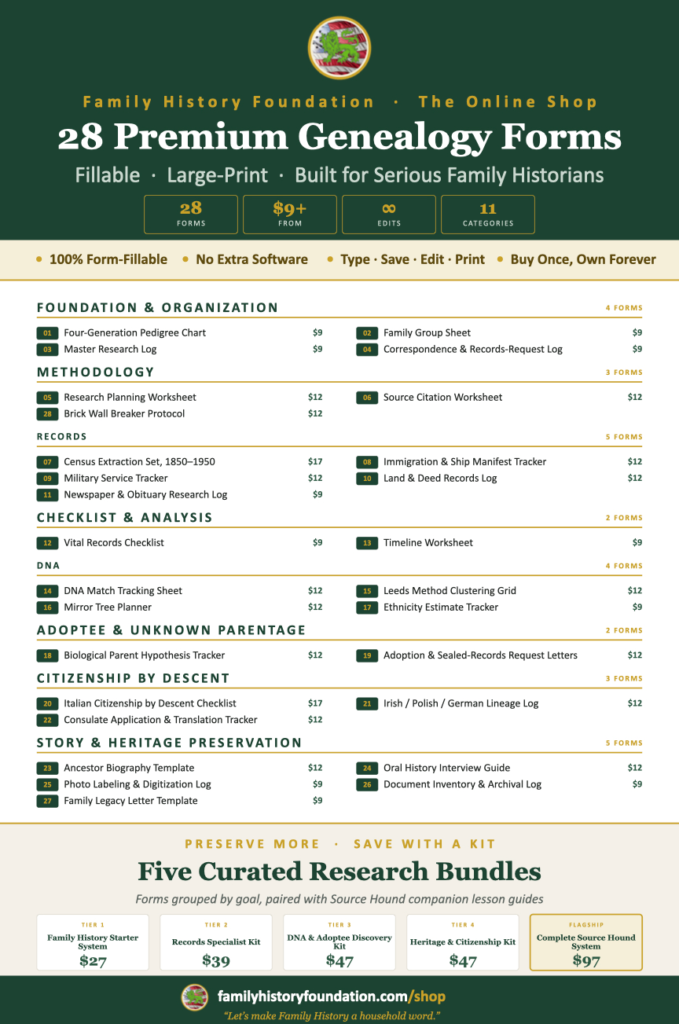
Working a line this deep means holding eight or nine generations in view at once, and a printed pedigree chart does that better than any screen. The Family History Foundation Online Shop carries form-fillable charts built for exactly this — fill, save, print, and mark off each generation as the documents come in. 🐾
Research Resources and Archival Portals
Start Where the Paper Is 🧭
If your line runs into Virginia and stops, you are not stuck — you are at the point where the method changes. Stop hunting a birth record that was never created and start reading land, tax, and court records sideways.
Pick one ancestor. Find the county. Learn whether its records burned — that one fact reshapes every Virginia Colony history search you will run. Then work the substitutes in order: patents, tax lists, vestry books, chancery. That sequence has broken more Virginia walls than any subscription database.
Once you find records, online or on paper, be prepared to become a handwriting expert. You will need to learn to read old archived records written in colonial script.
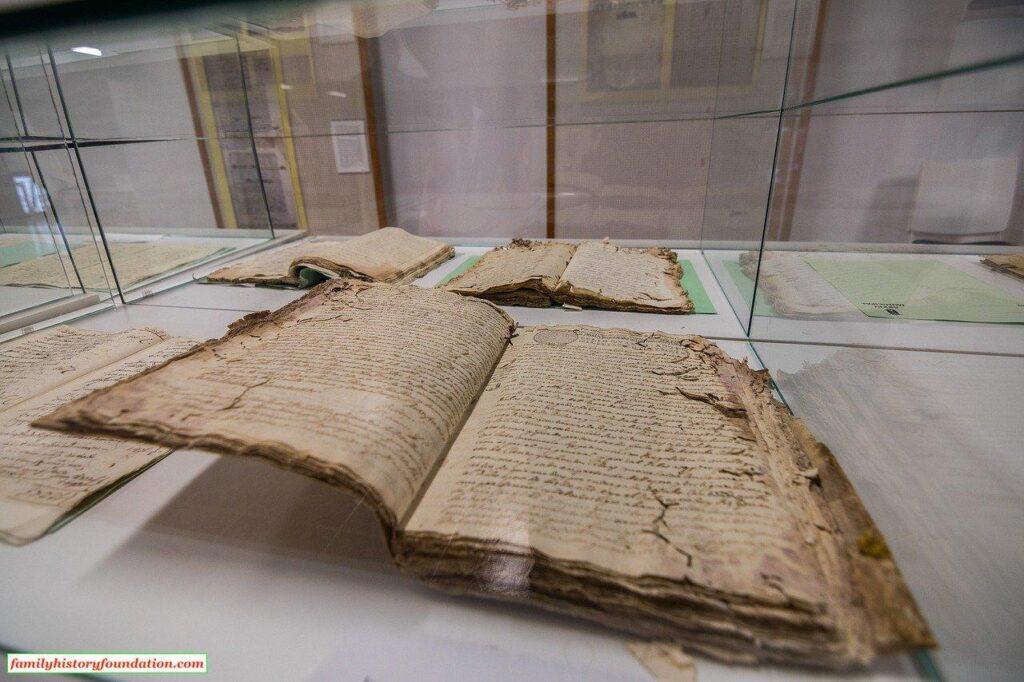
Four hundred years of Virginia Colony history are sitting in those files, and a surprising amount is free to read. 💚
Does your line run back to colonial Virginia — and which county has you stuck? Tell me in the comments. Somebody reading this has worked that courthouse and can help. 👇
Primary Archival Repositories
- Library of Virginia (LVA): Holds central Land Office Patents, Chancery Court indexes, personal property tax rolls, and county microfilm collections.
- Virginia Memory: Digital portal hosting digitized chancery causes, land grants, and colonial legislative documents.
- FamilySearch Wiki: Comprehensive county-by-county breakdowns detailing record loss dates and available parish substitutes.
Key Reference Works
- Nugent, Nell Marion. Cavaliers and Pioneers: Abstracts of Virginia Land Patents and Grants (1623–1732).
- Billings, Warren M. The Old Dominion in the Seventeenth Century: A Documentary History of Virginia, 1606–1700.
- The Family History Foundation. READING VIRGINIA: A List Of Recommended Books.
Keep Reading 📖
Virginia Colony history rewards depth, and there is far more of it than one article holds. For a reading list well beyond this summary, start with our recommended books on Virginia — and for a real line traced through these records, see my historical biography case study on James Toone of Virginia.
Join The Family History Foundation Community 🏡
You have the map of Virginia Colony history. Now come get the case studies, the challenges, and the occasional research rabbit hole worth falling into.
🎥 Subscribe on YouTube — every Friday, a video companion to the week’s article. Colonial records, walked through on screen.
📌 Follow on Pinterest — research charts, printable forms, and visual guides for your next session.
📬 Subscribe to the Newsletter — tips, challenges, and deep-dive case studies, with more Virginia Colony history to come as this series expands.
Four hundred years ago somebody in your family boarded a very small ship for reasons nobody wrote down. You cannot ask them why. You can still find out where they landed. 🌿
Let’s make Family History a household word. 🏠
The Family History Foundation Newsletter
Our Family History Is Disappearing Every Day!
Join the quest with 500+ family historians getting Franklin’s Source Hound weekly research breakthroughs — real case studies, source hacks, and the exact strategies that turn brick walls into discoveries.
Free. No fluff. Straight from the Source Hound’s desk to yours.
Your privacy is sacred — almost as sacred as a primary source. Read our Privacy Policy.
Shop Premium Genealogy Forms
Frequently Asked Questions
Was Jamestown the first permanent English settlement in North America?
Yes. Jamestown was settled in 1607, thirteen years before the Pilgrims landed in 1620. Virginia Colony history begins with England’s first permanent North American colony, which remained the largest and wealthiest through the colonial period.
Why was the Virginia Colony founded?
For profit. The Virginia Company of London was a joint-stock venture chartered in 1606 whose shareholders expected returns from gold, a passage to Asia, or exportable goods. Religious motives, central to Plymouth, played almost no part in Virginia Colony history.
What happened to the Roanoke settlers?
Nobody knows. When Governor John White returned in 1590 the site was abandoned and CROATOAN was carved into a post. The leading theory is that survivors joined nearby Algonquian communities, but no conclusive evidence has been found.
Who was the first English child born in America?
Virginia Dare, born on Roanoke Island on 18 August 1587 — granddaughter of Governor John White, and vanished with the rest of the settlement before her third birthday.
What was the headright system?
A land policy granting fifty acres to anyone who paid to transport a settler to Virginia. Because each patent named the people transported, headright records work as an unofficial passenger list — the most valuable resource in early Virginia Colony history research.
Why are so many Virginia records missing?
Courthouse fires, wartime destruction, and the burning of Richmond in 1865 destroyed county records across much of the state. Statewide birth and death registration did not begin until 1853 and lapsed from 1896 to 1912, which is why Virginia Colony history research leans on land patents, tax lists, vestry books, and chancery suits instead.
How do I know if I descend from a Jamestown settler?
Work backward one documented generation at a time to the seventeenth century, then check the 1624/25 Muster and the land patent abstracts. Anyone serious about Virginia Colony history should read the Jamestowne Society’s proof standards, even without applying.
Is my family’s Cavalier ancestry story likely to be true?
Usually not as told. Cavalier migration genuinely happened in the 1640s and 1650s, but most arrivals were indentured servants, and much Victorian-era genealogy was written to flatter rather than prove. Treat the tradition as a hypothesis and test it.