Interviewing elderly relatives is not the same as interviewing anyone else, and the sooner you make peace with that, the better every recording you make will be. 🎙️
Your ninety-year-old great-aunt is not a database you can query. She has a specific energy window, a hearing profile, a lifetime of things she decided long ago not to discuss, and a memory that will hand you 1943 in perfect detail and then lose the thread of what she said four minutes ago.
None of that is a problem to solve. It is the terrain. Interviewing elderly relatives well simply means walking that terrain gently. Interviewing elderly relatives is not about you, it’s about your family legacy.
Table of Contents
Why Interviewing Elderly Relatives Is Different
Interviewing elderly relatives asks you to trade efficiency for patience, and that trade is the whole game. Three things change: stamina limits how long you get, hearing and processing speed of questions change how you ask, and decades of accumulated experience change what you get.
Every technique below works with those realities instead of against them. For the overarching structure of the interview itself, the oral history interview field guide covers the method. This piece covers the human being sitting across from you – it’s your service to your family. 💚
Pick the Hour, Not Just the Day ⏰
The highest-leverage decision in interviewing elderly relatives is when, not what. Most older adults have a reliable good window — two or three hours where they are sharpest and most talkative.
For many people that window is mid-morning, after breakfast and medication but before the afternoon slump. For others it lands right after lunch, or early evening when the house quiets down.
Ask a caregiver or spouse: “When is she at her best?” They will know instantly. An interview at the wrong hour with brilliant questions loses to the right hour with mediocre ones, every time. However, just the thought of having a visitor or someone genuinely interested to hear their life story will perk them up immeasurably.
You see, the older we get and the more life experience we accumulate, the more we want to tell our story. Often times we forget our elders and tend to shelf them because of our youthful energy and faster lifestyle. Interviewing elderly relatives is a humanitarian activity, even above a family history endeavor. 💚
Set the Room Before You Set the Questions 🪑
Spend five minutes on the room before you press record — physical setup does most of the work of interviewing elderly relatives. Television off, radio off, air conditioner cycled down. Hard surfaces echo, so a carpeted room with curtains beats a tiled kitchen.
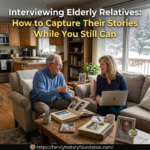
Sit at a right angle rather than straight across a table — it feels like conversation instead of interrogation. Put yourself on their better-hearing side, keep your face in the light so they can read your lips, and never sit backlit against a window. 🌤️
Having a coffee or tea or iced tea shared is a social cue to relax and engage in conversation. How you sit is also important, never scoot right up to someone’s face or sit too formally, unless the situation is warranted and will make your elder family member feel more at ease.
Slow Down — Silence Is Doing Work 🤫
The most common mistake in interviewing elderly relatives is filling silence. You ask about the farm, you get four seconds of nothing, you panic and rephrase — and you have just interrupted a memory that was surfacing.
Older retrieval is slower, not weaker. That pause is the search running. Count to seven before you say anything; seven feels unbearable and it is where the best material lives.
In my Linguistics degree I’ve studied speech ethnography and speech analysis, and silence is a curious subconscious phenomenon with respect to subtle language cues, and with English speakers silence is generally filled quickly. However, my advice is to pace yourself against the rhythm of the person you are interviewing. If they go slowly, go slowly; if they go quickly, go quickly.
Ask one question at a time, never stacked. And do not correct them mid-story — if she says the flood was 1936 and you know it was 1937, note it and move on. Being corrected shuts an elderly storyteller down faster than anything else. ✋
Corrections and interjections also depend on the modality of each individual family. In some families where there is a more comfortable allowance of overlapping speech, it might be okay to correct a fact mid stream if the social dynamic allows it.
For example, chatty family might find a false date recollection and correction funny and spur the continuation of enjoyable rhetoric.
Memory Arrives Sideways: Photos, Objects, and Smells 📷
Direct questions produce facts. Sensory prompts produce stories. When interviewing elderly relatives, bring props and watch what happens.
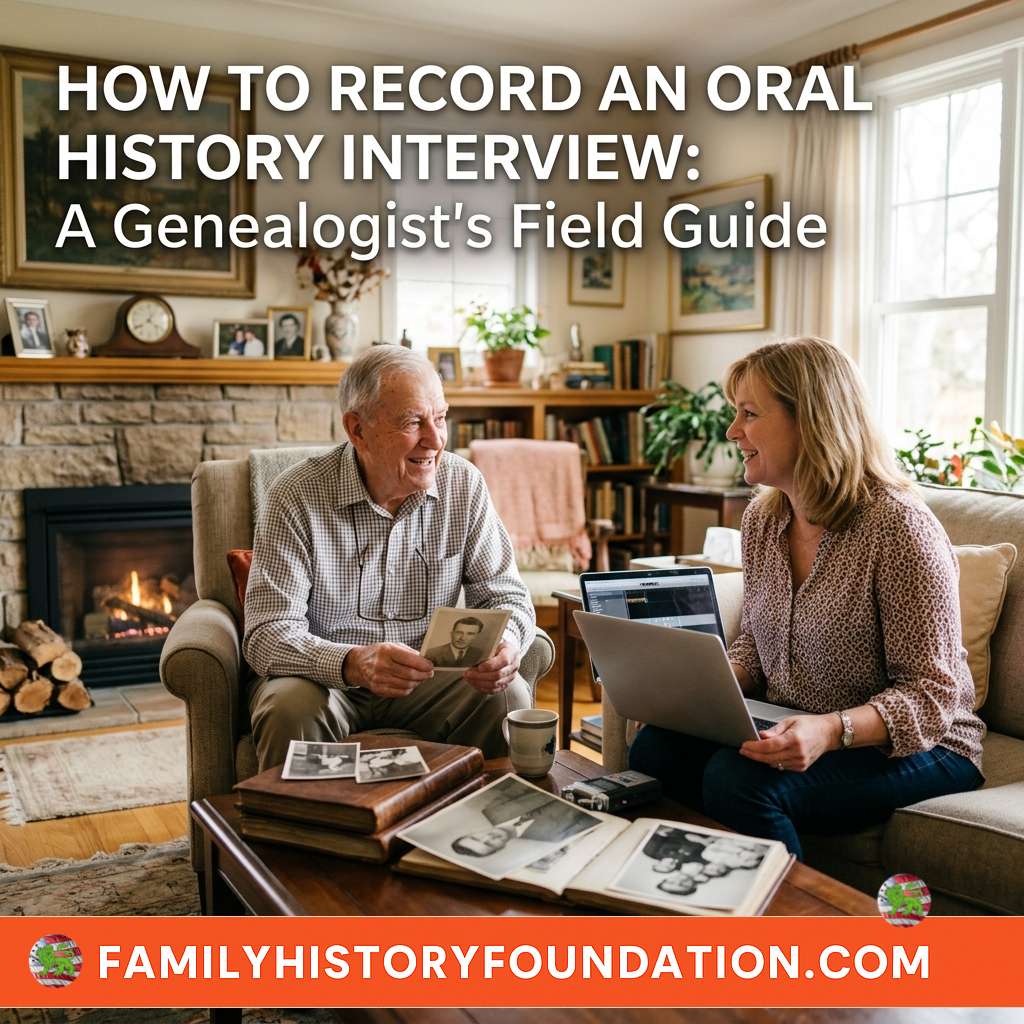
Photographs are your strongest trigger, especially unlabeled ones — the puzzle of “who is that?” pulls people in. Bring a shoebox, not an album, and let them sort. If images are too faded to read, restoring and animating old photos beforehand can turn a blur into a face they recognize instantly.
Even if you know who a person is, ask about them – especially if they are an ancestor dear to you. If your grandmother knows “the story” behind one of her parents you admire, ask! Maybe you’ve heard the story of uncle Joe 100 times, ask again if there is a lull in the conversation, you never know, you might just get something new.
I’ve opened up to one of my cousins about my great-grandmother who moved from Tennessee to California several times, and each time I do I get a new fun fact! For instance, the last time I did, I found out that she had a very green thumb and grew all kinds of stuff at her home – I even got a picture of her garden. 🪴
Objects work just as well: a ration book, a christening gown, a tool from the shop. So does music from when they were fifteen to twenty-five, and so does food. The smell of one specific cake has opened more family histories than any clever question ever written. 🍰
When They Say “Nothing Interesting Ever Happened to Me”
You will hear this constantly when interviewing elderly relatives. It usually means “I don’t know what you want” rather than anything true.
Don’t argue — get small and specific. Not “tell me about your childhood,” but “what did the kitchen smell like on a Monday?” Not “tell me about the war,” but “what did you eat that year?”
TOP TIP: If you are feeling stuck, lead in with a complimentary-style question. This has worked wonders for me. So, instead of “tell me about your childhood,” which might sound like they are sitting with a therapist, try something akin to “we are so spoiled nowadays by technology, I so admire how your generation grew up. You all are so strong, it’s amazing…”
By putting them a bit on a pedestal, it will open them up for sure. Cash in on this technique. And hey, it’s not being disingenuous, we should generally admire our elders for the lives they’ve lived. Interviewing elderly relatives is a community and legacy service, just to have talked with them before we lose them! Extolling praises on our elders is just good for the soul. 🙂
Ordinary detail is exactly what vanishes from the record. Nobody wrote down what the milk truck sounded like or how you kept a house warm in 1951. Say so. Once an elderly relative understands the everyday is the treasure, the floodgates open. 🌊
Handling Grief, War, and the Stories They Buried 🕯️
All doors you knock on. You never kick them in. This is the part of interviewing elderly relatives that separates a gift from a betrayal of trust.
Name the topic, hand them the key, let them choose: “I know your brother died young. If you ever want to talk about him, I’d like to hear it — and if not, that’s completely fine.” Then genuinely move on.
Nine times out of ten they circle back themselves, once they’ve confirmed you won’t push. Watch the body — shifting away, shorter answers, a hand to the face — and change subject when you see it. Keep recording through tears unless they ask you to stop, then honor that instantly. 🤍
Sensitive topics when interviewing elderly relatives all boils down to trust and the depth of the relationship you have with them. Having other family members present while asking sensitive questions can either help or hinder a person’s willingness to open up and speak confidentially.
This is especially so if you are recording them. Knowing that what they say is “going on record” can certainly inhibit a response – and naturally so. Ask if they’d like you to just hear the story off the record or provide a version they would like archived for future generations.
When Memory Is Failing: What Still Works 🧠
If cognition is declining, interviewing elderly relatives changes shape but does not become pointless. Distant memory is typically the last to go, so the 1940s may be far more reachable than last Tuesday.
Drop the chronology. Stop asking “and then what happened?” and start asking “what was she like?” — character and sensory description survive when sequence does not. Repetition isn’t failure; the fourth telling often carries a detail the first three didn’t.
Music reaches remarkably far. Keep sessions short, stop the moment agitation appears, and count a warm twenty minutes as a complete success. 🎵
At the end of the day, get what you can get. It’s not about the accuracy of the information per se, it’s about getting it on record. You can always add notes or disclaimers to what you share across family or on Ancestry which let other family historians know “this is uncle Jack’s version of the story at 97,” or something to that effect.


The Source Hound’s Newsletter
Still Hitting Dead Ends In Your Research?
Join 500+ family historians getting the Source Hound’s weekly research breakthroughs — real case studies, source hacks, and the exact strategies that turn brick walls into discoveries.
Free. No fluff. Straight from the Source Hound’s desk to yours.
Your privacy is sacred — almost as sacred as a primary source. Read our Privacy Policy.
Short Sessions Beat Marathon Interviews ⏳
When interviewing elderly relatives, plan for forty-five minutes. Bring three hours of material and expect to use a third of it.
Fatigue shows up as vaguer answers and stories that trail off. Once you see it, you’re no longer collecting good material — and pushing through teaches them that your visits are exhausting.
Also, interject break times if you or your respondent feel overwhelmed. Offer to get coffee or some nosh to revitalize the energy of the interview.
Stop while it’s still fun. “This was wonderful — can I come back Thursday?” Memory keeps working between visits, so expect a phone call two days later beginning with “I remembered something.” ☎️
My opinion is that interviewing elderly relatives is about legacy and service. No one likes to feel used and that you are only showing up to serve your interests over theirs. The “one-and-done” interview is LESS genuine over the Sunday chats over coffee and eggs.
Our elders are often lonely and craving interaction; so, in return for your story you are giving the gift of time, attention, and admiration.
TOP TIP: While you are there interviewing elderly relatives plan to do some CHORES! Nothing builds trust and companionship better than just helping your grandparents with the lawn or their computer or lifting that heavy box.
Recording Without Making Them Self-Conscious 🎙️
Ask permission on the recording, then make the device disappear. A quiet third of interviewing elderly relatives is getting technology out of the way. Set your phone face-down on a cloth — the cloth kills table vibration — and don’t touch it again. Never hold it, point it, or check the screen mid-answer.
The gear you own is fine; a quiet room and close placement beat an expensive microphone in a noisy one. Video changes everything, though. Many relatives who forget a phone on the table will stiffen for a tripod, so unless the visual truly matters, audio is kinder and often richer. 📱
TOP TIP: practice recording several times before going until you get comfortable with the recording levels. Conduct dry runs at home with your spouse or family and test the quality and efficacy of what you have recorded.
You know, some people are born performers and might love the mic or camera. If your elder is one of them, you’ve got it made. Seriously, ask the person you are interviewing if they would like to hear the recording, have a copy of the recording, or want to comment on it – seriously!
This alleviates the “secrecy” and creates an atmosphere of a shared experience. If they don’t want to, leave it there.
The Gatekeeper Factor: Caregivers and Adult Children 🚪
Interviewing elderly relatives often means getting past a gatekeeper first — a spouse, a live-in daughter, an aide who knows the routine. Win them over. Explain what you’re doing and ask their advice on timing and topics; they’ll tell you which subjects cause distress and that Tuesdays are physical therapy.
Then gently ask for the room. People edit themselves in front of their children — especially about money, marriages, and anything predating those children. Two chairs and a closed door produce a different interview entirely.
Interviewing elderly relatives in this context is also about plying the gatekeepers for information against which you can verify facts given during the interview. While that sounds all CIA, it’s not. It will help to engender more of a family aspect to the situation. After all, it’s all about legacy and family history – it’s much larger than you or me.
What to Do in the First 24 Hours 📝
Interviewing elderly relatives doesn’t end when you leave the house. Back the audio up in two places before you archive, then write a rough index — timestamps and topics, not a transcript — so you can find the good material a year from now.
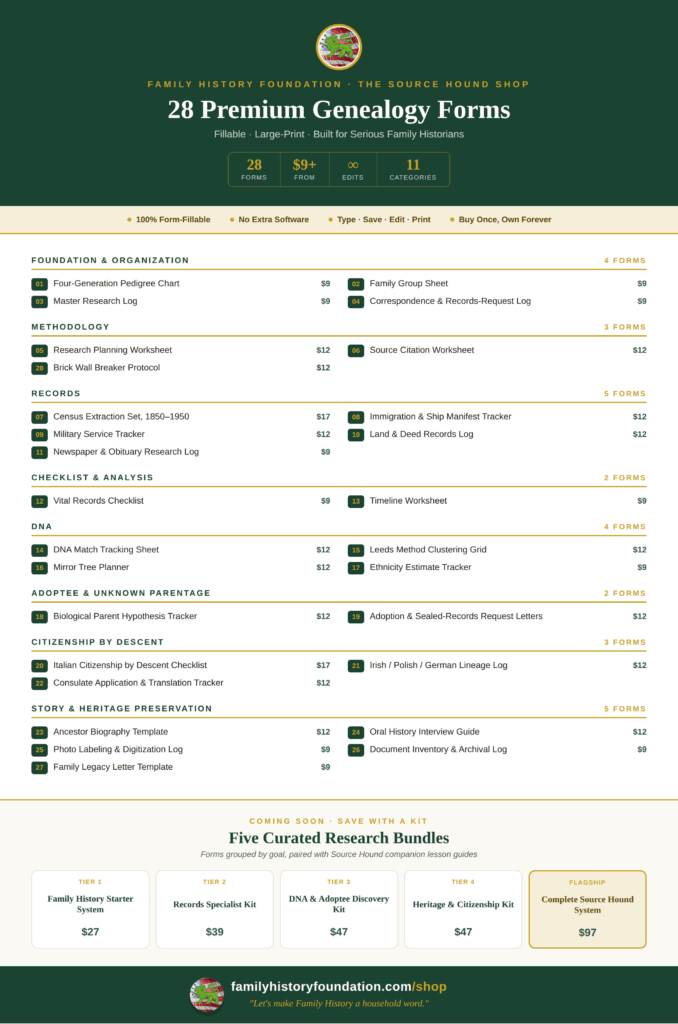
Then log it. Every name, date, and place you were given is a claim, not a fact, and belongs in your file as a sourced statement attributed to that person. Our Family History Foundation Online Forms Shop include the logs for this, and the Source Hound approach to online research turns testimony into proof.
Then verify. “We came over in 1912” gets checked against the federal census; a half-remembered wedding date gets checked against newspaper archives. Memory points the way; documents confirm it. 🔍
TOP TIP: Take the time to log all of the information about the interview! I cannot say this loudly enough and overtly enough! You will thank yourself later for this. CONSIDER THIS A NON-NEGOTIABLE!
LOG THE FOLLOWING (AT A MINIMUM):
- Date
- Time
- Location – town, address, city
- Location – home of, setting
- Person interviewed
- Genealogy of the person being interviewed
- Person interviewing
- Genealogy / relationship of the person interviewing
- Other people in the room
- Recording device
- Reason for interview
- Other facts (add as needed)
🧠 Fun Trivia Quiz
Your Suggested Field Kit 🧰
- 📄 A printed or form-fillable question sheet — never read questions off a phone screen
- 🔋 A charged recorder (phone), storage cleared, airplane mode on
- 📷 A shoebox of unlabeled photographs
- 🎵 A short playlist from their late teens
- 🖊️ A notepad for spellings and follow-ups
- ⏱️ A hard stop at forty-five minutes
Rather not build your own question sheet for interviewing elderly relatives? The Form 24 Oral History Interview Guide is a form-fillable PDF made for exactly this — prompts, consent language, and space to log answers as you go, so you’re listening instead of scrambling. Pair it with our 50 questions to ask relatives about family history and you’ll never run dry mid-visit. 🐾
Keep somewhere to put what you learn, too — a free family tree template turns an afternoon of stories into a structure you can build on.
Frequently Asked Questions
How long should an interview with an elderly relative last?
Forty-five minutes is the sweet spot when interviewing elderly relatives; ninety is almost always too long. Vaguer, shorter answers mean fatigue has arrived and the useful part is over.
What’s the best time of day for interviewing elderly relatives?
Whenever that person is sharpest — most commonly mid-morning, after breakfast and medication. Ask a caregiver rather than guessing; they’ll know the window immediately.
What if my relative refuses to be recorded
Respect it completely and take notes by hand, writing everything up within the hour. Many people who decline on the first visit agree by the third.
How do I ask about painful subjects without hurting them?
Name the topic, offer the opening, and let them decline without friction. Most people return to it on their own once they know you won’t push.
Can I still interview a relative with dementia?
Often yes — long-term memory frequently outlasts short-term. Interviewing elderly relatives with memory loss works best when you drop chronology, ask about character and sensory detail, keep sessions brief, and stop if agitation appears.
Do I need special recording equipment
No. A smartphone in a quiet room, face-down on a cloth a few feet away, beats expensive gear in a noisy one.
Should I interview relatives together or one at a time?
One at a time. People edit themselves in front of family, and a dominant sibling will take over the narrative.
How do I verify what an elderly relative tells me?
Interviewing elderly relatives produces claims, not facts. Treat every statement as a sourced claim, then check it against census returns, vital records, newspapers, and church registers. Memory points to the right decade and county; documents supply precision.
It’s Not About You, It’s About Your Legacy 🕰️
There’s never a convenient moment — only this month, and the relative who’s still here to answer the phone. Interviewing elderly relatives is not about you, it’s about your family legacy. It’s a moral imperative and community service.
Interviewing elderly relatives is the one research task with a real expiration date. Census records will be there next year. Newspaper archives will be there next year. Your great-uncle’s voice describing the boat, the farm, and the brother nobody talks about will not be.
So pick one person and one hour this week. Bring a shoebox of photographs and a charged phone. You don’t need to be good at interviewing elderly relatives — you only need to show up while there’s still someone to listen to. 💚
Which relative are you calling first? Tell me in the comments — and if you’ve got a technique that worked, share it. Somebody reading this needs it today. 👇
Join the Family History Foundation Source Hound Community 🏡
You have the method for interviewing elderly relatives. Now come get the encouragement, the case studies, and the occasional research rabbit hole worth falling into.
🎥 Subscribe on YouTube — every Friday, a video companion to the week’s article. Watch these techniques demonstrated rather than described.
📌 Follow on Pinterest — printable question sheets, research charts, and visual guides to save for your next session.
📬 Subscribe to the Newsletter — tips, active challenges, and deep-dive case studies. Never an overloaded inbox, always something you can use this weekend.
Your ancestors were ordinary people who lived extraordinary ordinary lives. The ones still with us are the only ones who can tell you about it themselves. Go listen. 🌿
Let’s make Family History a household word. 🏠
The Source Hound’s Newsletter
Still Hitting Dead Ends In Your Research?
Join 500+ family historians getting the Source Hound’s weekly research breakthroughs — real case studies, source hacks, and the exact strategies that turn brick walls into discoveries.
Free. No fluff. Straight from the Source Hound’s desk to yours.
Your privacy is sacred — almost as sacred as a primary source. Read our Privacy Policy.