Artificial intelligence is transforming nearly every corner of our world — and genealogy is no exception. ⚙️ For generations, family historians have relied on patient research, handwritten records, and intuition to uncover their ancestors’ stories. But now, AI and Genealogy have joined forces, promising to make research faster, smarter, and more powerful than ever before.
Can AI actually help with genealogy? Yes — AI can transcribe old handwriting, translate foreign-language records, and search billions of documents in seconds, saving genealogists hundreds of hours. But it also makes mistakes that can quietly corrupt your family tree, inventing records and misreading names.
Table of Contents
This guide covers exactly what AI does well, where it fails, and how to use it safely as you build your family tree in 2026.
TL;DR Executive Summary
How AI Is Changing Genealogy Research in 2026
Every genealogist knows the traditional challenges: deciphering faded handwriting, translating foreign records, searching endless microfilm reels, and trying to connect elusive relatives who appear in only a single census entry. It’s fulfilling work — but also painstaking and time-consuming.
That’s where AI steps in. Over the past few years, AI and Genealogy have converged into a digital gold rush. Machine learning algorithms are now indexing billions of historical documents, translating old letters, and even predicting possible relationships based on DNA or location data.
Think of it as a research assistant who never sleeps. 🕵️♀️ Yet as with any gold rush, there’s both opportunity and risk. AI brings unprecedented speed and accuracy, but it also challenges our notions of authenticity and historical truth. Is this new technology a boon or a burden for family historians?
By 2026, AI has moved from novelty to standard equipment. Ancestry and MyHeritage now run AI-powered record matching by default, handwriting-recognition tools read entire archives in an afternoon, and general-purpose assistants like Claude and ChatGPT help researchers organize findings and plan their next steps. The question is no longer whether to use AI in genealogy — it’s how to use it without letting it lead you astray.
Suddenly, what once took months can now take minutes. But does faster always mean better? That’s where the real story begins. Let’s find out how AI and Genealogy can help and inspire.
AI’s Superpowers for Your Family Tree
AI’s greatest gift to genealogists is automation. What once took hours — or even months — can now be done in minutes. Artificial intelligence has gifted genealogists several “superpowers.”
- Pattern recognition links names, dates, and relationships across massive databases in seconds.
- Optical Character Recognition (OCR) deciphers handwriting on century-old documents.
- Machine translation breaks open foreign records previously inaccessible.
📝 Transcription and Translation Made Easy
Old handwritten wills, parish records, and census pages used to require expert eyes. Now, AI handwriting recognition tools like Transkribus and Google Cloud Vision can read these documents instantly, producing searchable text. Add AI translation services, and researchers can finally understand ancestors’ letters written in German, Polish, or Italian.
🔍 Discovering Hidden Connections
AI doesn’t just read faster — it thinks faster. Algorithms can analyze millions of records, detect name variations, and uncover links between families who lived hundreds of miles apart. Platforms like Ancestry and MyHeritage use AI to suggest potential relatives you may never have found manually — analyzing DNA matches, shared surnames, and geographic patterns to surface connections hidden across millions of records. This is where AI and genealogy truly shines.
🖼️ Breathing Life into Old Photos
AI tools like MyHeritage Deep Nostalgia and Remini allow you to colorize and even animate ancestral photos. While these enhancements spark emotional connections, they also remind us that AI can interpret history, not just display it.
💡 Real-World Breakthroughs
Consider a researcher who used AI translation to decode 19th-century Danish church records. What took months by hand was completed in days — revealing generations of previously hidden family ties. That’s the transformative power of AI and Genealogy at work.
That’s the power of AI in genealogy when used with care and curiosity.
The Pros of AI and Genealogy
The upside of this technological partnership is undeniable. Let’s pause to appreciate what makes AI such a valuable ally for modern genealogists:
- Speed & Efficiency: Automates tedious tasks like transcribing or translating documents.
- Accessibility: Makes rare or foreign-language records readable to anyone.
- Discovery: Finds patterns across massive datasets humans could never process alone.
- Visualization: Enhances photos and builds visual narratives around your ancestors.
It’s like having a team of archivists, translators, and analysts at your fingertips — 24/7.
But perhaps the greatest advantage is emotional. AI and Genealogy doesn’t just find ancestors — it helps us see them. When you colorize an old photograph or animate your great-grandmother’s portrait, the connection becomes deeply human.
The Dark Side of the Digital Assistant
Yet, for every innovation, there’s a shadow. As dazzling as AI may seem, it’s not without shadows. Genealogists must tread carefully when embracing these tools.
🧩 Inaccuracies and “Hallucinations”
AI is brilliant, but not perfect. It can fabricate “plausible” records — a phenomenon known as AI hallucination. A missing data point might be guessed rather than verified, potentially leading genealogists down false trails.
AI models sometimes produce false information — inventing names, misreading handwriting, or connecting unrelated people. These “hallucinations” can quickly contaminate family trees if left unchecked.
🔒 Privacy and Ethical Concerns
Privacy is another concern. Uploading photos or DNA-linked data into commercial systems introduces potential vulnerabilities. Who owns that data once it’s analyzed? Can it be used for other purposes later?
Uploading photos, records, or DNA data into AI-powered systems means trusting companies with sensitive information. Before using AI tools, read privacy policies carefully and think twice before sharing identifiable family data.
🤖 Over-Reliance and the Human Touch
And then there’s the ethical question — when AI reimagines a person’s face or voice, are we preserving history or altering it? The responsibility lies with us to ensure that AI in genealogy remains a tool for truth, not distortion.
While AI can suggest, only humans can interpret. It’s our responsibility to verify every finding, cross-check every lead, and ensure that technology supports — not replaces — the art of storytelling in genealogy. There is a balance that must be struck between human hands and genealogy and AI and Genealogy.
The Cons of AI and Genealogy
Beyond accuracy and privacy, there’s a subtler risk — losing the human in family history. Every strength comes with a weakness. Here are key drawbacks genealogists should consider:
- False Matches: AI might suggest incorrect ancestor links due to similar names or data gaps.
- Loss of Context: Algorithms can’t interpret emotional or cultural nuances.
- Data Ownership: You may lose control over images or records uploaded to AI systems.
- Historical Distortion: AI-enhanced photos can subtly alter how we perceive the past.
Remember: AI can assist your research, but it cannot validate it.
AI can’t feel the thrill of finding a handwritten note in the margin of a record book. It can’t appreciate the emotional significance of a letter passed down through generations. Overreliance on digital assistants may reduce our role from researcher to observer.
And AI errors are not rare. For instance, one researcher found that an AI-indexed census record had misread “Wm.” (William) as “Ann.” — linking her family to an entirely different bloodline. She caught the error only by checking the original census image.
The lesson is simple but essential: always verify AI-derived results against the original source before trusting them. It’s the single most important habit in AI-assisted genealogy.
How to Use AI for Genealogy: 5 Rules for Safe Research
So how do you use AI responsibly while still taking advantage of its strengths? To use AI in genealogy wisely, combine its power with your human intuition. Here are some practical tips:
🔧 1. Start with Trusted Tools
Use reputable AI platforms such as MyHeritage Reimagine, Ancestry’s Record Hints, and Transkribus for transcription. These tools are transparent about their data sources and methods.
📚 2. Verify Everything
Always compare AI-generated results with original records or multiple sources. For extra guidance, explore this post on Genealogy Research Online: The 1 Ultimate User-Friendly Beginners Guide.
🧠 3. Use AI as an Educator
Let AI suggest ideas, summarize long documents, or flag leads. But keep critical thinking front and center.
☕️ 4. The Best AI Tools for Genealogy in 2026:
The right AI tool depends entirely on the job you need done. Here’s how the leading options compare for genealogy research in 2026:
Each of these AI tools earns its place for a specific genealogy task. Filter by category to find the right one for your research — and remember the golden rule: AI assists, you verify.
| Tool | Best for | Cost | Source Hound note |
|---|---|---|---|
| Transkribus | Reading old handwriting in wills, parish records, and census pages | Freemium | The gold standard for handwritten text recognition. Train it on a specific hand for remarkable accuracy. |
| Google Cloud Vision | OCR on printed historical documents and typed records | Freemium | Powerful for printed text and multilingual records, but less specialized for handwriting than Transkribus. |
| Ancestry Image Transcript | Auto-transcribing handwritten records within Ancestry | Subscription | Convenient if you already subscribe. Always compare the transcript against the original image. |
| MyHeritage Reimagine | Restoring, colorizing, and enhancing old family photos | Freemium | Excellent for repairing damaged photos. Remember: enhancement is interpretation, not historical fact. |
| Remini | Sharpening low-resolution and blurry ancestral portraits | Freemium | Great for clarity, but it can invent facial detail that was never there. Use a light touch. |
| Claude | Summarizing documents, building timelines, analyzing research notes, drafting record requests | Freemium | Strong at reasoning through complex family puzzles and long documents. Always verify any factual claim against primary sources. |
| ChatGPT | Summarizing notes, crafting timelines, brainstorming research angles | Freemium | Useful for organizing thoughts, but prone to hallucinating names, dates, and records. Never trust facts unverified. |
| Perplexity | Researching genealogy methods and sources with citations | Freemium | Its source citations make it easier to verify claims than most chatbots — a real advantage for researchers. |
Showing all 8 AI tools
🗂️ 5. Stay Organized
Document when AI tools assist your work. Note “AI-assisted” in your research log or citation — it maintains transparency and reliability. Balance innovation with discernment, and AI will amplify your skills, not replace them.
Fun Quiz Time: Which Type of AI Genealogist Are You?
When you hit a research roadblock, you…
Share your result in the comments! 👇

The Family History Foundation Newsletter
It’s Not About You, It’s About Documenting Before It Disappears
Join 500+ family historians getting Franklin's Source Hound weekly research breakthroughs — real case studies, source hacks, and the exact strategies that turn brick walls into discoveries.
Free. No fluff. Straight from the Source Hound's desk to yours.
Your privacy is sacred — almost as sacred as a primary source. Read our Privacy Policy.
Your Future Family History: A Collaborative Journey
The marriage of AI and Genealogy is still in its early stages, but its future potential is staggering. Imagine software that can:
- Predict ancestral migration routes based on surname clustering.
- Recreate family voices using historical recordings.
- Automatically map genetic relationships visually.
These innovations could transform genealogy into a dynamic, living tapestry — a blend of data and imagination.
The next decade will bring incredible advances — predictive DNA mapping, voice reconstructions, even 3D recreations of ancestral homes. AI won’t just assist genealogy; it will reimagine it.
But amid the algorithms and automation, one truth remains: family history is about connection, not computation. AI can help us find the facts, but only we can feel the meaning behind them.
AI can find the facts — the Source Hound helps you find the meaning. Get research strategies, tool reviews, and family history inspiration delivered free every other week.
But the heart of family history will always belong to the humans behind it. AI can analyze patterns, but it can’t feel the emotion of a great-grandparent’s story or understand the legacy of a family heirloom. That’s your role — the storyteller, the curator, the bridge between past and present. ❤️
🔗 Further Reading & Resources
Explore more inspiring recent posts from Family History Foundation:
- How to Find Family on Ancestry: 10 Essential Steps for Brainy Beginners
- Find Immigrant Ancestors Without Passenger Lists: 7 Proven Alternatives That Actually Work
- Beginner’s Guide to Organizing Family Documents and Photos Digitally: 12 Powerful Steps
- 25 Free Genealogy Templates to Download (And Links to Use Them!)
- The Ancestor Paradox: Why Your Family Tree Has Fewer Ancestors Than You Think
- Unlocking European Ancient DNA: A Fun Journey Through 10,000 Years of Migration
Challenge of the Week
Ready to test the future of AI and Genealogy? 💥
This week, try one AI-powered genealogy tool — whether it’s an image colorizer, a handwriting transcriber, or a translation bot. Compare its results to your manual findings and see what you learn. Then, share your experience in the comments below! Your story might inspire another researcher.
Join the Family History Foundation Source Hound Community
Our family history is disappearing every day, join the Source Hound community and join our pledge to be the protector of your family history. The lives and voices of our ancestors are depending on it for our future generations.
Celebrate Family History Fridays with us across our social media and community platforms!
📬 Subscribe to the Newsletter -- tips, active challenges, and deep-dive case studies. Never an overloaded inbox, always something you can use this weekend.
 Like & Subscribe on YouTube -- every Friday, a video companion to the week's article. Watch these techniques demonstrated rather than described.
 Pin Us on Pinterest -- printable question sheets, research charts, and visual guides to save for your next session.
 Podcasting on Spotify! -- podcasting now on Spotify, you can find all of the latest episodes on any of your favourite podcast platforms, starting with Spotify.
 Podcasting on Amazon! -- If you are not on Spotify we are also on Amazon Podcasts so you can listen while you drive and work. Every episode is curated just for you to binge your favourite episodes.
 Podcasting on Audible! -- Audible is an alternative offshoot of Amazon Podcasts to listen while search for your next favourite book. Ready for your next "audible?" Set, Go!
Let's make Family History a household word. 🏠
The Family History Foundation Newsletter
Our Family History Is Disappearing Every Day!
Join the quest with 500+ family historians getting Franklin’s Source Hound weekly research breakthroughs — real case studies, source hacks, and the exact strategies that turn brick walls into discoveries.
Free. No fluff. Straight from the Source Hound's desk to yours.
Your privacy is sacred — almost as sacred as a primary source. Read our Privacy Policy.
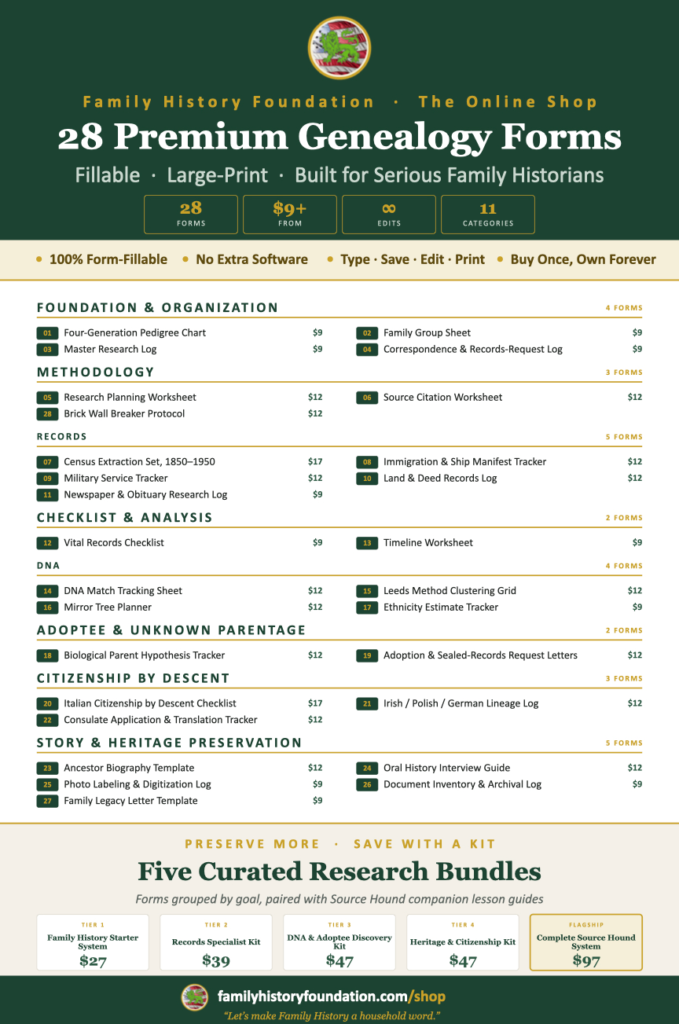
Shop Premium Genealogy Forms

About the Author
Hi there, my name is Franklin, the founder and author of The Family History Foundation.
Our family stories are disappearing every day and it's crucially important that the next generation is able to learn and appreciate their family history. It is up to you to take up the mantle of responsibility to ensure that how you research today will be passed on tomorrow with the highest standards possible.
I believe that genealogy is not just about names and dates, it's about your stories and how those stories inform your identity.
With a penchant for storytelling and a background in research, the insights and techniques you learn on The Family History Foundation will help you uncover the incredible stories and identities hidden within the tapestry of your ancestry.
My mission is "Let's make Family History a household word."
My motto is "The Past 'Relative' to the Future."
FAQs - AI in Genealogy
Q1: Can AI do genealogy research for you?
AI can accelerate genealogy research dramatically — transcribing handwriting, translating foreign-language records, and searching billions of documents in seconds — but it cannot do the research for you entirely. AI surfaces possibilities and handles tedious tasks, but a human researcher must verify every finding against original sources, interpret context, and make the judgment calls that determine whether a record truly belongs to your family. Think of AI as a tireless assistant, not a replacement genealogist.
Q2: Is AI accurate for genealogy?
AI is highly accurate for mechanical tasks like optical character recognition and translation, but unreliable for factual claims. AI models can "hallucinate" — inventing plausible names, dates, and records that never existed. This makes AI excellent for reading a document but dangerous for confirming a relationship. Always cross-check AI-generated results against original records before adding them to your family tree.
Q3: What is the best AI tool for genealogy in 2026?
There is no single best tool — the right choice depends on the task. Transkribus is the leading tool for reading old handwriting. MyHeritage Reimagine excels at restoring and colorizing old photos. Claude and Perplexity are strong for analyzing documents, building timelines, and researching methods, with Perplexity offering source citations that make verification easier. Match the tool to your specific need rather than expecting one AI to handle everything.
Q4: Is it safe to upload family photos and DNA data to AI tools?
It depends on the tool and your comfort with data sharing. Uploading photos, records, or DNA-linked data into commercial AI systems means trusting that company with sensitive family information. Before uploading, read the privacy policy carefully, understand who owns the data once analyzed, and think twice before sharing identifiable information about living relatives. When in doubt, use tools that process data locally or offer clear deletion policies.
Q5: How do I use AI without corrupting my family tree?
Follow three rules. First, use AI to assist — transcribing, translating, summarizing — never to conclude. Second, verify every AI-derived fact against at least one original source before recording it. Third, document when AI assisted a finding by noting "AI-assisted" in your research log. This keeps your family history transparent, honest, and reliable for the generations who inherit your work.