Irish Citizenship by Descent is widely considered the most accessible route to an EU passport for anyone with Irish roots — no language test, no residency requirement, and a clear bloodline pathway. 🇮🇪
If you have an Irish-born grandparent, or even an Irish-born great-grandparent under the right conditions, you may be entitled to claim an Irish ancestral passport and all the rights of European Union citizenship that come with it.
Table of Contents
But here is the hard truth that this guide exists to address: roughly half of all applications fail or stall — almost always for avoidable reasons. Photocopies instead of originals. Short-form certificates instead of long-form. A misunderstanding of the all-important registration rule.
This complete 2026 guide walks you through every eligibility tier, the Foreign Births Register process, the exact documents you need, and how your genealogy research unlocks the entire path. Get it right the first time, and your Irish Citizenship by Descent journey can be remarkably smooth.
This post is part of the Family History Foundation Citizenship by Descent series. If you are new to claiming an ancestral passport through your lineage, start with the pillar post: Citizenship by Descent: How to Claim Your Ancestral Passport in 2026. For parallel deep dives, see the Italian, German, and Polish guides.
Note: This post is educational in nature and does not constitute legal advice. For individual eligibility assessments, consult a qualified immigration professional.
The Three Tiers of Irish Citizenship by Descent
The system works on a clean, three-tier structure based on how many generations separate you from your Irish-born ancestor. Understanding which tier you fall into is the first and most important step.
Each tier carries different rules and a different process. Let’s walk through all three.
Tier 1 — A Parent Born in Ireland
If one of your parents was born on the island of Ireland, you are already an Irish citizen automatically. You do not need to apply for Irish Citizenship by Descent at all.
In this case, there is no Foreign Births Register step. You simply apply directly for an Irish passport, providing your parent’s long-form Irish birth certificate as proof of the connection.
This is the simplest tier — citizenship is yours by birthright the moment you were born. The only document hurdle is proving it. 🛂
Tier 2 — A Grandparent Born in Ireland
This is the most common Irish Citizenship by Descent scenario for Americans, Australians, Canadians, and New Zealanders. If one of your grandparents was born in Ireland, but neither of your parents was, you are eligible to claim Irish citizenship through Foreign Birth Registration.
This is the tier where the formal Irish Citizenship by Descent application process applies. You register your birth on the Foreign Births Register (FBR), and once entered, you become an Irish citizen from the date of registration — and can then apply for your Irish ancestral passport.
The vast majority of readers of this guide will fall into Tier 2. It is the heart of the system. ☘️
Tier 3 — A Great-Grandparent Born in Ireland
Here is where Irish Citizenship by Descent gets nuanced — and where the single most misunderstood rule in the entire system lives.
If your Irish ancestor is a great-grandparent, you can only claim Irish Citizenship by Descent if your parent registered on the Foreign Births Register before you were born. Citizenship is not retroactive.
⚠️ The Chain-of-Registration Rule — Read This Twice
Irish citizenship passes down the generations only if each generation registers before the next is born.
Example that works: Your great-grandfather was Irish. Your mother claimed her citizenship through the FBR in 1985. You were born in 1990. ✅ You qualify.
Example that fails: Your mother claims her citizenship today, in 2026. You were already born years ago. ❌ You do not qualify through this route, because she was not registered before your birth.
This single rule catches more hopeful applicants off guard than any other aspect of Irish Citizenship by Descent. If you have Irish great-grandparents and young children, the timing of your own registration directly affects your children’s eligibility.
Why Ireland Is the Most Accessible Program in This Series
Among all the citizenship pathways in this series, Irish Citizenship by Descent stands out for its sheer accessibility — and there are concrete reasons why.
There is no language test. Unlike many naturalisation routes across Europe, the descent pathway asks nothing of your Irish, your English, or any other language proficiency.
There is no residency requirement. You never need to set foot in Ireland to claim your Irish ancestral passport. The entire process can be completed from your home in the United States, Australia, Canada, or anywhere else in the world.
And Ireland fully embraces dual citizenship. Claiming Irish Citizenship by Descent does not require you to give up your existing nationality — you simply hold both. For an American, Australian, or Canadian, that means keeping your current passport while gaining full EU rights.
That combination — bloodline eligibility, no language test, no residency, and dual citizenship — is what makes this the gold standard of accessibility in the ancestral passport world.
The Foreign Births Register — How It Actually Works
For Tier 2 and qualifying Tier 3 applicants, the Foreign Births Register is the mechanism through which Irish Citizenship by Descent is claimed. Understanding it clearly removes most of the anxiety from the process.
The Foreign Births Register is the official log, maintained by Ireland’s Department of Foreign Affairs (DFA), of people born abroad who have claimed Irish citizenship through descent. Once your details are entered onto the register, you are legally an Irish citizen — effective from the date of registration, not from your date of birth.
One important 2026 update worth knowing: all Foreign Births Register applications are now processed centrally in Dublin. Irish embassies and consulates abroad no longer handle these applications. You complete the application online, then mail your original supporting documents to the DFA in Dublin.
The current processing time is approximately 9 to 12 months — so patience is part of the journey. But once you receive your Foreign Birth Register certificate, your Irish Citizenship by Descent is confirmed, and the path to your passport is open. 🎉
The Application Process — Step by Step
Claiming Irish Citizenship by Descent through the Foreign Births Register follows a clear sequence. Here is exactly what to expect.
Step 1 — Confirm your tier and eligibility. Establish whether you qualify through a parent (Tier 1), a grandparent (Tier 2), or a great-grandparent with prior parental registration (Tier 3).
Step 2 — Locate your Irish ancestor’s birth details. You need to know the precise birthplace — county, parish, or townland — to order the correct Irish birth certificate. This is where genealogical research becomes essential, and where many applicants need to do real detective work.
Step 3 — Order the Irish birth certificate. Obtain your Irish-born ancestor’s long-form civil birth certificate from Ireland’s General Register Office (GRO). This is the anchor document of your entire claim.
Step 4 — Gather your full document chain. Collect original long-form birth and marriage certificates for every generation connecting you to your Irish ancestor.
Step 5 — Apply online. Complete your Foreign Births Register application at the DFA’s official portal. You will need a valid email address and your document details.
Step 6 — Pay the fee. The current fee is approximately €278 for adults and €153 for minors, plus a small postage and handling charge.
Step 7 — Mail your original documents. Print your application summary and post it, along with all original supporting documents, to the DFA’s FBR processing unit in Dublin.
Step 8 — Receive your certificate and apply for your passport. Once your Irish Citizenship by Descent is confirmed and you receive your Foreign Birth Register certificate, you can apply for your Irish ancestral passport. 🛂
The Family History Foundation Newsletter
It’s Not About You, It’s About Documenting Before It Disappears
Join 500+ family historians getting Franklin’s Source Hound weekly research breakthroughs — real case studies, source hacks, and the exact strategies that turn brick walls into discoveries.
Free. No fluff. Straight from the Source Hound’s desk to yours.
Your privacy is sacred — almost as sacred as a primary source. Read our Privacy Policy.
The Documents That Make or Break Your Application
This is the section that matters most — because this is where roughly half of all Irish Citizenship by Descent applications fail or stall.
The single most common reason for rejection is simple: applicants submit the wrong type of document. Photocopies are rejected. Commemorative or decorative certificates are rejected. Short-form certificates are rejected.
You must submit original, long-form, state-issued civil certificates showing full parental details. Nothing less will do.
Here is the complete document chain for a Tier 2 (grandparent) application:
For your Irish-born grandparent:
- Original Irish civil birth certificate showing parental details
- Original civil marriage certificate, if applicable
For your parent (the connecting generation):
- Original civil birth certificate
- Original civil marriage certificate, if applicable
- Copy of current photographic ID, or death certificate if deceased
For you (the applicant):
- Original civil birth certificate showing your parents’ details
- Original civil marriage certificate or change-of-name document, if your name has changed
- Certified photocopy of your current state-issued photographic ID
Every certificate must be the long-form version — the one that shows parents’ names — not the abbreviated short-form version. This single requirement is responsible for more application delays than any other factor. ✅
The Genealogy Challenge — Finding Your Irish Records
Here is where Irish Citizenship by Descent becomes genuinely distinctive among the programs in this series — and where your skills as a family historian become decisive.
Ireland presents a unique research challenge. You cannot order an Irish birth certificate from the General Register Office unless you already know the specific location — the county, parish, or townland — where your ancestor was born. The GRO is a retrieval agency, not a research service. They will not find your ancestor for you. You must give them the details.
This is the wall that stops many Irish Citizenship by Descent applications before they even begin. And it is exactly the kind of layered, source-driven investigation the Source Hound methodology was built to solve.
Compounding the challenge, many Irish emigrants changed their stated birth dates after arriving in America — appearing younger for work, or older to qualify for a pension. When a US death certificate says 1905 but the Irish birth record says 1901, the passport office may reject the connection. Resolving these discrepancies often requires census records and corroborating documents to prove the two records describe the same person.
Our Source Hound Research Methodology is designed for exactly this kind of detective work — and our Free Genealogy Forms Bundle includes Research Log and Source Citation templates ideal for tracking documents across Irish and American archives simultaneously. 📝
Tools like Ancestry.com are invaluable for identifying emigration records, ship manifests, and census data that pinpoint your ancestor’s Irish origin. The Proving Ancestry ThruLines case study illustrates the documentation rigour an Irish Citizenship by Descent application demands, and Ancestry ThruLines can help identify living Irish relatives who may hold the records or local knowledge you need.
Cost and Timeline — What to Budget
Irish Citizenship by Descent is among the most affordable ancestral passport pathways available. Here is the realistic breakdown.
The Foreign Births Register fee: Approximately €278 for adults, €153 for minors, plus a small postage and handling charge.
Irish birth certificate from the GRO: Around €20 per certificate.
US and other vital records: $15–$50 per certified copy, depending on the issuing state or country.
Genealogist assistance: Optional, but valuable when you cannot locate your ancestor’s exact Irish birthplace — typically a few hundred dollars for targeted record retrieval.
Realistic total: Most independently handled applications cost between USD $500 and $2,000 all in — one of the lowest totals in this entire series.
Timeline: The Foreign Births Register processing time is approximately 9 to 12 months as of 2026. Add 3 to 6 months for document gathering, and a typical Irish Citizenship by Descent journey runs about 12 to 18 months from start to passport.
Common Mistakes That Derail Applications
Nearly every failed Irish Citizenship by Descent application stumbles on one of these avoidable errors.
- Submitting photocopies instead of originals. The Foreign Births Register requires original long-form certificates. Photocopies are rejected outright.
- Using short-form certificates. Only the long-form version showing parental details is accepted.
- Sending commemorative certificates. Decorative or souvenir certificates have no legal standing.
- Misunderstanding the chain-of-registration rule. For Tier 3 great-grandchild claims, your parent must have registered on the FBR before you were born.
- Not knowing the ancestor’s birthplace. You cannot order the Irish birth certificate without the county, parish, or townland.
- Unresolved name or date discrepancies. When records disagree, you need corroborating evidence to prove they describe the same person.
- Leaving registration too late for your children. If you want to pass Irish Citizenship by Descent to your future children, you must register yourself before they are born.
- Assuming a distant relative qualifies you. A great-aunt, cousin, or uncle does not establish eligibility — only your direct parent, grandparent, or qualifying great-grandparent line.
How Your Genealogy Research Unlocks the Application
Irish Citizenship by Descent and genealogy research are, at their core, the same pursuit. Every document the Foreign Births Register requires is a genealogical record, gathered and verified to the standard a serious family historian already applies.
The Irish research landscape has its own rich resources. The General Register Office holds civil birth, marriage, and death records. IrishGenealogy.ie offers free access to historical civil and church records. The National Archives of Ireland and the 1901 and 1911 census records are invaluable for pinpointing an ancestor’s origin — particularly important given that the 1922 Public Record Office fire destroyed many earlier records.
For the American side of the story, Ancestry.com and Newspapers.com help establish emigration timelines, naturalisation records, and the census data that often holds the key to an ancestor’s exact Irish birthplace.
The research you have already done on your family tree may be the foundation of one of the most accessible EU citizenships available — an Irish passport, full European Union rights, and a documented bond with the island your ancestors left behind. ☘️
Your Irish Ancestral Passport Is Within Reach
Irish Citizenship by Descent is the most accessible ancestral passport pathway in this entire series — no language test, no residency, modest fees, and a clear bloodline route. The only real obstacles are documentary: knowing your tier, understanding the chain-of-registration rule, and submitting the correct original long-form certificates.
Get those right, and the path to your Irish passport and full EU citizenship is remarkably open. The work you put into your family tree is the foundation — and it may be closer to complete than you think.
Are you exploring Irish Citizenship by Descent? Have you traced your family back to an Irish-born grandparent, navigated the Foreign Births Register, or hit the wall of finding an ancestor’s exact townland? Drop your story in the comments below — this community spans researchers at every stage of the journey, and your experience may be exactly what another reader needs. 💬
Join the Family History Foundation Source Hound Community
Our family history is disappearing every day, join the Source Hound community and join our pledge to be the protector of your family history. The lives and voices of our ancestors are depending on it for our future generations.
Celebrate Family History Fridays with us across our social media and community platforms!
📬 Subscribe to the Newsletter — tips, active challenges, and deep-dive case studies. Never an overloaded inbox, always something you can use this weekend.
 Like & Subscribe on YouTube — every Friday, a video companion to the week’s article. Watch these techniques demonstrated rather than described.
 Pin Us on Pinterest — printable question sheets, research charts, and visual guides to save for your next session.
 Podcasting on Spotify! — podcasting now on Spotify, you can find all of the latest episodes on any of your favourite podcast platforms, starting with Spotify.
 Podcasting on Amazon! — If you are not on Spotify we are also on Amazon Podcasts so you can listen while you drive and work. Every episode is curated just for you to binge your favourite episodes.
 Podcasting on Audible! — Audible is an alternative offshoot of Amazon Podcasts to listen while search for your next favourite book. Ready for your next “audible?” Set, Go!
Let’s make Family History a household word. 🏠
The Family History Foundation Newsletter
Our Family History Is Disappearing Every Day!
Join the quest with 500+ family historians getting Franklin’s Source Hound weekly research breakthroughs — real case studies, source hacks, and the exact strategies that turn brick walls into discoveries.
Free. No fluff. Straight from the Source Hound’s desk to yours.
Your privacy is sacred — almost as sacred as a primary source. Read our Privacy Policy.
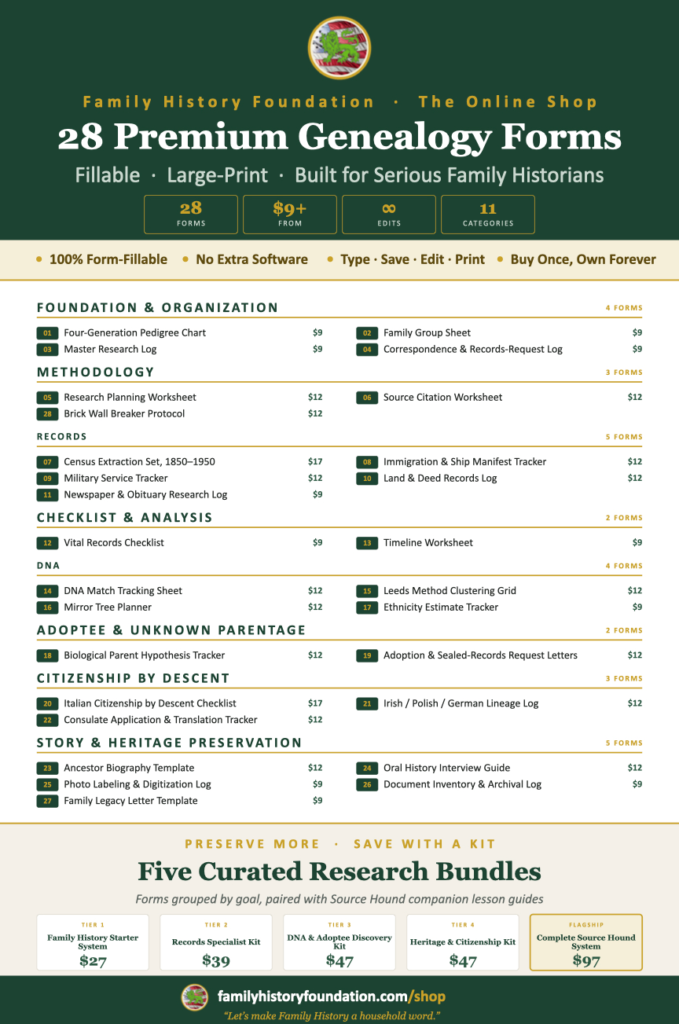
Shop Premium Genealogy Forms

About the Author
Hi there, my name is Franklin, the founder and author of The Family History Foundation.
Our family stories are disappearing every day and it’s crucially important that the next generation is able to learn and appreciate their family history. It is up to you to take up the mantle of responsibility to ensure that how you research today will be passed on tomorrow with the highest standards possible.
I believe that genealogy is not just about names and dates, it’s about your stories and how those stories inform your identity.
With a penchant for storytelling and a background in research, the insights and techniques you learn on The Family History Foundation will help you uncover the incredible stories and identities hidden within the tapestry of your ancestry.
My mission is “Let’s make Family History a household word.”
My motto is “The Past ‘Relative’ to the Future.”
Frequently Asked Questions
Q: Who is eligible for Irish Citizenship by Descent?
A: You are eligible if you have a parent born in Ireland (in which case you are already a citizen automatically), a grandparent born in Ireland (claim through the Foreign Births Register), or a great-grandparent born in Ireland — but only if your parent registered on the Foreign Births Register before you were born. See the Citizenship by Descent post for how this compares across Europe.
Q: Do I need to live in Ireland or speak Irish to claim?
A: No. Irish Citizenship by Descent has no residency requirement and no language test. The entire process can be completed from your home country, and no Irish or English language proficiency is assessed. However, taking the time to learn basic Irish can help you in terms of reading street signs and other publicly-posted information. Learning Irish is a great way to connect culturally to your heritage.
Q: What is the Foreign Births Register?
A: The Foreign Births Register is the official log, maintained by Ireland’s Department of Foreign Affairs, of people born abroad who have claimed Irish citizenship through descent. Once entered onto the register, you are an Irish citizen from the date of registration and may apply for an Irish passport.
Q: Why do so many Irish Citizenship by Descent applications fail?
A: The most common reason is documentation. Roughly half of applications stall because applicants submit photocopies, short-form certificates, or commemorative certificates instead of original long-form state-issued civil certificates. Submitting the correct documents the first time is the single biggest factor in a smooth application.
Q: How do I find my Irish ancestor’s birthplace?
A: This is the central research challenge. The General Register Office requires you to know the county, parish, or townland before you can order the certificate. Census records, emigration records, and church records are the keys — and the Source Hound methodology is designed for exactly this kind of investigation.
Q: Can I pass Irish Citizenship by Descent to my children?
A: Yes — but timing is everything. You must register yourself on the Foreign Births Register before your children are born for them to be eligible through you. If you register after they are born, they cannot claim through your registration.
Q: How much does Irish Citizenship by Descent cost and how long does it take?
A: The Foreign Births Register fee is approximately €278 for adults and €153 for minors. Total costs including document retrieval typically run USD $500–$2,000. Processing takes approximately 9–12 months, with a full journey of about 12–18 months including document gathering.
Q: Does claiming an Irish passport affect my current citizenship?
A: No. Ireland fully permits dual citizenship, and the US, Australia, Canada, and New Zealand all allow their citizens to hold additional nationalities. Claiming your Irish ancestral passport means holding both.