Proving Ancestry ThruLines is not something you do by clicking a button — and this case study is living proof of exactly why that matters. 🧬 When a DNA match pointed to someone named “Graham” in my well-documented “Collins” line, the easy answer would have been to dismiss it as a ThruLines error. But a Source Hound never takes the easy answer. Oh no, not me – and you won’t do this either!
Instead, what followed was a step-by-step research journey through Ancestry member trees, across to Find a Grave, and into a cemetery memorial that contained one of the most remarkable family stories I have ever encountered — the true identity of a seven-year-old boy named Daniel Boone Collins, who ran away from home and spent the rest of his life as Daniel Boone Graham.
Read on, you’ll not want to miss this as it is both an epic tale and a cautionary research tale all at the same time.
Table of Contents
This post walks you through the complete methodology, the exact steps taken, and the specific Source Hound principles that turned a confusing anomaly into a verified, documented breakthrough. Whether you are new to DNA research or have been staring at your own ThruLines for years, this case will change the way you think about the hints sitting in your tree right now.
🐕 Pull up a chair, let’s get to it.
What ThruLines Actually Shows You — and What It Doesn’t
Before we dive into the case, a quick but essential framing. Proving Ancestry ThruLines is the goal — but understanding what ThruLines is actually showing you is the starting point.
ThruLines on Ancestry.com is not a DNA conclusion. It is an algorithmically generated hypothesis built by connecting your tree with the trees of your DNA matches and filling in gaps using other searchable trees across the database. Understanding this distinction is the foundation of proving Ancestry ThruLines with any confidence.
Here are 2 essential points, if you haven’t noticed this already. 🤠🤓
- ┃The SOLID BOXES in your ThruLines display represent ancestors already in your confirmed tree.
- ┇ The DOTTED BOXES represent Ancestry’s suggestions — potential ancestors drawn from other people’s trees that have not yet been verified.
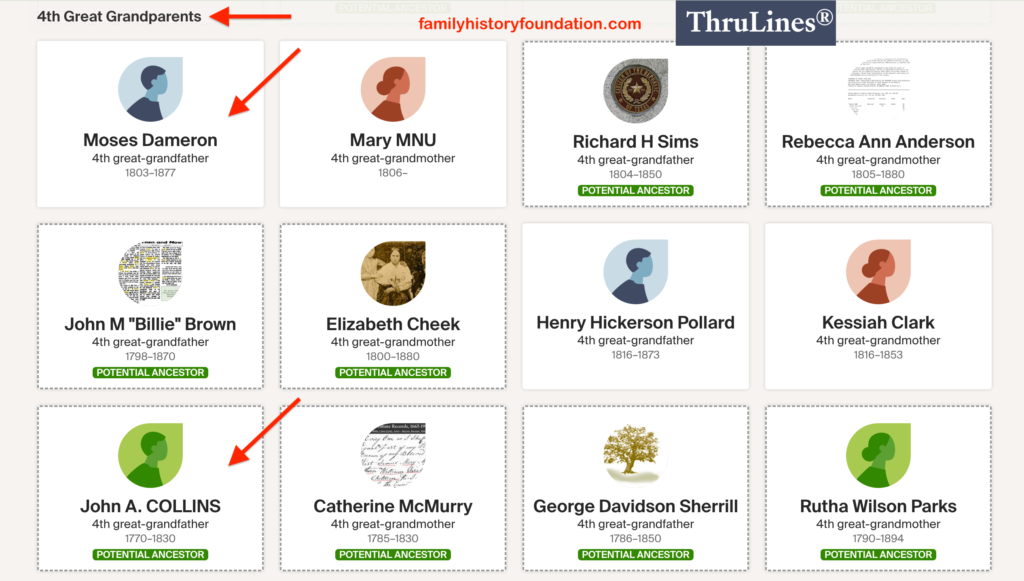
A dotted box is a research invitation, not a research conclusion. 📋
The challenge is that many researchers — particularly those newer to DNA analysis — see a ThruLines path that looks clean and logical, see the shared centimorgans alongside it, and feel confident enough to click confirm. That instinct is completely understandable. But it is precisely where errors enter trees and multiply across the database.
Let’s start by analyzing what YOU WANT TO SEE versus WHAT YOU DON’T WANT TO SEE when you click either of these example boxes.
Your Source Hound strategy is going to be looking deeper at the ancestor page Ancestry.com takes you to on ThruLines, this is the secret sauce. Let’s start with WHAT YOU DON’T WANT TO SEE.
I’m going to demonstrate my method for proving Ancestry ThruLines by showing you my own tree.

If you hover over the highlighted box, ThruLines will give you a readout of Centimorgan (cM) overlap and the number of shared ancestors. This is exciting, but can be somewhat misleading. Let’s continue to see what you actually don’t want to encounter. Or, let’s just say, what is less desirable or sub-optimal.
We don’t want to see all that empty space! It’s like the Fermi Paradox, there should be more life out there!
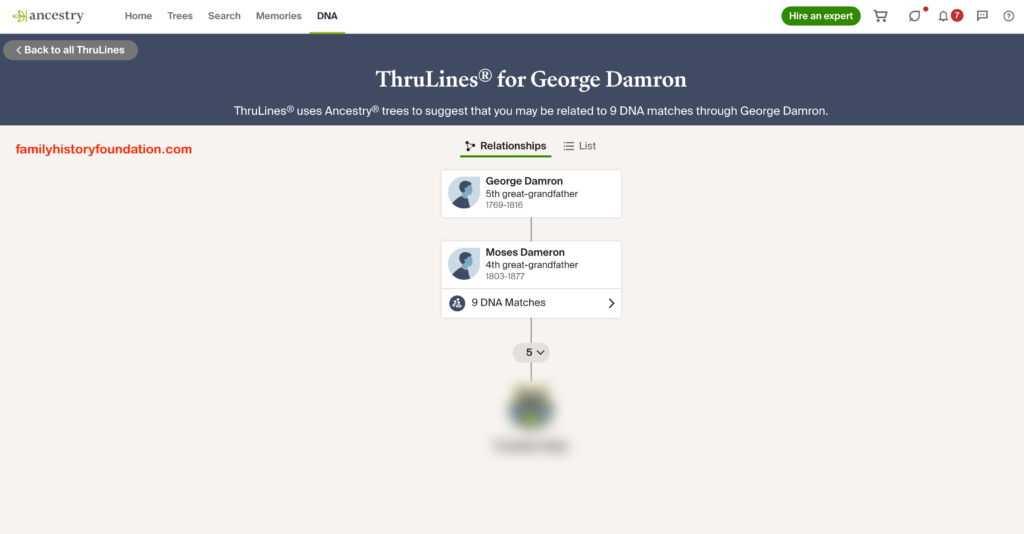
Do you see it? Well, actually, YOU DON’T SEE IT – and that’s the point. What you should be seeing are HORIZONTAL connections to your target ancestor. This is just a VERTICAL line of direct descent which I already know.
Yes, you can click on the 9 DNA Matches for my target ancestor Moses Dameron; however, that will only reveal DNA matches for my 3rd great-grandparents and younger.
All hope is not lost! Don’t simply dismiss pages like this. This particular Proving Ancestry ThruLines technique does not involve tracking down these specific types of leads, this is for other avenues of research.
For now, let’s look at an example of what you DO want to see, ideally.
I’m going to select this ancestor with a dotted box to try and find my Collins line in North Carolina.

Be aware that there is no real correlation between dotted boxes and solid line boxes in terms of the discoveries you can make, so make sure you watch my YouTube episode for this post linked down below.
Below is WHAT YOU WANT TO SEE! There is life out there in our ancestral past, or at least in Ancestry’s algorithm! Clicking on this ancestor generated a page with HORIZONTAL lines of potential ancestral connections.
CHALLENGE: Pretend this is your Ancestry DNA page, what is the first thing that jumps out at you?
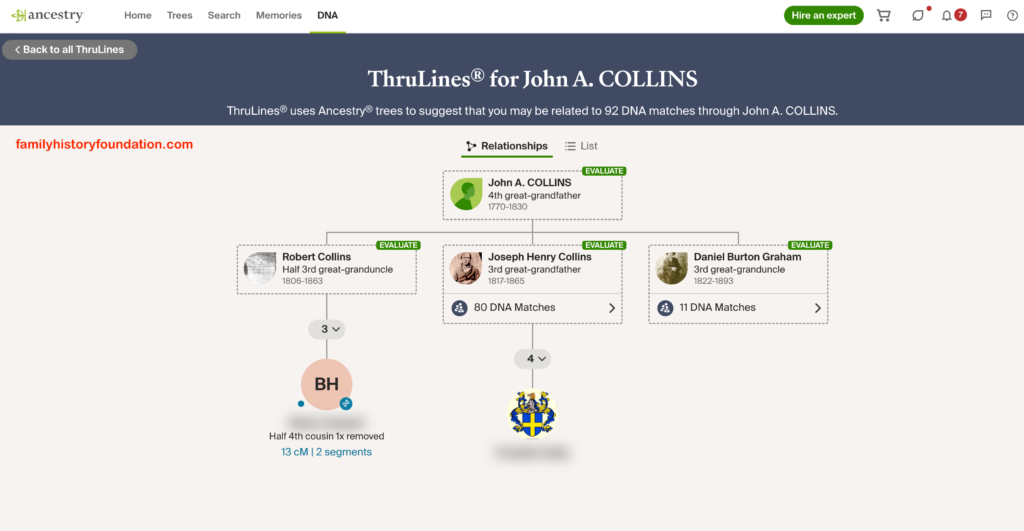
The reason this post is so instructional and representative of my Source Hound methodology, and why it is titled “Proving Ancestry ThruLines: The Source Hound Case of Daniel Boone Graham” is that there is an anomaly here . . . the surname GRAHAM.
CHALLENGE ANSWER: the surname Graham.
What is it doing there? Why is Daniel Burton Graham an implied son of John A. Collins, ergo a brother to my ancestor Joseph Henry Collins and Robert Collins? This is what I HAD TO FIND OUT.
It would be all too easy to simply dismiss Daniel Graham as some aberration or common research error, but why the 11 DNA Matches? If this person was someone who was mindlessly added in by some careless researcher, why would I have a DNA connection to him?
There must be some substance here to this person – I had to solve the mystery! And solve it I did!
Proving Ancestry ThruLines correctly means treating every dotted box as the beginning of a research trail, not the end of one. For a deeper grounding in how ThruLines works and the five most common traps researchers fall into, read my companion post Ancestry ThruLines Explained before continuing with this case study.
The Anomaly: A Graham in a Collins Line
Every Source Hound breakthrough begins with an anomaly — something that doesn’t fit, something that makes you stop and look twice rather than scroll past. Proving Ancestry ThruLines always starts at exactly this moment.
In this case, the anomaly was a surname. A DNA match was appearing in the ThruLines display connected to a known and well-documented Collins family line. But the suggested ancestor carried the name Graham. Not Collins. Graham.
Do you see him on the right-hand side of the page?
Also note that Robert Collins is listed as a HALF-BROTHER to my Ancestor Joseph. Another mystery! Given the time period of the late 1700s/early 1800s, there were fewer reasons why a father had half-siblings. Especially in rural North Carolina.
For a researcher less committed to proving Ancestry ThruLines properly, this might have been dismissed as a classic ThruLines error — a misidentified connection, a tree copying mistake, the kind of noise that clutters DNA research. After all, surname mismatches are one of the most common error types when proving Ancestry ThruLines, driven by tree mistakes that propagate across the database when researchers accept suggestions without verification.
But the DNA match was real. The shared centimorgans were real. And that meant the Graham had to be explained — not dismissed. Proving Ancestry ThruLines in this situation meant following the evidence wherever it led, regardless of how unexpected the destination turned out to be.
I walk you through all of the detailed maneuvers and tree-clicking in my companion YouTube episode below, but sufficed to say it was a journey of discovery you can most certainly benefit from by watching. You will want to copy those techniques as I walk you through them live.
The Source Hound principle at work here is simple but powerful: follow the anomaly, because anomalies are almost always attached to a story.
Thinking Horizontally: The Source Hound Research Matrix
Most genealogists naturally think vertically — tracing direct lines of descent from parent to child, generation by generation. Vertical research is essential and forms the backbone of any family tree. But proving Ancestry ThruLines suggestions frequently requires a different approach: thinking horizontally.
Horizontal research means looking sideways across a family — at siblings, cousins, and collateral relatives — rather than only up and down the direct line. This is where the verification clues almost always hide.
When you look at a ThruLines display and see a clean, direct vertical path from a proposed ancestor down to your DNA match, that path can feel reassuring. But the real test of proving Ancestry ThruLines is what happens horizontally — whether siblings share consistent names, locations, and dates; whether collateral family members appear in the right records at the right times; whether the family cluster behaves the way a real family cluster should.
In the Graham-Collins anomaly, horizontal thinking was the key that unlocked everything. Proving Ancestry ThruLines in this case required looking not just at the proposed ancestor, but at the entire family landscape around him. Who were his siblings? Who raised him? What does the record of his life as a whole suggest about his origins?
This approach — the Source Hound Research Matrix — is the same methodology I use across all of my genealogical work and introduce fully in my Ultimate Beginners Guide to Professional Genealogy Research Online. It is the framework that turns a confusing hint into a provable fact — and the backbone of proving Ancestry ThruLines at a professional standard.
Step One: Evaluating the Ancestry Member Trees
The first step in proving Ancestry ThruLines was to look beyond the ThruLines display itself and go directly to the member trees connected to the DNA match. This is where proving Ancestry ThruLines moves from hypothesis to active investigation.
This is a step many researchers skip — they see the ThruLines path, they note the shared cM, and they move on. But the trees connected to your DNA matches are a research resource in their own right, and evaluating them carefully is a non-negotiable part of the Source Hound verification process.
Two types of trees came up in this search. The first were trees managed by close genetic matches — researchers whose shared DNA with me is significant enough that the connection is biologically certain. The second were trees managed by more distant or non-genetic matches — researchers who appeared in the broader search but whose genetic connection was less definitive.
Here is a principle worth writing down: do not disregard trees managed by non-genetic matches. 🖊️
Non-genetic matches can still carry genealogical intelligence about a family line. A researcher who has documented a branch of the Graham family in detail — even if their genetic connection to you is uncertain — may have records, photographs, or family knowledge that are directly relevant to proving Ancestry ThruLines for your specific match.
Every tree is a potential source. A Source Hound evaluates the evidence it contains, not just the genetic credentials of the person who built it.
In this case, the trees pointed consistently toward a Graham family in North Carolina in the 1820s. The name Daniel Boone Graham appeared repeatedly. The dates and locations were internally consistent. But no tree explained why a Graham was appearing in a Collins DNA line — and proving Ancestry ThruLines requires answering exactly that kind of question. That explanation required moving off Ancestry entirely.
Step Two: Moving to Find a Grave
Step Two is actually to follow up on all of the resources you can when you root through the SOURCES shared on genetically connected family trees. In the case of Danieal “Boone” Graham, it led me to Find-A-Grave!
Find a Grave is one of the most underused verification tools in the DNA genealogist’s toolkit, and it was the platform that cracked this case wide open. When proving Ancestry ThruLines, moving off the Ancestry platform entirely is sometimes exactly what the research demands.
When primary records and member trees give you a name and approximate dates but leave a genealogical question unanswered, cemetery memorials are frequently where the answers are preserved. Find a Grave memorials are contributed by family members, local historians, and genealogical volunteers — and they often contain family knowledge that never made it into any official record.
Searching through an Ancestry tree linked to Daniel Graham, I found a Find a Grave Memorial link for Daniel Boone Graham, born approximately 1822 in BUNCOMBE COUNTY, North Carolina, led to Memorial ID 70946157. Daniel Burton “Boone” Graham. Buried at Elmwood Cemetery, Mineral Wells, Palo Pinto County, Texas. Died 28 November 1893.
When I saw Buncombe County, NC, I knew I was hot on the trail. My Collins family settled in Sherrills Ford, NC around Haywood County.
And then, in the memorial notes contributed by family descendants, the story was there. In full. In their own words. 📜
The Discovery: Daniel Boone Collins
The Find a Grave memorial for Daniel Burton “Boone” Graham records three family legends passed down through his descendants. Together, they constitute the most compelling single document in this entire case — and the breakthrough that made proving Ancestry ThruLines not just possible, but complete and irrefutable.
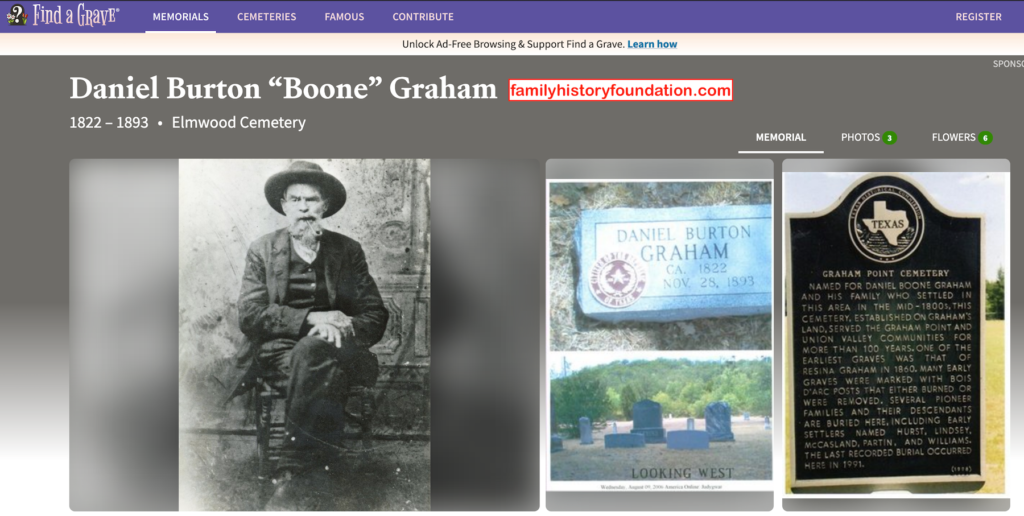
The memorial states that Daniel Boone Grayham was born in Buncombe County, North Carolina in 1822. It records that “legend says he ran away from home when he was seven years old and never went back.” It records that “he left home to get away from his mother who was supposed to be ‘no good,’ she had Daniel Boone Grayham and went by the name of Collins.” And it records that “Daniel Boone Collins was raised by a man named Grayham. Daniel Boone took the name of the man that raised him.”
Read that slowly. Let it settle in. 🌟
A seven-year-old boy. Born Daniel Boone Collins in 1822 in Buncombe County, North Carolina. He ran away from a difficult home situation, was taken in and raised by a man named Graham, and from that point forward he lived, married, had sixteen children, moved to Texas, and settled there — all as Daniel “Boone” Graham.
The Collins surname did not disappear from his DNA. It simply went underground for 170 years, waiting for a Source Hound to find it. And this is exactly why proving Ancestry ThruLines properly matters so profoundly — and why dismissing an anomaly too quickly can cost you the most extraordinary story in your entire family tree.
Remember the name “Boone?” Well that struck me as an interesting artifact, like the legendary Daniel Boone. Was there a connection? Read on and find out.
The Historical Context: Why “Daniel Boone?”
One of the Source Hound takeaways from this case involves historical naming conventions — a dimension of genealogical research that is easy to overlook but frequently carries significant evidential weight.
Another definitive part of my Source Hound Method is using the historical context in genealogy research. Understanding the history of the times in which you are researching will open up so many clues you will be unstoppable.
Daniel “Boone” Collins was born in 1822 in Buncombe County, North Carolina. Daniel Boone — the legendary frontiersman — died in 1820, just two years earlier. His death was widely reported and mourned across the American frontier states.
The name Daniel Boone in the early 1820s, particularly in a North Carolina mountain family, was not a coincidence. It was a tribute — and a crucial piece of evidence when proving Ancestry ThruLines for a family with deep Appalachian roots.
Boone, North Carolina is also just up the road from Buncombe County and Haywood County and is the legendary home of one of the greatest guitarists and country/bluegrass singers of all time: DOC WATSON.
This naming convention tells you something important about Daniel Burton “Boone” Collins’ parents. They were likely frontier-minded, Appalachian in culture, and aware enough of current events to name their son after a recently deceased national hero. That cultural and geographic profile is entirely consistent with a Collins family in Buncombe County in 1822 — and it is one more piece of corroborating evidence that this identification is correct.
Historical naming context is a legitimate genealogical source. When you are proving Ancestry ThruLines and the documentary record is thin, asking “why was this person named this?” can open research directions that strict record-searching would never reveal. It is one of the most underused tools in the Source Hound’s verification toolkit.
Genealogy vs. Family History: The Deeper Lesson
This case crystallises a distinction I return to again and again on this blog and in my YouTube episodes. There is a difference between genealogy and family history — and understanding that difference is what separates a name-collector from a true family historian. It is also what makes proving Ancestry ThruLines worth every hour of careful research.
Genealogy is the dates. Daniel Burton Collins, born 1822, Buncombe County, North Carolina. Died as Daniel Boone Graham, 28 November 1893, Palo Pinto County, Texas. That is what proving Ancestry ThruLines delivers at its most fundamental level — confirmed dates, confirmed identity, confirmed connection.
Family history is the story of a seven-year-old boy walking away from everything he knew, taking a new name, and building an entirely new life. It is the story of sixteen children who grew up as Grahams, not knowing — or perhaps half-knowing — that their father had once been a Collins. It is the story of a DNA connection that survived 170 years of a changed surname and waited patiently in a ThruLines display for someone to stop, look twice, and refuse to dismiss the anomaly.
CASE AND POINT: There may or may not be a connection, but Palo Pinto, Texas is just up the road from Graham, Texas. Spurious? Maybe, but I’d follow up on that lead because you never know!
Example, I was researching small towns near Eastland County, Texas and came across a Stephenville – come to find out that the town was founded by my 1st cousin’s maternal grandfather (we are related on our paternal side) so you never know.
Proving Ancestry ThruLines in this case did not just confirm a DNA connection. It recovered a human life that had been hiding in plain sight for nearly two centuries. That is what this work is for. 🌳
The Family History Foundation Newsletter
It’s Not About You, It’s About Documenting Before It Disappears
Join 500+ family historians getting Franklin’s Source Hound weekly research breakthroughs — real case studies, source hacks, and the exact strategies that turn brick walls into discoveries.
Free. No fluff. Straight from the Source Hound’s desk to yours.
Your privacy is sacred — almost as sacred as a primary source. Read our Privacy Policy.
The Collins Family — A Deeper Connection
For those who follow this blog and its long research thread through the Collins family, this discovery carries an additional resonance that deserves acknowledgment.
📚 The Collins Family and the Sultana Connection
The Collins line in this research is directly connected to one of the most dramatic stories in American history. My 3rd great-grandfather, Joseph Henry Collins (1817–1865), and his eldest son James Robert Collins (1844–1919) were both aboard the SS Sultana when it exploded on the Mississippi River on 27 April 1865 — the worst maritime disaster in US history, with greater loss of life than even the Titanic.
Joseph Henry Collins did not survive. His son James Robert did, and left a first-hand written account of that night.
The Collins family was a Unionist family from Bradley County, Tennessee — survivors of Cahaba Prison, the Civil War, and the Sultana. Understanding the broader Collins family landscape is what makes each new discovery within that line — including Daniel Boone — so meaningful.
📖 Read the full story: The Steamer Sultana Explosion and the Collins Family
📚 Every Sultana source ever published: 37 Sultana Disaster Books
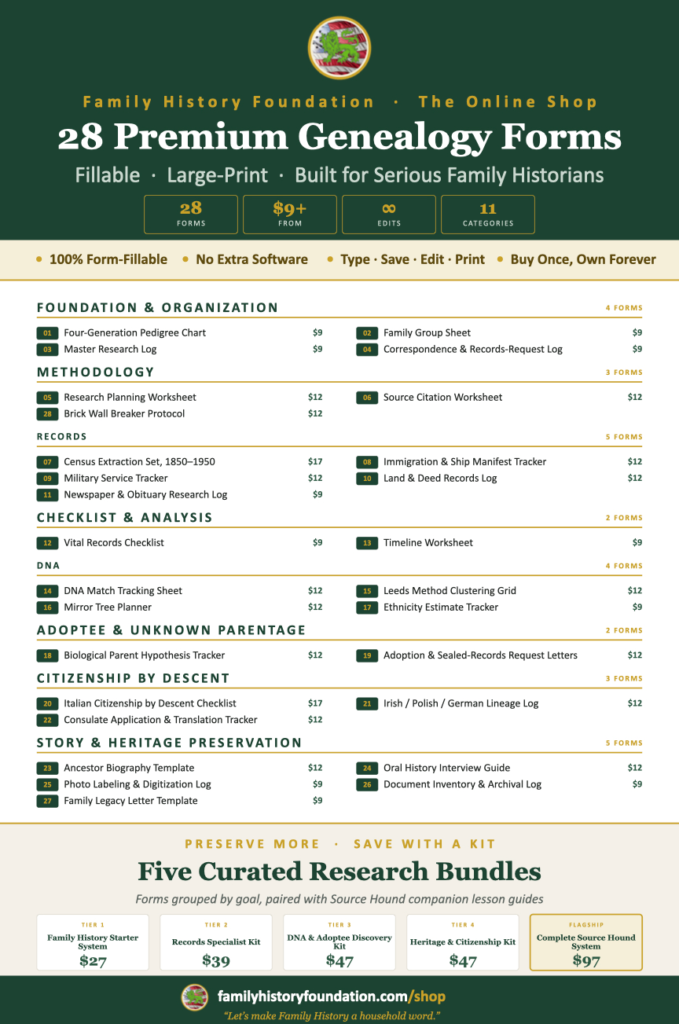
Having free forms is cool ~ having 100% FORM-FILLABLE genealogy forms with no fuss is even better! Visit The Family History Foundation Shop for Citizenship tracking forms, as well as 28 editable and fillable genealogy forms!

Source Hound Takeaways: What This Case Teaches
Every case study should leave you with principles you can apply immediately to your own research. Here are the five Source Hound takeaways from proving Ancestry ThruLines in the Daniel Boone Graham case — each one a principle you can apply to your very next ThruLines session.
1. Follow surname anomalies — they are almost always attached to a story. A surname mismatch in ThruLines is not automatically an error. It may be the most important clue in the entire display. Investigate before you dismiss.
2. Read the memorial, not just the index card. Find a Grave index entries give you dates and locations. The memorial notes — contributed by family members and descendants — give you the story. Always click through to the full memorial before moving on.
3. Evaluate every tree, including non-genetic matches. Genealogical intelligence does not require a genetic connection to be valuable. A well-documented tree from a non-genetic match may contain the record that proves your case.
4. Think horizontally, not just vertically. Direct line research tells you who your ancestors were. Collateral research — siblings, cousins, the broader family cluster — tells you why the records look the way they do.
5. Historical naming conventions are genealogical evidence. The name “Daniel Boone” in 1822 North Carolina is not a decoration. It is a data point. Ask why your ancestor was named what they were named. The answer may open research directions that records alone cannot.
Use our Free Genealogy Forms Bundle — particularly the Research Log and Source Citation templates — to document each of these steps as you apply them to your own ThruLines. The paperwork is as important as the discovery. 📝
Watch the Full Case Study on YouTube
This entire Source Hound journey — including the live ThruLines walkthrough, the Find a Grave discovery, and the full Daniel Boone Graham story — is documented in a dedicated episode on the Family History Foundation YouTube channel. If you prefer learning by watching, this episode is the perfect companion to this post on proving Ancestry ThruLines. 📺
If you are a visual learner, watching the screen walkthrough alongside reading this post will lock the methodology into your research practice far more effectively than either resource alone.
▶️ Watch: Proving Ancestry ThruLines — The Source Hound Journey
Subscribe while you are there and hit the 🔔 notification bell — new research episodes publish every week for Family History Fridays.
Let’s Connect — Your Community Is Waiting!
Have you ever followed a ThruLines anomaly that turned out to be the most extraordinary story in your entire family tree? 💬 Or have you dismissed one — and now you are wondering what story might be hiding behind it?
Drop your experience in the comments below. The genealogy community learns best when we share our real research — the breakthroughs, the brick walls, and the moments when an ancestor suddenly becomes a real, breathing human being rather than a name on a census form.
If this case study helped you think differently about proving Ancestry ThruLines in your own research, please share it with a fellow family historian – or family member! One share might be all it takes to help another researcher find their own Daniel Boone. 🌳
📺 Watch New Episodes Every Week on YouTube
Source Hound methodology walkthroughs, ThruLines case studies, census deep-dives, DNA research tutorials, and much more — new episodes every week, built for the serious family historian.
👉 Subscribe to The Family History Foundation on YouTube
Hit the 🔔 notification bell so you never miss a case study.
📌 Save Your Favourite Research Tips on Pinterest
Genealogy strategies, Source Hound checklists, family history inspiration, and research methodology guides — all organised and ready to save for your next research session.
👉 Follow The Family History Foundation on Pinterest
📧 Join the Newsletter
Exclusive research tips, new post alerts, case study summaries, and free resources delivered straight to your inbox every week. No spam. Pure genealogy.
👉 Subscribe to The Family History Foundation Newsletter
The Past — ‘Relative’ to the Future. Let’s make Family History a household word 🕰️
The Family History Foundation Newsletter
Our Family History Is Disappearing Every Day!
Join the quest with 500+ family historians getting Franklin’s Source Hound weekly research breakthroughs — real case studies, source hacks, and the exact strategies that turn brick walls into discoveries.
Free. No fluff. Straight from the Source Hound’s desk to yours.
Your privacy is sacred — almost as sacred as a primary source. Read our Privacy Policy.
Shop Premium Genealogy Forms
About the Author
Hi there, my name is Franklin, the founder and author of The Family History Foundation.
Our family stories are disappearing every day and it’s crucially important that the next generation is able to learn and appreciate their family history. It is up to you to take up the mantle of responsibility to ensure that how you research today will be passed on tomorrow with the highest standards possible.
I believe that genealogy is not just about names and dates, it’s about your stories and how those stories inform your identity.
With a penchant for storytelling and a background in research, the insights and techniques you learn on The Family History Foundation will help you uncover the incredible stories and identities hidden within the tapestry of your ancestry.
My mission is “Let’s make Family History a household word.”
My motto is “The Past ‘Relative’ to the Future.”
Frequently Asked Questions ❓
Q: What is the most important first step in proving Ancestry ThruLines?
A: Evaluating the shared centimorgan count first — before touching any tree information. The DNA figure is real and measured. The relationship path explaining it is a hypothesis. Start with the biology, then follow the paper trail. Proving Ancestry ThruLines always begins with the DNA, not the tree.
Q: Why did Find a Grave solve a case that Ancestry records couldn’t?
A: Because Find a Grave memorials are contributed by family members who carry oral history and family knowledge that never entered any official record system. A birth certificate, census record, or death certificate would never record the story of why Daniel Boone Collins became Daniel Boone Graham. A family memorial could — and did.
Q: Should I look at trees from non-genetic matches when proving Ancestry ThruLines?
A: Absolutely yes. Genealogical intelligence and genetic connection are two different things. A non-genetic match may have documented a family branch with exceptional detail. When proving Ancestry ThruLines, evaluate the evidence in the tree — not just the DNA credentials of the builder.
Q: What does “thinking horizontally” mean in practice?
A: It means looking at siblings, cousins, and collateral relatives of your proposed ancestor rather than only tracing the direct vertical line. Horizontal family members often appear in records that explain anomalies in the direct line — as they did in this case.
Q: How do historical naming conventions help with genealogy research?
A: Names in the 19th century were rarely random. A child named after a recently deceased public figure, a biblical character, or a prominent local person carries cultural and geographic information about their parents. That information can corroborate or contradict a proposed ancestor identification in ways that documentary records alone cannot.
Q: Can I apply the Source Hound methodology to other DNA platforms, not just Ancestry?
A: Yes — entirely. The Source Hound methodology is a research philosophy, not a platform-specific tool. The principles of following anomalies, thinking horizontally, evaluating every tree, and cross-referencing with independent records apply equally to MyHeritage, 23andMe, FamilyTreeDNA, and any other platform offering DNA matching. Proving Ancestry ThruLines is the focus here, but the same framework applies everywhere.
Q: Where can I learn more about the Source Hound methodology?
A: The full framework is introduced in my Ultimate Beginners Guide to Professional Genealogy Research Online. Read it alongside this case study and the ThruLines Explained post for the complete picture.