The 1830 Census introduced 13 age brackets for free white persons—the most granular age tracking in any census before 1850.
Most genealogists find their ancestor, note the age bracket, and move on. Here’s what they miss: those 5-year increments let you calculate birth years within narrow windows, transforming vague “early 1800s” estimates into targeted searches.
Table of Contents
This matters when you’re searching baptism records, verifying family relationships, or distinguishing between two people with the same name. The 1830 federal census gives you the tightest birth year window of any head-of-household enumeration—just 5 years instead of 10-20 year ranges in earlier censuses.
I’m Franklin, the “Source Hound” behind Family History Foundation. After finding both my biological parents as an adoptee, I’ve learned that precise dates unlock breakthroughs. The 1830 census sits at a critical junction: it’s the last head-of-household census before 1850’s individual name listings, and it captured America during peak westward expansion.
For complete context on all census years from 1790-1950, see our US Federal Census comprehensive guide. This post focuses specifically on using the 1830 enumeration to calculate precise birth years.
Why the 1830 Census Matters for Birth Year Calculations
The 1830 Census provides the finest age resolution of any census in the head-of-household era.
By 1830, the United States had expanded dramatically westward. Families streamed into Ohio River Valley territories and beyond the Mississippi. The nation needed accurate population counts for representation—and genealogists inherited the most precise age data yet.
Here’s what makes the 1830 federal census uniquely valuable:
📊 13 age brackets – Most granular tracking before 1850 (vs 6 in 1820, 5 in 1810)
📅 5-year increments – Narrows birth years to specific windows
🎯 Precise record targeting – Know exactly which years to search
🗺️ Migration context – Families captured during territorial expansion
🔍 Last head-of-household census – Final comparative analysis opportunity before 1850
The 1830 census won’t name every family member. But it calculates birth years more precisely than any census between 1790-1840.
Source Hound strategy: Use 1830 age brackets to create 5-year birth windows, then search only those years in baptism records. This saves hours compared to searching entire decades.
What the 1830 Census Contains: The Complete Age Structure
The 1830 Census used the most detailed age categorization system implemented to that point.
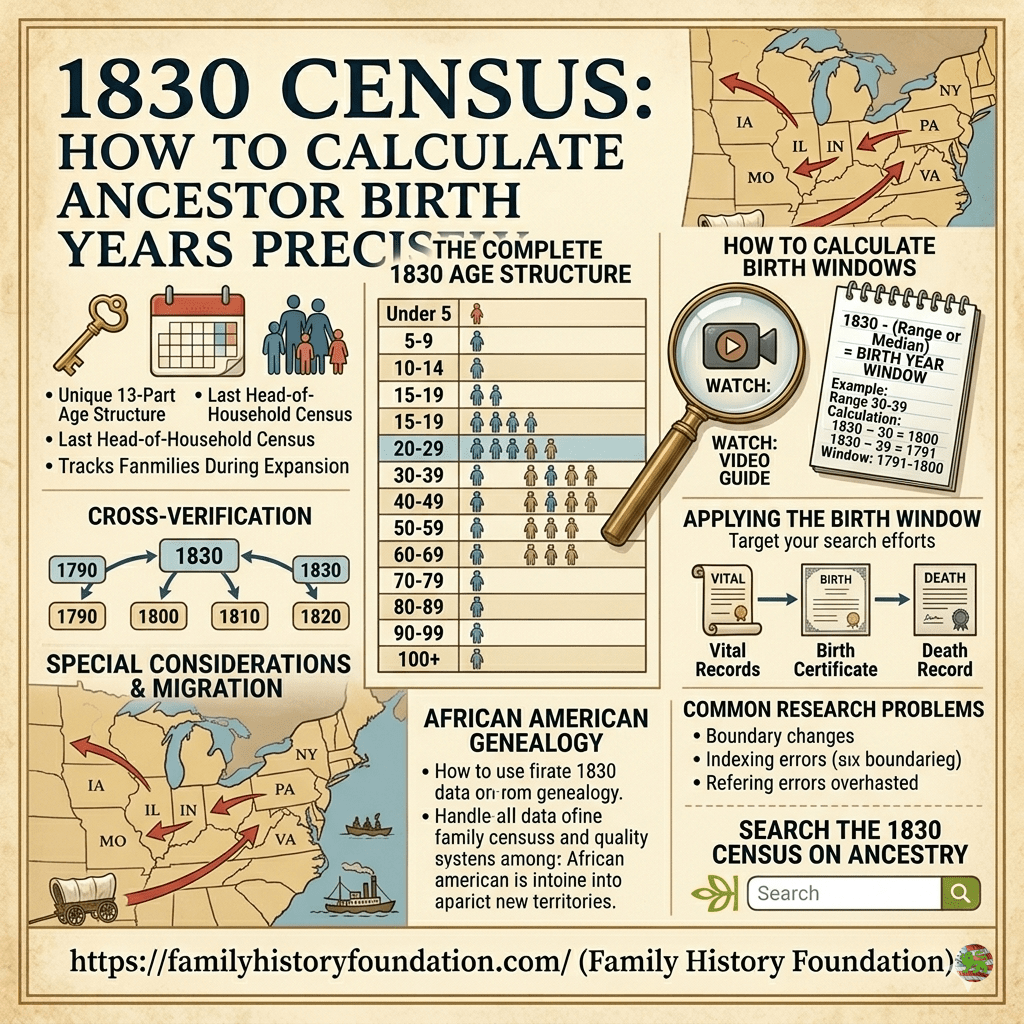
Free White Persons: 13 Age Brackets
Every free white person was counted in one of these categories:
Males and Females (identical brackets):
- Under 5 years
- 5 to 10 years
- 10 to 15 years
- 15 to 20 years
- 20 to 30 years
- 30 to 40 years
- 40 to 50 years
- 50 to 60 years
- 60 to 70 years
- 70 to 80 years
- 80 to 90 years
- 90 to 100 years
- 100 and upwards
Why this matters for genealogy:
The 5-year increments for children and young adults (under 20) give precise birth windows for the generation most likely appearing in later censuses as heads of household.
The 10-year increments for adults (20-100) still provide better precision than earlier censuses.
The inclusion of categories beyond 100 shows centenarians were tracked—though rare, they existed.
Slaves and Free Colored Persons
The 1830 federal census continued the age breakdowns introduced in 1820:
Age brackets (males and females separately):
- Under 10 years
- 10 to 24 years
- 24 to 36 years
- 36 to 55 years
- 55 to 100 years
- 100 and upwards
Critical for African American genealogy: These broader brackets still allow approximate birth year calculations for enslaved and free Black ancestors.
Disability Tracking (NEW!)
The 1830 census was the FIRST to track disabilities:
Categories recorded:
- Deaf and dumb under 14
- Deaf and dumb 14 to 25
- Deaf and dumb 25 and upwards
- Blind (all ages)
Genealogical significance: If your ancestor had a disability, the 1830 enumeration may be the first record mentioning it. Cross-reference with asylum records, special school enrollments, or estate documents.
Foreigners Not Naturalized
This column continued from 1820, counting immigrants who hadn’t completed naturalization.
Watch: Calculating Birth Years Using Census Data
Before diving into calculation methods, watch my YouTube Census tutorials on using age brackets to determine precise birth years and target vital records.
Subscribe to Family History Foundation on YouTube for the complete US Census series—new tutorial every Friday!
How to Calculate Birth Years from 1830 Age Brackets
The 1830 Census age brackets translate directly into birth year windows.
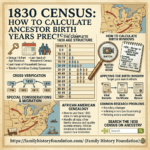
The Basic Formula
Birth year = Census year – Age bracket maximum
For the 1830 census:
- Someone in the “under 5” bracket was born 1826-1830
- Someone in the “5 to 10” bracket was born 1820-1825
- Someone in the “20 to 30” bracket was born 1800-1810
Step-by-Step Calculation Method
Example: Finding birth year for a male in the “10 to 15” bracket
Step 1: Note the census year (1830)
Step 2: Identify the age bracket (10 to 15)
Step 3: Calculate maximum age (15 years old on census day)
Step 4: Subtract from census year: 1830 – 15 = 1815
Step 5: Calculate minimum age (10 years old on census day)
Step 6: Subtract from census year: 1830 – 10 = 1820
Result: Birth year window is 1815-1820 (5 years)
This is the power of the 1830 federal census: you’ve narrowed a lifetime down to 5 specific years.
Real-World Example: The Miller Family
1830 Census shows:
- Males under 5: 2
- Males 5-10: 1
- Males 30-40: 1 (head of household)
- Females under 5: 1
- Females 20-30: 1 (likely wife)
Birth year calculations:
Head (male 30-40): Born 1790-1800 Wife (female 20-30): Born 1800-1810 Son 1 (male 5-10): Born 1820-1825 Son 2 (male under 5): Born 1826-1830 Son 3 (male under 5): Born 1826-1830 Daughter (female under 5): Born 1826-1830
Research implications:
Search baptism records 1820-1825 for oldest son. Search 1826-1830 for three youngest children. Search marriage records 1800-1810 for parents’ union (if wife was 16-20 at marriage).
This focused searching using our genealogy research methods saves tremendous time.
Using Birth Year Windows to Target Vital Records
Once you’ve calculated birth years from the 1830 Census, use them strategically.
Baptism and Birth Records
The traditional approach: Search “John Smith baptism” across entire county records (hundreds of pages)
The 1830 census approach:
- Calculate birth window from age bracket
- Search ONLY those specific years
- Reduce search time by 80%
Example: 1830 census shows male 10-15. Born 1815-1820. Search church baptism registers for only 1815, 1816, 1817, 1818, 1819, 1820. Ignore everything before 1815 and after 1820.
Marriage Records
The 1830 federal census helps estimate marriage years for couples.
Method:
Find couple in 1830 as head of household (male 30-40) and wife (female 20-30). Assume marriage when wife was 16-25 years old.
Calculation:
- Wife born 1800-1810 (female 20-30 in 1830)
- Likely married 1816-1835 (when she was 16-35)
- Oldest child born 1826-1830 (under 5 in 1830)
- Marriage probably 1825-1830 (shortly before first child)
Search marriage records 1825-1830 instead of entire decades.
Estate and Probate Records
For older ancestors appearing in upper age brackets, calculate death year estimates.
Example: Male aged 70-80 in 1830 was born 1750-1760. He’s likely to die 1830-1850 (typical lifespan). Search probate records in those decades, not randomly across 50 years.
Comparing 1830 to Earlier Censuses for Verification
The 1830 Census becomes exponentially more powerful when compared to 1820 and earlier enumerations.
The 40-Year Tracking Method
By 1830, you can track families across four decades: 1790 → 1800 → 1810 → 1820 → 1830.
Example: Tracking the Johnson Family
1790 (Virginia):
- Males under 16: 2
- Males 16+: 1
- Females: 2
1800 (Virginia):
- Males 26-44: 1 (head aged)
- Females 26-44: 1 (wife)
- Males under 10: 3 (new generation)
1810 (Virginia):
- Males 26-44: 1 (same head)
- Males under 10: 2 (more children)
- Males 10-15: 2 (first generation aging)
1820 (Ohio!):
- Males 26-44: 1 (head, now in Ohio)
- Females 26-44: 1 (wife)
- Males 10-15: 2
- Males under 10: 1
1830 (Ohio):
- Males 40-50: 1 (head, born 1780-1790)
- Females 30-40: 1 (wife, born 1790-1800)
- Males 20-30: 2 (oldest sons, born 1800-1810)
- Males 10-15: 1 (younger son, born 1815-1820)
What the progression reveals:
Original Virginia family migrated to Ohio between 1810-1820. The head of household was born 1780-1790 based on 1830’s “40-50” bracket. Two oldest sons are now young adults (20-30) born 1800-1810, matching the “under 10” males in 1800.
This verification process confirms you’re tracking the same family across 40 years and four censuses.
Birth Year Consistency Check
Use the 1830 census to verify earlier calculations.
Method:
If 1820 census showed a male 10-15 (born 1805-1810), he should appear in 1830 as male 20-30 (born 1800-1810).
If the numbers don’t align, you may be tracking the wrong family or misinterpreting brackets.
Special Considerations for Western Migration
The 1830 Census captured families during America’s peak westward expansion period.
New States and Territories in 1830
Between 1820-1830, the United States added:
- Missouri (statehood 1821)
- Arkansas Territory
- Michigan Territory
- Continued settlement in Ohio, Indiana, Illinois
Many Eastern families appear in Western locations by 1830.
Research strategy:
If your ancestor disappears from Virginia/North Carolina/Pennsylvania in 1820 and reappears in Ohio/Kentucky/Missouri in 1830, use the birth year calculation to confirm identity across geography.
Example: “William Brown” age 20-30 in 1830 Ohio was born 1800-1810. Search for “William Brown” born 1800-1810 in Virginia 1820 census. If you find male 10-15 in Virginia 1820, that’s your match—he migrated west as a young adult.
Land Records and Migration Timing
Cross-reference 1830 census birth years with land acquisition dates.
If 1830 shows your ancestor in Indiana aged 30-40 (born 1790-1800), search Indiana land records 1820-1830 for purchases. This narrows when they migrated.
Using the 1830 Census for African American Genealogy
The 1830 Census provides critical age data for both enslaved and free Black ancestors.
For Free Black Ancestors
The 1830 federal census continued age breakdowns for free colored persons from 1820.
Age brackets allow birth year calculations:
- Under 10 in 1830 = born 1821-1830
- 10-24 in 1830 = born 1806-1820
- 24-36 in 1830 = born 1794-1806
- 36-55 in 1830 = born 1775-1794
- 55-100 in 1830 = born 1730-1775
Research strategy:
Free Black heads of household are named in the 1830 census. Calculate their birth years, then search:
- Manumission records in that timeframe
- Free Black registers
- Church baptism records
- Property records (some free Blacks owned land)
For Enslaved Ancestors
The 1830 census still doesn’t name enslaved individuals. But age/gender data helps estimate family units.
Method:
Identify the enslaver in the 1830 federal census. Document all slave age/gender categories. Look for parent-child age patterns.
Example: Enslaver’s household shows:
- Slave males 36-55: 1
- Slave males under 10: 3
- Slave females 24-36: 1
- Slave females under 10: 2
Likely family unit: Adult male (born 1775-1794) and adult female (born 1794-1806) with 5 children born 1821-1830.
When you find estate records or sale documents naming enslaved people, use these age calculations to match unnamed census entries to named individuals in other records.
Common 1830 Census Research Problems
The 1830 federal census presents unique challenges despite its precision.
Problem 1: “The birth year doesn’t match other records”
You calculated 1800-1810 from the 1830 census, but baptism record shows 1798.
Possible explanations:
✓ Enumerator recorded age incorrectly (common) ✓ Person lied about age (especially women) ✓ Age rounded up/down at bracket boundaries ✓ Baptism happened years after birth ✓ You’re tracking wrong person (common surnames)
Solution: Treat 1830 calculations as estimates, not absolutes. Allow 2-3 year margin of error. Use multiple censuses to triangulate actual birth year.
Problem 2: “The household shrunk dramatically from 1820 to 1830”
Family had 8 people in 1820, only 3 in 1830.
Possible explanations:
✓ Multiple children married and left (normal for 10-year span) ✓ Adult children established own households nearby ✓ Family members died ✓ Household split due to inheritance
Solution: Search for new same-surname households in the 1830 census. Use birth year calculations to identify which children left. Check marriage records and land deeds 1820-1830 for sons establishing farms.
Problem 3: “I can’t find them in 1830 at all”
They were in 1820 Virginia, but no matching household in 1830.
Systematic search:
- 1️⃣ Calculate expected age bracket progression from 1820 to 1830
- 2️⃣ Search westward migration destinations (Ohio, Kentucky, Indiana, Missouri)
- 3️⃣ Try alternate spellings (enumerators varied widely)
- 4️⃣ Check if head died 1820-1830 (widow may head household now)
- 5️⃣ Search for adult children as new heads of household
- 6️⃣ Verify they survived (check estate records, church burials)
Our free genealogy forms include tracking worksheets for multi-census comparisons.
Problem 4: “The age bracket seems too old/too young”
1820 showed male 10-15 (born 1805-1810). 1830 shows male 30-40 (born 1790-1800).
This doesn’t match!
Likely causes:
- ✓ You’re tracking different people with same name
- ✓ One census has transcription error ✓ Age misreported in one enumeration
- ✓ Boundaries shifted (different household member counted)

The Family History Foundation Newsletter
It’s Not About You, It’s About Documenting Before It Disappears
Join 500+ family historians getting Franklin’s Source Hound weekly research breakthroughs — real case studies, source hacks, and the exact strategies that turn brick walls into discoveries.
Free. No fluff. Straight from the Source Hound’s desk to yours.
Your privacy is sacred — almost as sacred as a primary source. Read our Privacy Policy.
Solution: Always verify with original census images. Never trust transcriptions alone for age brackets. Use additional records (land, marriage, baptism) to confirm identity.
How to Search the 1830 Census on Ancestry
Ancestry.com hosts the complete 1830 Census collection with searchable indexes.
Step 1: Access the Collection
Navigate to: Search → Census & Voter Lists → 1830 United States Federal Census
The collection includes all states and territories enumerated in 1830.
Step 2: Strategic Search Fields
Start with:
- Name (use Soundex for spelling variations)
- State/County (narrow geographically)
- Birth year estimate (calculate from expected 1830 bracket)
Don’t waste time on:
- Exact ages (not recorded)
- Relationships (not specified until 1850)
- Birthplaces (not recorded)
Step 3: Verify with Original Images
Always view the actual census page.
Check:
- ✅ Correct name spelling
- ✅ Age brackets match your calculations
- ✅ Household composition makes sense
- ✅ Neighbors confirm location (FAN Club method)
- ✅ Disability notations if applicable
Transcription errors are common. Original images are authoritative.
Step 4: Document Everything
Record all age brackets for the household:
- Every male category count
- Every female category count
- Slave/free colored counts
- Disability notations
- Foreigners not naturalized
This complete documentation enables comparison with 1820 census and 1840 enumerations.
🔥 How to Access Ancestry Records for Free (Limited Time)
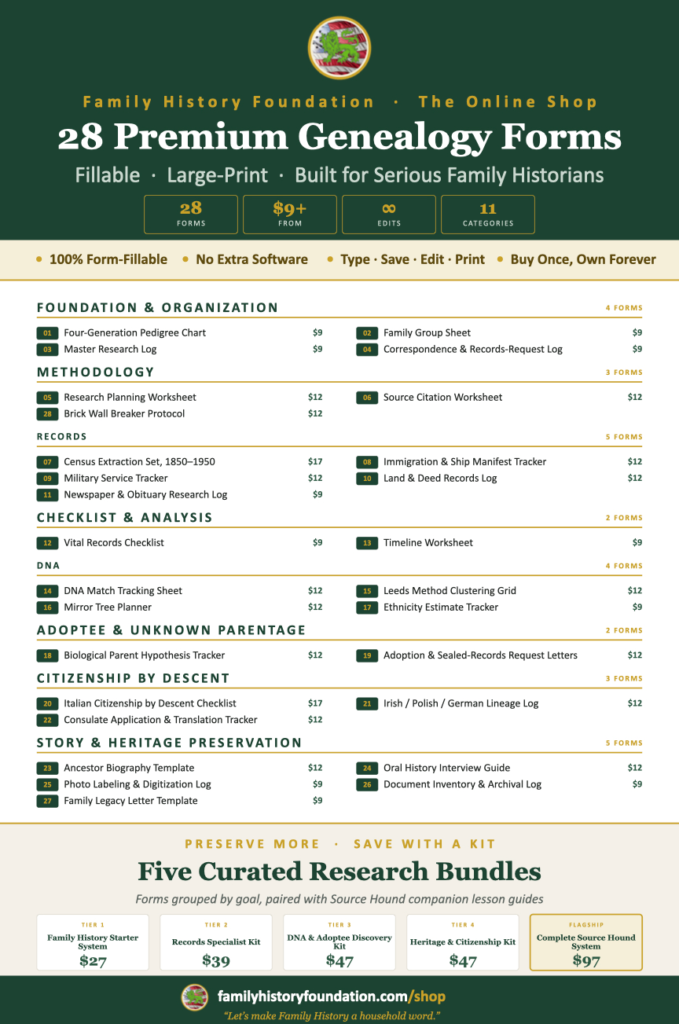
Having free forms is cool ~ having 100% FORM-FILLABLE genealogy forms with no fuss is even better! Visit The Family History Foundation Shop for Citizenship tracking forms, as well as 28 editable and fillable genealogy forms!
Next Steps: Building Your 1830 Census Strategy
You now understand how to calculate precise birth years from the 1830 Census and use them strategically.
Here’s your action plan:
- ✅ Find your ancestor in the 1830 federal census on Ancestry
- ✅ Document all age bracket numbers for the household
- ✅ Calculate 5-year birth windows for each person
- ✅ Search vital records within those specific year ranges
- ✅ Compare to 1820 and 1840 to verify identity across time
- ✅ Track westward migration if they moved states
- ✅ Use birth windows to target marriage, death, and land records
Your first action: Locate one ancestor in the 1830 census. Calculate their birth year window. Then search baptism records ONLY within that 5-year range.
You’ll find records in hours that others search decades for—because you’re using the 1830 federal census’s precision strategically.
The 1830 enumeration is the last and most detailed head-of-household census. Twenty years later, the 1850 census will list every person by name—but until then, master these age calculations to unlock vital records that prove your family tree.
For detailed guides on every census year through 1950, see our complete US Federal Census guide.
Join the Family History Foundation Source Hound Community
Our family history is disappearing every day, join the Source Hound community and join our pledge to be the protector of your family history. The lives and voices of our ancestors are depending on it for our future generations.
Celebrate Family History Fridays with us across our social media and community platforms!
📬 Subscribe to the Newsletter — tips, active challenges, and deep-dive case studies. Never an overloaded inbox, always something you can use this weekend.
 Like & Subscribe on YouTube — every Friday, a video companion to the week’s article. Watch these techniques demonstrated rather than described.
 Pin Us on Pinterest — printable question sheets, research charts, and visual guides to save for your next session.
 Podcasting on Spotify! — podcasting now on Spotify, you can find all of the latest episodes on any of your favourite podcast platforms, starting with Spotify.
 Podcasting on Amazon! — If you are not on Spotify we are also on Amazon Podcasts so you can listen while you drive and work. Every episode is curated just for you to binge your favourite episodes.
 Podcasting on Audible! — Audible is an alternative offshoot of Amazon Podcasts to listen while search for your next favourite book. Ready for your next “audible?” Set, Go!
Let’s make Family History a household word. 🏠
The Family History Foundation Newsletter
Our Family History Is Disappearing Every Day!
Join the quest with 500+ family historians getting Franklin’s Source Hound weekly research breakthroughs — real case studies, source hacks, and the exact strategies that turn brick walls into discoveries.
Free. No fluff. Straight from the Source Hound’s desk to yours.
Your privacy is sacred — almost as sacred as a primary source. Read our Privacy Policy.
Shop Premium Genealogy Forms

About the Author
Hi there, my name is Franklin, the founder and author of The Family History Foundation.
Our family stories are disappearing every day and it’s crucially important that the next generation is able to learn and appreciate their family history. It is up to you to take up the mantle of responsibility to ensure that how you research today will be passed on tomorrow with the highest standards possible.
I believe that genealogy is not just about names and dates, it’s about your stories and how those stories inform your identity.
With a penchant for storytelling and a background in research, the insights and techniques you learn on The Family History Foundation will help you uncover the incredible stories and identities hidden within the tapestry of your ancestry.
My mission is “Let’s make Family History a household word.”
My motto is “The Past ‘Relative’ to the Future.”
Your ancestors’ exact birth years deserve precision. Your family deserves dates you can prove with records—not guesses based on intuition. The 1830 census gives you the tools to calculate those dates accurately. ❤️
FAQ: Your 1830 Census Questions Answered
Q: How do I know which person in an age bracket is the head of household?
A: You don’t, directly. The 1830 census only names the head.
Inference method:
The head is usually the oldest male in adult brackets (30-40, 40-50, 50-60 ranges). If only one male in those ranges, that’s likely the head.
If multiple males in adult ranges, you’re probably seeing the head plus adult sons or other relatives. Cross-reference with land records (property owners were typically heads).
Q: Can I use 1830 census birth years to prove age for pension applications?
A: The 1830 census provides supporting evidence, not legal proof.
What it’s good for: ✓ Corroborating age from other records ✓ Narrowing birth year search windows ✓ Verifying family relationships via age gaps
What it’s NOT: ✗ Legal birth proof (need baptism/birth record) ✗ Exact birth date (only estimates) ✗ Definitive age (subject to enumerator error)
For pension applications requiring age proof, use the 1830 calculation to locate actual baptism/birth records that serve as legal documentation.
Q: Why does the 1830 census track disabilities but not occupations?
A: Congress added disability tracking to assess social welfare needs.
The 1830 census act specifically required counting deaf, dumb, and blind persons to inform policy decisions about institutions and education. Occupation tracking (agriculture/commerce/manufactures) was dropped after 1820.
Q: What if I find the same person in different age brackets across censuses?
A: This is common and doesn’t necessarily mean you have the wrong person.
Example: Male 10-15 in 1820 (born 1805-1810) should be 20-30 in 1830 (born 1800-1810). The overlap (1805-1810) confirms identity.
If there’s NO overlap (male 10-15 in 1820 shows as 40-50 in 1830), you’re tracking different people or there’s a major error.
Verification: Use land records, marriage records, and common name research strategies to confirm identity across censuses.