Citizenship by Descent could be the most valuable discovery you make this year — and if you have been quietly building your family tree, you may already have everything you need to claim it. 🌍 Across the United States, Australia, Canada, and New Zealand, millions of people carry ancestry from Ireland, Italy, Lithuania, Germany, and Poland without ever realising that their family history research may qualify them for a second passport, full EU rights, and the freedom to live and work across 27 European nations.
Not to mention, the pride of basically being a dual citizen in your ancestral homeland! No investment required. No language test. No minimum residency. Just the right ancestor — and the right documents to prove it.
Table of Contents
This is your complete guide to Citizenship by Descent in 2026: what it means, which countries offer it, how genealogy research is your single greatest asset, and exactly what steps the application process involves. Your ancestral passport may be closer than you think. 🛂
Note: This post is educational in nature and does not constitute legal advice. For individual eligibility assessments, consult a qualified immigration attorney.
You May Already Be a Citizen — and Not Know It
Here is a number worth sitting with for a moment. Over 1.2 million Citizenship by Descent applications were filed across Europe alone in 2025 — a record number, driven by Americans, Australians, Canadians, and Britons who discovered that their grandparents’ and great-grandparents’ origins entitled them to something far more tangible than a family story. 🗂️
This topic is close to home for me as I have often contemplated applying for Lithuanian, or even Italian dual citizenship via the Citizenship by Descent method! I know the Brits won’t take me back. 😂
The legal principle behind Citizenship by Descent is jure sanguinis (or jus sanguinis) — Latin for “right of blood.” It means that if your ancestor held citizenship in a country that recognises this principle, you may already be legally entitled to that citizenship. You are not applying for a privilege. You are confirming a right that has existed since the moment your qualifying ancestor passed it down the family line.
We will get into what it means to have a “qualifying ancestor” in just a bit.
For many a family history researcher who has spent years — perhaps decades — building their family tree, this is a moment of extraordinary potential. The census records you have traced, the vital records you have gathered, the immigration manifests you have tracked down — these are not just genealogical achievements. They may be the foundation of a citizenship application that changes your life and the lives of your children and grandchildren.
If you have famous ancestors, have been admitted to the DAR or SAR, this might be the ultimate feather in your cap!
As of 2026, more than 50 countries worldwide offer some form of Citizenship by Descent. This post focuses on the five accessible case studies and most sought-after programs for English-speaking researchers with European ancestry: Ireland, Italy, Lithuania, Germany, and Poland.
Plus a whole lot more, any country really, we have you covered here in this methodology!
What Is Citizenship by Descent?
Citizenship by Descent is a pathway to nationality based on your ancestral lineage — not your place of birth, not your length of residency, and not your financial investment. It’s an ANCESTRAL PASSPORT. How swanky does that sound, right?
It works on one core principle: citizenship is a heritable right that passes from parent to child across generations. If that chain of transmission was never broken — if no ancestor in your direct line formally renounced or lost their citizenship before passing it to the next generation — then the right may still be yours to claim today.
The critical concept to understand before you begin any Citizenship by Descent research is the unbroken chain. You cannot qualify if an ancestor in your direct line naturalised as a citizen of another country before the next person in your line was born. That act of naturalisation — becoming, for example, an American citizen in 1910 — may have severed the transmission of their original nationality at that point. Whether it did, and for which country’s laws, is precisely where genealogical research and legal analysis work together.
Citizenship by Descent differs fundamentally from two other pathways you may have encountered. Naturalization by residency requires you to live in the country for several years and often pass a language test. Citizenship by investment requires a significant financial commitment. Citizenship by Descent requires neither — only an ancestor, a documented lineage, and the patience to gather the necessary records.
Why Your Family Tree Is Your Greatest Asset
If you have been doing genealogy research for any length of time, you are already ahead of most Citizenship by Descent applicants before you even begin.
Every Citizenship by Descent application requires a chain of documentation that maps precisely onto a well-researched family tree: birth certificates, marriage certificates, death certificates, and naturalization records for every generation between you and your qualifying ancestor. This is exactly the evidence a Source Hound genealogist gathers as a matter of course.
The Source Hound Research Methodology — the framework I use across all of my genealogical work — is particularly well-suited to Citizenship by Descent preparation. The Source Hound principle of verifying every claim through independent primary sources is not just good genealogy. It is the evidentiary standard that citizenship authorities require.
Our Free Genealogy Forms Bundle includes Research Log and Source Citation templates that are ideal for tracking your document chain across multiple generations. Download them before you begin your Citizenship by Descent research and use them to log every record you find, every archive you search, and every document you still need to obtain. 📝
One important distinction: research tools like Ancestry.com, Newspapers.com, and Fold3 are invaluable for identifying and locating the records you need. But citizenship applications require official certified copies from civil registries and government archives — not genealogy website printouts. Think of your research as the map; the certified documents are the passport itself.
One more tool worth noting: Ancestry ThruLines can help you identify living relatives in your ancestral country who may hold family documents, photographs, or records that are directly relevant to your application. A DNA match in County Clare or a shared cousin in Vilnius may have the exact vital record you are missing. 🧬
The Global Landscape: 50+ Countries, One Principle
Citizenship by Descent is not an exclusively European phenomenon — though Europe offers the most accessible and most beneficial programs for English-speaking applicants due to the EU passport’s extraordinary travel, work, and residency rights.
Here is how the global landscape breaks down in 2026:
Europe offers the deepest concentration of Citizenship by Descent programs, with generational eligibility ranging from first-generation only (France, most Nordic countries) to unlimited generations where lineage can be proven (historically Italy, Poland, Hungary, Luxembourg).
The Americas offer programs through Argentina, Brazil, and Mexico, among others. These are particularly relevant for researchers with 19th-century immigration patterns that brought ancestors through South America before continuing north.
Israel offers the Law of Return, which provides a pathway to citizenship for those with Jewish ancestry — a program of particular significance for researchers with Central and Eastern European heritage.
Armenia and Croatia both offer diaspora-focused programs that are increasingly relevant as researchers document 20th-century immigration patterns.
The five countries below represent the programs most frequently sought by American, Australian, and New Zealand researchers with European ancestry — and the five where genealogical research is most directly actionable right now.
The Five Most Accessible Programs for English-Speaking Researchers – Case Studies
🇮🇪 Ireland — The Most Straightforward Path
Ireland’s Citizenship by Descent program is widely regarded as the most accessible and clearly defined of all European programs — and it is the starting point for the millions of Americans and Australians with Irish grandparents.
Who qualifies: You can claim Irish citizenship if a parent or grandparent was born on the island of Ireland. Great-grandchildren may also qualify if their parent registered in the Foreign Births Register before they were born — making the registration sequence critically important for preserving eligibility across generations.
Generational limit: Grandparent (with pathways to great-grandchild under specific registration conditions)
Key documents: Your Irish-born ancestor’s birth certificate; your connecting family’s birth and marriage certificates; proof of your own identity
Processing time: 12–18 months via the Foreign Births Register
Approximate cost: USD $500–$1,500 — the most affordable EU Citizenship by Descent program
Watch out for: The registration order matters enormously in Ireland. A great-grandchild’s eligibility depends on whether their parent registered before they were born. If you have Irish ancestry and are considering future generations, register now rather than later. ☘️
🇮🇹 Italy — A Major 2026 Rule Change You Must Know
Italy has historically offered one of the most generous Citizenship by Descent programs in the world — with no generational limit, meaning some applicants successfully claimed citizenship through great-great-grandparents. That era is now over.
⚠️ Important Italy 2026 Update
Italy’s Law 74/2025, which came into force in March 2025, fundamentally changed the eligibility rules for Italian Citizenship by Descent. Applications are now generally limited to descendants of parents or grandparents who were Italian citizens at the time of their child’s birth.
If you previously assumed you qualified through a great-grandparent or further, you must reassess under the new rules. However — and this is equally important — many researchers who assumed they no longer qualify may still have a valid pathway. The legal landscape is nuanced. Do not self-eliminate without professional assessment.
Always verify your eligibility against current Italian law with a qualified immigration attorney before beginning the application process.
Who qualifies (post-Law 74/2025): Descendants of parents or grandparents who were Italian citizens at the time of the applicant’s parent’s/grandparent’s birth.
Generational limit: Parent or grandparent (general rule post-March 2025)
Key documents: Italian ancestor’s birth certificate; every generation’s birth, marriage, and naturalization records; proof of non-naturalization before the chain-breaking date
Processing time: Consular route 2–4 years (backlog); in-country route via comune 3–6 months
Approximate cost: USD $1,500–$5,000 consular route; $5,000–$15,000 in-country route (including relocation)
Watch out for: The naturalization break. If your Italian ancestor became an American citizen before your connecting relative was born, the chain is broken. Exact naturalization dates are critical — and this is where Ancestry.com records, ship manifests, and naturalization indexes become genuinely valuable research tools. 🍕
These current rules disqualify me, as my great-grandparents emigrated circa 1904. Perhaps they may apply to you.
🇱🇹 Lithuania — The Heart of Europe
Lithuania is one of the most underappreciated Citizenship by Descent programs in Europe — and for researchers with Lithuanian heritage, it is extraordinarily accessible. As of 2026, Lithuania has one of the EU’s highest approval rates for descent-based applications, with over 90% of clearly documented cases succeeding.
FRANKLIN'S STORY
I realize Lithuania is a small country, but it has one amazing quality. The Lithuanians and their culture! Also, ME! I am part Lithuanian and have been bandying about the idea of gaining an Ancestral Passport to "Lietuva" after watching the Lithuanian Song Contest in 2018, it was mind-blowing!
The country of Lithuania also sits in the geographic Heart of Europe!
Who qualifies: Descendants of Lithuanian citizens who held citizenship before June 15, 1940 — the date of Soviet occupation. This includes those whose ancestors left Lithuania before or during Soviet occupation and did not formally renounce their citizenship, as well as those whose citizenship was lost due to historical persecution or political circumstances beyond their control.
Generational limit: No strict generational limit — eligibility depends on documentary evidence of an unbroken connection to pre-1940 Lithuanian citizenship, not the number of generations
Key documents: Proof of ancestral Lithuanian citizenship (passport, birth certificate, or military records from the pre-1940 Republic of Lithuania); connecting family birth and marriage certificates; evidence of emigration history
Processing time: Up to 9 months — the fastest processing time of the five countries covered here
Approximate cost: USD $1,000–$3,000 depending on document complexity
Watch out for: The June 15, 1940 date is a hard legal threshold. Your research needs to establish that your qualifying ancestor was a Lithuanian citizen before that date. For families who left during the Soviet era, the legal pathway is different — restoration of citizenship rather than descent. The distinction matters legally, so document the emigration timeline carefully. 🇱🇹
Unfortunately for me, this might also be a tricky Citizenship by Descent application for me as my great-grandparents came over before the cutoff date. Hmmm. 🤔 🧐
A note for 2026: Lithuania has introduced a “digital oath” pilot program allowing overseas applicants to complete their citizenship oath via video call — a significant convenience for applicants in the US, Australia, and New Zealand. Dual citizenship is fully recognised for EU/EEA and NATO country nationals from 2026 under Lithuania’s reformed law.
🇩🇪 Germany — The Most Complex, With a Powerful Exception
Germany’s Citizenship by Descent program is the most legally complex of the five (of course it is 😆) — but it carries a particularly significant provision that is highly relevant to American researchers with Jewish ancestry.
Who qualifies (standard pathway): Germany generally limits Citizenship by Descent to children of German citizens — meaning one parent must have been a German citizen at the time of your birth. Since June 2024, Germany now fully permits dual citizenship, removing a major previous barrier.
The Article 116 Exception: Descendants of individuals who were persecuted by the Nazi regime and lost German citizenship between 1933 and 1945 — including Jewish families, political dissidents, and others who fled Germany — have a significantly expanded eligibility pathway under Article 116 of the German Basic Law. This provision has no generational limit and has been actively used by thousands of American and Israeli descendants of German-Jewish families. If your family history includes flight from pre-war or wartime Germany, this pathway deserves serious investigation. 🕍
Generational limit: Standard: parent only. Article 116: no generational limit for persecution-based claims.
Key documents: German ancestor’s citizenship documentation; birth and marriage certificates for every generation; for Article 116 — evidence of persecution and loss of citizenship
Processing time: 12–24 months
Approximate cost: USD $500–$2,000 with free government processing — the most cost-efficient of the five programs
Watch out for: The pre-1975 married parents rule. For individuals born before January 1, 1975, both parents needed to be legally married for citizenship to transmit through the mother’s line. This has caught many researchers off-guard and requires careful analysis of your specific generational timeline.
🇵🇱 Poland — No Generational Limit, Exceptional Value
Poland offers one of the most accessible and cost-effective Citizenship by Descent programs in Europe — and for the millions of Americans with Polish heritage, it represents an extraordinary and frequently overlooked opportunity.
Who qualifies: Poland has no strict generational limit for Citizenship by Descent, provided the ancestral chain of Polish citizenship was never broken. Your ancestor must have been born in Poland after 1900 and lived there as a Polish citizen. Each generation in your line must have retained Polish citizenship — not renounced it or naturalised elsewhere before the next generation was born.
Generational limit: No strict limit — continuity of citizenship chain is the determining factor
Key documents: Ancestor’s Polish birth certificate; every generation’s birth, marriage, and death certificates; evidence that no ancestor in the line renounced Polish citizenship before passing it on
Processing time: 3–12 months — among the fastest in the EU
Approximate cost: USD $1,500–$5,000 — the most affordable EU option alongside Ireland
Watch out for: Poland’s 20th century history is extraordinarily complex in terms of borders and nationality. An ancestor described as “Polish” in American records may have been born in a region that was part of the Russian Empire, Austria-Hungary, or Prussia at the time — and may have held a different formal nationality depending on the year. Pinpointing the exact birth location and the political entity governing it at the time of birth is essential research work before any application begins. 🦅

The Family History Foundation Newsletter
It’s Not About You, It’s About Documenting Before It Disappears
Join 500+ family historians getting Franklin’s Source Hound weekly research breakthroughs — real case studies, source hacks, and the exact strategies that turn brick walls into discoveries.
Free. No fluff. Straight from the Source Hound’s desk to yours.
Your privacy is sacred — almost as sacred as a primary source. Read our Privacy Policy.
The Application Process: Eight Steps That Apply to Every Country
While every Citizenship by Descent program has its own specific requirements, the BROAD APPLICATION FRAMEWORK is consistent across all five countries. Here are a set of general expectations.
Step 1 — Identify your qualifying ancestor. This is the genealogical RESEARCH phase — establishing not just that an ancestor existed, but that they held the relevant citizenship at the relevant time and that the chain was unbroken to you. The Source Hound methodology applies fully here.
Step 2 — Build your document chain. Every generation between you and your qualifying ancestor needs to be DOCUMENTED with official records — birth, marriage, and death certificates at minimum.
Step 3 — Obtain certified long-form copies. Citizenship authorities require official LONG-FORM certificates from civil registries and government archives — not genealogy printouts, not short-form summaries. This is a step that surprises many applicants. Contact the relevant civil registries in each country, state, or county directly.
Step 4 — Apostille your documents. Documents issued in one country and used in another must be officially certified under the Hague Apostille Convention. In the US, APOSTILLES are issued by the Secretary of State in the state where the document was issued. This step takes time — build it into your timeline.
Step 5 — Obtain certified translations. Every document not in the official language of the country you are applying to must be TRANSLATED by a certified translator. This applies to US, Australian, and NZ birth and marriage records submitted to European authorities.
Step 6 — Submit your application. Most applicants outside Europe apply through the relevant country’s CONSULATE in their home country. Italy offers an in-country route via the comune (municipal office) for faster processing, which requires temporary relocation.
Step 7 — Wait for processing. Processing times range from 9 months (Lithuania) to 4 years (Italian consular backlog). Use this time to continue your genealogical research — authorities may request ADDITIONAL DOCUMENTS during review.
Step 8 — Receive citizenship and apply for your ancestral passport. Once citizenship is confirmed, you apply for a PASSPORT through the standard national passport authority of your new country of citizenship. 🛂
The Most Common Mistakes — and How to Avoid Them
Every Citizenship by Descent application that fails does so for one of a small number of predictable reasons:
- Submitting a short-form certificate instead of a full long-form document
- Failing to check whether an ancestor naturalised before the chain-breaking date
- Name variations across documents that are not properly explained or reconciled
- Missing the apostille step entirely
- Applying under rules that changed recently — particularly critical for Italy in 2026
- Not documenting the emigration timeline precisely enough to establish pre/post occupation dates (particularly relevant for Lithuania)
A Source Hound approach — verify every claim, document every source, never accept a name match as a proven identity — is your best defence against all of these. 🐕🦺
Your Ancestral Passport Is Waiting
Citizenship by Descent is one of the most meaningful intersections between genealogy and real-world impact. The family history research you have been doing — tracing names, locating records, building a documented tree — may be the key that unlocks a second nationality, a European passport, and a connection to your ancestral homeland that goes far beyond a family story.
The work you do on your family tree matters. It always has. But beyond 2026, it may matter more than ever.
Have you started exploring your Citizenship by Descent eligibility? Do you have Irish grandparents, Italian heritage, Lithuanian roots, German ancestry, or Polish lineage that you have been documenting? Or any other for that matter? Drop your story in the comments below — I would love to hear which ancestral passport you are pursuing, and this community is full of researchers who may have walked exactly the same path. 💬
If this post opened a door you never knew existed, please share it with a family member or fellow researcher who might qualify. The ancestral passport waiting for them might be one family tree discovery away. 🛂🌳
Join the Family History Foundation Source Hound Community
Our family history is disappearing every day, join the Source Hound community and join our pledge to be the protector of your family history. The lives and voices of our ancestors are depending on it for our future generations.
Celebrate Family History Fridays with us across our social media and community platforms!
📬 Subscribe to the Newsletter — tips, active challenges, and deep-dive case studies. Never an overloaded inbox, always something you can use this weekend.
 Like & Subscribe on YouTube — every Friday, a video companion to the week’s article. Watch these techniques demonstrated rather than described.
 Pin Us on Pinterest — printable question sheets, research charts, and visual guides to save for your next session.
 Podcasting on Spotify! — podcasting now on Spotify, you can find all of the latest episodes on any of your favourite podcast platforms, starting with Spotify.
 Podcasting on Amazon! — If you are not on Spotify we are also on Amazon Podcasts so you can listen while you drive and work. Every episode is curated just for you to binge your favourite episodes.
 Podcasting on Audible! — Audible is an alternative offshoot of Amazon Podcasts to listen while search for your next favourite book. Ready for your next “audible?” Set, Go!
Let’s make Family History a household word. 🏠
The Family History Foundation Newsletter
Our Family History Is Disappearing Every Day!
Join the quest with 500+ family historians getting Franklin’s Source Hound weekly research breakthroughs — real case studies, source hacks, and the exact strategies that turn brick walls into discoveries.
Free. No fluff. Straight from the Source Hound’s desk to yours.
Your privacy is sacred — almost as sacred as a primary source. Read our Privacy Policy.
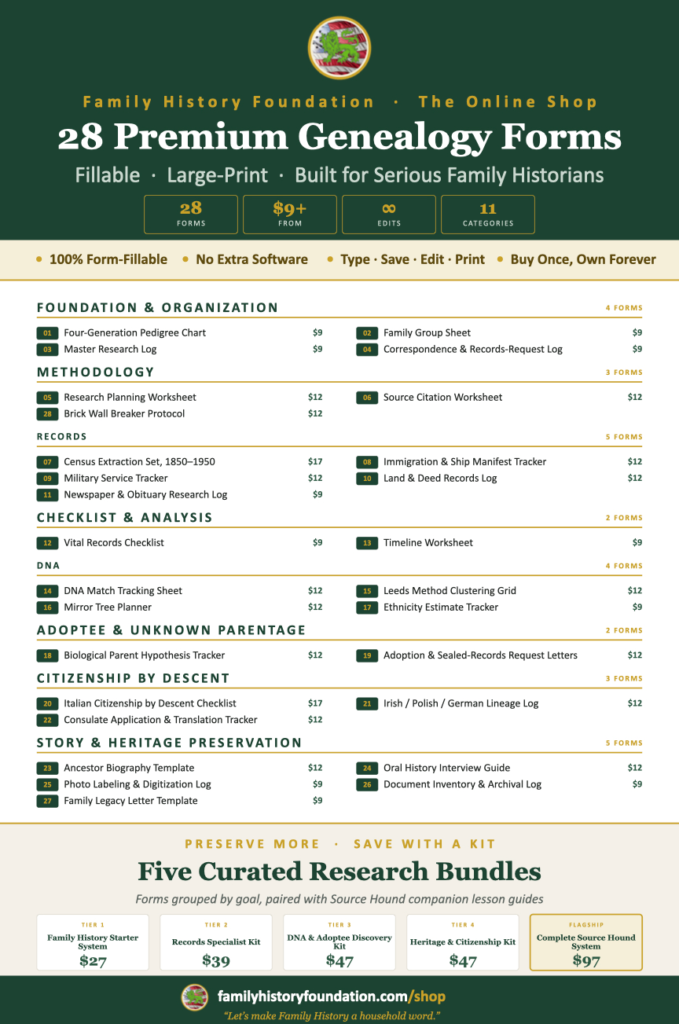
Shop Premium Genealogy Forms

About the Author
Hi there, my name is Franklin, the founder and author of The Family History Foundation.
Our family stories are disappearing every day and it’s crucially important that the next generation is able to learn and appreciate their family history. It is up to you to take up the mantle of responsibility to ensure that how you research today will be passed on tomorrow with the highest standards possible.
I believe that genealogy is not just about names and dates, it’s about your stories and how those stories inform your identity.
With a penchant for storytelling and a background in research, the insights and techniques you learn on The Family History Foundation will help you uncover the incredible stories and identities hidden within the tapestry of your ancestry.
My mission is “Let’s make Family History a household word.”
My motto is “The Past ‘Relative’ to the Future.”
Frequently Asked Questions
Q: Can I claim Citizenship by Descent if my ancestor emigrated generations ago?
" is included.](https://familyhistoryfoundation.com/wp-content/uploads/2026/05/Citizenship-by-Descent-How-to-Claim-Your-Ancestral-Passport-in-2026-featured-150x150.png "Citizenship by Descent: How to Claim Your Ancestral Passport in 2026 12")
A: Yes — in many countries. The key question is not how many generations ago the emigration occurred, but whether the citizenship chain was unbroken across those generations. Poland and Lithuania have no strict generational limits. Ireland allows grandparent claims with pathways to great-grandchildren under specific conditions. Germany’s Article 116 pathway has no generational limit for persecution-based claims.
Q: What is the difference between Citizenship by Descent and dual citizenship?
A: Citizenship by Descent is a pathway to acquiring citizenship. Dual citizenship is the outcome — holding two nationalities simultaneously. Most of the countries covered here permit dual citizenship. Always confirm the rules in both your current country and the country you are applying to, as requirements vary.
Q: Will claiming a second passport affect my US, Australian, or NZ citizenship?
A: The US, Australia, and New Zealand all allow dual citizenship. Claiming Citizenship by Descent through a European country will not require you to renounce your existing passport. You will simply hold two.
Q: What if my ancestor naturalised as American — does that break my Citizenship by Descent claim?
A: It depends on the country and the timing. If your ancestor naturalised before your connecting relative was born, it likely breaks the chain for that country’s program. The exact naturalization date and the country’s specific transmission rules determine the answer — this is the most important research question in any Citizenship by Descent case.
Q: Do I need to speak the language of the country I am applying to?
A: For descent-based applications, generally no. Ireland, Poland, and Lithuania all exempt descent applicants from language testing. Germany’s standard program has no language requirement for descent cases. Italy similarly requires no language test for descent applicants.
However, I believe it is our duty to learn our ancestral language and be prepared to “fit in” by learning the language of the country you are applying to out of respect and personal growth!
Q: What is an apostille and why do I need one?
A: An apostille is an official certification that authenticates a document for use in another country under the Hague Apostille Convention (1961). Without it, documents issued in one country are not officially recognised by another country’s government. In the US, apostilles are issued by the Secretary of State in the issuing document’s state.
Q: How does my genealogy research help with a Citizenship by Descent application?
A: Directly and substantially. The birth, marriage, death, immigration, and naturalization records you gather for your family tree are the exact documents a citizenship application requires. Your research log, source citations, and document archive are the foundation of your application package. The Source Hound methodology — and the Proving Ancestry ThruLines case study — illustrate exactly the standard of documentation required.
Q: Where do I get official certified copies of the records I need?
A: For US-side documents: county clerk offices, state vital records agencies, NARA for federal records, and state archives. For European-side documents: the relevant national civil registry, parish archives, or national state archives in each country. The FamilySearch Wiki is an excellent free resource for identifying exactly which archives hold records for specific regions and time periods.