Plymouth Colony history begins with a leaky ship, a hand-signed compact, and a winter that killed half the passengers — and if your roots run deep in America, it may quietly begin with you, too. 🌱 This is the story of who those 1620 settlers really were, why they crossed an ocean, and how the colony they built still threads through millions of family trees today.
You will get the real Plymouth Colony history first — the England they fled, the faith that drove them, the families who survived — and then the practical part: exactly where to find the records, societies, and databases that let you trace your own line back to the Mayflower.
Table of Contents
📜 Plymouth Colony history at a glance: Founded in 1620 by English Separatists (the Pilgrims) who sailed on the Mayflower, Plymouth was the second permanent English colony in America after Jamestown (1607). It was founded for religious freedom, governed by the Mayflower Compact, and absorbed into the larger Province of Massachusetts Bay in 1691. Tens of millions of people alive today descend from its passengers.
Where Plymouth Colony History Really Begins: England and the Crown 👑
To understand Plymouth Colony history, start in England under King James I, who took the throne in 1603 and united the crowns of England and Scotland. James believed his authority came directly from God, and in his England, church and state were a single fabric. Question one and you questioned the other.
At the center of that fabric sat the Church of England, born when Henry VIII broke from Rome in the 1530s and settled into its familiar shape under Elizabeth I. By James’s reign, most English people simply belonged to it from birth. Worship, baptism, marriage, burial — all ran through the established church.
But not everyone was content. Some reformers wanted to purify the church from within; history remembers them as Puritans. A smaller, bolder group believed the church was beyond saving and chose to separate from it entirely. These Separatists — illegal, hunted, and unwilling to bend — are the people at the origin of Plymouth Colony history.
Why the Pilgrims Left: The Religious Roots of Plymouth Colony ⛪
A Separatist congregation gathered in the village of Scrooby in Nottinghamshire. Worshiping outside the Church of England was a crime, so around 1608 they fled to Leiden in the Netherlands, where they could pray as they wished.
Holland gave them freedom but not a future. Their children were growing up Dutch, work was hard, and another war with Spain loomed. So they made a staggering decision: cross the Atlantic and build a community of their own. That decision is the hinge of all Plymouth Colony history.
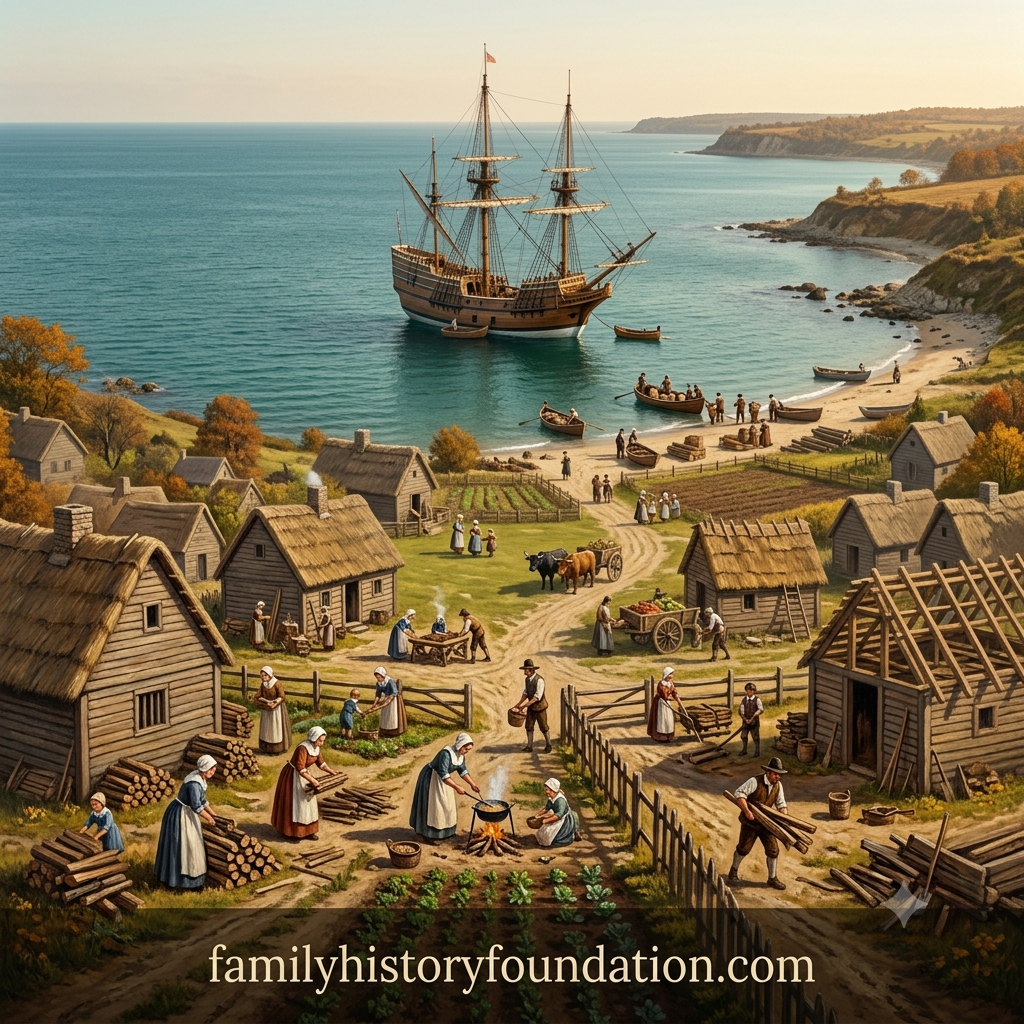
They secured a patent to settle in the northern part of the Virginia territory, and in September 1620 roughly 102 passengers crowded aboard the Mayflower. Storms blew them off course, and they made landfall not in Virginia but at Cape Cod — outside the bounds of their patent, with no legal government waiting for them.
Their answer became one of the most important documents in early American history. Before stepping ashore, 41 men signed the Mayflower Compact, agreeing to govern themselves by “just and equal laws” for the good of the colony. It was a small, radical act of self-rule that still echoes centuries later.
Could One of These Families Be Yours? 🧭
Could One of These Families Be Yours? 🧭
Before you go further, map what you already know. Our fillable Pedigree Chart lets you sketch your known ancestors and see just how close you already are to 1620 — the first step every Source Hound takes.
Get the Pedigree Chart →The Families at the Heart of Plymouth Colony History 👪
The passengers split into two groups. The “Saints” were the religious Separatists; the “Strangers” were craftsmen, servants, and adventurers recruited to make the venture work. Together they carried surnames that genealogists now know by heart: Bradford, Brewster, Winslow, Alden, Standish, Howland, Allerton, and Hopkins, among others.
Not all of them lived to build the colony. That first winter of 1620–1621 was catastrophic — disease and exposure killed roughly half the passengers before spring. The survivors, and the specific lines that lived on to have children, are exactly why so much Plymouth Colony history can be traced today: a relatively small, well-documented founding group.
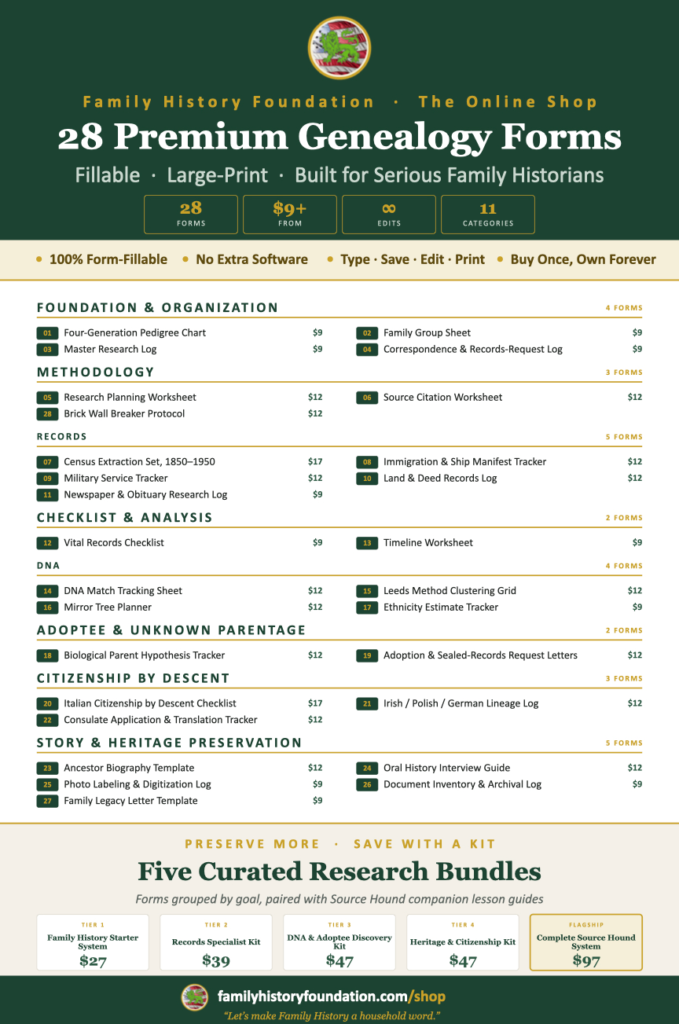
If you want to keep your own discoveries organized as you dig into these families, start with the right paperwork. Our guide to free genealogy forms gives you the research logs and family group sheets that keep a colonial line from turning into guesswork.
Surviving That First Winter — and the Wampanoag Alliance 🌽
Plymouth Colony history is not just a Pilgrim story — it is a Wampanoag story, and honesty here matters. The colonists survived only because of the Indigenous people already living on that land, a truth no honest account of Plymouth Colony history can skip.
In the spring of 1621, the colony formed a treaty of mutual protection with Massasoit, the Wampanoag sachem. A man the English called Squanto (Tisquantum), who spoke English after being kidnapped and taken to Europe years earlier, taught them to plant corn, catch fish, and navigate the land.
That autumn’s harvest feast — shared by the surviving colonists and roughly 90 Wampanoag men — is the event later generations reshaped into “the first Thanksgiving.” The real moment was more fragile and more political than the greeting-card version, and understanding it is central to telling Plymouth Colony history truthfully.
Flags, Seals, and Symbols of Plymouth Colony 🏴
People often ask what flag flew over Plymouth, and it’s one of the murkier corners of Plymouth Colony history. The honest answer — and a good example of the Source Hound approach — is that the record is thin. As English subjects, the colonists would have identified with the flags of the crown: the red St George’s Cross and the early Union Flag (the “King’s Colours”) introduced in 1606 after England and Scotland shared a monarch.
There was no unique “Pilgrim flag.” The familiar colonial seal associated with Plymouth came later, as the colony formalized its government. Anyone who tells you they know precisely which banner snapped over the 1620 settlement is guessing — the surviving sources simply don’t spell it out.
Plymouth vs. Jamestown vs. Massachusetts Bay: What Made Plymouth Different 🗺️
Plymouth Colony history is constantly confused with its neighbors. Two comparisons clear most of it up. Jamestown came first, in 1607, as a for-profit venture. Massachusetts Bay came in 1630, far larger and richer. Here is how the three stack up.
| Feature | Jamestown (1607) | Plymouth (1620) | Mass. Bay (1630) |
|---|---|---|---|
| Backers | Virginia Company (investors) | Merchant Adventurers + Separatists | Massachusetts Bay Company (Puritans) |
| Main motive | Profit & trade | Religious separation | Religious reform & a “city on a hill” |
| Faith | Anglican | Separatist Pilgrims | Non-separating Puritans |
| Scale | ~100+ settlers | ~102 passengers | ~1,000, then thousands more |
| Governance | Company charter | Mayflower Compact | Royal-style colonial charter |
| Fate | Grew into Virginia | Absorbed into Mass. Bay, 1691 | Became the dominant New England colony |
The key takeaway: Jamestown chased money, Plymouth chased freedom of worship, and Massachusetts Bay arrived a decade later with the numbers and funding Plymouth never had. In 1691 a new royal charter folded little Plymouth into that larger Province of Massachusetts Bay — which is why the two are so easily blurred.
The Plymouth Witch Trials — and Why Salem Wasn’t Plymouth 🔮
Here is a correction worth printing: the Salem witch trials of 1692 did not happen in Plymouth Colony. By 1692, Plymouth had already been absorbed into the Province of Massachusetts Bay, and Salem sat firmly in that former Massachusetts Bay world.
Plymouth Colony’s own record is remarkably different. It saw only two witchcraft trials in its entire history, decades before Salem — and both ended in not guilty verdicts. In fact, the Plymouth court fined the accusers for making false accusations. Where Salem convulsed into hangings, Plymouth punished the people crying “witch.” It is one of the quiet surprises of Plymouth Colony history.
The Family History Foundation Newsletter
It’s Not About You, It’s About Documenting Before It Disappears
Join 500+ family historians getting Franklin’s Source Hound weekly research breakthroughs — real case studies, source hacks, and the exact strategies that turn brick walls into discoveries.
Free. No fluff. Straight from the Source Hound’s desk to yours.
Your privacy is sacred — almost as sacred as a primary source. Read our Privacy Policy.
Little-Known Facts About Plymouth Colony 💡
Ready for the fun part? Tap each one to reveal a piece of Plymouth Colony history that rarely makes the textbooks.
Little-Known Facts About Plymouth Colony 💡
Ready for the fun part? Tap each one to reveal a piece of Plymouth Colony history that rarely makes the textbooks.
Where Are the Plymouth Descendants Today? 🌍
Here’s the number that stops people cold: tens of millions of people alive today descend from the Mayflower passengers. That small, half-lost group became one of the most prolific founding populations in American history, which is why Plymouth Colony history feels so personal to so many families.
Presidents, poets, actors, and quite possibly the person reading this share that ancestry. Once you’ve traced and confirmed a line, the next joy is sharing it — our free family history templates help you turn a proven Plymouth Colony line into a book, display, or heirloom worth passing down.
Essential Literature and Primary Sources 📚
Serious research into Plymouth Colony history starts with the sources the Pilgrims left behind:
🖋️ Of Plymouth Plantation by William Bradford — the colony’s governor and its irreplaceable eyewitness historian.
📗 Mourt’s Relation and Edward Winslow’s Good Newes from New England — firsthand accounts of the earliest years.
📘 The Mayflower Families Through Five Generations “Silver Books” — 44 volumes of vetted, sourced lineages published by the Mayflower Society.
Where to Find Plymouth Colony Records 🗃️
The paper trail is richer than most colonial eras. Look to the printed Records of the Colony of New Plymouth, plus wills, probate files, town and vital records, and church records. These are the documents that turn a family legend into proven Plymouth Colony history.
Don’t overlook newspapers for the later generations that bridge a colonial ancestor to you. Our honest Newspapers.com review shows what full-page newspaper access finds that indexed records miss entirely.
Genealogical Societies for Mayflower Research 🏛️
Two organizations do the heavy lifting for Plymouth Colony history research:
🏛️ The General Society of Mayflower Descendants (the “Mayflower Society”), founded in 1897, verifies and certifies descent from Mayflower passengers and publishes the Silver Books.
📚 The New England Historic Genealogical Society (NEHGS / AmericanAncestors) holds one of the deepest collections of early New England records anywhere.
Using DNA to Confirm Your Line 🧬
When the paper trail runs dry — and across 400 years of Plymouth Colony history, it will — DNA can help. Autosomal matches and tools like ThruLines can point toward a shared colonial ancestor. But be careful: DNA supports a Mayflower line, it rarely proves one on its own across so many generations.
Treat every algorithmic hint as a lead to verify with documents, not a conclusion. Our AncestryDNA ThruLines reality check walks through exactly how a Source Hound confirms — or debunks — a suggested ancestor.
Researching on FamilySearch and Ancestry 💻
The two big databases are your workhorses for Plymouth Colony history. On FamilySearch (free), search the Massachusetts and Plymouth Colony collections and the shared collaborative tree. On Ancestry, lean on record hints, member trees, and DNA — just remember trees are clues, not proof.
For a full walkthrough of building an accurate tree from these platforms, start with our cornerstone guide to genealogy research online, and see why Ancestry ranks as the number one genealogy website for record depth.
How to Prove Your Line to the Mayflower Society ✅
This is the summit of Plymouth Colony history for a genealogist: a documented, generation-by-generation path from you back to a passenger. The Mayflower Society requires a source behind every single link — a birth, marriage, or death record connecting each parent to each child.
No family tradition, no unsourced online tree, and no lone DNA match will satisfy the application. Every generation must stand on evidence. That is precisely why the pedigree chart below matters.
Build a Society-Ready Line 🏅
Build a Society-Ready Line 🏅
Chart each confirmed generation with a source behind it, exactly the way a Mayflower Society application demands. Our fillable Pedigree Chart is built for proof, not guesswork.
Get the Pedigree Chart →Prefer to start with a printable option first? Compare formats in our best free family tree templates guide, then upgrade to the fillable version when you’re ready to document seriously.
Frequently Asked Questions ❓
Who founded Plymouth Colony?
English Separatists known as the Pilgrims, who sailed from England on the Mayflower and established the colony in 1620.
Did the Salem witch trials happen in Plymouth Colony?
No. The 1692 Salem trials took place in the former Massachusetts Bay area. Plymouth Colony had only two witch trials in its history, and both ended in not-guilty verdicts.
Is Plymouth Colony the same as Massachusetts Bay Colony?
No. They were separate colonies founded ten years apart. Plymouth (1620) was absorbed into the Province of Massachusetts Bay in 1691.
Was Plymouth or Jamestown first?
Jamestown, Virginia, came first in 1607. Plymouth followed in 1620 as the second permanent English colony in America.
How many passengers were on the Mayflower?
Roughly 102 passengers made the 1620 crossing, plus crew. About half died during the first winter.
How do I know if I’m a Mayflower descendant?
Trace your family line backward with sourced records. If you connect to a documented passenger line, the Mayflower Society can verify it.
How do I join the Mayflower Society?
You submit a lineage application proving descent from a Mayflower passenger, with a primary-source document for every generation.
What happened to Plymouth Colony?
It never grew large and was merged into the Province of Massachusetts Bay under a royal charter in 1691.
Join the Hunt 🐾
Every family tree hides a Bradford, a Brewster, or a Standish waiting to be found — and history, dear reader, rewards the curious. 🔍 If this journey through Plymouth Colony history stirred something in you, don’t let the trail go cold.
🎥 Subscribe on YouTube for research walkthroughs that make the archives feel alive.
📌 Follow us on Pinterest for charts, templates, and inspiration to pin your next breakthrough.
💬 Then tell me below: do you have a Mayflower line — or a brick wall you’re determined to break? Leave a comment, and let’s chase it together. 🌟
Let’s make Family History a household word.
The Family History Foundation Newsletter
Our Family History Is Disappearing Every Day!
Join the quest with 500+ family historians getting Franklin’s Source Hound weekly research breakthroughs — real case studies, source hacks, and the exact strategies that turn brick walls into discoveries.
Free. No fluff. Straight from the Source Hound’s desk to yours.
Your privacy is sacred — almost as sacred as a primary source. Read our Privacy Policy.
Shop Premium Genealogy Forms