Coat of arms colors are often overlooked as just colors, big mistake. The colors used on various coats of arms actually contain hidden meanings with respect to ideals such as “strength,” “valor,” “courage,” and so forth. They also are pertinent to your genealogy.
Whether you have stumbled upon a vibrant painting in an antique shop or a digital image attached to a surname on Ancestry.com, the striking reds, golds, and blues beg the question: “What does this actually mean?”
Let’s cover all of it in this article: from the battlefields of ancient Europe to the royal coats of arms seen in family crests to your own family history research.
TL;DR Executive Summary of Coat of Arms Colors
The seven heraldic tinctures — two metals and five colors — are the building blocks of every coat of arms. Each carries specific symbolic meaning and strict rules governing how they may be combined.
The Rule of Tincture — the first law of heraldry — states that metal may never be placed on metal, nor color on color. Or and Argent are metals; the remaining five are colors. This rule existed for a simple reason: contrast was survival on the medieval battlefield.
Table of Contents
While modern logos are designed for marketing, coat of arms colors—known technically as tinctures—were designed for life-and-death communication on the medieval battlefield. They told a story of identity, allegiance, and values. Understanding this “color coding” is a critical step in moving from simply collecting names to truly understanding the lives of the people who came before you.
In this guide, we are going to strip away the myths and look at the history, the rules, and the meanings behind the heraldic palette. 🎨
The Language of Tinctures: What The Colors Mean
Before we dive into specific meanings, we need to adjust our vocabulary. In the world of genealogy and heraldry, we don’t just say “yellow” or “silver.”
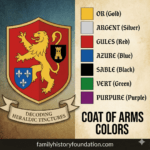
The system of coat of arms colors is divided into three specific categories:
- Metals: Gold (Or) and Silver (Argent).
- Colors: Red (Gules), Blue (Azure), Black (Sable), Green (Vert), and Purple (Purpure).
- Furs: Patterns representing animal skins, like Ermine.
Why is this distinction important? It all comes down to the Rule of Tincture, the first and most unbreakable rule of heraldic design. The rule states: “Metal should not be put on metal, nor color on color.”
This wasn’t just a fashion choice; it was about visibility. Imagine a dark blue lion painted on a black shield. From 200 yards away in the heat of battle, that image would be a muddy blur. But a Gold (Metal) lion on a Black (Color) shield? That pops. It is instantly recognizable.
As you research your family history, keeping this rule in mind can actually help you spot “fake” heraldry. If you find a crest that has a red lion on a blue background, be skeptical. It likely violates the fundamental laws of coat of arms colors.
For those of you just starting to dig into HERALDRY, it is helpful to brush up on your fundamentals. You can read more about starting your journey in my guide on 75 Heraldic Lion Positions Explained (Rampant, Passant, Statant & More).
The Metals: Gold and Silver
When analyzing coat of arms colors, the metals take precedence. They represent the light that illuminates the shield.
Or (Gold)
- Heraldic Name: Or
- Visual Representation: Yellow or Gold leaf.
- Symbolism: Generosity, Elevation of Mind, and Glory.
“Or” comes from the Latin word for gold (think “Aurum”). In the medieval mind, gold was the imperishable metal. It represented the sun, celestial light, and spiritual purity. If your ancestor’s shield features a significant amount of Or, it often signified a family that held themselves to a standard of noble generosity. They were expected to be leaders who “shined” in their community.
Argent (Silver)
- Heraldic Name: Argent
- Visual Representation: White or Silver.
- Symbolism: Peace, Sincerity, and Truth.
In heraldic artwork, white is almost always a stand-in for silver. When you see a white shield, do not think of it as “blank space.” Think of it as shining silver armor. Coat of arms colors utilizing Argent suggest a desire for purity and a lack of deception. In an era of political intrigue, proclaiming “Truth” on your shield was a bold statement.
If you are looking at a black-and-white sketch of a crest (common in old genealogy books), you can identify Argent because the shield will be left plain/blank, while Or is usually represented by a pattern of dots.
The Colors: From Red Through Purple
Now we move to the “Colours” proper. This is where the personality of the bearer often shines through.
Gules (Red) 🔴
- Heraldic Name: Gules
- Visual Representation: Bright Red.
- Symbolism: Warrior, Martyr, Military Strength, and Magnanimity.
Gules is perhaps the most common of all coat of arms colors. It screams for attention. Historically, red dye was expensive and associated with Mars, the God of War. A shield dominated by Gules often suggests a military history. It implies that the bearer was willing to spill blood (or have their own spilled) for their liege lord.
If you are dealing with a surname that has a long military tradition, expect to see Gules. However, always remember that owning a surname doesn’t automatically grant you the rights to the arms. We discuss this complex topic in detail in our post on coat of arms for a surname.
Azure (Blue) 🔵
- Heraldic Name: Azure
- Visual Representation: Royal Blue.
- Symbolism: Truth, Loyalty, and Strength.
Azure represents the sky and the heavens. While Gules is aggressive, Azure is steadfast. It is the color of loyalty. In the English tradition, blue became heavily associated with the monarchy and loyal service.
When decoding coat of arms colors, finding Azure can sometimes indicate a family that served in administrative or judicial roles—those who had to remain “true blue” to their duties.
Sable (Black) ⚫
- Heraldic Name: Sable
- Visual Representation: Black.
- Symbolism: Constancy, Grief, Wisdom, and Prudence.
Sable is a fascinating tincture. While modern minds might associate black with evil, the medieval mind associated it with iron, earth, and stability. A Sable shield is unmovable. It represents a family that stands firm regardless of the changing winds of politics.
In some cases, Sable was also used to denote grief or remembrance, perhaps adopted after the loss of a significant patriarch.
Vert (Green) 🟢
- Heraldic Name: Vert
- Visual Representation: Emerald Green.
- Symbolism: Hope, Joy, and Loyalty in Love.
Vert is rarer in ancient heraldry than Red or Blue. Why? Because historically, green dyes were unstable and would fade to brown. However, when it appears, it is vibrant with meaning. It represents the spring, renewal, and hope.
Interestingly, in Irish heraldry, Vert takes on a nationalistic meaning, but in general continental heraldry, coat of arms colors featuring green often point to families associated with the land, forestry, or hunting.
Purpure (Purple) 🟣
- Heraldic Name: Purpure
- Visual Representation: Royal Purple.
- Symbolism: Royal Majesty, Sovereignty, and Justice.
This is the unicorn of coat of arms colors. It is incredibly rare. Purple dye (Tyrian purple) was astronomically expensive, reserved historically for emperors. If you find Purpure on a non-royal shield, it is a significant anomaly that warrants deep research. It may indicate a special grant from a monarch.
Coat of Arms Colors Quiz
🧠 Let’s take a quick QUIZ BREAK. You’ve learned the basics of the palette. Can you speak the language of the heralds?
You find an old black-and-white sketch of a shield covered in small dots. Which tincture does this pattern represent?
The Furs: Why Furs Are Tinctures
Beyond standard coat of arms colors, we have the "Furs." These are patterns representing the pelts of animals, worn on the cloaks of the nobility.
Ermine
Ermine represents the winter coat of the stoat (a type of weasel), which is white with a black tail tip. In heraldry, this looks like a white field with little black abstract shapes (spots). Ermine is a mark of high dignity. You will often see it lining the mantling (the cloth flowing from the helmet).
Vair
Vair represents the skin of the squirrel. It looks like a pattern of alternating blue and white bells or cups. It usually implies great wealth, as it took thousands of squirrel pelts to line a single cloak!
Coat of Arms Colors at a Glance: A Reference Chart
Use this reference table to identify and decode any heraldic tincture. Filter by category to see metals and colors separately.
| Shield | Tincture | English name | Category | Core symbolism | Notable examples |
|---|---|---|---|---|---|
| Or | Gold / Yellow | Metal | Generosity, elevation of mind, glory | Scotland’s Lion Rampant (gold lion on red); England’s three golden lions on red | |
| Argent | Silver / White | Metal | Peace, sincerity, truth | St George’s Cross of England (red cross on white); many English judicial families | |
| Gules | Red | Color | Military strength, courage, martyrdom, magnanimity | Royal Arms of England; St Andrew’s Saltire of Scotland; most common heraldic color | |
| Azure | Blue | Color | Truth, loyalty, strength | France (golden fleurs-de-lis on blue); English judicial and administrative families | |
| Sable | Black | Color | Constancy, grief, wisdom, prudence | Flag of Flanders (black lion on gold); many German noble and imperial families | |
| Vert | Green | Color | Hope, joy, loyalty in love | Irish heraldry; families associated with forests, land, and hunting; rarer than red or blue | |
| Purpure | Purple | Color — rare | Royal majesty, sovereignty, justice | Extraordinarily rare; reserved for special royal grants. If you find Purpure, research deeply. |
Showing all 7 tinctures
The Lion in Heraldry: What Does a Lion on a Coat of Arms Mean?
The lion is the most depicted charge in the entire history of Western heraldry. From the royal arms of England and Scotland to thousands of noble family shields across Europe, no animal has been more consistently used to represent power, valor, and identity.
If you have found a lion on your family’s coat of arms, you have found something significant — but what it means depends entirely on two things: the lion’s color (tincture) and its posture (attitude).
The tincture of the lion is where this guide becomes directly useful. A gold (Or) lion on a red (Gules) field is the Lion Rampant of Scotland — one of the oldest and most recognisable symbols in European heraldry, representing fierce independence and noble generosity. A red (Gules) lion on a gold field signals warrior spirit and military ancestry, common across English and Norman noble families.
A black (Sable) lion on gold is the symbol of Flanders, associated with constancy and wisdom. A silver (Argent) lion on blue (Azure) combines truth with loyalty — a pairing found frequently in the arms of families with judicial or administrative roles. Green (Vert) lions are rare and beautiful, associated with hope and renewal; purple (Purpure) lions are extraordinary — if you find one, begin researching immediately.
The color is only half the story. A lion can stand upright in the rampant attitude, stride forward in the passant attitude, sit in the sejant, or recline in the couchant — and each posture carries its own distinct meaning.
"Discovering what your family's coat of arms reveals? The Source Hound goes deeper every week — research strategies, case studies, and historical context delivered free."
The Family History Foundation Newsletter
It’s Not About You, It’s About Documenting Before It Disappears
Join 500+ family historians getting Franklin's Source Hound weekly research breakthroughs — real case studies, source hacks, and the exact strategies that turn brick walls into discoveries.
Free. No fluff. Straight from the Source Hound's desk to yours.
Your privacy is sacred — almost as sacred as a primary source. Read our Privacy Policy.
No Coat of Arms Colors Without a "Charge"
You rarely see coat of arms colors in isolation. They form the background for "Charges"—the animals and objects on the shield.
This is where the story gets complex. A red shield is one thing; a red shield with a golden lion is another. The posture of the animal matters just as much as the color. A lion might be "Rampant" (attacking) or "Passant" (walking).
If you are struggling to identify the beast on your shield, you need to read our companion guide on heraldic lion positions. It explains why the direction the animal is facing changes the meaning entirely.
For example, a Lion Rampant Or (Gold attacking lion) on a Field Gules (Red background) is the classic royal arms of Scotland. The combination of the aggressive red background and the noble gold lion creates a symbol of fierce independence and royalty.
The Problem of "Romanticism"
A word of warning to the "Brainy Beginner": Be careful with Victorian interpretations.
In the 18th and 19th centuries, genealogy became a trendy hobby. Many writers published books assigning flowery, poetic meanings to every single line and dot. They might claim that "a wavy line means the ancestor was a sea captain."
Sometimes, this is true. But sometimes, a wavy line was just a way to make the shield look different from the neighbor's shield.
When analyzing coat of arms colors, look for consistency. If the surname is "Green," and the shield is Vert (Green), that is called "Canting Arms" (a visual pun). It doesn't mean they were hopeful; it means they were making a play on words.
Understanding these nuances helps you avoid common pitfalls. Arm yourself with the best genealogy research methodology possible, I call this my Source Hound methodology for genealogy research online.
Documenting Your Findings
Once you have identified the colors, how do you save this information?
Don't just save the JPG image to your desktop. You need to record the "Blazon." The blazon is the written description of the arms. It allows an artist to recreate the image perfectly without ever seeing it.
For example: "Azure, a bend Or."
This tells you the background is Blue, and there is a diagonal Gold stripe.
Recording the blazon ensures that even if your digital image file gets corrupted, the data is safe. Speaking of safety, if you haven't set up a protocol for your digital files, please review our genealogy data preservation plan. It is the only way to ensure your hard work survives for the next generation.
Furthermore, as you dig deeper, you might hit walls where the paper trail vanishes. This is common when trying to connect a specific heraldic shield to a specific ancestor. If you are stuck on a difficult lineage, check out our advice on the maiden name dead end, which utilizes lateral thinking to break through brick walls.
Technology and Heraldry
In the modern age, we are blessed with tools that medieval heralds could only dream of. AI is starting to play a role in deciphering old manuscripts and even identifying coat of arms colors from black-and-white photos based on hatching patterns.
If you are interested in how technology is changing the game, read our thoughts on AI and genealogy.
Additionally, if you are using platforms like Ancestry.com to find these images, you need to be surgical in your search. It is easy to attach the wrong image to the wrong John Smith. This is known as the common name ancestor problem, and it is one of the most frustrating aspects of family history.
If you are new to the platform, we have a step-by-step breakdown on how to find family on Ancestry that ensures you are attaching records—and heraldry—correctly.
Conclusion: Painting the Picture of the Past
Understanding coat of arms colors is about more than memorizing a list of definitions. It is about empathy. It allows you to stand in the shoes of your ancestor, look at the shield they bore, and understand what they valued.
Did they value Truth (Blue)? Warrior spirit (Red)? Wisdom (Black)?
As you continue your research, treat these colors as clues, not just decorations. They are the silent language of history, waiting for you to translate them.
What colors appear in your family research? Let us know in the comments below! 👇
Join the Family History Foundation Source Hound Community
Our family history is disappearing every day, join the Source Hound community and join our pledge to be the protector of your family history. The lives and voices of our ancestors are depending on it for our future generations.
Celebrate Family History Fridays with us across our social media and community platforms!
📬 Subscribe to the Newsletter -- tips, active challenges, and deep-dive case studies. Never an overloaded inbox, always something you can use this weekend.
 Like & Subscribe on YouTube -- every Friday, a video companion to the week's article. Watch these techniques demonstrated rather than described.
 Pin Us on Pinterest -- printable question sheets, research charts, and visual guides to save for your next session.
 Podcasting on Spotify! -- podcasting now on Spotify, you can find all of the latest episodes on any of your favourite podcast platforms, starting with Spotify.
 Podcasting on Amazon! -- If you are not on Spotify we are also on Amazon Podcasts so you can listen while you drive and work. Every episode is curated just for you to binge your favourite episodes.
 Podcasting on Audible! -- Audible is an alternative offshoot of Amazon Podcasts to listen while search for your next favourite book. Ready for your next "audible?" Set, Go!
Let's make Family History a household word. 🏠
The Family History Foundation Newsletter
Our Family History Is Disappearing Every Day!
Join the quest with 500+ family historians getting Franklin’s Source Hound weekly research breakthroughs — real case studies, source hacks, and the exact strategies that turn brick walls into discoveries.
Free. No fluff. Straight from the Source Hound's desk to yours.
Your privacy is sacred — almost as sacred as a primary source. Read our Privacy Policy.
Shop Premium Genealogy Forms

About the Author
Hi there, my name is Franklin, the founder and author of The Family History Foundation.
Our family stories are disappearing every day and it's crucially important that the next generation is able to learn and appreciate their family history. It is up to you to take up the mantle of responsibility to ensure that how you research today will be passed on tomorrow with the highest standards possible.
I believe that genealogy is not just about names and dates, it's about your stories and how those stories inform your identity.
With a penchant for storytelling and a background in research, the insights and techniques you learn on The Family History Foundation will help you uncover the incredible stories and identities hidden within the tapestry of your ancestry.
My mission is "Let's make Family History a household word."
My motto is "The Past 'Relative' to the Future."
Coat of Arms Colors: Frequently Asked Questions
Q1: What does gold mean on a coat of arms?
Gold — known in heraldry as Or — symbolises generosity, elevation of mind, and glory. In the medieval tradition, gold represented the sun and celestial light. A shield featuring a significant amount of Or typically indicated a family expected to be community leaders who "shone" in their generosity. The most famous example is the gold Lion Rampant of Scotland on its red field.
Q2: What does red mean on a coat of arms?
Red — the heraldic tincture Gules — is the most common coat of arms color. It symbolises military strength, courage, magnanimity, and martyrdom. In the medieval mind, red dye was expensive and associated with Mars, the god of war. A shield dominated by Gules almost always suggests a military history or a willingness to sacrifice for one's lord. It appears in the English royal arms, the St George's Cross, and thousands of noble family crests.
Q3: What does blue mean on a coat of arms?
Blue — Azure in heraldry — represents truth, loyalty, and strength. While red is aggressive, blue is steadfast. It is the color of the sky and the heavens, associated with faithful service and administrative duty. In English heraldry, blue became strongly linked with families who held judicial or civic roles — those expected to remain "true blue" to their obligations. The Royal Arms of France featured gold fleurs-de-lis on an Azure field.
Q4: What does black mean on a coat of arms?
Black — Sable in heraldry — represents constancy, wisdom, grief, and prudence. Despite its modern associations with darkness, the medieval mind linked black with iron, earth, and immovability. A Sable shield signals a family that stands firm regardless of changing political winds. It was sometimes used to denote grief after the loss of a great patriarch. The most famous Sable charge is the black lion of Flanders on its gold field.
Q5: What does a lion on a coat of arms mean?
A lion on a coat of arms is the most common heraldic charge in Western heraldry and its meaning depends on two things: its color and its posture. A gold lion on red represents the fierce independence of Scotland's Lion Rampant. A red lion on gold signals warrior ancestry common in English and Norman noble families. A black lion on gold — as in the arms of Flanders — represents constancy and wisdom. The posture matters equally: a rampant lion attacks, a passant lion walks with controlled authority, and a sejant lion sits in composed sovereignty. For a full breakdown of lion postures, see our guide to heraldic lion positions

" is included.](https://familyhistoryfoundation.com/wp-content/uploads/2026/05/Citizenship-by-Descent-How-to-Claim-Your-Ancestral-Passport-in-2026-featured.png "Citizenship by Descent: How to Claim Your Ancestral Passport in 2026 47")