Every genealogist needs a once removed cousin chart. Genealogy isn’t just names and dates — it’s the web of relationships that connect generations, and cousin relationships ‘once removed’ are among the trickiest pieces to place correctly.
This guide breaks down how these relationships are defined and how to place them in your own family tree. You’ll also get a once removed cousin chart that lays out the connections between siblings, cousins, and grandparents, so the whole picture clicks into place.
Table of Contents
Understanding the Once Removed Cousin Chart
To comprehend the once removed cousin chart and the cousin relationships “once removed,” it’s essential first to understand the basic structure of cousin relationships:
- First Cousins: First cousins are individuals who share a set of grandparents. They are the children of siblings.
- Second Cousins: Second cousins share a set of great-grandparents. They are the grandchildren of siblings.
- Third Cousins: Third cousins share a set of great-great-grandparents. They are the great-grandchildren of siblings.
The term “removed” is used to indicate a difference in generations between cousins. When cousins are “once removed,” this means there is a one-generation difference between them.
Defining “Once Removed” for a Cousin
- First Cousins Once Removed: These are the children of first cousins. For example, if you are first cousins with someone, your child and your cousin’s child are first cousins once removed to each other.
- Second Cousins Once Removed: These are the grandchildren of second cousins. For instance, if you and someone else are second cousins, your grandchild and their grandchild are second cousins once removed.
- Third Cousins Once Removed: These are the great-grandchildren of third cousins. If you and someone else are third cousins, your great-grandchild and their great-grandchild are third cousins once removed.
Visualizing Cousin Relationships
Let’s now visualize these relationships through an actual once removed cousin chart, focusing on siblings, cousins, and grandparents:
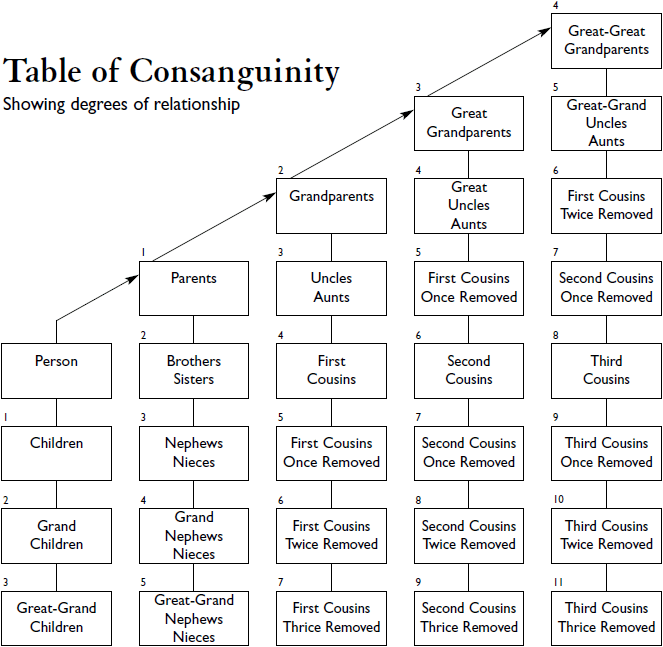
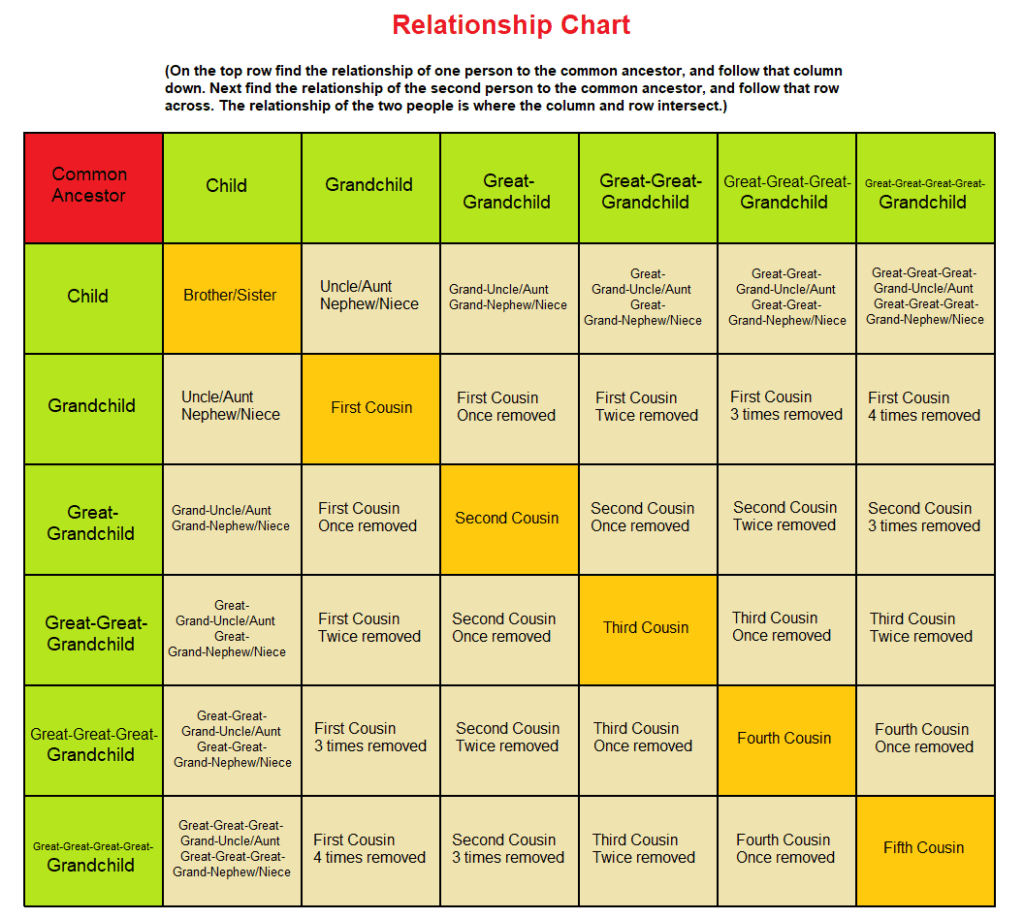
In this Once Removed Cousin Chart:
- Child 1 and Child 2 are siblings, sharing the same parents (Parent 1 and Parent 2).
- Child 1 and Child 3 are first cousins, as they share the same grandparents (Grandparent A and Grandparent B).
- Grandchild 1 and Grandchild 2 are first cousins once removed, as Grandchild 1 is the child of Child 1 and Grandchild 2 is the child of Child 3.
- Child 1 and Grandchild 3 are grandparents and grandchild, separated by two generations.
“Removed” vs. “Great”: What’s the Difference?
Great’ and ‘removed’ solve two different problems. ‘Great’ stretches a direct line — your grandparent’s parent is your great-grandparent. ‘Removed’ marks a generational gap between cousins on different branches. So your first cousin’s child isn’t your ‘great’ anything — they’re your first cousin once removed. Keeping the two ideas separate is what makes a once removed cousin chart click.
📊 Once Removed Cousin Chart: Quick Reference

| Relationship | Shared ancestor | What it means | Quick example |
|---|---|---|---|
| Siblings | Parents | You share both parents | You and your brother |
| First cousins | Grandparents | Children of siblings | You and your aunt’s child |
| First cousins once removed | Grandparent / great-grandparent | One generation apart from a first cousin | You and your first cousin’s child |
| First cousins twice removed | Great-grandparent | Two generations apart from a first cousin | You and your first cousin’s grandchild |
| Second cousins | Great-grandparents | Grandchildren of siblings | You and your grandparent’s sibling’s grandchild |
| Second cousins once removed | Great- / great-great-grandparent | One generation apart from a second cousin | You and your second cousin’s child |
| Third cousins | Great-great-grandparents | Great-grandchildren of siblings | You and a shared 2×-great-grandparent’s descendant |
| Third cousins once removed | Great-great- / 3×-great-grandparent | One generation apart from a third cousin | You and your third cousin’s child |
📊 Once Removed Cousin Calculator: Quiz Reference
Find the most recent ancestor you both share, then tell us how each of you connects to that person. (This assumes you both descend from that common ancestor.)
Please choose an option for both people.
Navigating Cousin Relationships in Genealogical Research
Genealogical research often involves piecing together these relationships through historical records, oral histories, and DNA testing. Here are some tips for navigating cousin relationships in your research:
- Start with What You Know: Begin with yourself and work backward, documenting information about your parents, grandparents, and great-grandparents. This foundation will help you identify potential cousins and establish connections. Also, focus on maiden names in your family.
- Utilize Family Interviews: Interview older relatives to gather family stories, names, and dates that may not be documented elsewhere. Oral history can provide valuable clues for further research. THIS GUIDE WILL SUPERCHARGE YOUR INTERVIEW SKILLS!
- Use Genealogical Software or Websites: Platforms like Ancestry.com, MyHeritage, and FamilySearch offer tools to build and visualize family trees. These tools can help you track relationships and identify cousin connections more efficiently.
- Consult Historical Records: Census data, birth certificates, marriage records, and immigration records are essential for verifying relationships and filling in gaps in your family tree. Many of these records are now digitized and accessible online.
- Explore DNA Testing: DNA testing services like AncestryDNA and 23andMe can confirm relationships and connect you with genetic cousins who share segments of DNA. This can be particularly useful for uncovering distant cousin relationships.
- Understand Regional and Cultural Differences: Family structures and naming conventions can vary across regions and cultures. Familiarize yourself with these differences to interpret historical records accurately.
Practical Example: Researching Cousins “Once Removed”
Let’s consider a practical example to illustrate researching cousin relationships “once removed” via a Once Removed Cousin Chart using Ancestry.com:
- Create a Family Tree: Start by creating a family tree on Ancestry.com, entering information about yourself, your parents, grandparents, and great-grandparents.
- Search for Records: Utilize Ancestry.com’s extensive database to search for records related to your known relatives. Look for census records, birth certificates, and marriage records to confirm relationships and gather additional details.
- Expand Your Search: Once you’ve established connections with your direct ancestors, expand your search to include their siblings and extended family members. This will help you identify potential cousins “once removed” and other distant relatives.
- DNA Matching: If you’ve taken a DNA test through AncestryDNA, explore your DNA matches to identify genetic cousins. Review shared matches and genetic communities to pinpoint potential connections.
- Collaborate with Others: Ancestry.com allows you to connect and collaborate with other researchers who may have overlapping family lines. Share information, compare research findings, and work together to uncover shared ancestors.
- Document Your Findings: Keep detailed notes and records of your research findings, including sources and citations. This documentation will not only help you track your progress but also serve as a valuable resource for future generations.
The Family History Foundation Newsletter
Our Family History Is Disappearing Every Day!
Join the quest with 500+ family historians getting Franklin’s Source Hound weekly research breakthroughs — real case studies, source hacks, and the exact strategies that turn brick walls into discoveries.
Free. No fluff. Straight from the Source Hound’s desk to yours.
Your privacy is sacred — almost as sacred as a primary source. Read our Privacy Policy.
❓ Frequently Asked Questions
What does “once removed” actually mean on a cousin chart?
A one-generation gap between two cousins on different branches; each “removed” = one more generation of difference. (https://familyhistoryfoundation.com/blog/once-removed-cousin-chart/)
What is a first cousin once removed?
Your first cousin’s child, or (looking up) your parent’s first cousin — same relationship label, viewed from either direction.
Are “first cousin once removed” and “second cousin” the same thing?
No. Second cousins are the same generation sharing great-grandparents; a first cousin once removed sits one generation off from a first cousin.
How do DNA tests show cousins once removed?
Shared-cM ranges overlap between relationship types, so pair the estimate with a paper trail before you label a match. (https://familyhistoryfoundation.com/blog/why-siblings-have-different-test-results-autosomal-dna/)
How should I record cousin relationships in my research?
Track them on a dedicated log so every relationship has a source behind it.
What’s the difference between “removed” and “great”?
“Great” extends a direct line; “removed” marks a generational gap between cousins. The numbering indicates an equivalent generational distance; for example, a 1x or 2x great-grandparent is 1 or 2 generations beyond your parent. A “removed” cousin is much more fluid, you can have multiple levels of cousins and multiple levels of “removed” cousins.
Is there a cousin chart or calculator to figure this out fast?
(link: Once Removed Cousin Chart) — Yes — use the once removed cousin chart above, and confirm tricky lines with a solid research method. You should start with yourself as the reference point and work out from there.
Conclusion
In conclusion, understanding a once removed cousin chart adds depth to your genealogical research, revealing how individuals are connected across generations within your family tree. By grasping these concepts and utilizing tools like Ancestry.com, you can uncover hidden stories, connect with distant relatives, and trace your lineage with greater accuracy and confidence.
Embark on your genealogical journey today—explore the past, celebrate your heritage, and discover the fascinating connections that define your family’s history. Your ancestors’ stories are waiting to be told, and through diligent research and exploration, you can preserve their legacy for generations to come.
For more information on the basics of genealogical research, which can be trickier than you think, check out my The Ultimate Beginners Guide to Professional Genealogy Research Online!
The Family History Foundation Newsletter
It’s Not About You, It’s About Documenting Before It Disappears
Join 500+ family historians getting Franklin’s Source Hound weekly research breakthroughs — real case studies, source hacks, and the exact strategies that turn brick walls into discoveries.
Free. No fluff. Straight from the Source Hound’s desk to yours.
Your privacy is sacred — almost as sacred as a primary source. Read our Privacy Policy.
Shop Premium Genealogy Forms

About the Author
Hi there, my name is Franklin, the founder and author of The Family History Foundation.
Our family stories are disappearing every day and it’s crucially important that the next generation is able to learn and appreciate their family history. It is up to you to take up the mantle of responsibility to ensure that how you research today will be passed on tomorrow with the highest standards possible.
I believe that genealogy is not just about names and dates, it’s about your stories and how those stories inform your identity.
With a penchant for storytelling and a background in research, the insights and techniques you learn on The Family History Foundation will help you uncover the incredible stories and identities hidden within the tapestry of your ancestry.
My mission is “Let’s make Family History a household word.”
My motto is “The Past ‘Relative’ to the Future.”