The common assumption is that you how to interview relatives, because, well, they’re your relatives and you already know them. This is a dangerous assumption. It is an assumption which will not serve you well in the art of how to interview relatives because it is prescriptive.
More on that term later. Let’s start here: most of us default to the worst possible instrument: the yes-or-no question. 🎙️
You sit down with your grandmother, press record, and ask “did you like growing up on the farm?” She says “oh, it was fine.” Forty-five minutes later you have eleven minutes of “fine” and “I suppose so,” and you conclude she isn’t much of a talker.
She is. You just handed her a form to fill out instead of a door to walk through. Learning how to interview relatives is almost entirely a matter of question craft, and question craft can be learned in an afternoon. Let’s learn the proper art and all the nuances of how to interview relatives.
Table of Contents
The Three Kinds of Questions 🔑
Every question you ask lands in one of three buckets, and knowing which one you just used is the foundation of how to interview relatives well. We covered these in the first article in this series: How to Record an Oral History Interview: A Genealogist’s Field Guide.
Closed questions have a finite answer. Did you serve in Korea? What year did you marry? Excellent at collecting facts, useless at collecting stories.
Leading questions smuggle the answer inside the question. Grandpa was strict, wasn’t he? They feel conversational and warm, and they quietly poison your research.
Open questions hand over control to the person being asked the question. What was your father like? Tell me about that winter. They cannot be answered in a word, which is exactly the point.
There are great open ended question lead ins such as:
- “How did you feel about…?”
- “Who else was there?” “
- Focus in on a detail and ask for elaboration in a conversational way.
You need all three. The skill is knowing which one you just reached for. There are more questions and scenarios throughout this article 🎉
Think of the last kitchen you sat in that belonged to someone older than you. What was on the table?
Why Leading Questions Wreck Genealogy 🚫
Here is the part most interview guides skip. Ask “she came over from Sicily, right?” and you have told your relative the answer you want — and human memory is agreeable. Under pressure, people confirm.
Six months later your source says Sicily and you cannot tell whether that came from her memory or your question. Any Source Hound worth the name will tell you a leading question turns testimony into an echo of your assumptions.
Here’s the counterintuitive part: you should be asking questions you already know the answer to!
That’s right, consequently that’s what every great interviewer does, and ever great lawyer too. However, when considering how to interview relatives, your job is not to put someone on the stand and squeeze them for information, but to draw out more memories using your inside knowledge as a base point.
Follow this script logic. If you ask a question you already know the answer to and your relative confirms your information, use that as an opportunity to dig deeper and probe further. If they answer contrary to your information, use the opportunity to seek clarification.
At all times be INQUISITIVE. How to interview relatives is just that.
In my Linguistics degree, while doing fieldwork, I was taught to be descriptive not prescriptive. That is to say to “describe” (descriptive) what you see and not interject your own biases onto your subject.
This is why how to interview relatives matters as methodology, not just etiquette. Ask “where did the family come from?” and let the answer be wrong, surprising, or contradictory. Wrong answers are data. Confirmed guesses are noise. 🔍
Eight Rewrites That Change Everything ✍️
You do not need a hundred questions. You need to fix the eight you already ask. This is the practical core of how to interview relatives:
- ❌ Did you have a happy childhood? → ✅ What did a normal Saturday look like when you were ten?
- ❌ Was Grandpa a hard worker? → ✅ Walk me through his day. What time did he leave the house?
- ❌ Do you remember the Depression? → ✅ What changed in the house during those years?
- ❌ Were you close to your sister? → ✅ What did you two fight about?
- ❌ Did you like school? → ✅ Who was your worst teacher, and what did they do?
- ❌ Was it hard when you moved? → ✅ What did you take with you, and what got left behind?
- ❌ Did the family go to church? → ✅ What happened on Sunday mornings, start to finish?
- ❌ Was your mother a good cook? → ✅ What was on the table on a Tuesday night?
Notice the pattern: every rewrite trades a judgment for a scene. Judgments get you an adjective; scenes get you three minutes of detail you never knew existed. That is how to interview relatives, compressed into a single habit. 🎬

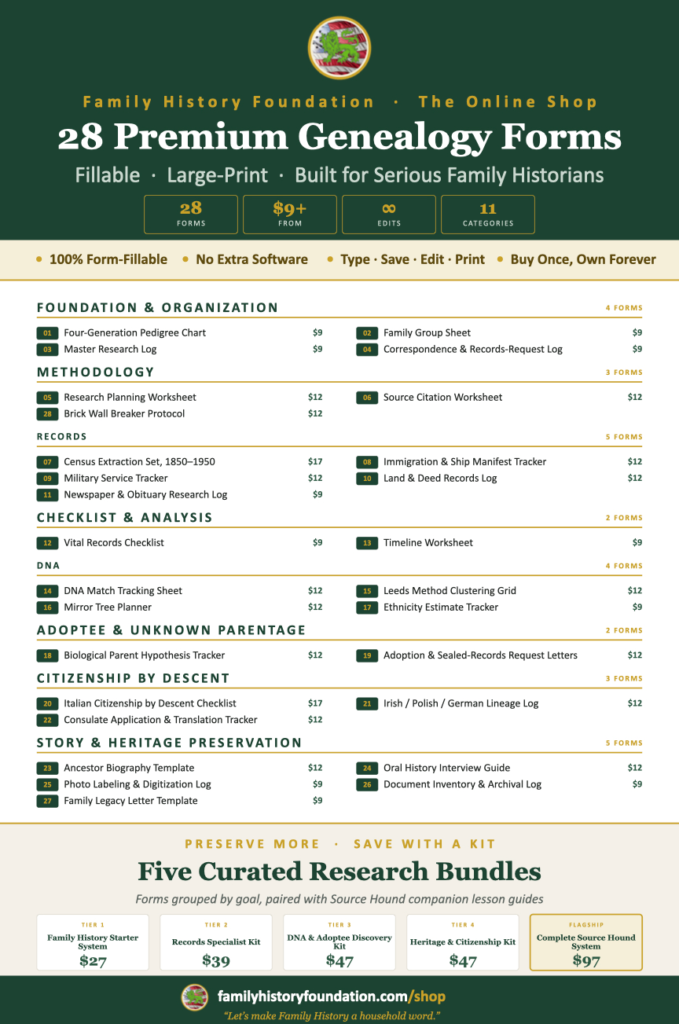
If you would rather walk in with the rewrites already done for you, the Form 24 Oral History Interview Guide in the Family History Foundation Online Shop is a form-fillable PDF built on exactly this structure — open prompts, follow-up cues, and space to log answers as you go.
The Funnel: Wide First, Narrow Later 🔽
Order matters as much as wording, and half of how to interview relatives is sequencing. Open wide, then tighten — never the reverse.
Start with something enormous: tell me about the house you grew up in. Let them wander for five minutes. Only once they are talking do you drop in the closed questions — what year was that? what was her maiden name?
Do it backwards and you set an interrogation tone in the first two minutes. Nobody relaxes after a quiz.
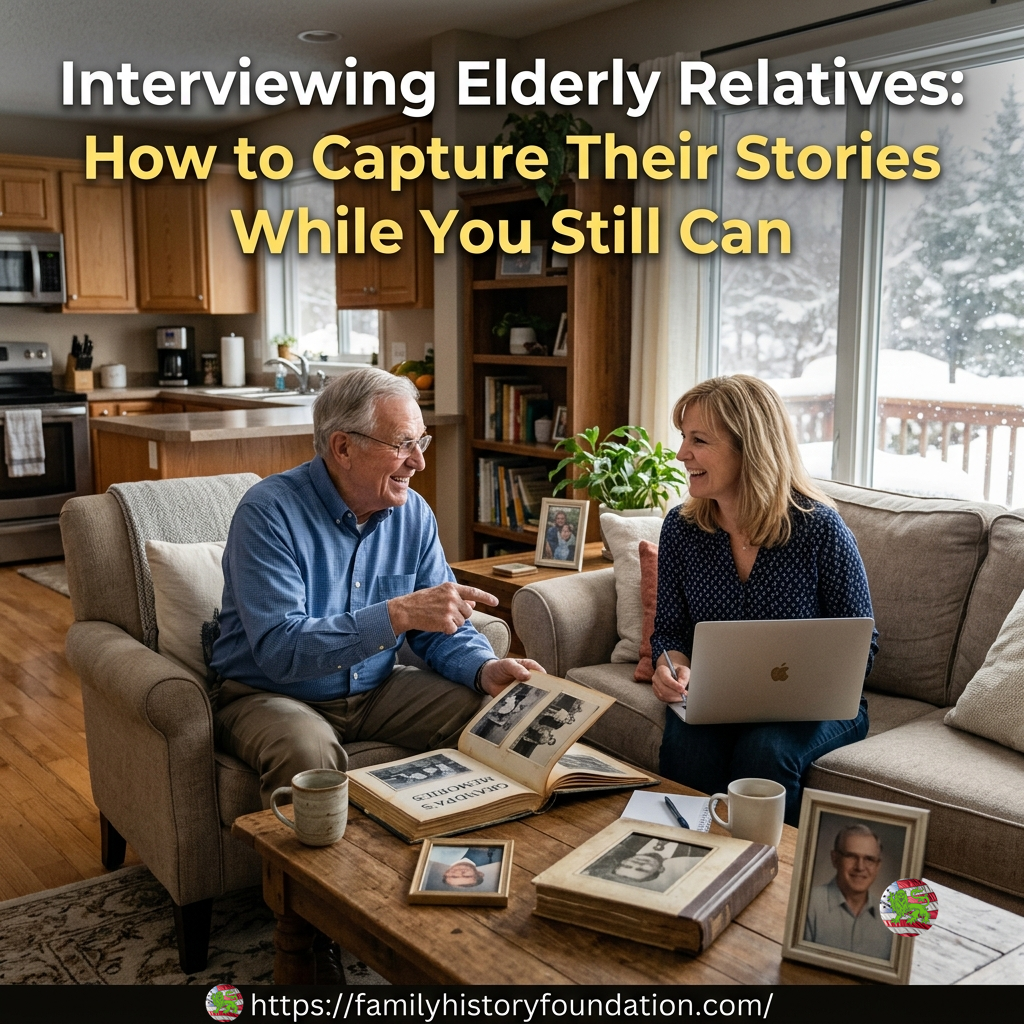
Speaking of relaxing, as we covered in the second article in this series, set a relaxing and fun tone for the how to interview relatives interview. I cover all of this in the following article: Interviewing Elderly Relatives: How to Capture Their Stories While You Still Can.
I’m going to get tough on you. There is more at stake with interviewing elderly relatives than you might think. Every day we are losing our family history to constant distractions and a constant barrage of AI subterfuge redefining who we are. Take back control of your legacy by staying informed and taking action.

The Family History Foundation Newsletter
It’s Not About You, It’s About Documenting Before It Disappears
Join 500+ family historians getting the Source Hound’s weekly research breakthroughs — real case studies, source hacks, and the exact strategies that turn brick walls into discoveries.
Free. No fluff. Straight from the Source Hound’s desk to yours.
Your privacy is sacred — almost as sacred as a primary source. Read our Privacy Policy.
The Follow-Up Matters More Than the Question 🪝
Most of how to interview relatives happens after the answer, not before it. Your first question opens a door; your second decides whether you walk through.
The four most valuable follow-ups are short: “What do you mean by that?” — “What happened next?” — “How did that feel?” — and best of all, “Who else was there?” That last one has broken more brick walls than any database, because it produces names you did not know to look for.
So when she says “we had to leave in a hurry,” stop. Ask what she means. 🧭
Ask for Scenes, Not Summaries 🎬
A summary sounds like “times were hard.” A scene sounds like “we ate potatoes six nights a week and Daddy sold the mule in March.” One is a sentence; the other is a family history — and choosing between them is what how to interview relatives really comes down to.
Anchor every question in time, place, and sense. Ask what a room smelled like, what the radio was playing, what a haircut cost and who cut it. Photographs help enormously — even damaged ones, especially if you have restored or animated them first so faces are recognizable.
And when a scene arrives, shut up and let it run. 🤫
A technique I like to use is to share family stories that you have heard and get their reactions. For example, I was asking a cousin about my great-grandfather’s dairy farm and she started opening up about our great-grandmother and her personality. What a great discovery that was!
The Questions That Quietly Fail ⚠️
Four habits sabotage otherwise good interviews, and knowing how to interview relatives means catching all four in your own mouth.
Stacked questions. Where did you live, and how long, and did you like it? They answer the last one and the first two vanish. One question, then silence.
Genealogy jargon. Nobody outside the hobby knows what a collateral line is. Ask about “your mother’s family before she married.”
Questions with a right answer. You must have been proud, right? Now they cannot say no.
Questions about categories, not people. “Tell me about your ancestors” gets you nothing. “Tell me about your grandmother’s hands” gets you everything.
Fishing, not wishing. “You were born in Boston, right?” will get you a one line answer. “I was driving through Stephenville the other day…” may get you something if you are fishing for an answer with a prompt.
This often works for me! Having a fascination for small town names, I often study them for fun. When talking with relatives, I’ll often go fishing with this in a fun way. I’ll bring up a small town name and see how they respond. My favourite “catch” came once when a cousin of mine opened up and told me that the town of Stephenville, Texas was named after her maternal grandfather’s line as she descended from the founder of the town. Cool!
If a question can be answered in one word and you did not want one word, it is the wrong question. That single test will fix half your interviews. ✋
Save This One for Last 🏁
When you think you are finished, ask this: “What haven’t I asked you about?” It is the last move in how to interview relatives, and the most overlooked.
It is the single most productive question in the craft, and no discussion of how to interview relatives is complete without it. You arrived with your own assumptions, and your relative has spent an hour politely answering them while sitting on the thing they actually wanted to tell you.
Its cousin is nearly as good: “Who else should I be talking to?” That is how you find the cousin in Ohio with the family Bible. 🎁
What to Do With the Answers 📝
Knowing how to interview relatives is only half the job. Every answer you collect is a claim until a document backs it up, so log each one as a sourced statement attributed to the person who said it — our free genealogy forms include the research logs for exactly this.
Then verify. A remembered arrival year gets checked against the federal census; a half-remembered wedding against newspaper archives. Testimony points; documents confirm — and a free family tree template keeps the confirmed material from evaporating into a notes app.
Where to Go Next 🧭
Question craft is one piece of a larger method. For the full process — preparation, recording, consent, preservation — start with the oral history interview field guide, which is where how to interview relatives fits into the wider workflow.
If the person you are sitting with is in their eighties or nineties, how to interview relatives shifts again — pacing, hearing, and fatigue all change what works. That is covered in interviewing elderly relatives.
For raw material to adapt, our 50 questions to ask relatives about family history is the place to shop for prompts — just rewrite each one into a scene first. 💚
Frequently Asked Questions
What is the best question to ask a relative about family history?
“What haven’t I asked you about?” Save it for the end of every session. It hands control to the person who actually knows what matters, and it routinely produces the best material of the day.
What is the difference between an open and a leading question?
An open question invites any answer — “what was your father like?” A leading question contains the answer you expect — “he was strict, wasn’t he?” Mastering that distinction is most of how to interview relatives well.
How many questions should I prepare?
Twelve open questions is plenty for a ninety-minute session — the follow-ups do the real work. How to interview relatives well is mostly about listening harder, not preparing more. Use a pre-filled genealogy PDF form to help you.
Are closed questions ever useful?
Yes, for pinning down dates, names, spellings, and places. Deploy them late, after the storytelling has started, so you never open on a quiz.
What if my relative only gives one-word answers?
Be patient. Change the question, not the person — this is the most common stumbling block in how to interview relatives. Swap the judgment for a scene: instead of “was it hard?”, ask “what did you eat that week?” The most important part is to have empathy.
How do I keep from putting words in their mouth?
Never name the answer inside the question, and never correct a story mid-telling. If you believe the family came from County Cork, ask where they came from and let the record disagree with you.
Should I use a genealogy script or improvise?
Both. Bring a printed list or genealogy interview question PDF so you never stall, but treat it as a safety net rather than a route. Learning how to interview relatives means abandoning the script the moment something interesting appears.
Go Ask a Better Question This Week 📞
You already know who to call. What was missing is the second half — how to interview relatives in a way that makes them want to keep talking.
So pick one person and rewrite three questions before you dial. Trade every judgment for a scene, ask “who else was there?” whenever a story stalls, and finish with “what haven’t I asked you about?”
That is how to interview relatives, start to finish. Everything else is patience and a charged phone. 💚
Which question are you stealing for your next call? Tell me in the comments — and if you have one that always works, share it. Somebody reading this needs it. 👇
Join the Family History Community 🏡
Your family history is eroding fast. Join the movement to make family history a household word. Arm yourself with the skills and attitude to make a difference in the future of your family today. Future generations will thank you.
🎥 Subscribe on YouTube — every Friday, a video companion to the week’s article. Watch these questions demonstrated rather than described.
📌 Follow on Pinterest — printable question sheets, research charts, and visual guides to save for your next session.
📬 Subscribe to the Newsletter — tips, challenges, and deep-dive case studies. Never an overloaded inbox, always something you can use this weekend.
A good question is the cheapest research tool ever invented, and the only one that works on people. Learning how to interview relatives costs you nothing but attention — go use it while there is still someone to ask. 🌿
Let’s make Family History a household word. 🏠
The Family History Foundation Newsletter
Still Hitting Dead Ends In Your Research?
Join 500+ family historians getting the Source Hound’s weekly research breakthroughs — real case studies, source hacks, and the exact strategies that turn brick walls into discoveries.
Free. No fluff. Straight from the Source Hound’s desk to yours.
Your privacy is sacred — almost as sacred as a primary source. Read our Privacy Policy.