Lithuanian Citizenship by Descent is unlike any other pathway in this series, because it is not really about acquiring something new, it is about reinstating a connection and realigning with history. 🇱🇹
When the Soviet occupation of Lithuania (and the Baltic states) began in 1940, hundreds of thousands of families fought, fled, were exiled, or were scattered across the world. This occupation lasted until 1990, with Germany occupying Lithuania from 1941-1944 during WWII. The history of Lithuania and the Baltic States during this period is quite complex.
Their citizenship did not vanish because they stopped being Lithuanian. It was interrupted by history. And today, their descendants have the right to reclaim it.
However, given the long and complex history of occupations, independence, and re-occupations, Lithuanian Citizenship by Descent can be somewhat confusing. For example, what about your Lithuanian ancestors who left before 1918? What about your Lithuanian ancestors who left between 1940 and 1990? Let’s tell the story and clear this all up.
Table of Contents
If your parent, grandparent, or great-grandparent was a citizen of the independent Republic of Lithuania between February 16, 1918 and June 15, 1940, you may be entitled to a Lithuanian ancestral passport — full European Union citizenship, with no language test, no residency requirement, and the right to keep your current nationality. This is one of the most emotionally meaningful and practically accessible citizenship pathways in all of Europe.
This complete 2026 guide walks you through the two dates that govern everything, the eligibility rules, the application process through Lithuania’s MIGRIS system, and how your genealogy research is the key that unlocks the entire path.
This post is part of the Family History Foundation Citizenship by Descent series. If you are new to claiming an ancestral passport through your lineage, start with the series overview: Citizenship by Descent: How to Claim Your Ancestral Passport in 2026. For parallel guides, see Italy, Germany, Poland, and Ireland.
Note: This post is educational in nature and does not constitute legal advice. For individual eligibility assessments, consult a qualified immigration professional.
Reaches back
4 generations
Language test
Not required
Residency
Not required
Dual citizenship
Allowed
THE TWO DATES THAT GOVERN EVERY CLAIM
Start of Soviet occupation
Your ancestor must have held citizenship of the Republic of Lithuania before this date. This is the anchor of your entire claim.
Restoration of independence
Your ancestor must have left Lithuania before this date to allow you to keep your current passport as a dual citizen.
AT A GLANCE
For general reference only. Descent and restoration routes are exempt from language and Constitution tests. Confirm current requirements with the Migration Department or a qualified immigration professional.
Reinstatement, Not Acquisition — Why the Distinction Matters
The first thing to understand about Lithuanian Citizenship by Descent is that Lithuanian law frames it as reinstatement — the restoration of a citizenship that was interrupted, not the granting of a new one.
This is not merely a matter of wording. It reflects a national understanding that the people who left as diaspora, fled occupation, as well as their descendants who never truly lost their claim to Lithuania. The citizenship was suspended by force of history, and the modern Republic of Lithuania — restored to independence in 1990 — recognises the right of those families to come home, at least on paper and passport.
Lithuanian Citizenship by Descent is the legal expression of that recognition.
Be careful here, this Citizenship by descent applies only to descendants of citizens of the Republic of Lithuania (1918-1940). If your family, like mine, left Lithuania at a time before that, you may not be eligible for an ancestral passport (read on to find out).
FRANKLIN'S STORY
My great-grandparents emigrated from Lithuania in 1904 - this was during the first Russian occupation of Lithuania between 1795 and 1918.
To view a more comprehensive TIMELINE OF LITHUANIAN SOVEREIGNTY CYCLES, read this article:
Before 1918, Lithuania was illegally occupied by Russia from 1795 until 1918 in WWI.
Before 1795, Lithuania was a part of the Polish-Lithuanian Commonwealth from 1569 until 1795.
Before 1569, The Kingdom of Lithuania ruled from 1253 until 1569 and was founded by King Mindaugas.
That framing runs through every step of the Lithuanian Citizenship by Descent process, and it is what makes this pathway so meaningful for the global Lithuanian diaspora across the United States, Canada, Australia, South Africa, Brazil, and beyond. 🌍
The Two Dates That Govern Everything
Every Lithuanian Citizenship by Descent claim turns on two specific dates. Commit them to memory, because they define who qualifies and how.
June 15, 1940 — the start of Soviet occupation. Your qualifying ancestor must have held citizenship of the independent Republic of Lithuania, which existed from 1918 to 1940, during these dates. This is the anchor of your entire claim. The Republic was restored on February 16, 1918 — so an ancestor who left before that date may not have held Lithuanian citizenship at all, an important nuance to check.
March 11, 1990 — the restoration of independence. To retain your current citizenship alongside your Lithuanian one — in other words, to hold dual citizenship — your ancestor must have left Lithuania before this date, and after 1940. This is the second threshold, and it is what allows members of the diaspora to reclaim their heritage without renouncing their American, Australian, or Canadian passport.
Between these two dates lies half a century of exile, displacement, and survival. Your Lithuanian Citizenship by Descent claim is, in a very real sense, the documentary story of your family navigating that period — and emerging on the other side with their heritage intact. Understanding these two thresholds is the foundation of every Lithuanian Citizenship by Descent application. ⏳
For an inside view into a March 11 Lithuanian Restoration Day celebration in Kaunas, check this out!
What If My Lithuanian Ancestor Left Prior To 1918?
Here is the sticking point all other Lithuanian citizenship by descent sites miss! It frustrates me to no end because my great-grandparents were citizens of a version of Lithuania which has existed since before the 11th century, were Lithuanian by blood, language, and culture, passed on their Lithuanian heritage and DNA to me, and are of Lietuva! 🇱🇹
That “version” of Lithuania, however, legally, does not qualify me for citizenship by descent because they left prior to 1918!
You see, this passport application “reinstatement” process only qualifies if your ancestors left when the Republic of Lithuania existed between February 16, 1918 and June 15, 1940, and then the restored Lithuania between June 15, 1940 and March 11, 1990.
All other iterations of “Lithuania” don’t apply (no pun intended), and therefore all of us Lithuanians by descent from those eras are sidelined, and can’t apply.
FRANKLIN'S STORY
My great-grandparents were born in Tauragė and Šiauliai and emigrated to the United States around 1904. They settled in New Haven, Connecticut, started businesses and worked, raised their families, gained United States citizenship, and a few even went back for family visits. My great-grand uncle (my great-grandmother's brother) returned to Lithuania in 1912 for good.
In essence, if your family also left Lithuania before February 15, 1918, you would have to research to find out if they did claim some form of citizenship as a part of the Republic of Lithuania, even though they were living abroad all those years later.
That’s your only “in,” and it’s a long shot.
Do You Qualify? The 2026 Eligibility Test
You may be eligible for Lithuanian Citizenship by Descent if you can answer yes to the core conditions below.
You have a qualifying ancestor. Your parent, grandparent, or great-grandparent was a citizen of the Republic of Lithuania between February 16, 1918 and June 15, 1940. The great-grandparent is the most distant ancestor who qualifies — but that still reaches back four generations, which is more generous than many programs.
Your ancestor left before independence was restored. For dual citizenship — keeping your existing passport — your ancestor must have departed Lithuania between June 15, 1940 and March 11, 1990. This covers virtually all diaspora families who fled occupation or exile.
This 50 year period between 1940 and 1990 was the darkest in Lithuanian history. Successively occupied by the Soviet Union, Germany, and then Stalinist Russia, it wasn’t until 1988 that mass protests across the Baltic States of Lithuania, Latvia, and Estonia brought occupying Russia to its knees, resulting in independence on March 11, 1990!
To read a heart-wrenching and heart-warming story of the Lithuanian occupation during the WWII 1940s, written by a Lithuanian author, read this:
The citizenship was not formally renounced. Your ancestor must not have voluntarily and formally given up their Lithuanian citizenship through a legal process. Fleeing, being exiled, or naturalising elsewhere under duress does not count as renunciation for these purposes.
You can document the chain. Every generational link between you and your Lithuanian ancestor must be established through official records — birth certificates, marriage certificates, and the evidence of your ancestor’s pre-1940 Lithuanian citizenship.
Here is the reassuring part. Lithuania has one of the European Union’s highest approval rates for descent-based citizenship — well over 90% of clearly documented applications succeed. And crucially, Lithuanian Citizenship by Descent is exempt from the language exam and Constitution test that naturalisation applicants must pass. Your heritage is the qualification. 🎓
Looking for Lithuanian books and resources? Look no further, brush up on basic Conversational Lithuanian, History, and more:
QUIZ: Lithuanian CBD Qualification Self-Check
QUESTION 1 OF 5
Do you have a Lithuanian ancestor in your direct line — a parent, grandparent, or great-grandparent?
The Litvak Heritage Pathway — A Note for Jewish Descendants
No guide to Lithuanian Citizenship by Descent would be complete without addressing the Litvak connection — and it deserves particular care and respect.
Lithuania was, for centuries, one of the great centres of Jewish life and learning in the world. Vilnius was known as the Jerusalem of the North. The Holocaust and the Soviet occupation devastated that community, and those who survived scattered across the globe — to South Africa, the United States, Israel, and beyond.
Need a reference? Think William Shatner, aka, James T. Kirk for starters! And then there’s Henry Winkler, aka, “The Fonz!” Eyyyy!
Lithuanian law explicitly recognises this history. Jewish descendants of Lithuanian citizens may qualify for Lithuanian Citizenship by Descent if they can prove direct ancestry to a person who held Lithuanian citizenship before 1940 and lost it due to persecution, war, or emigration.
The documentary research can be more challenging — but Lithuanian, Jewish, and international archives hold more than many families expect, and specialist archival researchers familiar with Litvak heritage claims can help bridge the gaps.
For Litvak families, Lithuanian Citizenship by Descent is more than a passport. It is a formal acknowledgement that this history is not forgotten, and that the connection endures. 🕯️
The MIGRIS Application Process — Step by Step
Lithuanian Citizenship by Descent can ONLY be applied through MIGRIS — the Lithuanian Migration Information System — the online portal through which all modern citizenship applications flow. Here is exactly what the journey looks like.
Step 1 — Confirm eligibility and map your lineage. Establish which ancestor qualifies, confirm they held Lithuanian citizenship before June 15, 1940, and trace the documented chain down to you. This is the genealogical research phase.
Step 2 — Locate proof of your ancestor’s Lithuanian citizenship. This is the anchor of your claim. Acceptable evidence includes a pre-1940 Lithuanian internal or foreign passport, military service records, civil registry records, or archival certificates from the Republic of Lithuania.
Step 3 — Request archival records where needed. If you lack direct proof, the Lithuanian Central State Archives and the Lithuanian State Historical Archives can search for evidence of your ancestor’s pre-1940 citizenship. These archives are essential allies in a Lithuanian Citizenship by Descent claim.
Step 4 — Gather your document chain. Collect birth, marriage, and where relevant death certificates for every generation connecting you to your Lithuanian ancestor, plus your own identity documents.
Step 5 — Apostille and translate. Every foreign document, except passports, must carry a Hague Apostille from the issuing country and be officially translated into Lithuanian by a certified translator. In the United States, apostilles come from the Secretary of State in the issuing state.
For this step, you will need to contact a translator on the MIGRIS page above.
FRANKLIN'S STORY
I have hired Lithuanian translators to do genealogy for me several times, they are very fair and trustworthy - I'd recommend Sigita Gasparavičienė.
For a comprehensive, Family History Foundation-sponsored list of Lithuanian Genealogists and Translators, read this post:
Step 6 — Submit through MIGRIS. File your Lithuanian Citizenship by Descent application personally through the MIGRIS system at migracija.lt, uploading all documents.
Step 7 — Verify originals. The Migration Department conducts a preliminary assessment. If your file is in order, you will be asked to present your original documents at a Lithuanian consulate within a set window.
Step 8 — Receive your decision and apply for your passport. Once your Lithuanian Citizenship by Descent is confirmed and your personal identification code is issued, you can apply for your Lithuanian ancestral passport at a consulate or in Lithuania itself. 🛂
The Document Chain — What You Need
A successful Lithuanian Citizenship by Descent claim rests on two pillars of documentation: proof that your ancestor was a Lithuanian citizen February 16, 1918 and June 15, 194, and proof of your direct descent from them.
Proof of your ancestor’s pre-1940 Lithuanian citizenship — any of the following:
- An internal or foreign passport of the Republic of Lithuania issued before June 15, 1940
- Documents attesting to service in the Lithuanian armed forces or civil service
- A birth certificate issued by Lithuanian authorities within the 1918–1940 borders
- Archival certificates from the Lithuanian Central State Archives confirming citizenship
Proof of the exile or emigration timeline:
- Evidence the ancestor left before March 11, 1990 — a US naturalisation certificate, refugee camp documents, old foreign passports, or a certificate from the Lithuanian Special Archive confirming forced removal
Proof of your direct lineage — for every generation:
- Birth certificates linking you to your Lithuanian ancestor
- Marriage certificates, and any name-change documentation where surnames were altered
Certification requirements:
- Hague Apostille on every foreign document except passports
- Official certified translation into Lithuanian
- Name discrepancies — common when Lithuanian surnames were anglicised at immigration — must be documented and reconciled, sometimes via US Social Security records or court documents
The genealogy research connection: Your family tree research is the foundation of your Lithuanian Citizenship by Descent claim. Tools like Ancestry.com help you locate emigration records, ship manifests, and naturalisation documents that establish your ancestor’s departure timeline.
Our Source Hound Research Methodology maps directly onto the evidentiary standard the Migration Department requires, and our Free Genealogy Forms Bundle includes Research Log and Source Citation templates ideal for tracking documents across Lithuanian and American archives at once. 📝
The Proving Ancestry ThruLines case study illustrates the documentation rigour a claim like this demands, and Ancestry ThruLines can help identify living Lithuanian relatives who may hold family records or archival knowledge you need.

The Family History Foundation Newsletter
It’s Not About You, It’s About Documenting Before It Disappears
Join 500+ family historians getting Franklin’s Source Hound weekly research breakthroughs — real case studies, source hacks, and the exact strategies that turn brick walls into discoveries.
Free. No fluff. Straight from the Source Hound’s desk to yours.
Your privacy is sacred — almost as sacred as a primary source. Read our Privacy Policy.
The Name Challenge — A Genealogist’s Reality
Here is where Lithuanian Citizenship by Descent becomes genuinely demanding research — and where your skills as a family historian become decisive.
Lithuanian surnames were frequently transformed on the journey to a new country. The Lithuanian surname Kazlauskas might appear as Kazlow on a US naturalisation record. Gendered surname endings — the -as, -ienė, and -aitė suffixes that Lithuanian names carry — were often stripped or standardised by immigration officials who did not understand them. First names were anglicised.
Towns were misspelled by clerks who had never seen them written. In this instance, Google Maps is your best friend!
FRANKLIN'S STORY
I've had to learn all about the intricacies of Lithuanian surnames through my own research! It was both tough and rewarding at the same time. My revelation came while searching for a surname listed as "Gedrim" in Connecticut in 1906.

As I was searching ship manifests and other immigration documents, I couldn't find any "Gedrim" matches for my great-grandmother. What I did see was a name matching her first name, place of origin, and arrival date, but the surname was Gedrimaitė.

I later learned about the intricacies of Lithuanian maiden names on a wonderful Lithuanian Facebook group and I learned that -aitė is the unmarried female suffix for the surname Gedrimas. I had found my great-grandmother!
Every one of these transformations can create a gap between your ancestor’s Lithuanian records and their American ones — and each gap must be bridged with evidence before a Lithuanian Citizenship by Descent claim can succeed. This is exactly the kind of layered, source-driven investigation the Source Hound methodology was built to handle.
Resolving these discrepancies often means assembling a chain of corroborating documents — census records, Social Security applications, naturalisation files, and ship manifests — that together prove the person named in the Lithuanian archive and the person named in the American record are one and the same.
It is painstaking work. It is also deeply rewarding, because each resolved discrepancy brings your family’s story into sharper focus. 🔍
Cost and Timeline — What to Budget
Lithuanian Citizenship by Descent is among the more affordable EU citizenship pathways, particularly given its generous four-generation reach.
Document retrieval: Lithuanian archive requests, US vital records ($15–$50 per certified copy), and international records as needed.
Apostille fees: $10–$20 per document through most US Secretary of State offices.
Certified Lithuanian translation: $40–$120 per document depending on length.
Legal or archival assistance: Optional but often valuable given the archival and name-reconciliation challenges — typically $1,000–$4,000 for full-service support.
Realistic total: Most independently handled Lithuanian Citizenship by Descent applications run USD $1,000–$4,000 all in; complex cases with heavy archival research and legal help run higher.
Timeline: The Migration Department review typically takes 9 to 12 months, and in complex cases longer. Adding the research and document-gathering phase, a full Lithuanian Citizenship by Descent journey generally spans 12 to 24 months from first record to passport.
Lithuania’s 2026 digital-oath pilot, which allows the citizenship oath to be taken by video call for verified applicants abroad, is making the final stage more accessible than ever for the diaspora. 🎥
Common Mistakes That Derail Applications
Most Lithuanian Citizenship by Descent applications that stall do so for a small set of avoidable reasons.
- Assuming ethnicity equals citizenship. Lithuanian origin is not the same as Lithuanian citizenship. Your claim rests on your ancestor having been a citizen before 1940 — not simply being ethnically Lithuanian.
- Missing the 1918 nuance. An ancestor who emigrated before February 16, 1918 may never have held citizenship of the modern Republic of Lithuania.
- Overlooking the pre-1990 departure requirement for dual citizenship. The March 11, 1990 date determines whether you can keep your existing passport.
- Failing to reconcile name changes. Anglicised surnames and stripped gender endings must be bridged with documentation.
- Submitting untranslated or un-apostilled documents. Every foreign document except passports needs both.
- Assuming records are lost. Lithuanian archives survived the Soviet period remarkably well — do not assume proof no longer exists before searching. Using Lithuanian researchers can help this process tremendously, as records were kept in Lithuanian, Russian, and Latin!
- Confusing the descent route with naturalisation. Descent and restoration are exempt from the language and Constitution exams that naturalisation requires.
How Your Genealogy Research Unlocks the Application
Lithuanian Citizenship by Descent and genealogy research are, at their heart, the same pursuit — the patient, documented reconstruction of a family’s journey through history.
The Lithuanian research landscape has its own remarkable resources. The Lithuanian State Historical Archives hold pre-1940 civil and church records. The Lithuanian Central State Archives hold citizenship, passport, and military documentation. The Lithuanian Special Archive holds records of deportation and forced removal.
Together, these archives preserve the documentary evidence that makes a Lithuanian Citizenship by Descent claim possible — even for families who assumed everything had been lost to occupation.
For the American side of the story, Ancestry.com and Newspapers.com help establish emigration timelines, naturalisation records, and the corroborating evidence that resolves name discrepancies and confirms identity across borders.
My secret weapon of researching my Lithuanian ancestors in the United States has been through City Directories and Ship Passenger Manifests! These cannot be understated, read more to level up your genealogy research. 🌿
The research you have already done on your family tree may be the foundation of something profound: not just an EU passport, but the restoration of a citizenship that occupation interrupted — a circle, closed at last, in your generation. 🇱🇹
Your Lithuanian Ancestral Passport: A Circle Closed
Lithuanian Citizenship by Descent is the most emotionally resonant pathway in this entire series, because it is not simply about gaining an EU passport — it is about restoring a connection that history tried to sever. No language test. No residency. Dual citizenship for the diaspora. And a four-generation reach that keeps the door open for families who feared it had closed forever.
If your family carried Lithuania with them across an ocean and across the decades — in a name, a story, a photograph, a fragment of language — then the right to reclaim that citizenship may still be yours. The work of your family tree is the key. And the reward is a circle, closed at last.
Are you exploring Lithuanian Citizenship by Descent? Do you carry a Lithuanian surname, a family story of exile, or a grandparent who spoke of a homeland left behind? Drop your story in the comments below — this community spans researchers at every stage of this remarkable journey, and yours may be exactly the story another reader needs to hear. 💬
Join the Family History Foundation Source Hound Community
Our family history is disappearing every day, join the Source Hound community and join our pledge to be the protector of your family history. The lives and voices of our ancestors are depending on it for our future generations.
Celebrate Family History Fridays with us across our social media and community platforms!
📬 Subscribe to the Newsletter — tips, active challenges, and deep-dive case studies. Never an overloaded inbox, always something you can use this weekend.
 Like & Subscribe on YouTube — every Friday, a video companion to the week’s article. Watch these techniques demonstrated rather than described.
 Pin Us on Pinterest — printable question sheets, research charts, and visual guides to save for your next session.
 Podcasting on Spotify! — podcasting now on Spotify, you can find all of the latest episodes on any of your favourite podcast platforms, starting with Spotify.
 Podcasting on Amazon! — If you are not on Spotify we are also on Amazon Podcasts so you can listen while you drive and work. Every episode is curated just for you to binge your favourite episodes.
 Podcasting on Audible! — Audible is an alternative offshoot of Amazon Podcasts to listen while search for your next favourite book. Ready for your next “audible?” Set, Go!
Let’s make Family History a household word. 🏠
The Family History Foundation Newsletter
Our Family History Is Disappearing Every Day!
Join the quest with 500+ family historians getting Franklin’s Source Hound weekly research breakthroughs — real case studies, source hacks, and the exact strategies that turn brick walls into discoveries.
Free. No fluff. Straight from the Source Hound’s desk to yours.
Your privacy is sacred — almost as sacred as a primary source. Read our Privacy Policy.
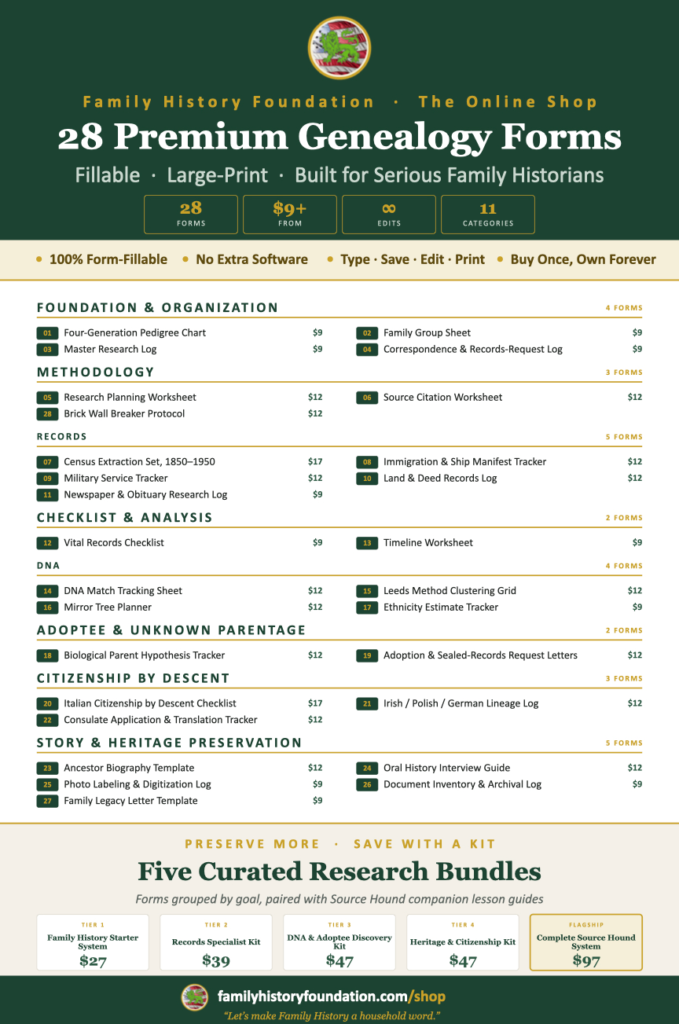
Shop Premium Genealogy Forms

About the Author
Hi there, my name is Franklin, the founder and author of The Family History Foundation.
Our family stories are disappearing every day and it’s crucially important that the next generation is able to learn and appreciate their family history. It is up to you to take up the mantle of responsibility to ensure that how you research today will be passed on tomorrow with the highest standards possible.
I believe that genealogy is not just about names and dates, it’s about your stories and how those stories inform your identity.
With a penchant for storytelling and a background in research, the insights and techniques you learn on The Family History Foundation will help you uncover the incredible stories and identities hidden within the tapestry of your ancestry.
My mission is “Let’s make Family History a household word.”
My motto is “The Past ‘Relative’ to the Future.”
Frequently Asked Questions
Q: Who qualifies for Lithuanian Citizenship by Descent?
A: You qualify if your parent, grandparent, or great-grandparent was a citizen of the Republic of Lithuania before June 15, 1940, left the country before March 11, 1990, and did not formally renounce their citizenship. You must be able to document each generational link. See the Citizenship by Descent series overview for how this compares across Europe.
Q: What is the difference between Lithuanian descent and Lithuanian origin?
A: This distinction is crucial. Lithuanian origin refers to ethnicity — your ancestral belonging to the Lithuanian people. Lithuanian citizenship is a legal status. Lithuanian Citizenship by Descent rests on your ancestor having held citizenship before 1940, not simply on ethnic heritage. Origin alone follows a different, more limited pathway.
Q: Can I keep my current passport?
A: Yes, in most diaspora cases. If your ancestor left Lithuania before March 11, 1990 — which covers virtually all families who fled occupation or exile — you may restore Lithuanian citizenship while keeping your existing nationality. Dual citizenship is expressly permitted for descendants of those who fled or were exiled.
Q: Do I need to speak Lithuanian or live in Lithuania?
A: No. Lithuanian Citizenship by Descent through the descent and restoration routes is exempt from the language exam, the Constitution test, and any residency requirement. Your heritage and documentation are the qualification. However, you SHOULD learn some Lithuanian if you want to visit or learn more about yourself – language is life!
Q: What if my ancestor’s name was changed when they emigrated?
A: This is extremely common and does not disqualify you — but it must be documented. Anglicised surnames, stripped gender endings, and misspelled town names all need to be reconciled with corroborating evidence such as naturalisation records, census data, and Social Security documents. The Source Hound methodology is built for exactly this kind of investigation.
Q: How long does Lithuanian Citizenship by Descent take, and how much does it cost?
A: The Migration Department review typically takes 9–12 months. Including research and document gathering, expect a full journey of 12–24 months. Costs for independently handled cases generally run USD $1,000–$4,000, depending on archival and translation needs.
Q: Are Lithuanian records even still available after the Soviet period?
A: Yes — often more than families expect. The Lithuanian State Historical Archives, Central State Archives, and Special Archive preserved substantial pre-1940 and Soviet-era documentation. Do not assume proof is lost before searching; many successful claims are built on records recovered from these archives.