An oral history interview is the single most valuable thing you can do for your family history right now, more valuable, in this moment, than any archive, any database, or any DNA test. 🎙️ Records will wait for you. The living memory of your oldest relatives will not. Every day that passes, stories that exist nowhere else in the world quietly slip away, and no census, no certificate, no algorithm can ever bring them back.
But there is a real difference between a pleasant chat over coffee and a proper oral history interview that captures those stories with the depth, accuracy, and care they deserve. Let’s learn how to preserve those memories.
Table of Contents
This is a genealogist’s field guide to doing it well — the ethics, the etiquette, the art of asking, the practical setup, and the quiet human skill of helping someone open the door to their past. If you already have our companion post about the “art” of asking relatives about family history, this guide is how you turn those questions into a real, lasting record. ✍️
Why an Oral History Interview Matters More Than You Think
Before the how, a word on the why — because it shapes everything about how you should approach the work.
An oral history interview is not merely a way to collect facts you can verify later. It captures something records never will: tone of voice, emotion, the way a grandmother pauses before speaking about her mother, the laugh that accompanies a story about a mischievous uncle. These are the textures of a life, and they exist only in the telling.
FRANKLIN'S STORY
For example, I found out that my grandfather saved a drunk driver's life after he crashed into his Texaco station in 1960! You can read that story here 👇
There is also urgency that no other genealogical task carries. A parish register from 1850 will still be there next year. Your ninety-year-old great-aunt’s memory of her wedding day may not be. It is the one research method where waiting carries a genuine and irreversible cost.
This is why oral history sits at the emotional heart of genealogy. It is where the dates and documents finally become people. And if you are only just starting your family tree, an interview with your oldest living relative is one of the smartest first moves you can make — it hands you names, places, and leads that fuel every research step that follows. 🕰️
Hey, in a nutshell, we are The Family History Foundation because we are more than just genealogy, but the stories (the family history) behind the dates and names.
The Ethics of the Oral History Interview
Here is where a genealogist’s field guide differs from a simple list of questions — because an oral history interview is not just research. It is a relationship, and it carries real ethical weight. I’ve done fieldwork in my Linguistics degree, and here’s what matters.
Informed consent comes first. Before you record a single word, your relative must understand what you are doing, why, and what will happen to the recording. Explain plainly: “I’d love to record our conversation so the family can keep it. Is that alright with you?” Consent is not a formality — it is the foundation of trust the entire oral history interview rests on.
The story belongs to the teller. You are the custodian of their memory, not the owner of it. If your relative shares something and later asks you not to repeat it, honor that completely. The moment a person feels their words might be used against their wishes, the door closes — and it rarely reopens.
Handle sensitive territory with care. Family histories contain pain as well as joy — estrangements, losses, secrets, hardships. An oral history interview may brush against these. Never push. If a relative grows uncomfortable, gently move on. A story extracted under pressure is not worth the harm it causes, and it is rarely honest anyway.
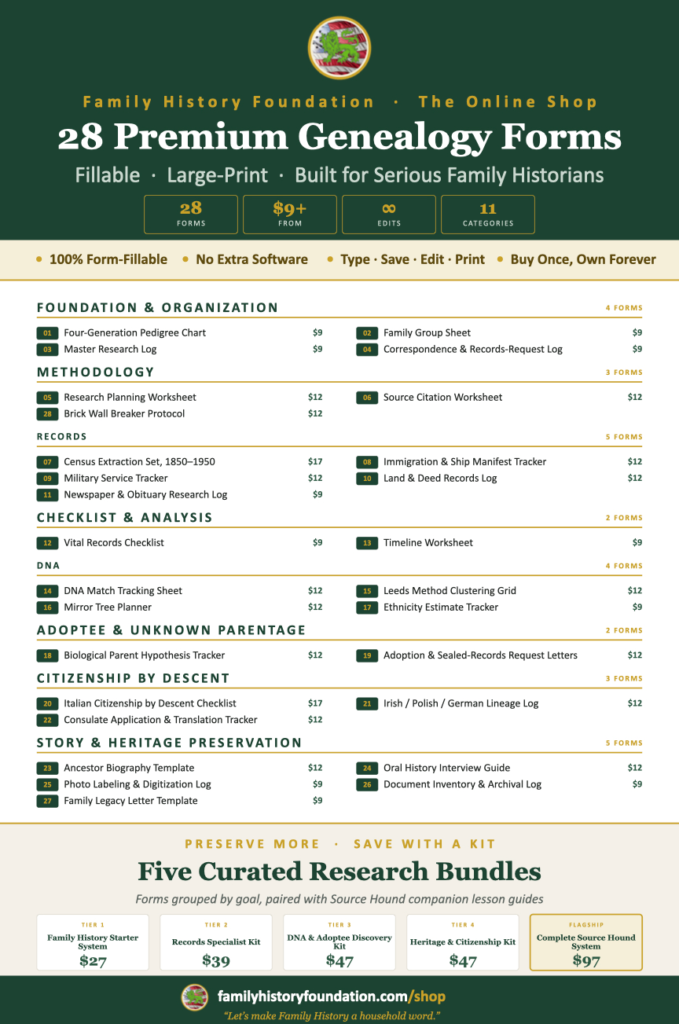
Be honest about where the recording will live. Will it be shared with the whole family? Archived privately? Posted online? Your relative deserves to know before they speak, not after. Our Form 24 Oral History Interview Guide includes a consent section precisely because this step is too important to leave to memory. 📋
And also remember that there are many chances to conduct family history interviews so take them in bits. Actually, when speaking with our elders, I’d venture to be they would welcome the chance to speak over multiple visits, because it lets them know that you value their company!
Time spent with our elders is the most valuable gift we can give them. It’s all about reciprocation when it comes to oral history interviews.
Manners and Etiquette – Best Practices
The best interview feels less like a formal exercise and more like being truly listened to. That feeling is built from small courtesies.
Come to them, on their terms. Interview your relative in their own home, at their own pace, at a time of day when they are rested and alert. For interviewing elderly relatives especially, morning is often better than a tiring late afternoon. You are the guest and the servant here, not the director.
Let silence do its work. When you ask a question and your relative pauses, resist the urge to fill the gap. Silence is where memory surfaces. Count to ten in your head if you must. Some of the richest moments in any interview arrive after an uncomfortable pause you were tempted to interrupt.
Interpersonal communication is also cultural. So, if your cultural context allows interruptions and a tighter back and forth, then do what will make your respondent feel most at ease, and keep them talking!
Never correct or argue. If your grandfather says the family arrived in 1912 and your research says 1913, do not correct him mid-story. Note it quietly and verify later. The interview is for capturing his account — reconciling it with the records comes afterward, and is your job, not his burden.
You can ask for clarification. Take these moment by moment, but never interject yourself to the point where their narrative gets stifled. Read their body language at all times – this is the best way to gauge their involvement.
Bring patience as your primary tool. You may need several shorter sessions rather than one long one. An hour is often the natural limit before fatigue sets in, particularly with older relatives. Honor their energy. There is no prize for finishing in a single sitting.

The Family History Foundation Newsletter
It’s Not About You, It’s About Documenting Before It Disappears
Join 500+ family historians getting Franklin’s Source Hound weekly research breakthroughs — real case studies, source hacks, and the exact strategies that turn brick walls into discoveries.
Free. No fluff. Straight from the Source Hound’s desk to yours.
Your privacy is sacred — almost as sacred as a primary source. Read our Privacy Policy.
The Art of Asking: Direct vs. Leading Questions
This is the technical craft at the center of every good interview — and getting it right separates a rich record from a thin one.
Open questions unlock stories. Closed questions close them. A closed question — “Were you happy as a child?” — invites a one-word answer. An open question — “What was your childhood like?” — invites a story. In an oral history interview, favor open questions almost always. They hand the narrative back to the teller.
Avoid leading questions that plant answers. A leading question — “It must have been terrible during the Depression, wasn’t it?” — tells your relative what to feel and what to say. It contaminates the record with your assumptions.
Ask instead: “What was daily life like during those years?” Let them supply the emotion. The story that emerges will be truer and often surprising.
Use the funnel technique. Start broad, then narrow. Begin with “Tell me about your mother” and let the answer guide your follow-ups: “You mentioned she sewed — where did she learn?” This lets the conversation follow the memory’s natural contours rather than forcing it down a checklist.
I have a form in the Online Shop which is specific to the family history oral interview.
Ask about the senses. “What did Sunday dinner smell like? What did your street sound like at night?” Sensory questions unlock vivid, specific memories that abstract questions never reach — and they bring an interview to life in a way dates never can. 👃
Keep one question in reserve for the end. Always close with: “Is there anything I didn’t ask that you’d like to share?” Some of the most precious material in an interview arrives in answer to that single, open door.
Take the time to learn more about the psychology behind the many types of family history interview questions, you’ll be surprised at how great you will feel walking into interview your family once you grasp these.
Setting the Scene: Time, Space, and Equipment
The environment of your interview shapes its quality more than most people realize.
Choose a quiet, familiar space. Background noise — a television, a busy café, a ticking clock near the microphone — will ruin a recording you cannot redo. A quiet room in your relative’s own home is ideal: familiar, comfortable, and controllable.
Time it for their energy, not your schedule. The best session happens when your relative is alert and unhurried. Avoid mealtimes, medication-related drowsiness, or the tail end of a long day. Ask them when they feel sharpest, and build around that. Again, you can always come back and the more comfortable they feel from the off, the more you will be invited back!
Keep your equipment simple and tested. You do not need professional gear. A modern smartphone records excellent audio. What matters is that you test it first — record thirty seconds, play it back, check the levels. Nothing is more heartbreaking than finishing a beautiful oral history interview only to discover the recording failed. Bring a backup: a second phone, or a notebook for key facts.
Reduce the intimidation factor. Place the recording device where it is present but not staring at your relative. Once you press record and begin talking naturally, most people forget it is there within minutes. The goal is a conversation, not a performance.
Have your materials ready. Photographs, heirlooms, old letters, and maps are powerful memory triggers. Laying a photograph on the table can unlock an entire interview’s worth of stories. Preparation is respect — it tells your relative their time matters.
One more piece of preparation makes an enormous difference: walk in with a structured guide in hand rather than a blank notebook. A prepared framework keeps you calm, keeps the conversation on track, and ensures you never forget the consent step or the crucial closing question.
You will find a ready-made one in our online shop, alongside the other fillable tools that keep a research project organized. 🗂️

The Ethnography of the Interview – Reading the Whole Story
Here is the deepest layer of the interview, and the one that separates a genealogist from a mere note-taker.
An interview is never just the words. It is the whole communication — the pauses, the emotions, the things said carefully and the things not said at all. Anthropologists call this ethnographic listening, and it turns an oral history interview from a transcript into an understanding.
Notice what the silences mean. When a relative goes quiet before answering, or changes the subject, that hesitation is itself information. It may signal grief, secrecy, or a memory too tender to voice. You do not need to pry it open — but noting where the silences fall tells you where the family’s deeper stories are buried.
Watch for the emotional weather. The same fact — a move, a marriage, a death — may be told with warmth by one relative and tension by another. Those differences are not contradictions to resolve; they are the emotional truth of how each person lived the same history. A good interview captures the feeling, not just the fact.
Respect the story’s shape. People tell their lives in the order that matters to them, not chronologically. Resist the urge to force a timeline mid-conversation. Let the story unfold in their shape, and reconstruct the chronology later from your notes and records.
Corroborate with care, afterward. Everything your relative tells you is a lead to be verified — gently and after the fact — using the same source-driven approach we teach in the Source Hound research methodology.
The outcome for your interview is really to build your family tree and preserve your family legacy. You probably want to have the substance of your interview archived on Ancestry or another repository. Choosing the right genealogy questions for relatives to be used in your interview will certainly impact the scope and frame through which others will interpret those family stories.
After the Interview: Preserving What You Captured
An oral history interview only becomes a family treasure if you preserve it properly. The more thoroughly you preserve oral history recordings with the best technical archiving skills, the better you will sleep at night knowing your family stories will be around forever.
Back it up immediately, in more than one place. The recording is now irreplaceable. Save it to your computer, a cloud service, and ideally an external drive. A single copy is a disaster waiting to happen.
Transcribe while it is fresh. A written transcript makes the oral history interview searchable, shareable, and permanent — recordings can degrade or become unplayable as technology changes, but text endures. Free tools like Otter.ai can produce a first draft you then correct by hand.
Log it properly. Note the date, place, who was interviewed, who conducted it, and what topics were covered. This is exactly what the Form 24 Oral History Interview Guide is built to capture — a structured, fillable record that keeps every oral history interview organized and citable within your wider research.
Pairing it with a research log from our free genealogy forms collection keeps the stories connected to the documents that corroborate them.
Link the stories to your tree. Attach anecdotes, audio, and transcripts to the right people in your genealogy software so the emotional record lives alongside the factual one. This is how an oral history interview stops being a standalone recording and becomes a permanent part of your family’s documented history. 🌳
Your Field Guide, In Short
A great oral history interview rests on a handful of principles: come to your relative with consent and respect, ask open questions rather than leading ones, create a calm and familiar setting, listen to the silences as closely as the words, and preserve what you capture with care.
Do those things, and you will not just gather names and dates. You will capture a living voice — and give your family something no archive on earth can offer.
The records will wait. The stories will not. The best time to begin your first oral history interview is this week. 💛
Join the Family History Foundation Source Hound Community
Our family history is disappearing every day, join the Source Hound community and join our pledge to be the protector of your family history. The lives and voices of our ancestors are depending on it for our future generations.
Celebrate Family History Fridays with us across our social media and community platforms!
📬 Subscribe to the Newsletter — tips, active challenges, and deep-dive case studies. Never an overloaded inbox, always something you can use this weekend.
 Like & Subscribe on YouTube — every Friday, a video companion to the week’s article. Watch these techniques demonstrated rather than described.
 Pin Us on Pinterest — printable question sheets, research charts, and visual guides to save for your next session.
 Podcasting on Spotify! — podcasting now on Spotify, you can find all of the latest episodes on any of your favourite podcast platforms, starting with Spotify.
 Podcasting on Amazon! — If you are not on Spotify we are also on Amazon Podcasts so you can listen while you drive and work. Every episode is curated just for you to binge your favourite episodes.
 Podcasting on Audible! — Audible is an alternative offshoot of Amazon Podcasts to listen while search for your next favourite book. Ready for your next “audible?” Set, Go!
Let’s make Family History a household word. 🏠
Watch New Episodes Every Week on YouTube
The Family History Foundation Newsletter
Our Family History Is Disappearing Every Day!
Join the quest with 500+ family historians getting Franklin’s Source Hound weekly research breakthroughs — real case studies, source hacks, and the exact strategies that turn brick walls into discoveries.
Free. No fluff. Straight from the Source Hound’s desk to yours.
Your privacy is sacred — almost as sacred as a primary source. Read our Privacy Policy.
Shop Premium Genealogy Forms

About the Author
Hi there, my name is Franklin, the founder and author of The Family History Foundation.
Our family stories are disappearing every day and it’s crucially important that the next generation is able to learn and appreciate their family history. It is up to you to take up the mantle of responsibility to ensure that how you research today will be passed on tomorrow with the highest standards possible.
I believe that genealogy is not just about names and dates, it’s about your stories and how those stories inform your identity.
With a penchant for storytelling and a background in research, the insights and techniques you learn on The Family History Foundation will help you uncover the incredible stories and identities hidden within the tapestry of your ancestry.
My mission is “Let’s make Family History a household word.”
My motto is “The Past ‘Relative’ to the Future.”
Frequently Asked Questions
Q: What is an oral history interview?
A: An oral history interview is a recorded conversation in which you capture a relative’s memories, stories, and firsthand accounts of family history. Unlike casual conversation, it is conducted with intention — with consent, thoughtful questions, and proper recording — so the record lasts for future generations.
Q: What questions should I ask in an oral history interview?
A: Favor open questions that invite stories rather than one-word answers — “What was your childhood like?” rather than “Were you happy?” Our companion post of 50 questions to ask relatives about family history offers a full starting list you can adapt.
Q: How do I record an oral history interview?
A: A modern smartphone records excellent audio — the key is to test it first and keep a backup. Choose a quiet, familiar room, place the device where it is unobtrusive, and record a short test clip before you begin to confirm your levels are good.
Q: Do I need permission to record a relative?
A: Yes, always. Informed consent is the ethical foundation of any oral history interview. Explain what you are recording, why, and where it will be kept before you begin. This protects the trust the entire conversation depends on.
Q: How long should an oral history interview last?
A: About an hour is often the natural limit before fatigue sets in, especially with elderly relatives. Several shorter sessions usually produce a richer record than one exhausting marathon. Always follow your relative’s energy, not your schedule. This is something that can be discussed in advance of the interview.
Q: What is the difference between a direct question and a leading question?
A: A direct question asks openly — “What was daily life like then?” A leading question plants an answer — “It must have been awful, wasn’t it?” Leading questions contaminate the record with your assumptions. In an oral history interview, let your relative supply the emotion themselves.
Q: How do I preserve the interview afterward?
A: Back up the recording in multiple places immediately, transcribe it while it is fresh, log the details, and attach the stories to the right people in your family tree. A structured tool like the Form 24 Oral History Interview Guide keeps every interview organized and citable.