
Old City Directories are the single most underrated tool in a genealogist’s arsenal, yet they are often skipped by beginners who rely solely on the census. If you have ever hit a “brick wall” because your ancestor disappeared between 1880 and 1900, these books are the key to solving the mystery.
While the Federal Census only provides a snapshot of a family once every ten years, Old City Directories were typically published every single year. This means they can help you track your ancestors’ movements, job changes, and social status with granular precision.
Table of Contents
In this comprehensive guide, we will walk you through exactly how to find, read, and analyze these historical goldmines. We will move beyond the basics and dive into advanced search strategies, helping you squeeze every drop of information from these dusty pages. 🕵️♀️
Why You Need Old City Directories in Your Research
Imagine trying to reconstruct a person’s life when you only get to see a photo of them once a decade. That is essentially what we do when we rely exclusively on census records. People move, change jobs, lose spouses, and remarry in the ten years between census enumerations.
Old City Directories fill in those massive gaps. They serve as an annual census for a specific town or city.
By tracing an ancestor through a sequential run of directories, you can often pinpoint the exact year they died (when their wife appears as a “widow”), the year they migrated to a new city, or the year they finally bought their own home.
The “Gap Year” Problem Solved
One of the most frustrating aspects of American genealogy is the loss of the 1890 Federal Census, which was destroyed by fire. This leaves a twenty-year black hole between 1880 and 1900.
Old City Directories are the primary substitute for this lost data. If your ancestor lived in an urban area during the 1890s, these directories are likely the only government-level record of their existence during that decade.
But beyond just locating a person, Old City Directories offer social context. They don’t just tell you where someone lived; they tell you how they lived. Did they work as a laborer one year and a foreman the next? Did they move from a boarding house to a private residence? These books tell the story of social mobility. 📈
For more insights on gathering this kind of data digitally, check out our guide on Genealogy Research Online, which details how to pair digital findings with physical books.
The Anatomy of a Directory Entry
To the untrained eye, a page from one of these books looks like a wall of tiny text and confusing abbreviations. However, once you understand the structure, Old City Directories become incredibly easy to navigate.
Most entries follow a standard three-part format:
- The Name: Usually the head of the household.
- The Occupation: What they did for a living.
- The Address: Where they lived or worked.
Let’s break down a hypothetical entry to see what it reveals:
Smith, John (Mary), carp, h 124 Maple av
At first glance, this is short. But decoded, it tells us:
- Name: John Smith.
- Spouse: His wife is Mary (often listed in parentheses in later directories).
- Job: He is a Carpenter (
carp). - Status: He is the Head of Household (
h) who resides at 124 Maple Avenue.
The Crucial Difference: “h” vs. “r”
If you learn only one thing from this guide, let it be the difference between the abbreviations h and r. In the context of Old City Directories, these two little letters change the entire meaning of an entry.
- h (Householder): This typically means the person is the head of the house. They might own it, or they might be the primary renter whose name is on the lease.
- r (Resides) or bds (Boards): This means the person lives at the address but is not the head of the household. They are likely a child living with parents, a lodger renting a room, or a servant.
Understanding this distinction allows you to infer family dynamics. If your ancestor John is listed with an r at the same address as a William who is listed with an h, William is likely the father or an older brother.
Deciphering the Code: Abbreviations and Symbols
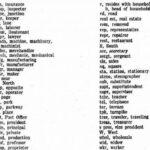
To save ink and paper, publishers of Old City Directories used an aggressive system of abbreviations. Some are obvious, like lab for laborer or cllk for clerk. Others, like do (ditto) or wid (widow), are essential for tracking relationships.
However, the list of symbols can be overwhelming. You might see cryptic job titles like huckster (a seller of small goods) or drayman (a cart driver). You might see symbols like an asterisk * or a cross † next to a name, which often denoted race or a death in the family during the publication year.
Because these lists can be extensive, it is easy to get lost. If you find yourself staring at a confusing set of letters, don’t guess. We have compiled a dedicated resource to help you translate these terms.
💡 Pro Tip: For a complete breakdown of every symbol, occupation, and short-code you will encounter, verify the terms against a trusted list. You can find our master list of terms in our guide to City Directory Abbreviations.
Understanding these codes is vital because a misinterpretation can lead your research astray. For example, mistaking bds (boards) for a business address could have you looking for a shop that never existed.
Step-by-Step: How to Search Old City Directories
Searching Old City Directories requires a different mindset than searching the census. Because these books were published commercially and not by the federal government, the standards of spelling and alphabetizing were much looser.
Here is a practical workflow to ensure you don’t miss your ancestor.
1. Start with the Surname (But Don’t Trust the Alphabet)
In a modern digital database, you type a name and hit “enter.” When browsing digital images or physical books of Old City Directories, you often have to scroll through the pages manually.
Warning: Do not assume the alphabetizing is perfect.
In the 19th century, typesetting was done by hand. It is very common to find “Smith” listed after “Smythe” due to a printer’s error, or to find a forgotten “Johnson” squeezed in at the bottom of the page in a smaller font.
Always scan 2-3 pages before and after where your ancestor’s name should be. If you are tracking a family like the Plantagenets, checking spelling variations is key—learn more about name variations in our Plantagenet Dynasty Reading List post.
2. Locate the “Street Guide” (The Reverse Search)
Many Old City Directories contain a section in the back called the “Street Guide” or “House Guide.” This is a reverse directory. Instead of listing people alphabetically by name, it lists streets alphabetically, then shows who lived at each house number.
This is invaluable for two reasons:
- Finding Neighbors: You can see exactly who lived next door. Often, neighbors were relatives or in-laws.
- Verifying Addresses: If you can’t find your ancestor by name (perhaps due to a misspelling), but you know they lived on “Chestnut Street” in the previous year, you can check the Street Guide to see if they are still there under a garbled name.
3. Check the “Business Directory” Section
If your ancestor owned a business or had a specialized trade, they might be listed twice: once in the main residential section and again in the “Business Directory” (usually found at the back of the book or on colored pages).
This section can give you clues about their economic standing. A simple “shoemaker” in the residential list might be listed as a “Boot and Shoe Manufacturer” in the business section, implying they owned a shop rather than just working in one.
Case Study #1: How to Search City Directories on Ancestry.com
Don’t overlook Ancestry City Directories in your Ancestry.com research! Here’s how to mine the often mundane data in them like a pro genealogist! Squeezing every last drop of information out of City Directories can be tedious for sure; however, you can make major breakthroughs with what I will show you.
Ancestry City Directories are like the parable of the elephant where a blind man was asked to identify what he was touching: different parts of the elephant let him to postulate different conclusions without ever identifying the whole.
It’s a part to whole thing! One year in a City Directory might not tell you much, but over a 10 or 20 year span it can open up pachyderm-like avenues of information. In the same vein, check out my wildly successful article “10 Tips For Researching Census, City Directories, and Street Guides.”
First of all, the ancestor you are researching must have lived in an area, and in a time period, where City Directories where kept. For example, for the one side of my family who were farmers living in rural Texas and Tennessee, City Directories did not exist. However, even then I was still able to find a widowed spouse on a Dallas, TX City Directory who had moved there to live with her daughter.
What can be kind of off-putting is that on sites like Ancestry, City Directories can clog up your search results and all seem very samey. What further drives me nuts is that the dates of the Ancestry City Directories in search results aren’t in chronological order and they don’t offer up much on first glance. I’ll show you how to work past that!
Here’s how to use Ancestry City Directories like a pro genealogist:
- Stay organized, make a year-by-year reference list;
- Add each City Directory to your ancestor’s timeline on Ancestry WITH the address;
- Search by year, even if Ancestry doesn’t have a search result for that year;
- Check if the City Directory has a Street Directory;
- Check under alternate spellings if you don’t find someone;
- Look for other family names on each City Directory listing;
- Look for biographical information on each City Directory;
- Always make sure the person you are tracking is your ancestor and not someone else!
Here’s an example of #1, a year-by-year reference list that I used successfully.
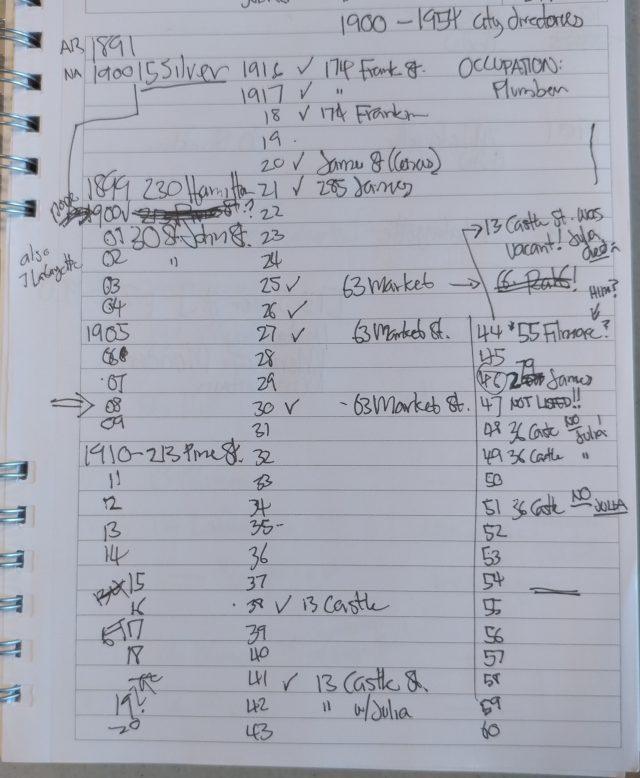
This is a year-by-year reference list that I made for an ancestor I was trying to find out more information on. Specifically: (1) when did his wife pass away?; and (2) was the Petition for Naturalization record I had his or not?
There were SO many City Directory results for this person so I listed every year I knew him to be in the city I was researching and then proceeded to go through EACH year (from 1891 – 1954), noting his address and others on the page around him. It was super tedious but I hit pay dirt, big time!
Ancestry didn’t have all of the years on its search results, its search algorithms aren’t perfect, you know. However, when you are looking at an Ancestry City Directory record you can change the fields, such as the year, and search back or ahead on your own. Doing this I also found that some (not all!) Ancestry City Directories have a separate section where they list residents by street address – it will list all of the people living street-by-street and were contemporaneous neighbors.
This can be an invaluable research tool. For me, it was how I surmised my grandparents met: they were neighbors in their late teens!
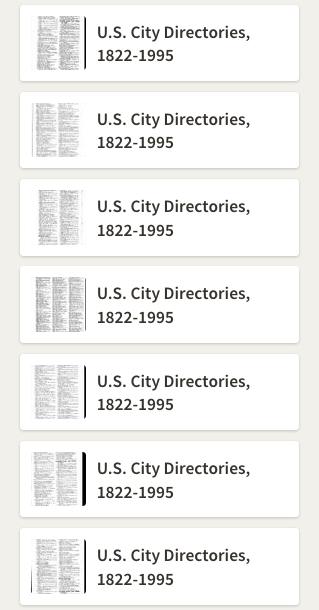
I cannot overstate enough the importance of adding each City Directory to your ancestor’s Ancestry timeline noting the address in either the comments box or using the location feature. You will thank me later if you do this! Otherwise you won’t be able to make sense of this mess:
Numbers 6 and 7 on my list (Look for other family names on each City Directory listing & Look for biographical information on each City Directory) are of the utmost importance and really where your research skills will become like the pros. Listing information is one thing, but extrapolating what you find from that information is another altogether! This is the mind of a true researcher!
For example, with the ancestor I was researching I was able to estimate when his wife passed away as no other information was available online. Using only information from Ancestry City Directories, I surmised she died sometime around 1943 based on the fact that she was not listed as a spouse after 1942.
In another case, for a great-grand uncle, his City Directory listing informed me that in 1916 he returned to Lithuania! For another ancestor a City Directory listing had the person’s exact death date in there. You never know what you’ll get, so search out each year and look that information over very carefully.
It’s also a good idea to see who else is listed under your ancestor’s surname at the same address. You may find new family members or be able to tell family members with the same names a part from one another using this technique.
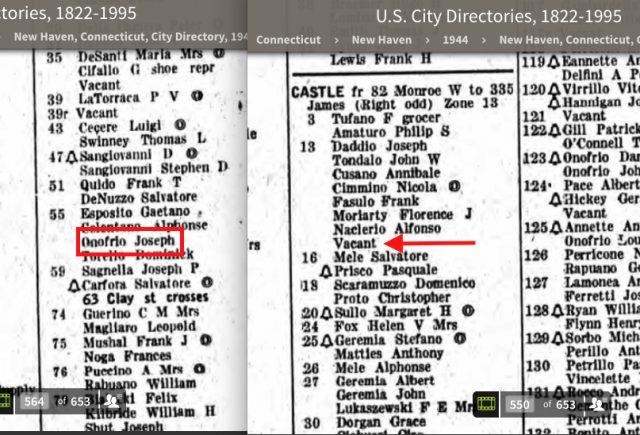
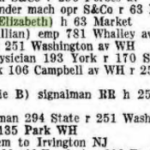
Using Ancestry City Directories allowed me to finally confirm that the Petition for Naturalization I had was actually my ancestor’s. The Petition had a strange address: 55 Filmore St., which I did not associate with him. Most of his City Directory listings had him and his family at 63 Market St. After carefully searching EVERY City Directory between 1891 and 1954, I found him, in the same year he was granted citizenship, living at 55 Filmore St – even though Ancestry never correlated this information. Boom!
It was the breakthrough I needed, I hit pay dirt! I pieced the timeline together and concluded that my ancestor’s wife passed away in 1943, he then moved to this 55 Filmore address (for whatever reason) and, with a sad sense of irony, was granted citizenship the following year. I also checked his prior address in the City Directory and found that in 1944 it was vacant, finally confirming the facts.
The U.S. City Directories national database is also a wonderfully rich source of genealogical information if you know how to separate the wheat from the chaff. If you practice my techniques you can also use Ancestry City Directories like a pro genealogist.
Advanced Search Strategies for Genealogy Pros
Once you have mastered the basics of finding a name, it is time to use Old City Directories to solve complex genealogy problems. These advanced techniques can help you break down brick walls.
The “Widow” Trick
One of the most powerful uses of Old City Directories is pinpointing a death date.
- Year 1: Smith, John (Mary), clerk.
- Year 2: Smith, John (Mary), clerk.
- Year 3: Smith, Mary, wid John, h 124 Maple.
In this sequence, you know with high certainty that John died between the canvassing date of Year 2 and Year 3. This narrows your search for a death certificate or obituary from a 10-year window to a 12-month window.
The “Moving Day” Clue
In many 19th-century American cities (especially New York and Chicago), May 1st was known as “Moving Day.” All leases expired simultaneously. If you see your ancestor’s address change in a directory published in June or July, it likely corresponds to this May 1st cycle.
Tracking these moves can help you correlate other records. Did they move to a smaller house? Perhaps they fell on hard times. Did they move to a wealthy neighborhood? Perhaps they received an inheritance.
If you are researching ancestors in England, the patterns of movement might differ. Check out our guide on Norman Dynasty Reading List to understand the geography and history that might have influenced their movements.
Using Directories to Find Living Relatives
While we usually use Old City Directories for the deceased, later editions (from the 1920s to the 1960s) can help you track lines forward in time to find living cousins. By following the “Resides” (r) entries for children as they grow up and establish their own households, you can trace a surname through the mid-20th century.
Where to Find Old City Directories Online
The internet has made accessing Old City Directories easier than ever, but they are scattered across various platforms. You won’t find them all in one place.
1. Ancestry.com
Ancestry has one of the largest searchable collections of U.S. City Directories. Their “U.S. City Directories, 1822-1995” collection is indexed, meaning you can search by name. However, always view the original image, as the optical character recognition (OCR) often misreads the tiny, faded text.
2. Internet Archive (Free)
The Internet Archive is a goldmine for free, digitized books. Search for “City Directory [Town Name] [Year]” to find full scans. These are often not indexed by name, so you will have to turn the virtual pages manually, just like a real book.
3. FamilySearch (Free)
FamilySearch offers a growing collection of digital directories. Some are searchable; others are image-only. Using their catalog search by “Place” is usually the most effective way to see what they hold for a specific town.
4. Local Libraries and Historical Societies
Never underestimate the local library. Many libraries have digitized their local Old City Directories and host them on their own websites, completely free of charge. If you are researching a specific county, visit the website of that county’s public library system.
For those organizing their findings from these various sources, having a good system is key. You might find our Best Free Family Tree Templates useful for charting the data you pull from these directories.

The Family History Foundation Newsletter
It’s Not About You, It’s About Documenting Before It Disappears
Join 500+ family historians getting Franklin’s Source Hound weekly research breakthroughs — real case studies, source hacks, and the exact strategies that turn brick walls into discoveries.
Free. No fluff. Straight from the Source Hound’s desk to yours.
Your privacy is sacred — almost as sacred as a primary source. Read our Privacy Policy.
Common Pitfalls and How to Avoid Them
Even seasoned pros make mistakes when using Old City Directories. Here are the most common traps and how to avoid them.
Trap 1: Assuming the “Publication Year” is the “Event Year”
A directory published in “1890” was likely compiled (canvassed) in late 1889. The information reflects who lived there at the time of the survey, not necessarily the date on the cover. Always check the preface of the directory to see when the canvassing took place.
Trap 2: Ignoring the “Addenda” or “Too Late” List
Sometimes, people moved into town or changed addresses after the main pages were typeset but before the book was printed. Publishers would add a list of “Removals,” “Alterations,” or “Too Late for Classification” at the very beginning or very end of the book. Always check these pages!
Trap 3: Confusing Similar Abbreviations
Is that clk (clerk) or clg (clergyman)? In faded ink, they look identical. Context is your friend. A clergyman might be listed near a church address, while a clerk might be listed near a business district. If you are unsure about an occupation, cross-reference with the City Directory Genealogy Decoder! list to see standard abbreviations for that era.
Case Study #2: Tracing a Laborer in 1880s Boston
Let’s look at a practical example of how Old City Directories can tell a story.
Subject: Patrick O’Malley.
- 1880 Census: Lists Patrick as a “Laborer” living at 10 Dock Square.
- 1881 Directory: “O’Malley, Patrick, lab, h 10 Dock Sq.”
- 1882 Directory: “O’Malley, Patrick, lab, h 12 Dock Sq.” (He moved two doors down).
- 1883 Directory: “O’Malley, Patrick, police, h 45 Charles St.”
The Discovery: Within two years, Patrick went from an unskilled laborer to a police officer and moved to a better street. This job change would have been completely invisible if we had waited for the 1900 Census. The Old City Directories revealed his career trajectory and social rise.
If you are researching ancestors with common names like Patrick O’Malley, using visual aids can help keep them straight. Our Free Family History Templates are great for sketching out these timelines.
Integrating Directory Findings into Your Family Tree
Once you have extracted data from Old City Directories, don’t just leave it in a notebook. This data should be cited and integrated into your main tree.
Citation Format:
Title of Directory (City, State: Publisher, Year), Page Number, Entry for [Name]. accessed via [Website Name].
When adding this to your software or online tree, treat each directory entry as a “Residence” event. This creates a timeline map of your ancestor’s life.
If you are looking for more ways to visualize your family history, you might be interested in Heraldic Lion Positions to understand the crests that might accompany your family name, or perhaps explore Books About Charlemagne if your directory research leads you back to European nobility.
The Hidden Value of Ads
Don’t ignore the advertisements! The margins of Old City Directories are filled with ads for local businesses.
If your ancestor was a “grocer,” check the ads. You might find an advertisement for “Smith’s Grocery” that lists the products he sold (“Fine Teas and Coffees”) or even an engraving of his shop front. This adds incredible color to your family history narrative.
Sometimes, the businesses themselves have long histories. Just as we look back at the What is Bigger, Europe or the USA? for structural history, looking at the commercial history of a town through its directory ads can help you understand the world your ancestor walked through every day.
Conclusion: The “Annual Census” You Cannot Ignore
Old City Directories are more than just phone books from the past. They are dynamic, annual records of your ancestors’ lives. They capture the moves, the promotions, the tragedies, and the triumphs that occurred in the long years between federal censuses.
By mastering the art of reading these directories—understanding the abbreviations, navigating the “street guides,” and analyzing the “h” vs “r” distinction—you turn a simple list of names into a vivid motion picture of the past.
Remember, genealogy is not just about names and dates; it’s about context. And few records provide more year-over-year context than the humble city directory. So, the next time you find yourself stuck in a research gap, reach for the directory. The answer is likely waiting there, printed in tiny type, ready to be discovered. 📜
If you enjoyed this deep dive, you might also want to explore our list of 6 Must-Read Ron Chernow Books for more historical context, or download our 20 Free Genealogy Templates to organize your new findings.
For even more resources, be sure to visit our Pinterest boards for visual inspiration and subscribe to our YouTube Channel for video tutorials.
Frequently Asked Questions (FAQ)
Q: What if I can’t find my ancestor in a City Directory?
A: There are several reasons for this. They may have lived outside the city limits (in a rural area not canvassed), they may have been “missed” by the canvasser, or they may have been too poor to be listed (though most directories attempted to list everyone). Also, check for spelling variations!
Q: Do Old City Directories list women?
A: In the 19th century, directories primarily listed the head of household (usually men). Women were typically listed only if they were widows (wid) or single women with their own employment (e.g., teacher, milliner). However, by the early 20th century, it became common to list wives in parentheses next to their husbands.
Q: What does “do” mean in a directory entry?

A: “do” is an abbreviation for “ditto.” It means “the same as above.” If the person above is listed as a “Blacksmith,” and your ancestor has “do” next to their name, they were also a Blacksmith.
Q: Are City Directories accurate?
A: They are generally reliable but contain errors. Names could be misspelled, and information was self-reported or provided by neighbors. Always try to corroborate directory information with other records like the census or tax rolls.
Q: How often were these directories published?
A: Most major cities had directories published annually. Smaller towns might have had them every 2-3 years.
About the Author
The Family History Foundation is dedicated to helping you discover your roots. We believe that every family has a story worth telling. Whether you are a beginner just starting your tree or a seasoned researcher looking for advanced techniques, we provide the tools, templates, and guides you need to succeed. From deciphering Old City Directories to understanding heraldry, our mission is to make history accessible and engaging for everyone.
For more helpful guides, visit our Best Books on Eleanor of Aquitaine or explore our resources on Free Family Tree Templates. Happy hunting! 🌳
The Family History Foundation Newsletter
Our Family History Is Disappearing Every Day!
Join the quest with 500+ family historians getting Franklin’s Source Hound weekly research breakthroughs — real case studies, source hacks, and the exact strategies that turn brick walls into discoveries.
Free. No fluff. Straight from the Source Hound’s desk to yours.
Your privacy is sacred — almost as sacred as a primary source. Read our Privacy Policy.
Shop Premium Genealogy Forms



Great Stuff!!!
Thank you so much! Cheers.