The Common Name Ancestor Problem is arguably the most frustrating and persistent roadblock faced by family historians today. Imagine you are tracing your lineage back through the generations, confidently recording dates and places, only to hit a wall: a dozen men, all named John Smith, living in the same small county during the same period.
They all appear to be the right age, and they all disappear from the records at approximately the right time. How do you definitively know which one is your John Smith? If you choose the wrong one, you have just sent your entire family tree down a historical rabbit hole, potentially erasing a century of accurate research in a single click. Solving this requires more than just luck; it demands a strategic, systematic approach that moves beyond names and focuses on unique identifying details.
Table of Contents
In this comprehensive guide, we will unpack this genealogy challenge, provide a tactical blueprint for overcoming it, and ensure your ancestral journey remains authentic and accurate from generation to generation.
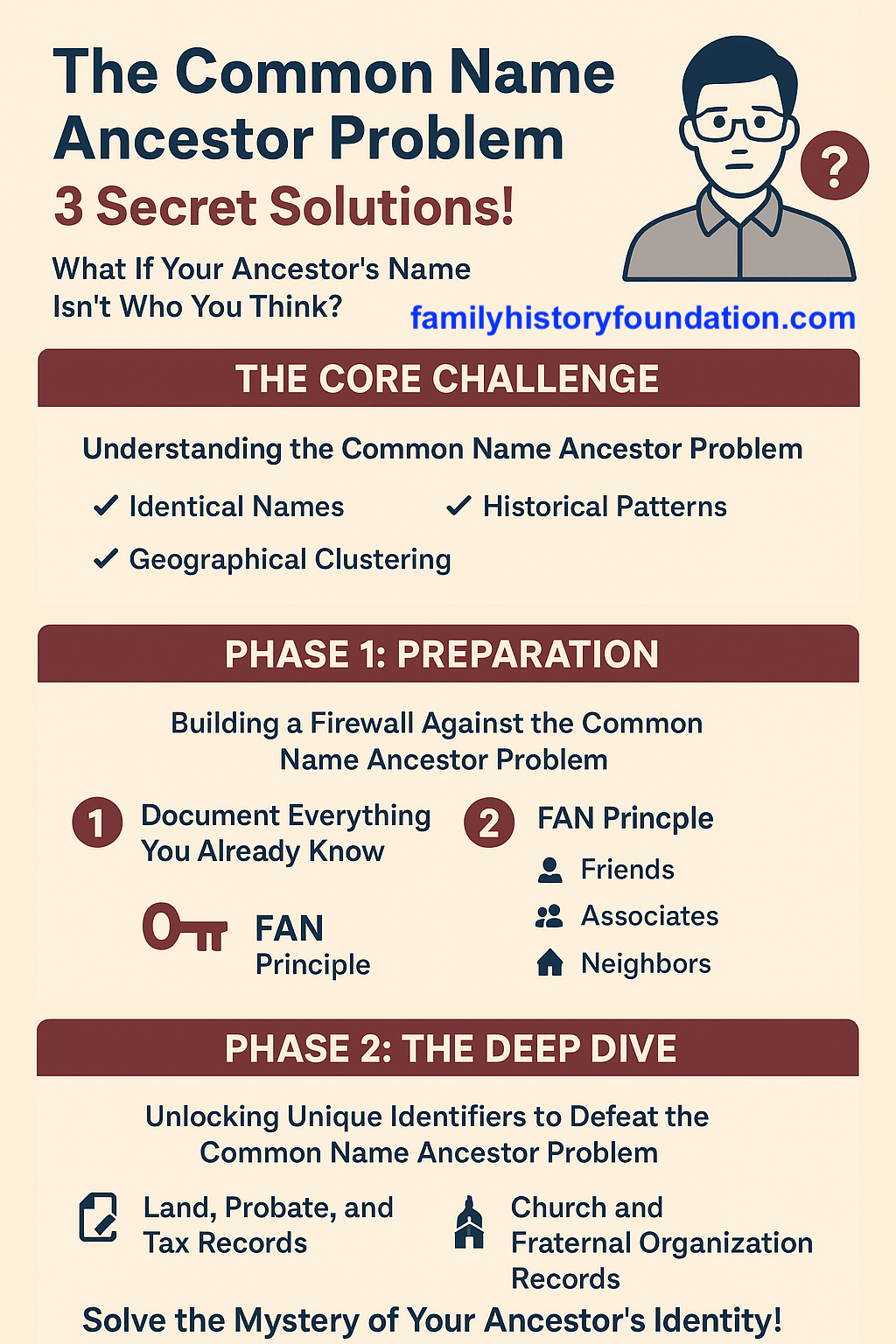
The Core Challenge: Understanding the Common Name Ancestor Problem
To solve a problem, you must first understand its roots. The Common Name Ancestor Problem is more than just having a George Washington or a William Johnson in your tree; it is the near-impossibility of distinguishing between contemporaneously living individuals with identical or highly similar names.
This challenge is compounded by historical patterns, geographical clustering, and record loss. Genealogy research, especially online, can sometimes feel like a game of probability, but we are here to shift the odds back into your favor.
The issue isn’t limited to the well-known “Smiths” or “Joneses.” It extends to any name that was highly popular in a specific time or region, particularly those adhering to traditional naming conventions. For instance, in many European cultures, the first male child was named after the paternal grandfather, the second after the maternal grandfather, and so forth.
This custom ensured that the same set of names—often only three or four variants—would be recycled across entire villages for centuries, making the Common Name Ancestor Problem a persistent menace for researchers of Irish, Scottish, German, or Scandinavian descent, just to name a few.
The danger of this is called “genealogical identity theft”—attaching the records of one person to the profile of another. This is an all-too-easy error when dealing with the Common Name Ancestor Problem.
You may think you are accurately building your family story, only to realize years later that you have the wrong wife, the wrong children, or the wrong immigrant ancestor. The time and energy wasted correcting this kind of monumental error can be heartbreaking, which is why prevention and proper methodology are paramount.
Phase 1: Preparation—Building a Firewall Against the Common Name Ancestor Problem
Before you dive into records, you must first secure the ground you are standing on. Your goal in this initial phase is to create a “firewall” of proven, sourced facts around the common name ancestor. This foundational work is essential to preventing the Common Name Ancestor Problem from ever taking hold.
1. Document Everything You Already Know
This may seem obvious, but many genealogists stop documenting when they feel they have “enough.” When dealing with the Common Name Ancestor Problem, enough is never enough. Start with the most recent, most reliable generation—the child of your common-name ancestor—and work backward.
- Birth/Death Certificates: These are high-quality primary sources. What information do they provide? The name of the deceased’s parents, often including the mother’s maiden name.
- Marriage Records: A marriage license often names both sets of parents and witnesses. Witnesses are frequently close relatives—an aunt, a cousin, or a sibling.
- Census Records: These are critical. They provide year of birth, place of birth, year of immigration (if applicable), and crucially, the names of all household members, their relationship to the head of the house, and their occupations.
Every single fact must be documented with a formal citation. Proper citation is your strongest defense against the Common Name Ancestor Problem because it forces you to justify where you found the information and how it links to your ancestor. For advice on mastering this foundational step, consider revisiting our essential guide on Genealogy Research Online: The 1 Ultimate User-Friendly Beginners Guide.
2. Isolate the Three Key Variables
When facing the Common Name Ancestor Problem, you need to zoom in on three things to create a unique fingerprint for your ancestor: Location, Time, and Associates.
- Location (The “Where”): Don’t stop at “New York.” Was it Queens County, the 3rd Ward of Brooklyn, or a small town upstate? Common names are localized; the name may be common across the U.S., but far less common in a specific township. Pinpointing the smallest possible geographic area is vital.
- Time (The “When”): Instead of saying “1850s,” try to narrow it down. Was the ancestor recorded in a city directory in 1853, but not 1852? Did he appear on a tax list in 1856? These precise temporal markers help distinguish him from a person of the same name born a few years earlier or later.
- Associates (The “Who”): This is often the most powerful tool against the Common Name Ancestor Problem. Who were his neighbors in the census? Who witnessed his land sale? Who were the godparents of his children? These individuals—often family, neighbors, or business partners—form a vital network that belongs to only one person. If “John Smith” is consistently associated with “Patrick O’Malley” and “Sarah Jones,” and a record for another “John Smith” is consistently associated with “Hendrik Van Der Meer,” you have found your distinction.
🔑 Introducing the FAN Principle
The FAN Principle is a research strategy that helps distinguish between people who share a name. FAN stands for Friends, Associates, and Neighbors.
The idea is simple: your ancestor didn’t live in isolation. By studying the people they interacted with, you can identify patterns and relationships that confirm identities.
How to use the FAN Principle:
- Friends: Look for recurring names in social documents, letters, and church records.
- Associates: Examine business partnerships, professional connections, and colleagues in records like tax lists or court cases.
- Neighbors: Study land records, city directories, and census listings to see who lived nearby.
By tracking these social networks, you can often differentiate between two John Smiths who lived in the same town.
🗂️ Case Study 1: City Directories
City directories are an underutilized goldmine for genealogists tackling common names. They typically include:
- Name
- Occupation
- Address
- Household members (sometimes)
Example:
Suppose you have two John Smiths in Albany, New York, in 1880. One is a blacksmith, and the other is a tailor. The city directory provides their addresses and occupations, helping you separate their lives.
By cross-referencing neighbors, you may notice that the blacksmith lives next to your ancestor’s known associates. That connection can confirm the correct John Smith.
🏡 Case Study 2: Land Records
Land records can also solve the common name ancestor problem. Titles, deeds, and property transfers often list:
- Grantor (seller)
- Grantee (buyer)
- Witnesses
- Location specifics
Example:
Two John Smiths own plots on different streets. By examining the deeds, you discover that the blacksmith’s transactions involve people who appear in census records with your family. The FAN Principle confirms this is your ancestor.
Land records also help track migration. If one John Smith moves out of the county while your ancestor remains local, you’ve found another distinguishing factor.
👥 Case Study 3: Witnesses and Associates
Witnesses to legal documents—like probate records, wills, and affidavits—are often overlooked. Yet, they provide invaluable context.
Example:
In a will, a John Smith lists his neighbors and associates as witnesses. If these names align with other known family members, it strengthens the identification of the correct ancestor.
Even small connections matter. Church records, business contracts, and tax documents often reveal repeated patterns that make identifying the right person much easier.
🧠 Step-by-Step Strategy for Common Name Ancestors
- Collect all records with the name. Don’t discard duplicates.
- Organize by location and date. Maps and timelines help visualize clusters.
- Apply the FAN Principle. Identify friends, associates, and neighbors in each record.
- Look for unique identifiers. Occupations, spouse names, and children can narrow down the correct person.
- Compare multiple sources. Census data, land deeds, wills, and directories should tell a consistent story.
- Document your reasoning. Record why you chose one individual over another to avoid future confusion.
🔍 Using Ancestry.com to Supplement FAN Research
Ancestry.com is a powerful tool for analyzing common name ancestors. Its features allow you to:
- Search by name, location, and date
- Filter by relatives and associates
- Examine historical maps to understand neighborhoods
- Access digitized records like city directories, land deeds, and wills
Combining FAN Principle research with Ancestry.com’s extensive databases can significantly reduce ambiguity in your research.
Phase 2: The Deep Dive—Unlocking Unique Identifiers to Defeat the Common Name Ancestor Problem
Once your firewall is built, you must move into the offensive phase. Here, we pursue less-common records that often contain the definitive data needed to solve the Common Name Ancestor Problem. These records are typically the ones a casual researcher overlooks, but they hold the keys to separating the John Smiths.
1. The Power of Land, Probate, and Tax Records 📜
These documents are often handwritten, hard to read, and time-consuming to search, but they are goldmines for solving the Common Name Ancestor Problem.
- Land Records: A deed of sale or purchase often includes the ancestor’s wife’s name (she had to relinquish dower rights), the names of adjacent landowners (Associates!), and, critically, a metes and bounds description of the property that is unique. If you can prove your John Smith owned Lot 4 in the Old Town Survey, and another John Smith owned Lot 7, you have solved the puzzle.
- Probate Records (Wills): A will is the ultimate unique identifier. It names the spouse, children, and often specific relatives or friends who receive bequests. If your ancestor’s will names a daughter named “Agnes” and a son named “William,” and another common-name ancestor’s will names only a “Henry” and a “Mary,” the choice is clear.
- Tax Records: These documents can track an individual year-by-year, filling in the blanks between census years. They often list property types, which helps establish occupation and wealth—two factors that can separate two men of the same name.
2. Military Records and Pension Files 🎖️
Military records, especially pension files, require a great deal of effort to acquire, but they are arguably the most robust tool against the Common Name Ancestor Problem.
A pension application, particularly from the Civil War or earlier, is an extensive, multi-year correspondence designed to prove the soldier’s identity. These files often contain:
- Affidavits from neighbors (Associates!).
- Testimony from a minister about the marriage.
- A page torn from a family Bible recording births and deaths.
- Physical descriptions (height, eye color, scars).
If you are researching an immigrant, these records can be equally powerful. For strategies on where to look when official records are sparse, consult our detailed post, Find Immigrant Ancestors Without Passenger Lists: 7 Proven Alternatives That Actually Work.
3. Church and Fraternal Organization Records ⛪
Local churches, especially those serving immigrant communities, kept meticulous records of baptisms, confirmations, marriages, and burials.
These documents frequently list godparents, sponsors, and witnesses who are invariably close family members—sometimes even using names (like a mother’s maiden name or a father’s place of birth) that are absent from civil records. This network of Associates is crucial when tackling the Common Name Ancestor Problem.
Also, don’t overlook fraternal organizations like the Masons, Odd Fellows, or specific immigrant benevolent societies. Membership lists often include the individual’s birth date, last known address, and sometimes even their original hometown overseas.
✨ Fun Genealogy Quiz: The Common Name Ancestor Problem Test! ✨
You’ve learned the fundamentals. Now, let’s test your readiness to tackle the Common Name Ancestor Problem in the field.
Instructions: Answer True or False (or select A, B, or C).
- True or False: A U.S. Census record that lists a “John Smith” as a blacksmith is a primary source for his occupation but is only a secondary source for his birthplace.
- What is the single most powerful factor for distinguishing between two individuals with the exact same name living in the same county?
- A) Their relative ages (e.g., one is 35, the other is 37).
- B) Their unique network of Associates (neighbors, witnesses, relatives).
- C) Their middle initial, if one is known.
- True or False: When dealing with the Common Name Ancestor Problem, it is safe to assume that a family’s traditional naming pattern (naming children after grandparents) ended by the 20th century.
- Which document is most likely to contain the name of an ancestor’s mother’s maiden name, solving a complex instance of the Common Name Ancestor Problem?
- A) The ancestor’s own death certificate.
- B) A marriage license for one of the ancestor’s siblings.
- C) A 1900 U.S. Federal Census Record.
(Answers are at the very end of the post!)

The Family History Foundation Newsletter
It’s Not About You, It’s About Documenting Before It Disappears
Join 500+ family historians getting Franklin’s Source Hound weekly research breakthroughs — real case studies, source hacks, and the exact strategies that turn brick walls into discoveries.
Free. No fluff. Straight from the Source Hound’s desk to yours.
Your privacy is sacred — almost as sacred as a primary source. Read our Privacy Policy.
Phase 3: Advanced Strategies for the Common Name Ancestor Problem
Once the fundamental records have been exhausted, it is time to deploy advanced tools and methods. These strategies often combine traditional research with modern technology, giving you the edge necessary to definitively solve the Common Name Ancestor Problem.
1. Reverse Genealogy and Collateral Research 💡
When you hit a brick wall with the ancestor himself, pivot and search laterally. This strategy involves researching the ancestor’s siblings, children, aunts, uncles, and cousins. These collateral lines often lead to documentation that confirms the parent’s identity, thereby cracking the Common Name Ancestor Problem.
For example: You can’t find the birth record for John Smith (b. 1850). But you find the death record for his sister, Mary Smith. Mary’s death record names her parents as “John Smith and Jane Miller.” This highly specific maternal name (Jane Miller) provides the unique link you were missing, allowing you to confidently differentiate your John Smith from all the others.
This kind of lateral thinking is essential when confronting the toughest instances of the Common Name Ancestor Problem.
2. Leveraging Digital Resources and DNA 🧬
The digital age has gifted us with powerful tools that can make short work of the Common Name Ancestor Problem. Utilizing these tools, which include billion-record databases and genetic matching, is a must.
- Online Platforms: Platforms like Ancestry.com have centralized millions of records, allowing for rapid cross-referencing of data. Its leaf hints can be overwhelming, but when filtered by the Associates you’ve already identified, they can quickly confirm or deny an identity. For a deeper look at the power of these platforms, check out our piece, Why Ancestry.com Is the Number 1 Genealogy Website for Boldly Building Your Forever Family Tree.
- DNA Matching: If traditional records fail, DNA is the ultimate arbitrator. If you suspect your John Smith is the one married to Jane Miller, testing a direct descendant can provide the necessary proof. If your DNA matches known descendants of Jane Miller’s siblings, you have a definitive genetic link that no duplicate name can falsify. This is the single most effective way to separate individuals with the Common Name Ancestor Problem when records are ambiguous. For a fascinating look at the genetic stories DNA can tell, read Unlocking European Ancient DNA: A Fun Journey Through 10,000 Years of Migration.
3. Mastering the Search Engine 🔍
A robust search strategy is paramount. When using online databases, do not search for “John Smith” in isolation. You will get millions of useless results. Instead, construct a “search block” using the unique identifiers you found in Phase 1:
"John Smith" + "Jane Miller" + "Queens County""John Smith" + "Blacksmith" + "1853 Tax List"
Using quotes and keywords forces the search engine to look for specific, connected facts. This granular approach prevents you from being overwhelmed by the sheer number of results created by the Common Name Ancestor Problem. The most effective way to start any search is by utilizing the resources in our guide, Top 5 Sites for Free Genealogy Research, which details some of the largest free collections that can serve as the foundation for your research blocks.
Furthermore, we provide more comprehensive options in Free Genealogy Research: Ultimate Top 20 Websites.
4. Correlation and the Burden of Proof
The final step in solving the Common Name Ancestor Problem is correlation. You must take all the disparate facts you’ve collected—the census data, the tax record, the deed, the birth certificate of a nephew, the DNA match, and the church record—and ensure they all tell a single, consistent story. If 90% of the evidence points to John Smith of Lot 4, but one small record points to a different John Smith, you must assume the single outlier record is either an error or refers to the other individual.
The burden of proof in genealogy is not finding one record, but finding enough records that, when taken together, logically exclude all other possibilities. This rigorous approach is the ultimate weapon against the Common Name Ancestor Problem.
Conclusion and Your Genealogy Challenge! 🚀
The Common Name Ancestor Problem is the Everest of genealogical research. It is a formidable opponent that demands patience, meticulous organization, and a willingness to move beyond the simplest records.
By applying the multi-phased approach outlined in this guide—building a firewall of verified facts, diving deep into unique identifier records, and employing advanced collateral and DNA strategies—you can confidently distinguish your ancestor from his namesakes. Solving the Common Name Ancestor Problem is not just about moving your tree back another generation; it’s about validating the entire line, ensuring the integrity of your family’s story for posterity.
This is what separates the dedicated, authoritative family historian from the casual hobbyist, and it is a skill worth mastering. Remember: when confronted by the Common Name Ancestor Problem, the answer is not in the name itself, but in the life lived around it.
The Ultimate Genealogy Challenge: Solving the Common Name Ancestor Problem
We want to know about your most difficult brick wall created by the Common Name Ancestor Problem!
Your Challenge: Pick one ancestor whose common name has stumped you. Use the “Associates” strategy from this post to find one new piece of evidence (a neighbor’s name, a witness on a marriage bond, a godparent, or a specific parcel number from a deed).
Share your discovery in the comments below! Let us know the name and the single, unique identifier you found to help separate your ancestor.
If you enjoyed this deep dive and are ready to tackle more complex family history challenges, be sure to subscribe to the Family History Foundation newsletter!
You can also find quick tips and visual inspiration for your research journey on our 📌 Pinterest page, and watch our detailed research tutorials on our ▶️ YouTube channel.
Quiz Answers
- True. A primary source is one created at the time of the event by an immediate participant (e.g., a birth certificate for the birth). The census taker recorded the birthplace based on what the head of household said, making it a secondary statement about the birthplace, but a primary statement about the household composition and occupation at the time of the census.
- B) Their unique network of Associates. Names and ages are variable and common. The collection of people they consistently interacted with (neighbors, witnesses, spouses, parents, children) is a unique, non-duplicable fingerprint for an individual, which is essential to defeating the Common Name Ancestor Problem.
- False. While less common in the modern era, naming patterns still persist in many cultures and families. Assuming a pattern has ended is a dangerous way to dismiss a valuable clue.
- B) A marriage license for one of the ancestor’s siblings. The ancestor’s death certificate (A) may list the mother’s maiden name, but a sibling’s marriage license (B) is often a more reliable source because the parents were more likely to have been present or the information provided by someone with closer, more recent memory. The census (C) rarely provides the mother’s maiden name.
Family History Foundation exists to help everyday genealogists uncover, preserve, and share family stories. With years of research experience, creative templates, and practical guides, the blog equips readers to turn genealogy into meaningful family history.

About the Author
Hi there, my name is Franklin, the founder and author of The Family History Foundation.
Our family stories are disappearing every day and it’s crucially important that the next generation is able to learn and appreciate their family history. It is up to you to take up the mantle of responsibility to ensure that how you research today will be passed on tomorrow with the highest standards possible.
I believe that genealogy is not just about names and dates, it’s about your stories and how those stories inform your identity.
With a penchant for storytelling and a background in research, the insights and techniques you learn on The Family History Foundation will help you uncover the incredible stories and identities hidden within the tapestry of your ancestry.
My mission is “Let’s make Family History a household word.”
My motto is “The Past ‘Relative’ to the Future.”
The Source Hound’s Newsletter
Still Hitting Dead Ends In Your Research?
Join 500+ family historians getting the Source Hound’s weekly research breakthroughs — real case studies, source hacks, and the exact strategies that turn brick walls into discoveries.
Free. No fluff. Straight from the Source Hound’s desk to yours.
Your privacy is sacred — almost as sacred as a primary source. Read our Privacy Policy.