If you want to build a family tree that survives scrutiny, you must learn to verify Ancestry hints with the skepticism of a detective.
Grab your free downloadable PDF Checklist at the very end of this article ✅ 📋.
We all know the feeling. You log into Ancestry.com, and there it is—the seductive “Shaky Leaf.” It’s waving at you, promising a new ancestor, a new photo, or a breakthrough on a brick wall. Your dopamine spikes. You want to click “Accept” immediately. However, if you do not take the time to verify Ancestry hints, you risk filling your tree with errors that can take years to unravel.
Table of Contents
But here is the hard truth: That leaf is not a fact. It is a suggestion. And often, it is a lie.
The algorithm that generates these hints is a powerful tool, but it lacks human nuance. It cannot tell the difference between a John Smith born in London and a John Smith born in Lincoln if the dates are “close enough.” If you blindly accept these hints without a rigorous vetting process, you are not building a family history; you are building a house of cards. This is why every serious researcher must verify Ancestry hints before adding them to their database.
In this guide, I am going to teach you how to verify Ancestry hints by identifying the major “Red Flags” that signal a bad match. We will move beyond the thrill of the click and into the discipline of the professional researcher.
If you are just starting your journey and feel overwhelmed by the sheer volume of records, I highly recommend pausing here and reading our foundational guide on genealogy research online. It will give you the structural blueprint you need before you start evaluating individual leaves.
The “Shaky Leaf” Reality Check
Before we dive into the specific red flags, we need to understand what actually happens when you verify Ancestry hints in the system.
When you see a hint, Ancestry’s computer program has scanned billions of records and found a name, date, or location that mathematically resembles the person in your tree. It is a probability match, not a verified historical connection.
The danger arises when we treat the algorithm as an authority figure. We assume, “Well, the computer put it there, so it must be true.” This is the fastest way to corrupt your research. You must shift your mindset from “Collector” to “Auditor.” Every time you verify Ancestry hints, you are conducting an audit of that record’s credibility.
Many beginners make the mistake of clicking “Yes” on every hint to watch their tree grow fast. If this sounds like you, don’t worry—you can fix it. Check out our guide on Ancestry family tree mistakes for a broader look at how to clean up a messy tree.
Now, let’s look at the specific warning signs that appear when you verify Ancestry hints that are trying to lead you astray.
Wait? Not on Ancestry.com yet? Check out my US Ancestry Deal just for you! (sponsored)
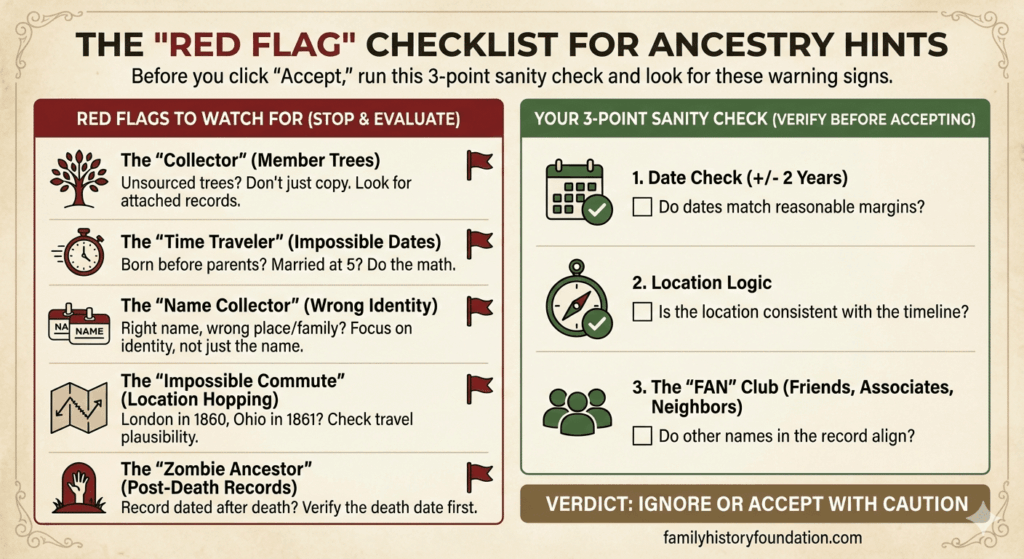
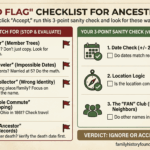
Red Flag #1: The “Collector” (Other Member Trees) 🚩
This is the single most dangerous hint type on the platform.
When you go to verify Ancestry hints, you will often see “Ancestry Member Trees” as the source. This means the algorithm is suggesting that because User123 has this person in their tree, you should too.
Why it’s a Red Flag: Most public family trees are unsourced. They are often copies of copies. If one person makes a mistake (like attaching the wrong parents), and ten people copy that tree, the algorithm sees ten “sources” confirming the fact. In reality, it is just one mistake echoed ten times. You simply cannot verify Ancestry hints based solely on hearsay.
The Rule: Never accept a Member Tree hint as proof. Use it only as a clue to find actual documents. If the other tree doesn’t have attached records (Census, Birth Certificates, Wills), ignore it.
For more on how to discern good data from bad, read about our strategies for genealogy research redundancy.
Red Flag #2: The “Time Traveler” (Chronological Impossibilities) ⏳
You would be amazed at how many accepted hints violate the laws of physics. The algorithm looks at names and places, but it isn’t always great at math. This is why you must verify Ancestry hints against a timeline.
Common Scenarios to Watch For:
- The Pre-Parent Child: A child born before the parent was born (or when the parent was 5 years old).
- The Ghost Parent: A child born after the mother died. (Fathers can conceive children before death that are born after, but mothers certainly cannot).
- The Toddler Groom: A marriage record attached to a person who would have been 8 years old at the time.
When you verify Ancestry hints, you must do the mental math. If your ancestor was born in 1850, they cannot be the parent of a child born in 1860. It seems obvious, but in the heat of “click fever,” we often miss these glaring errors.
If you struggle with organizing these dates, I recommend setting up a timeline. We discuss the importance of timelines in our article on 15 genealogy research habits that save time.
Red Flag #3: The “Name Collector” (The John Smith Problem) 📛
This is the classic blunder. You are looking for “Mary Jones” born in 1890 in Ohio. The hint pops up: “Mary Jones, born 1891.” You think, “Close enough!” and click accept without taking a moment to verify Ancestry hints properly.
Why it’s a Red Flag: You didn’t check the location. The hint is for a Mary Jones in Ireland. Or maybe the county is right, but the parents’ names are different.
The “Name Collector” red flag happens when we prioritize the name over the identity. A name is just a label; an identity is a collection of dates, places, and relationships. When you verify Ancestry hints, the name is actually the least important factor because names are so common.
This is especially difficult when dealing with common surnames. If you are stuck in this trap, you need to read our guide on the common name ancestor problem. It gives you specific strategies to tease apart these identical identities.
Red Flag #4: The “Impossible Commute” (Location Hopping) 🗺️
Geography is your best friend when you verify Ancestry hints.
The Scenario: Your ancestor, a farmer in rural Kentucky, appears in the 1860 Census in Kentucky. The hint suggests a “Will Record” for the same name in 1861 in… London, England. Then, he appears in the 1870 Census in Kentucky again.
Why it’s a Red Flag: Unless your ancestor was a wealthy merchant or a diplomat, they likely did not travel across the ocean and back in the middle of the 19th century just to die and come back to life. It is critical to verify Ancestry hints by asking: “Is it plausible for this person to be here?”
Beginners often ignore the location field because they are so focused on the name. If you are dealing with city-dwelling ancestors, tracking their specific location is easier. Learn how to pinpoint them in our guide to old city directories.
Red Flag #5: The “Zombie Ancestor” (The Immortal) 🧟
We all want our ancestors to live long, healthy lives. But if a hint suggests your great-great-grandfather signed a marriage bond in 1910, but you already have his death certificate from 1890, you need to verify Ancestry hints more carefully.
Why it’s a Red Flag: This often happens with “Find A Grave” hints or secondary records where the algorithm matches a son with the same name as the father. If you accept this hint, you merge two people into one, creating a “Frankenstein” ancestor who lives for 150 years and is married to his own daughter-in-law.
Always cross-reference the death date first before you verify Ancestry hints for any post-death events.
To avoid this, make sure you are properly documenting the death dates you already have. See our tips on how to find family on Ancestry.
🧠 Pop Quiz: Would You Click the Leaf?
Let’s test your new skills. Below are three scenarios. Decided if you would VERIFY (Accept) or DENY (Reject) the hint.
Scenario A:
- Your Tree: Sarah Miller, born 1845 in Boston, MA.
- The Hint: Sarah Miller, Marriage Record, 1865, London, England. Spouse: John Smith.
- Decision: ______________
Scenario B:
- Your Tree: James T. Kirk, born 1900 in Iowa.
- The Hint: James T. Kirk, 1910 Census, Iowa. Living with parents George and Winona (which matches your tree).
- Decision: ______________
Scenario C:
- Your Tree: Elizabeth Bennett, died 1898 in Hertfordshire.
- The Hint: Elizabeth Bennett, 1901 Census, Hertfordshire. Living with husband Darcy.
- Decision: ______________
(Scroll to the bottom of the article for the answers!)

The Source Hound’s Newsletter
Still Hitting Dead Ends In Your Research?
Join 500+ family historians getting the Source Hound’s weekly research breakthroughs — real case studies, source hacks, and the exact strategies that turn brick walls into discoveries.
Free. No fluff. Straight from the Source Hound’s desk to yours.
Your privacy is sacred — almost as sacred as a primary source. Read our Privacy Policy.
The “Sanity Check” Protocol
Now that you know the Red Flags, how do you practically verify Ancestry hints without spending hours on every single one?
You need a system. I use the “3-Point Sanity Check.” I do not click “Accept” until the hint passes all three points.
1. The Date Check (+/- 2 Years)
Does the birth/marriage/death date match within a reasonable margin of error? You must verify Ancestry hints are chronologically sound.
- Pass: Your tree says 1850; Hint says 1851.
- Fail: Your tree says 1850; Hint says 1865.
2. The Location Logic
Is the location consistent with the timeline?
- Pass: Born in Ohio, Married in Ohio.
- Fail: Born in Ohio, Married in Germany, Died in Ohio.
3. The “FAN” Club (Friends, Associates, Neighbors)
This is the advanced move. Look at the other people in the record. This is the best way to verify Ancestry hints definitively.
- Pass: The hint is a census record. The head of house is your ancestor, and the wife and children’s names match your tree.
- Fail: The name matches, but the wife’s name is “Susan” and your ancestor’s wife was “Margaret.”
If you want to master the “FAN” principle, it is a core part of overcoming brick walls. Read more in our article on how to overcome genealogy brick walls.
Why You Should Occasionally “Ignore” Hints
There is a button next to “Accept” that many people are afraid to use: “Ignore.” You should use it liberally when you verify Ancestry hints.
When you determine they are wrong, ignoring them does two things:
- It cleans up your workspace so you can focus on legitimate leads.
- It (theoretically) trains the algorithm that this match was bad.
Don’t be a digital hoarder. If a leaf is dead, prune it.
This is part of being a bold researcher. We talk about the mindset of a successful genealogist in our post on why Ancestry.com is the number 1 genealogy website.
The Danger of the “Maybe”
Ancestry also offers a “Maybe” button. Use this with caution. The “Maybe” pile is where hints go to die because you failed to verify Ancestry hints in the moment.
If you aren’t sure, it is better to open the record, analyze it, and write a research note than to just click “Maybe” and forget about it.
If you are unsure about a hint because it involves a female ancestor and you don’t know her surname, don’t guess. Use the techniques in our guide on how to find maiden names in genealogy.
Frequently Asked Questions (FAQ)
Q: If I ignore a hint, can I get it back later?
A: Yes! Ancestry has a filter in the hints tab for “Ignored Hints.” Nothing is deleted forever. You can go back and review them if new information arises as you verify Ancestry hints in the future.
Q: Why do my hints sometimes disappear?
A: This happens if the underlying record database is updated or if the “source” (like another member’s tree) is deleted or made private.
Q: Can I trust hints from “Find A Grave”?
A: Treat them like Member Trees. Find A Grave is user-generated content. Always look for a photo of the headstone to verify Ancestry hints from that site.
Q: Should I turn off email notifications for hints? A: If you find them overwhelming, yes. It is better to log in once a week and methodically verify Ancestry hints than to be distracted by constant emails.
Q: What if a hint contradicts my personal family knowledge? A: Trust your primary evidence (family bibles, certificates) over a hint. However, be open to the possibility that family stories might be wrong. Correct procedure requires you to verify Ancestry hints against all available sources.
Conclusion: The Leaf is Just the Beginning
The “Shaky Leaf” is a brilliant invention. It has sparked the curiosity of millions of people. But for the serious genealogist—the “Brainy Beginner”—it is just the starting line.
Check out my Ancestry.com 14-Day Trial Deal (sponsored)!
When you take the time to verify Ancestry hints, you are showing respect for your ancestors. You are ensuring that their true story is told, not a convenient fiction created by an algorithm.
Remember, a small tree that is 100% accurate is infinitely more valuable than a massive tree full of strangers.
So, the next time that leaf starts shaking, take a deep breath. Check the dates. Check the map. Check the relations. And only then, if it passes your “Red Flag” inspection, do you click “Accept.” That is the only way to verify Ancestry hints like a pro.
If you are looking for free resources to help cross-reference these hints, don’t forget to check our list of the best free genealogy search engines.
Happy Hunting! 🕵️♀️
Quiz Answers
Scenario A: DENY. Why? The “Impossible Commute.” It is highly unlikely Sarah moved from Boston to London during the Civil War era without corroborating evidence. It’s likely a different Sarah Miller.
Scenario B: VERIFY. Why? The dates align, the location aligns, and most importantly, the parents (the FAN club) match perfectly. This is a high-quality hint.
Scenario C: DENY. Why? The “Zombie Ancestor.” If she died in 1898, she cannot be alive in the 1901 census. Either the death date is wrong, or the census is for a different Elizabeth.
About the Author
I’m Franklin, the founder and lead researcher behind The Family History Foundation.
My passion is helping “Brainy Beginners” navigate the complex, emotional, and often confusing world of genealogy. I believe that family history is more than just names and dates—it’s about understanding the people who made us who we are.
I’ve spent over two decades digging through archives, scrolling through microfilm, and yes, clicking on thousands of Shaky Leaves (and rejecting many of them!). My goal is to save you from the mistakes I made when I was starting out by teaching you to verify Ancestry hints correctly from day one.
When I’m not writing blog posts or filming tutorials for our YouTube Channel, you can find me organizing my own digital archives or pinning cool history finds on Pinterest.
If you’re ready to take your research to the next level, I invite you to explore more of the site. Let’s build a family tree you can be proud of, together. 🌿
The Source Hound’s Newsletter
Still Hitting Dead Ends In Your Research?
Join 500+ family historians getting the Source Hound’s weekly research breakthroughs — real case studies, source hacks, and the exact strategies that turn brick walls into discoveries.
Free. No fluff. Straight from the Source Hound’s desk to yours.
Your privacy is sacred — almost as sacred as a primary source. Read our Privacy Policy.