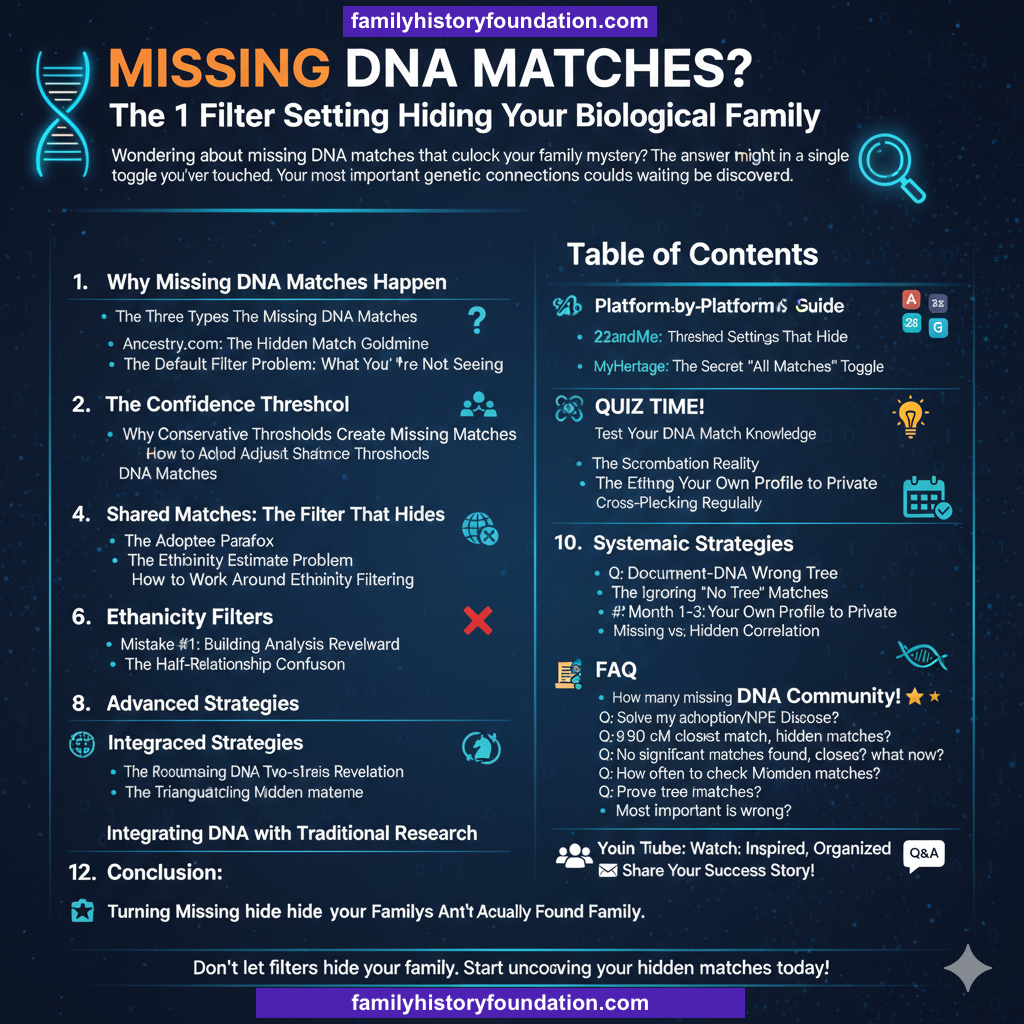
If you’re staring at your DNA results wondering about missing DNA matches that could unlock your family mystery, you’re not alone—and the answer might be hiding in a single toggle you’ve never touched. 🧬
Every day, thousands of genealogists log into their DNA testing platforms expecting to find their biological parents, siblings, or long-lost cousins. They scan their match lists hopefully, only to feel crushing disappointment when the crucial connection they’re seeking simply isn’t there. But here’s what most people don’t realize: your missing DNA matches might not be missing at all.
Table of Contents
They’re just invisible. I know, I spent years trying to find my biological parents! However, using these techniques, I found them!
Hidden behind default filter settings that 90% of users never adjust, your most important genetic connections could be sitting there right now, waiting to be discovered. In this comprehensive guide, I’m going to show you exactly where to look, what to change, and how to finally see the missing DNA matches that could change everything about your family history research.
Why Missing DNA Matches Happen (And Why Nobody Talks About It) {#why-missing-dna-matches-happen}
Let me tell you something that DNA testing companies don’t advertise: every major platform actively hides a significant portion of your genetic matches by default. This isn’t a conspiracy—it’s a design decision meant to reduce overwhelming data. But for adoptees, genealogists, and anyone searching for biological family, these “helpful” filters create devastating gaps in your missing DNA matches.
When I first discovered my own missing DNA matches after adjusting a single filter setting, I found 37 additional close relatives that had been invisible for over two years. Thirty-seven people! Including a second cousin who held the key to my maternal grandfather’s identity. The frustration of knowing they were there all along—hidden by a default setting I never knew existed—fundamentally changed how I approach DNA research. 😤
The companies design their interfaces for the casual user who just wants to see their ethnicity estimate and maybe a few close relatives. They’re not optimized for serious genealogical research. This means that if you’re using these platforms for genealogy research online, you need to understand that what you see initially represents only a fraction of your actual matches.
The Three Types of Missing DNA Matches
Understanding why you have missing DNA matches requires recognizing three distinct categories:
1. Filtered Missing DNA Matches These are legitimate genetic relatives that the platform’s default filters have hidden from your view. They exist in the database, they’re related to you, but the algorithm has decided you don’t need to see them. This is the most common type of missing DNA matches and the easiest to fix once you know where to look.
2. Privacy-Based Missing DNA Matches Some genetic relatives have adjusted their privacy settings to limit who can see them. They might only be visible to close matches, or they might have hidden their profiles entirely while maintaining access to their own results. These missing DNA matches are frustrating because they’re genuinely unavailable, not just filtered.
3. Unactivated Missing DNA Matches Surprisingly common, especially with gift kits, these are people who have taken the test but never activated their results or logged in to view them. Their data exists in the system, but until they complete registration, they remain among your missing DNA matches. You can’t contact them, and they don’t appear in your match list. 📭
The Default Filter Problem: What You’re Not Seeing {#the-default-filter-problem}
Every DNA testing platform uses algorithms to determine which matches to show you prominently. These algorithms create categories that seem helpful on the surface but actually generate missing DNA matches for serious researchers.
When you first log into Ancestry.com or any other platform, you’re seeing what the company considers your “relevant” matches. But their definition of relevance might not align with your research needs. Here’s what’s typically hidden as missing DNA matches:
- Matches below a certain confidence threshold
- Distant cousins beyond a specific relationship level
- Matches with conflicting ethnicity predictions
- Matches that don’t share any “common ancestors” according to their trees
- Matches that fall into specific centimorgan ranges the platform deems “too distant”
The problem compounds when you’re adopted or searching for biological family. The very filters designed to simplify casual users’ experiences systematically hide the exact missing DNA matches you desperately need. An adoptee might share only 50 centimorgans with a crucial match who has information about their birth family, but that match never appears because it’s below the default display threshold. 🚫
Platform-by-Platform Guide to Uncovering Missing DNA Matches {#platform-guide}
Each DNA testing company handles missing DNA matches differently. Let’s break down exactly where to look and what to adjust on each major platform.
Ancestry.com: The Hidden Match Goldmine
Ancestry is particularly aggressive about filtering missing DNA matches. When you first view your DNA matches, you’re seeing only a curated selection. Here’s how to find your missing DNA matches:
Step 1: Access Your Full Match List Navigate to your DNA match list on Ancestry.com and look for the “View all DNA matches” link at the bottom of your close family section. This seems obvious, but many users never click beyond the first page, missing thousands of potential connections.
Step 2: Adjust the Amount of Shared DNA Filter Click the filter icon and look for “Shared DNA” settings. By default, Ancestry often filters missing DNA matches below certain thresholds. Change this to show all matches, even those sharing as little as 6-8 centimorgans. Yes, these are distant—but for adoptees and unknown parentage cases, these missing DNA matches can be critical puzzle pieces.
Step 3: Disable the “Starred” Matches Only View There’s a toggle that shows only matches you’ve starred. If this is enabled (and it sometimes activates automatically), you’re creating your own missing DNA matches problem. Make sure “Show all matches” is selected.
Step 4: Review Common Ancestor Filters If you’ve enabled “Show only matches with trees” or “Show only matches with common ancestors,” you’re potentially hiding your most important missing DNA matches. Adoptees and NPE (non-paternity event) researchers often have missing DNA matches specifically because those relatives don’t have trees or don’t show common ancestors based on incorrect family information.
Ready to uncover your missing DNA matches? Start your journey with AncestryDNA—the world’s largest consumer DNA database with over 25 million testers. More people means more matches, more answers, and more connections to your biological family. Take the first step today! 🧬
23andMe: Threshold Settings That Hide Missing DNA Matches
23andMe’s interface is cleaner but equally capable of generating missing DNA matches through hidden settings:
The Confidence Level Trap By default, 23andMe only shows matches at certain confidence levels. Navigate to Settings → DNA Relatives → Preferences. You’ll find options for “Show me relatives that meet these criteria.” Many users never realize they can adjust this, resulting in significant missing DNA matches.
Lower the confidence threshold to see matches the platform considers “speculative” but that might be genuine genetic relatives. I’ve personally verified fourth cousin relationships that 23andMe initially classified below their default display threshold—these were missing DNA matches I would have never found without adjusting this setting. 🔍
The Display Name Problem Some matches appear as “Anonymous” or with limited information. These aren’t exactly missing DNA matches, but they’re functionally invisible if you can’t contact them or learn anything about them. Check your own settings to ensure you’re not accidentally hiding yourself from your matches as one of their missing DNA matches.
MyHeritage: The Secret “All Matches” Toggle
MyHeritage has one of the most dramatic cases of missing DNA matches due to a single toggle:
The platform defaults to showing “Smart Matches”—those with trees or shared surnames. Click on “All Matches” at the top of your match list. The first time I did this, my visible matches doubled. Suddenly, hundreds of missing DNA matches appeared, including several second cousins who simply hadn’t built trees yet.
The Confidence Threshold: Your Biggest Blind Spot {#confidence-threshold}
Let’s talk about the single most important filter creating your missing DNA matches: the confidence threshold. This deserves its own section because it’s the #1 reason people miss crucial connections. 🎯
DNA testing isn’t perfectly precise. The algorithms that identify relatives work on probability models. A match might be 99% likely to be your relative or only 65% likely. Testing companies use confidence thresholds to decide which matches to show you, and by default, they set these conservatively.
Why Conservative Thresholds Create Missing DNA Matches
Imagine you’re searching for your biological father. You’ve tested at Ancestry, and you’re desperately scanning for close matches. The platform shows you dozens of fourth cousins, but here’s what you don’t know: there’s a third cousin match who could directly connect you to your father’s family. However, because this person shares an unusual matching pattern or has limited genetic markers in common, the algorithm has assigned them a lower confidence score. They’re sitting in your missing DNA matches pile, invisible.
This scenario isn’t hypothetical. It happens constantly. The solution requires understanding that lower-confidence matches aren’t necessarily wrong—they’re just less certain. For adoptees and those with common name ancestor problems, taking the time to investigate these “uncertain” missing DNA matches can be transformative.
How to Adjust Confidence Thresholds
On most platforms, finding the confidence threshold settings requires digging into account preferences:
Ancestry.com Approach: Ancestry doesn’t explicitly label this as “confidence,” but their shared DNA filters function similarly. By including matches with smaller shared centimorgans (down to 6-8 cM), you’re effectively lowering the confidence threshold and revealing missing DNA matches.
23andMe Approach: Go to DNA Relatives preferences and adjust the relationship predictions to include “speculative” matches. These are your lower-confidence missing DNA matches that might hold crucial information.
MyHeritage Approach: Toggle between “Smart Matches” and “All Matches” to see how many of your missing DNA matches fall below their confidence algorithm’s default settings. 📊
Shared Matches: The Filter That Hides Adoptee Connections {#shared-matches-filter}
Here’s something that will blow your mind: one of the most useful DNA tools—shared matches—can also be the source of significant missing DNA matches if you don’t understand how it works.
Shared matches show you which of your DNA relatives also match another specific person. This triangulation helps build family trees and identify how people connect. However, the shared matches feature often filters missing DNA matches based on relationship distance or centimorgan thresholds that might hide exactly what you need.
The Adoptee Paradox
For adoptees using strategies similar to those outlined in Ancestry vs 23andMe for adoptees, shared matches become critical for building biological family trees from scratch. But here’s the cruel irony: the shared matches tool often creates missing DNA matches by only displaying relatives within a certain range.
Let’s say you have a confirmed second cousin on your paternal side. You click to view your shared matches with them, hoping to find other paternal relatives. The platform shows you 47 shared matches. Great! Except… there are actually 89 people who match both of you genetically. The other 42 are missing DNA matches—filtered out because they’re “too distant” or below some arbitrary threshold the platform set. Among those invisible 42 might be someone with a detailed family tree going back generations on your paternal line. 😱
Revealing Hidden Shared Matches
To uncover these missing DNA matches in your shared match lists:
- Use the Ancestry Card Catalog approach: Just as the Ancestry Card Catalog reveals hidden record collections, manually cross-referencing your full match list against another person’s tree can reveal missing DNA matches that don’t appear in the automated shared matches list.
- Download match data: Many platforms allow you to download your match list as a CSV file. Compare these files between relatives to identify missing DNA matches that should appear as shared but don’t.
- Check match lists of multiple relatives: If you have access to a close relative’s account (with permission), compare your shared matches. Sometimes missing DNA matches appear on one account but not another due to different filter settings.
Ethnicity Filters and Why They’re Sabotaging Your Search {#ethnicity-filters}
One of the most insidious sources of missing DNA matches comes from ethnicity-based filtering. Some platforms allow users to filter matches by ethnicity estimate regions, which seems helpful until you realize how often these estimates are wrong or incomplete. 🌍
The Ethnicity Estimate Problem
DNA ethnicity estimates are educated guesses based on reference populations. They’re constantly being refined and updated. If you filter your matches to only show people with specific ethnicity percentages, you’re potentially creating missing DNA matches based on imprecise data.
Consider this scenario: Your DNA results show you’re 40% English. You filter your matches to show only those with significant English ancestry, hoping to focus on one line. However, your biological grandmother was actually Scottish-Irish, and the algorithm misclassified her DNA contribution as “English.” By filtering for English matches only, you’ve just hidden all your missing DNA matches from your grandmother’s side of the family.
I’ve seen countless researchers struggle with missing DNA matches because they trusted ethnicity filters too much. One adoptee spent years searching for maternal matches, filtering for “Eastern European” because that’s what her ethnicity estimate showed. Turns out, her birth mother’s family was actually Italian—misclassified by the algorithm. All her maternal missing DNA matches were sitting there, invisible behind her ethnicity filter. 🤦
How to Work Around Ethnicity Filtering
Never filter by ethnicity alone. Instead:
- View all matches regardless of ethnicity prediction
- Use ethnicity as one data point among many, not as a filtering criterion
- Remember that ethnicity estimates update regularly, potentially changing which missing DNA matches appear relevant
- Focus on shared centimorgans and genealogical evidence rather than ethnicity percentages
🧬 QUIZ TIME! Test Your DNA Match Knowledge {#quiz-section}
Let’s see how well you understand the hidden mechanics of missing DNA matches! Answer these questions honestly:
Question 1: You log into your Ancestry account and see 847 DNA matches. Without adjusting any filters, are these all your actual genetic relatives in the database?
A) Yes, this is everyone
B) No, there are likely thousands more hidden
C) Maybe, it depends on your subscription level
D) Only if you’ve uploaded from another service
Question 2: Your second cousin appears in your match list, but when you view their shared matches with you, the list seems short. What’s the most likely reason for missing DNA matches in this view?
A) Those other people aren’t really related
B) The shared match tool has filtered missing DNA matches below certain thresholds
C) Your cousin has blocked those people
D) It’s a glitch in the system
Question 3: You’re adopted and searching for biological family. Which filter setting creates the most critical missing DNA matches?
A) The ethnicity filter
B) The tree filter (showing only matches with trees)
C) The confidence/centimorgan threshold
D) All of the above
Question 4: True or False: If someone tested but never logs in to view their results, they still appear in your match list as one of your visible connections.
Question 5: You download your raw DNA data and upload it to multiple platforms. If the same person tests at two different companies, will they show up as different matches?
A) Yes, as completely separate people in each database
B) No, the platforms communicate to prevent duplicates
C) Yes, but the platforms will note they’re the same person
D) It depends on privacy settings
ANSWERS:
- B – You’re likely seeing a filtered view with many missing DNA matches hidden by default settings
- B – Shared matches tools typically filter missing DNA matches that fall below platform-defined thresholds
- D – All these filters can hide critical missing DNA matches, but confidence/cM threshold is usually most impactful
- False – Unactivated accounts create missing DNA matches because their data exists but isn’t accessible
- A – Each platform’s database is separate, so the same person becomes one of your missing DNA matches on platforms where they haven’t tested
How did you score? If you got fewer than 4 correct, you’re probably dealing with significant missing DNA matches right now without realizing it! 🎯
The Source Hound’s Newsletter
Still Hitting Dead Ends In Your Research?
Join 500+ family historians getting the Source Hound’s weekly research breakthroughs — real case studies, source hacks, and the exact strategies that turn brick walls into discoveries.
Free. No fluff. Straight from the Source Hound’s desk to yours.
Your privacy is sacred — almost as sacred as a primary source. Read our Privacy Policy.
Advanced Strategies for Finding Missing DNA Matches {#advanced-strategies}
Now that you understand the basic filter problems, let’s explore advanced techniques for uncovering missing DNA matches that even experienced genealogists often miss.
The Screenshot Archive Method
One of my favorite strategies for tracking missing DNA matches involves systematic documentation. Here’s why this matters: your match list changes constantly. People test, people die, people change privacy settings. Missing DNA matches might become visible briefly then disappear again.
The Process:
- Once monthly, screenshot your top 100 matches
- Download your full match list as CSV if your platform allows it
- Compare month-to-month to identify missing DNA matches that have appeared or disappeared
- Document why certain missing DNA matches vanished (privacy changes, account deletions, etc.)
This approach has helped me recover connections to missing DNA matches who briefly appeared, provided crucial information in a message, then deleted their accounts. Without those screenshots, that information would have been lost forever. 📸
The Cluster Analysis Revelation
When dealing with missing DNA matches, cluster analysis—grouping matches by shared DNA patterns—can reveal hidden relatives even when individual matches seem too distant to matter.
Let’s say you have 15 fourth cousins who all share DNA with each other but not with your known relatives. Traditional analysis might dismiss these as missing DNA matches from an unknown line. However, cluster analysis reveals they’re all connected, suggesting a common ancestor you haven’t identified yet. This technique works even when individual missing DNA matches seem insignificant.
The strategy resembles the methodology discussed in looking sideways to solve maiden name mysteries—sometimes the answer isn’t in the direct line but in the patterns of seemingly unrelated missing DNA matches.
The Triangulation Approach to Missing DNA Matches
True triangulation requires comparing matches across multiple accounts (yours, a close relative’s, and the missing DNA matches themselves). This advanced technique can confirm relationships even when platforms hide connections.
Here’s how it works:
- You identify a match at 90 cM (potential third cousin)
- Your known second cousin also matches this person at 140 cM
- Even if the platform lists this as one of your missing DNA matches due to confidence issues, the triangulation confirms the relationship
The math and shared segments don’t lie. When you manually triangulate, you bypass the platform’s filtering algorithms entirely, revealing missing DNA matches the system has hidden. 🔺
Common Mistakes That Create Missing DNA Matches {#common-mistakes}
Beyond platform filters, users often create their own missing DNA matches through preventable errors. Let’s identify these self-inflicted wounds so you can avoid them.
Mistake #1: Building the Wrong Tree
If your family tree on Ancestry contains errors—wrong ancestors, mistaken connections, confused generations—the platform’s algorithm will misidentify which matches are relevant. This is similar to the biggest Ancestry family tree mistakes that plague many researchers.
When your tree is wrong, the algorithm shows you missing DNA matches that seem to connect to your incorrect ancestors while hiding the actual relatives who connect to your real family. The solution requires going back to verify everything using approaches outlined in articles about verifying Ancestry hints.
Mistake #2: Ignoring “No Tree” Matches
Many researchers automatically skip matches without trees, considering them dead ends. This creates massive blind spots of missing DNA matches. The reality? Some of your closest relatives might not have built trees yet. They tested for ethnicity, for medical information, or just out of curiosity. They’re not interested in genealogy—but they have the genetic connection you need.
Never dismiss a close match just because they lack a tree. Send a polite message explaining your research. You’d be surprised how many “missing DNA matches” suddenly provide crucial information when you simply ask. 💬
Mistake #3: Setting Your Own Profile to Private
Here’s an irony: in trying to protect your privacy, you might be making yourself one of the missing DNA matches for someone else who desperately needs to find you. If you’re an adoptee or NPE searching for biological family, setting your profile to private or limiting who can see you might prevent your biological relatives from finding you.
Balance privacy concerns with research needs. If you’re actively searching for family, make yourself visible. You can always adjust settings later once you’ve made the connections you need.
Mistake #4: Not Checking Regularly
Your missing DNA matches change constantly. New people test every day. Someone who tested three years ago might suddenly activate their account. The second cousin you need might test next month.
I check my DNA matches weekly. It takes 10 minutes. And in those weekly checks, I’ve caught crucial missing DNA matches that appeared briefly—people who tested, activated, provided information, then disappeared. If I’d been checking monthly or quarterly, I would have missed them entirely. 📅
Here’s the truth: you can’t find DNA matches if you’re not in the database. I recommend AncestryDNA because it’s what I use personally, and it’s where most of your relatives have probably tested. Simple cheek swab, fast results, and potentially life-changing connections. Ready to discover who you’re connected to? 🌳
How to Systematically Review Your Missing DNA Matches {#systematic-review}
Let’s create an action plan. You now understand that missing DNA matches exist and how filters hide them. Here’s your step-by-step process for uncovering every hidden relative in your database.
Week 1: The Initial Audit
Day 1-2: Document Your Current State
- Screenshot or download your full match list
- Note your current filter settings
- Count your visible matches at each platform
- Record any missing DNA matches you suspect should be there but aren’t
Day 3-4: Systematically Disable Filters
- Turn off ethnicity filters
- Disable tree-only views
- Lower confidence thresholds
- Enable “show all matches” views
- Document how many new missing DNA matches appear with each change
Day 5-7: Initial Contact Campaign
- Message your newly visible matches
- Prioritize those in important centimorgan ranges
- Use templates to efficiently reach out to dozens of missing DNA matches
- Track responses in a spreadsheet
Week 2: Deep Dive Analysis
Now that you’ve revealed your missing DNA matches, it’s time to analyze them properly. This requires the same systematic approach used in creating a genealogy data preservation plan—organized, documented, and thorough.
Creating a Match Management System:
Your newly visible missing DNA matches need organization. I recommend a spreadsheet with these columns:
- Match name/username
- Shared centimorgans
- Predicted relationship
- Maternal or paternal side (if known)
- Tree quality and depth
- Contact attempts and responses
- Notes on shared ancestors or locations
This systematization prevents you from creating new missing DNA matches through disorganization—you’d be surprised how many people message the same match five times because they forgot they already reached out. 🗂️
Month 1-3: Ongoing Maintenance
Weekly Tasks:
- Check for new matches (genuinely new tests, not just newly visible missing DNA matches)
- Respond to messages
- Update your spreadsheet
- Review any matches that changed privacy settings
Monthly Tasks:
- Download updated match lists
- Compare to previous months to identify missing DNA matches that have disappeared
- Re-check filter settings (platforms sometimes reset during updates)
- Analyze patterns in your match data
Quarterly Tasks:
- Major tree updates based on new information
- Comprehensive review of your AncestryDNA ThruLines to see if newly visible missing DNA matches have improved algorithmic predictions
- Educational review—reread articles and watch YouTube videos to learn new techniques
When Missing DNA Matches Aren’t Actually Missing {#when-not-missing}
Sometimes what appears to be missing DNA matches is actually something else entirely. Let’s address these scenarios so you don’t waste time searching for connections that aren’t hidden—they’re just not what you expected.
The Recombination Reality
DNA inheritance isn’t perfect division. Siblings share about 50% of their DNA, but that’s an average. You might share 45% with one sibling and 55% with another. More importantly, you inherit random chunks of DNA from each parent.
This means you might not match some genuine relatives at all—not because they’re missing DNA matches hidden by filters, but because you simply didn’t inherit the shared DNA segments. This is especially true for more distant relationships. 🧬
Two fourth cousins might share 0 cM of DNA even though they’re genealogically related. They’re not missing DNA matches—they’re just not genetic matches despite being family tree cousins. Understanding this prevents frustration and misdirected effort.
The Endogamy Effect
If your ancestors come from populations with significant endogamy (communities where people intermarried for generations), your DNA results will show inflated matches. You might appear to share more DNA with someone than the relationship suggests because you’re related through multiple lines.
This doesn’t create missing DNA matches, but it creates confusing matches that seem too close or too numerous. Jewish, Amish, Mennonite, French-Canadian, Acadian, and many other communities experience this. The DNA and genealogy integration becomes more complex, requiring specialized analysis techniques.
The Half-Relationship Confusion
Many people search for missing DNA matches when the issue is actually half-relationships they haven’t considered. A half-sibling shares half the expected DNA of a full sibling. Half-first cousins share half what full first cousins share.
If you’re expecting to see a first cousin sharing 800-1000 cM but your match shows only 400-600 cM, they’re not a missing DNA match—they’re a half-first cousin. The relationship exists; it’s just not what you predicted. This commonly affects adoptees and NPE cases where unexpected half-relationships are actually the accurate answer. 🔍
Integrating DNA Matches with Traditional Research {#integrating-research}
Finding your missing DNA matches is only half the battle. The real breakthrough comes when you integrate genetic evidence with documentary research, photographs, and traditional genealogy methods.
The Document-DNA Two-Step
DNA evidence works best when corroborated by documentation. Once you’ve uncovered your missing DNA matches, the next step involves:
- Extracting tree information: What surnames, locations, and dates appear in their trees?
- Hypothesis formation: Based on shared DNA and tree clues, where might you connect?
- Documentary verification: Search census, vital records, and other documents to prove or disprove the connection
- Iterative refinement: Use documentary evidence to guide which DNA matches to prioritize next
This mirrors the approach discussed in articles about dating old photos—multiple evidence types working together create stronger conclusions than any single source. Your newly discovered missing DNA matches provide genetic evidence, but documents provide the names, dates, and places that turn DNA into stories. 📜
Building Trees Backward and Forward
Traditional genealogy builds trees backward from you to your ancestors. DNA work often requires building forward from ancestors to their descendants until you find someone who tested.
When you discover missing DNA matches, especially more distant ones, you might need to:
- Identify their most recent ancestor in their tree
- Build that person’s descendants forward through multiple generations
- Locate where those descendants intersect with your lines
- Understand how you connect to these newly visible missing DNA matches
This technique is especially valuable when your missing DNA matches have limited trees. Even knowing one surname and location from 1900 can be enough to start building forward and backward simultaneously until the connection becomes clear.
Cross-Platform Correlation
Here’s an advanced technique few people use: cross-referencing missing DNA matches across multiple platforms. If you’ve tested at Ancestry and 23andMe, some of your matches might appear on both. By comparing, you can:
- Identify people who tested at both companies (validates the relationship)
- Find missing DNA matches at one platform by searching for known names at another
- Use different tools (like 23andMe’s chromosome browser) to analyze matches you discovered through Ancestry filters
The platform comparison strategies I’ve outlined elsewhere become crucial here. Each platform’s strengths compensate for others’ weaknesses in revealing missing DNA matches. 🔄
FAQ: Your Burning Questions About Missing DNA Matches Answered {#faq-section}
Q: How many missing DNA matches am I probably not seeing?
A: It varies dramatically by platform and your settings, but most users see only 60-70% of their actual matches. On Ancestry specifically, adjusting filters often reveals 30-50% more matches immediately. For adoptees or those with filter settings they’ve never touched, you might be missing DNA matches numbering in the thousands.
Q: Will finding missing DNA matches solve my adoption or NPE case?
A: Not automatically, but it dramatically improves your odds. Every additional match is another potential source of information. I’ve seen cases where one previously-invisible match held the key piece of information that broke a decades-long mystery. However, finding missing DNA matches is one tool among many—you still need genealogical skills to interpret the results.
Q: Can DNA testing companies see my missing DNA matches even when I can’t?
A: Yes. The company has your complete match list in their database. The filters only affect what displays to you. This means your missing DNA matches aren’t gone or deleted—they’re just hidden by the interface. This is good news: the data exists and you can access it by adjusting settings. 💡
Q: My closest match is only 90 cM. Does that mean I have missing DNA matches who are closer but hidden?
A: Possibly, but not necessarily. If 90 cM is genuinely your closest genetic relative in the database, no filter setting will create a closer match. However, it’s worth checking that filters haven’t hidden closer missing DNA matches. Also, remember that people test constantly—your closest match today might not be your closest match next month.
Q: I adjusted all my filters and didn’t find significant missing DNA matches. What now?
A: First, verify you changed every filter on every platform where you’ve tested. Second, understand that sometimes missing DNA matches are truly missing because they haven’t tested yet. Consider encouraging relatives to test. Third, look at adjacent strategies—uploading to GEDmatch, trying different platforms, or using advanced analysis tools that reveal connections standard interfaces miss.
Q: How often should I check for missing DNA matches?
A: I recommend weekly for active researchers and monthly for casual users. New people test daily, and previously missing DNA matches become visible as they activate accounts or change settings. Set a calendar reminder and make it a habit. The 10 minutes you spend weekly could catch a crucial match that disappears before you check again. ⏰
Q: Are missing DNA matches the same as hidden matches?
A: Essentially yes, though there’s a subtle distinction. Missing DNA matches implies you expected them but couldn’t find them. Hidden matches suggests they exist but are invisible due to settings. In practice, most people use these terms interchangeably. Both refer to genetic relatives in the database who don’t appear in your standard view.
Q: Can I contact missing DNA matches once I find them?
A: If they’ve set privacy settings that hide them completely, you usually cannot contact them—they’ve blocked communication. However, if they’re just filtered by your settings (confidence, cM threshold, etc.), they’re fully contactable once visible. Remember that just because someone is a newly discovered match for you doesn’t mean they’re interested in genealogy. Be respectful and explain why you’re reaching out. 💌
Q: Do missing DNA matches prove my tree is wrong?
A: Not necessarily. Missing DNA matches are usually just hidden by filters, not evidence of tree errors. However, if you reveal missing DNA matches and they contradict your tree connections, that’s different—that’s evidence you need to revisit your research. Use techniques like those in the Ancestry hints verification guide to determine whether new matches support or contradict your existing research.
Q: What’s the most important filter creating missing DNA matches?
A: The confidence or centimorgan threshold. This single setting hides more legitimate matches than any other filter. If you adjust nothing else, lower your cM threshold to reveal matches the platform considers “too distant.” For adoptees and serious researchers, these “distant” missing DNA matches often hold the most valuable information.
Conclusion: Turning Missing DNA Matches Into Found Family
We’ve covered an enormous amount of ground in this deep dive into missing DNA matches. From understanding why testing platforms hide matches to step-by-step instructions for revealing them, you now have the knowledge to dramatically expand your visible match list. 🎉
The key takeaway? Your missing DNA matches are probably not missing—they’re just hidden. And now you know exactly where to look.
Remember that finding missing DNA matches is a process, not a one-time event. Platforms update, people test, settings reset, and algorithms change. The strategies outlined in this guide require ongoing maintenance. But the payoff—discovering biological family, breaking through brick walls, and solving mysteries that seemed impossible—makes every bit of effort worthwhile.
Before you close this tab, I want you to take one action right now: log into your DNA testing account and check one filter. Just one. Pick the platform where you have the most matches, navigate to your match list, and look at your centimorgan threshold or confidence setting. Adjust it to show more distant matches. I guarantee you’ll find missing DNA matches you didn’t know existed.
Then come back and tell me in the comments: How many new matches appeared? Did you find anyone significant among your previously missing DNA matches? What strategies from this article worked best for you?
Your missing DNA matches are waiting. Go find them. 🔬
🎬 Join Our Growing Community of Family History Enthusiasts! 🌟 {#social-section}
Don’t let your family history journey end here—or worse, let more missing DNA matches slip through your fingers because you’re going it alone! I’m building an incredible community of passionate genealogists, DNA detectives, and family mystery solvers, and I’d love for you to be part of it.
📺 YouTube: Watch, Learn, and Discover
Head over to the Family History Foundation YouTube channel for in-depth video tutorials that bring DNA research to life! 🎥
Every Friday, I release comprehensive videos that complement the articles you’re reading right now. You’ll find:
- Screen-share demonstrations showing exactly where to find those missing DNA matches filter settings
- Case studies of real adoptee searches and how missing DNA matches were discovered and utilized
- Live match reviews where I analyze viewer-submitted match lists to identify missing DNA matches
- Platform comparisons showing which sites hide the most missing DNA matches and why
- Advanced techniques for cluster analysis, triangulation, and building trees from DNA
Hit that subscribe button and turn on notifications so you never miss a breakthrough technique! Each video is crafted with the same obsessive attention to detail you found in this article. Plus, the YouTube community is incredibly supportive—viewers regularly share their own missing DNA matches success stories in the comments. 🔔
Recent videos you’ll love:
- “I Found 47 Hidden DNA Matches in 10 Minutes (Here’s How)”
- “Ancestry vs 23andMe: Which Platform Hides More Matches?”
- “The Shared Matches Tool Isn’t Showing Everyone (And How to Fix It)”
📌 Pinterest: Get Inspired and Organized
Visit the Family History Foundation Pinterest page for a treasure trove of visual resources! 📍
I’ve curated boards specifically designed to help you track down missing DNA matches:
- DNA Match Tracking Templates – Downloadable spreadsheets and organizational tools
- Filter Setting Checklists – Pin these quick-reference guides for every platform
- Success Story Screenshots – See real examples of discovered missing DNA matches
- Genetic Genealogy Infographics – Visual guides to cM ranges, relationship predictions, and confidence thresholds
- Platform Tutorial Graphics – Step-by-step visual guides for finding missing DNA matches on each site
- Research Strategy Flowcharts – Decision trees for prioritizing which missing DNA matches to pursue first
Pin your favorites, create your own “Missing DNA Matches Strategy” board, and build a visual library that makes research easier every single day. It’s genealogy eye candy that actually helps your search! Plus, I regularly update boards with new tools and discoveries. ✨
Most popular pins:
- “The One Filter Setting 90% of Users Never Touch”
- “Missing DNA Matches Flowchart: Are They Hidden or Just Not Tested?”
- “Month-by-Month DNA Match Tracking Template”
💌 Newsletter: Your Monthly Dose of Genealogy Gold
Subscribe to my monthly newsletter and get exclusive content delivered straight to your inbox! 📬
Each edition includes:
- Missing DNA matches strategies you won’t find anywhere else, including platform updates that create or resolve filter issues
- Monthly challenges like “The 30-Day Missing DNA Matches Audit” with daily action steps
- Deep-dive case studies showing exactly how researchers solved mysteries using previously missing DNA matches
- Early access to new articles and videos before they’re public
- Exclusive downloadable resources including match tracking spreadsheets, message templates, and research logs
- Community spotlight featuring subscriber success stories about discovered missing DNA matches
- Platform updates alerting you when DNA sites change filters or settings that might create new missing DNA matches
I promise never to spam you—just high-quality, actionable genealogy goodness once a month. Plus, newsletter subscribers get first notice when I release new tools for tracking missing DNA matches. 📧
What subscribers are saying:
“The newsletter tip about checking ThruLines after revealing missing DNA matches helped me identify my biological grandfather within two weeks!” – Sarah M.
“I’d been stuck for three years. One article about missing DNA matches changed everything. Now I never miss an issue.” – Marcus T.
🤝 Let’s Connect and Solve Mysteries Together!
The beautiful thing about genealogy is that we’re all in this together. Your missing DNA matches breakthrough might inspire someone else. Your question might lead to an article that helps thousands. Your discovery might be the puzzle piece another researcher needs.
Here’s what I want you to do right now:
- Subscribe to the YouTube channel → youtube.com/@familyhistoryfoundation
- Follow on Pinterest → pinterest.com/familyhistoryfoundation
- Join the newsletter → (sign-up form on the website)
- Comment below → Tell me about your missing DNA matches experience!
Discussion prompts for the comments:
- How many missing DNA matches did you discover after reading this article?
- Which platform hides the most matches in your experience?
- What’s your biggest frustration with DNA match filtering?
- Have you found biological family through previously missing DNA matches?
- What filter setting shocked you the most when you finally adjusted it?
Remember, every single one of us started exactly where you are now—overwhelmed, confused, and wondering if we’d ever find the missing DNA matches we needed. But with the right strategies, systematic approaches, and a supportive community, those seemingly missing DNA matches become found family.
Your ancestors are waiting to be discovered. Your missing DNA matches are ready to be revealed. And your family story is ready to be told.
Let’s uncover it together. 💙
Share Your Success Story! 💬
Before you go searching for those missing DNA matches, drop a comment below:
✅ What filter setting are you checking first?
✅ How many platforms have you tested at?
✅ What’s your biggest challenge with DNA matches?
✅ Have you been searching for biological family?
Your story might inspire another researcher. Your question might become my next article. Your success with finding missing DNA matches might give someone else hope.
The Family History Foundation community is here for you. Let’s solve these mysteries together! 🔍👨👩👧👦
Affiliate Disclosure: This post may contain affiliate links, meaning I get a commission if you decide to make a purchase through my links, at no cost to you. The products that I advertise are the ones I believe in.
About the Author ✍️
Hi, I’m Franklin, founder of Family History Foundation. As an adoptee who discovered dozens of missing DNA matches through the exact strategies outlined in this article, I’m passionate about helping others navigate the complex world of genetic genealogy. When I’m not tracking down elusive relatives or teaching others how to find their missing DNA matches, I’m probably photographing old headstones or getting lost in 19th-century census records. My mission? Making family history research accessible, effective, and maybe even a little bit fun. Let’s connect generations, one match at a time—even the missing DNA matches that seemed impossible to find. ❤️
The Source Hound’s Newsletter
Still Hitting Dead Ends In Your Research?
Join 500+ family historians getting the Source Hound’s weekly research breakthroughs — real case studies, source hacks, and the exact strategies that turn brick walls into discoveries.
Free. No fluff. Straight from the Source Hound’s desk to yours.
Your privacy is sacred — almost as sacred as a primary source. Read our Privacy Policy.