The 1790 census is America’s first federal census—and most genealogists search it completely wrong. I’ve gone from mishandles census forms to thoroughly understanding how to tap into these forms for my family history – you can too.
You’ve probably typed your ancestor’s name into Ancestry, gotten zero results, and assumed they weren’t counted. Here’s what actually happened: the 1790 census only lists heads of household by name. Your 5th-great-grandmother? She’s a tally mark in a column. Your 4th-great-grandfather who was 12 years old in 1790? He’s counted, but not named…another tally.
Right-o! Tally ho!
Table of Contents
This limitation frustrates researchers, but once you understand what the first US census actually contains, it becomes a powerful tool for establishing family presence, estimating household size, and connecting to later records.
I’ve found several ancestors on the 1790 Census and it was only through careful research that I was able to confirm this information. This census is the trickiest of all to use, primarily because of the era (it’s the 1700s!) and also because the names enumerated were only Heads Of Households with limited categories.
For a complete overview of all census years from 1790-1950, see my US Federal Census comprehensive guide. This post focuses specifically on mastering the 1790 enumeration. I’ll take you step by step through this and share my story along the way which is incredible.
Why the 1790 Census Matters for Genealogy
The 1790 federal census establishes your family’s presence in early America—and that matters more than you might think.
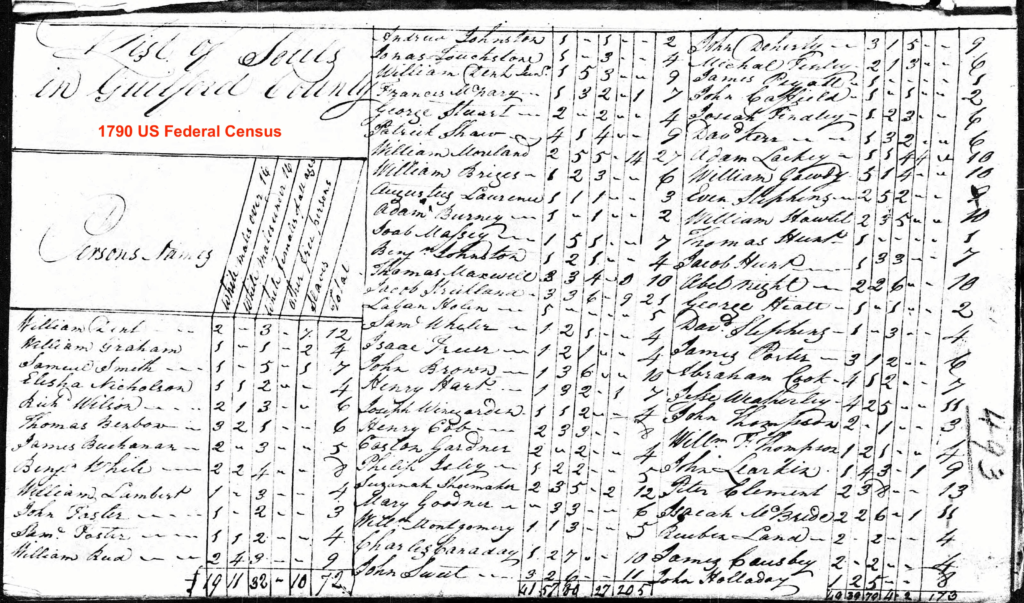
This example census proves your ancestor lived in a specific location in 1790. Notice the notation at the top left: “list of souls in Guilford County.” Very 18th century, don’t you think?
The implications for the 1790 census can apply to lineage societies like the Daughters of the American Revolution (DAR) or Colonial Dames, proving 1790 residence can support Revolutionary War service claims or colonial lineage applications. It’s definitely a status symbol along just having an ancestor on this census. Chances are your ancestor was in the United States at the time of the American Revolution.
Here’s what the 1790 census accomplishes:
📍 Proves geographic location – Confirms your ancestor lived in a specific county/township in 1790
👨👩👧👦 Estimates family size – Tally marks show approximate household composition
🔍 Connects to land records – Name + location has the potential to point to deeds, tax records, estate files
⚔️ Supports lineage applications – DAR and other societies require proof of 1790 residence for certain lines
The first US census won’t tell you birthdates, birthplaces, or occupations. But it confirms your ancestor existed at a specific place and time—the foundation of all genealogical research.
Source Hound reality check: Don’t expect miracles from the 1790 census. It’s a blunt instrument. But combined with land records, church records, and Revolutionary War pension files, it becomes part of a larger proof strategy.
What the 1790 Census Actually Contains
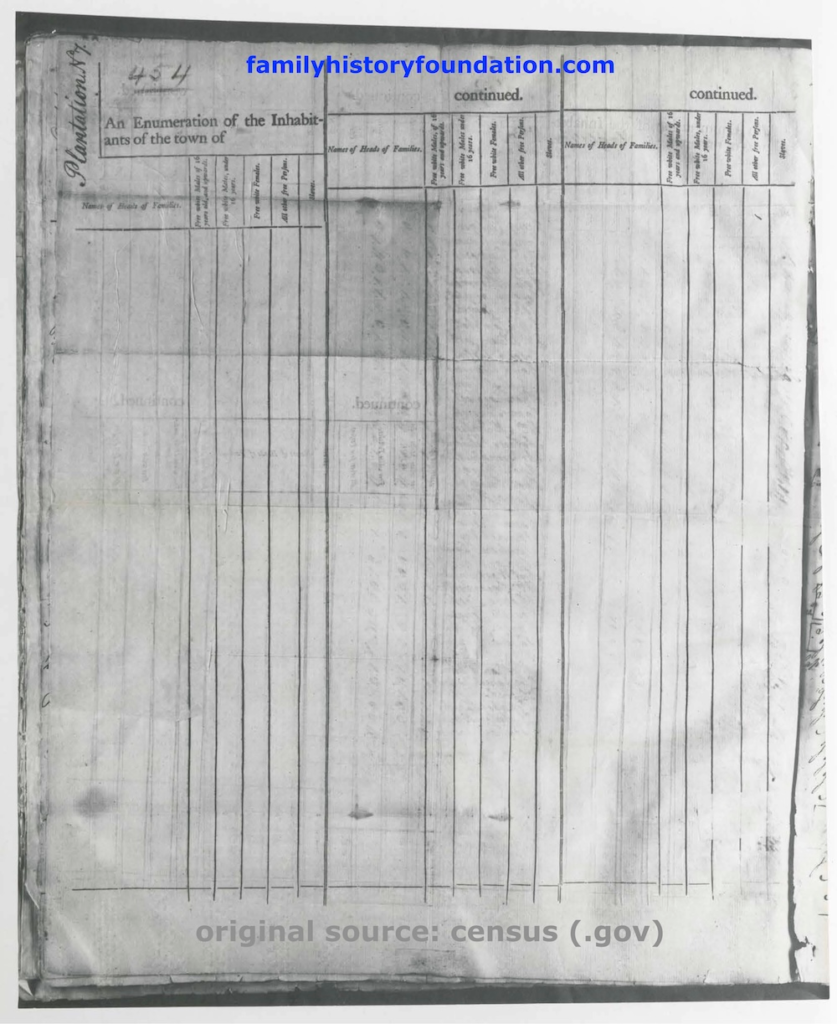
The 1790 census collected minimal information by modern standards—but every data point matters for genealogists. The example below is from The National Archives, Ancestry.com also has blank forms. For an actual, real-life blank form, keep reading 📖.

The Six Categories
Every household in the 1790 federal census was divided into exactly six categories:
1. Head of Household, or Head of Family
This column is the only column that lists names. This column names the head of household, MALE or FEMALE. Although rare, females were counted as HoH if they were widowed. This has been the case in my genealogy. This is where you will search for the name of your ancestor.
2. Free White Males 16 years and older (including head of household)
This column includes the head of household plus adult sons, male boarders, or adult male relatives. If you see “3” in this column, the household has 3 males aged 16+.
3. Free White Males under 16
This counts boys under 16. A “2” here suggests two sons under 16—but could also mean grandsons, nephews, or boarder’s children.
4. Free White Females (all ages)
This column lumps all females together: wives, daughters, mothers, servants, boarders. No age breakdown. A “5” could mean wife + 4 daughters, or wife + 2 daughters + mother + sister.
5. All Other Persons
This category includes free people of color (Black, Native American, mixed race). The 1790 census didn’t distinguish between races within this category.
6. Slaves
In slaveholding states, this column shows the number of enslaved people in the household. No names, ages, or details—just a number.
What’s Missing from the 1790 Census
Understanding what the 1790 census records don’t contain is crucial:
❌ No individual names (except head of household)
❌ No ages (just broad male age categories)
❌ No birthplaces
❌ No occupations
❌ No relationships (can’t prove who’s wife, son, daughter)
❌ No property values
❌ No immigration information
These details appear in later censuses. The 1850 census was the first to list everyone by name—60 years later.
Which States Have Surviving 1790 Census Records
The 1790 census wasn’t preserved perfectly. Several states’ records were lost or destroyed before microfilming.
Complete or Nearly Complete Records
These states have mostly intact 1790 federal census records:
✅ Connecticut (complete)
✅ Maine (complete – counted as part of Massachusetts)
✅ Maryland (complete)
✅ Massachusetts (complete)
✅ New Hampshire (complete)
✅ New York (complete)
✅ North Carolina (complete)
✅ Pennsylvania (complete)
✅ Rhode Island (complete)
✅ South Carolina (complete)
✅ Vermont (complete)
✅ Virginia (partial – some counties lost)
Lost or Missing Records
These states’ 1790 census records were destroyed:
❌ Delaware (completely lost)
❌ Georgia (completely lost)
❌ Kentucky (completely lost)
❌ New Jersey (completely lost)
❌ Tennessee (completely lost)
❌ Virginia (partial – several counties missing)
What to do if your state is missing: Use tax lists, land records, church records, and genealogical research techniques to establish 1790 residence. These substitute records often provide better detail than the census would have.
How to Search the 1790 Census on Ancestry (Step-by-Step)
Ancestry.com hosts digitized images and indexed transcriptions of the 1790 census—but the search function requires specific strategies. Below is a sample blank 1790 Census from Massachusetts. Each state’s forms looked slightly different so be aware of this as you conduct your own family history research across family lines.
Step 1: Access the 1790 Census Collection
Navigate to: Search → Census & Voter Lists → 1790 United States Federal Census. You can also use the general search or the Card Catalog.
Direct URL: www.ancestry.com/search/collections/5058
Family History Foundation YouTube 1790 Census walkthrough video URL: “1790 Federal Census Tutorial Ancestry Search Walkthrough – How to Search on Ancestry.com.”
This collection contains all surviving 1790 census records digitized from National Archives microfilm.
Step 2: Enter Your Search Criteria
Start broad, not specific. The first US census has transcription errors, spelling variations, and handwriting challenges.
Search fields to use:
📝 First & Last Name: Use the phonetic “Soundex” option
📍 Location: Select state + county if known
⚠️ Skip: Birthplace, birth year, family members (not recorded in 1790)
Example search:
- Last Name: “Smith” (exact) or “Smyth/Schmidt” (phonetic)
- Location: Pennsylvania → Chester County
- Leave all other fields blank
Step 3: Review Search Results Carefully
The 1790 census transcriptions have errors. Always verify with the original image. Also, be wary as common names abound so use your Ancestry tree to verify how many were in the household as you review the 1790 census details! This is crucially important.
What you’ll see in results:
- Head of household name (as transcribed)
- County/township location
- Number in each of the 5 categories
- Link to view original image
Click “View Image” to see the actual census page. This is non-negotiable—never trust transcriptions alone.
Step 4: Analyze the Household Composition
Once you’ve found your ancestor’s 1790 census entry, decode the tally marks:
Example entry:
John Smith, Chester County, PA
- Free white males 16+: 2
- Free white males under 16: 3
- Free white females: 4
- All other free persons: 0
- Slaves: 0
What this tells you:
- John Smith + 1 adult male (likely a son 16+ or male relative)
- 3 boys under 16 (sons or male relatives)
- 4 females all ages (likely wife + 3 daughters, or wife + children + mother)
- Total household: 9 people
Step 5: Expand Your Search If No Results
If Ancestry returns zero results:
Try these strategies:
1️⃣ Use wildcard searches: John Sm*th finds Smith, Smyth, Smythe.
2️⃣ Search neighbors: Find known neighbors and browse census pages
3️⃣ Try alternate spellings: Johann Schmidt, Jean Schmitt
4️⃣ Search without first name: Last name + location only
5️⃣ Browse by location: Navigate to county and read every page
Reality check: Some ancestors simply aren’t indexed correctly. Manual page-by-page review may be necessary for the 1790 federal census.
Reading Tally Marks and Age Categories
The 1790 census uses tally marks instead of written numbers—and enumerators’ handwriting varies wildly.
Decoding Tally Marks
Standard tally format:
|||| = 4 (four vertical lines)
|||| = 5 (four lines crossed with fifth)
|||| |||| = 9 (crossed group of 5 + 4 lines)
Common problems:
- Smudged ink makes lines hard to count
- Faded pages obscure marks
- Different enumerators used different styles
- Page edges may cut off tallies
Solution: Compare the transcription to the image. If the image shows 6 tally marks but the transcription says “8,” trust the image.
Understanding Male Age Categories
The 1790 census records only distinguish males by age—and only at the 16-year cutoff.
“Free white males 16 years and older”
Could be ages: 16, 17, 18, 25, 40, 65, 90
You can’t tell a 20-year-old from a 70-year-old in this census
“Free white males under 16”
Could be ages: newborn through 15
You can’t determine exact age within this range
Genealogical implications:
If you know your ancestor was born in 1770 (age 20 in 1790), he’d appear in the “16 and older” column. If he was born in 1775 (age 15 in 1790), he’d be in the “under 16” column—but you won’t see his name.
This is why the 1790 census works best when combined with birth records, church records, and the 1800 census (which has more age categories).

The Family History Foundation Newsletter
It’s Not About You, It’s About Documenting Before It Disappears
Join 500+ family historians getting Franklin’s Source Hound weekly research breakthroughs — real case studies, source hacks, and the exact strategies that turn brick walls into discoveries.
Free. No fluff. Straight from the Source Hound’s desk to yours.
Your privacy is sacred — almost as sacred as a primary source. Read our Privacy Policy.
Common 1790 Census Search Problems (And How to Solve Them)
The 1790 census presents unique research challenges. Here’s how to solve the most common problems.
Problem 1: “I can’t find my ancestor at all”
Possible reasons:
✓ Name spelling variation (Schmidt vs Smith vs Smyth)
✓ Living in a lost state (DE, GA, KY, NJ, TN)
✓ Living in a missing Virginia county
✓ Counted under a different head of household (father, uncle, employer)
✓ Transcription error makes them unsearchable
✓ They weren’t enumerated (census taker missed them)
Solutions:
- Search alternate spellings using wildcards
- Check lost state substitutes (tax lists, land records)
- Search for relatives and check their households
- Browse county pages manually
- Verify they were actually alive and in America in 1790
Problem 2: “The tally marks don’t match my family”
Example: You know John had 4 sons in 1790, but the 1790 federal census shows only 2 boys under 16.
Possible explanations:
✓ Some sons were 16+ (adult category)
✓ Some sons were living elsewhere (apprenticed, working)
✓ Census taker miscounted
✓ You’ve identified the wrong John Smith
✓ Birth/death dates you have are incorrect
Solution: Never force records to match assumptions. Let the 1790 census tell you what the household actually looked like in that moment, then use other records to explain discrepancies.
Problem 3: “Multiple people have the same name in the same county”
The first US census has no birthdates or ages to distinguish people. If there are 6 John Smiths in Chester County, PA, how do you know which is yours?
Strategies:
1️⃣ Check household composition: Does the tally match your known family size?
2️⃣ Look at location: Is he in the right township/district?
3️⃣ Find neighbors: Known neighbors can confirm identity
4️⃣ Track to next census: Follow each John Smith to 1800 to see which matches
5️⃣ Use land records: Match census location to deeds
Reality check: You may never be 100% certain which John Smith is yours. Present all possibilities and explain why you chose one over the others. That’s acceptable genealogy.
Problem 4: “My female ancestor doesn’t appear”
This is expected. The 1790 census doesn’t name women unless they were heads of household.
When women appear as heads of household:
- Widows living alone or with children
- Unmarried women with their own households
- Women whose husbands died between census enumeration periods
For married women or daughters: They’re counted as tally marks in their father’s or husband’s household. You won’t see their names until the 1850 census.
Quiz: Test Your 1790 Census Knowledge
Let’s test what you’ve learned about the 1790 census:
Scenario 1: You find “Thomas Brown” in the 1790 census with these tallies:
- Free white males 16+: 1
- Free white males under 16: 2
- Free white females: 3
- All other free persons: 0
- Slaves: 0
What can you definitively conclude?
A) Thomas has 2 sons and 3 daughters
B) Thomas has at least 5 other people in his household
C) Thomas is between 16 and 100 years old
Answer: B
Why: The tallies show 5 people beyond Thomas (who’s counted in the first column). You cannot determine relationships, exact ages, or who’s who—only that 6 total people are in the household.
Scenario 2: Your ancestor lived in New Jersey in 1790. You can’t find them in the census. What’s the most likely reason?
A) They moved to Pennsylvania
B) The census taker missed them
C) The New Jersey census was destroyed
Answer: C
Why: New Jersey’s 1790 census records were completely destroyed. Use tax lists, land records, and church records as substitutes.
Scenario 3: You know your ancestor was born in 1775, making him 15 in 1790. Which column would he appear in?
A) Free white males 16 and older
B) Free white males under 16
C) He wouldn’t appear at all
Answer: B
Why: At age 15, he falls into the “under 16” category—but you won’t see his name, just a tally mark in his father’s or guardian’s household.
How did you score?
3/3: Source Hound in training! 🏆
2/3: You’re on the right track
0-1: Review the sections above
Next Steps: Moving from 1790 to Later Censuses
You now understand what the 1790 census contains, how to search it on Ancestry, and how to interpret tally marks.
Here’s your action plan:
✅ Search the 1790 census for your ancestor using the strategies in this guide
✅ Document household composition (save tally marks + location)
✅ Verify with the image (never trust transcriptions alone)
✅ Search the 1800 census to track family changes
✅ Connect to land records using the location you established
Your first action: Identify one ancestor who should appear in the 1790 federal census. Search for them using phonetic spelling and browse their county manually if needed.
Within your next research session, you’ll establish baseline residence that unlocks land records, tax lists, and church records.
The 1790 census won’t give you the whole story—but it gives you the geographic starting point. That’s where all great genealogy research begins.
For detailed guides on every census year through 1950, see our complete US Federal Census guide.
Join the Family History Foundation Source Hound Community
Our family history is disappearing every day, join the Source Hound community and join our pledge to be the protector of your family history. The lives and voices of our ancestors are depending on it for our future generations.
Celebrate Family History Fridays with us across our social media and community platforms!
📬 Subscribe to the Newsletter — tips, active challenges, and deep-dive case studies. Never an overloaded inbox, always something you can use this weekend.
 Like & Subscribe on YouTube — every Friday, a video companion to the week’s article. Watch these techniques demonstrated rather than described.
 Pin Us on Pinterest — printable question sheets, research charts, and visual guides to save for your next session.
 Podcasting on Spotify! — podcasting now on Spotify, you can find all of the latest episodes on any of your favourite podcast platforms, starting with Spotify.
 Podcasting on Amazon! — If you are not on Spotify we are also on Amazon Podcasts so you can listen while you drive and work. Every episode is curated just for you to binge your favourite episodes.
 Podcasting on Audible! — Audible is an alternative offshoot of Amazon Podcasts to listen while search for your next favourite book. Ready for your next “audible?” Set, Go!
Let’s make Family History a household word. 🏠
The Family History Foundation Newsletter
Our Family History Is Disappearing Every Day!
Join the quest with 500+ family historians getting Franklin’s Source Hound weekly research breakthroughs — real case studies, source hacks, and the exact strategies that turn brick walls into discoveries.
Free. No fluff. Straight from the Source Hound’s desk to yours.
Your privacy is sacred — almost as sacred as a primary source. Read our Privacy Policy.
Shop Premium Genealogy Forms

About the Author
Hi there, my name is Franklin, the founder and author of The Family History Foundation.
Our family stories are disappearing every day and it’s crucially important that the next generation is able to learn and appreciate their family history. It is up to you to take up the mantle of responsibility to ensure that how you research today will be passed on tomorrow with the highest standards possible.
I believe that genealogy is not just about names and dates, it’s about your stories and how those stories inform your identity.
With a penchant for storytelling and a background in research, the insights and techniques you learn on The Family History Foundation will help you uncover the incredible stories and identities hidden within the tapestry of your ancestry.
My mission is “Let’s make Family History a household word.”
My motto is “The Past ‘Relative’ to the Future.”
FAQ: Your 1790 Census Questions Answered
Q: Can I use the 1790 census to prove my ancestor’s exact age?
A: No. The 1790 federal census doesn’t record exact ages or even age ranges beyond “16 and older” vs “under 16” for males.
You can make educated guesses if you find your ancestor as head of household in 1790. If he’s listed as head, he’s likely at least 21 (legal adulthood) but could be anywhere from 21 to 90+.
For exact ages, you need birth records, baptismal records, death records that list age, or later censuses that asked for specific ages (starting in 1850).
Q: My ancestor was a woman who owned property in 1790. Why don’t I see her in the census?
A: She should appear if she was head of household. Widows and unmarried women with their own households were counted.
Check these possibilities:
She remarried before August 1790 (census date) and appears under new husband’s name
Census taker listed her household under a male relative’s name (brother, son)
Transcription error makes her name unsearchable
She lived in a state with lost records
Search strategy: Look for her property in land records or tax lists from 1790, then search that specific location in the 1790 census manually, page by page.
Q: I found my ancestor in the 1790 census. What should I search next?
A: The 1790 census is a starting point, not an endpoint. Here’s your research sequence:
1. Search the 1800 census (10 years later, more age categories)
2. Find land records (deeds, grants, tax lists from 1785-1795)
3. Search church records (baptisms, marriages, burials)
4. Look for military records (Revolutionary War pensions if applicable)
5. Find probate records (wills, estate files)
The first US census confirms location—now use that location to find records with more detail.