Ancestry ThruLines is one of the most exciting — and most misunderstood — features ever released for DNA researchers on the platform. 🧬 If you have ever logged in and spotted a new ThruLines suggestion glowing on your screen, you already know that irresistible pull — the feeling that your family tree is about to get a little bigger, a little clearer, and a little more real.
But here is the truth that every serious genealogist needs to hear about Ancestry ThruLines: knowing how to evaluate what this feature is actually telling you is not optional. It is the single most important skill you can develop when working with DNA matches. Today, I am going to show you exactly how to do it — using my own proven Source Hound Strategy.
Table of Contents
What Is Ancestry ThruLines — Really?
Before we can work with this tool intelligently, we need to understand what it is actually doing under the hood.
Ancestry ThruLines is the platform’s automated system for grouping your DNA matches under potential common ancestors. It works by combining your linked family tree with the trees of your DNA matches — and then filling in the gaps using other searchable trees from across the entire database. That last part is the critical piece, and we will come back to it shortly.
Here is a simple way to picture it. Imagine a chain of bridges connecting you to a distant cousin. The tool tries to build those bridges automatically — but some of the bridge materials come from other people’s trees, which may or may not be built on solid ground. 🌉
The solid boxes you see in the display represent ancestors already in your tree. The dotted boxes — those are the ones that need your full attention. A dotted box means the system is suggesting a potential ancestor based on trees found elsewhere in the database. It has not changed your tree. It is raising its hand and saying: “Hey, take a look at this.”
That is a useful hand-raise. But it is not a proven fact. Not yet. 🧐
Why Ancestry ThruLines Is a Suggestion, Not a Conclusion
Ancestry itself is admirably transparent about this. The platform states clearly that Ancestry ThruLines “does not validate your relationships with DNA matches.” It is designed to help you see relevant information — trees, records, shared DNA — so that you can reach your own conclusions.
The challenge is that many researchers — especially those of us who are newer to DNA analysis — see that green leaf, see the shared centimorgans displayed alongside it, and assume the computer has done the verification work for them. It has not. 🚫
The shared DNA figure the tool displays is real and scientifically measured. The relationship path explaining that DNA? That is a hypothesis. A very useful hypothesis — but a hypothesis nonetheless.
This is not a criticism of Ancestry.com, which has built a genuinely powerful research platform. The problem is not the tool itself. The problem is treating a suggestion as a confirmed fact before you have done the verification work. That is how errors propagate through family trees — and through the very database the feature draws from.
One inaccurate tree becomes a source. That source feeds another suggestion. That suggestion gets accepted without verification. And now the error lives in five trees instead of one. You can see how quickly this compounds. 🔄
The 5 Most Common Ancestry ThruLines Traps
Over years of research — and from the comment sections of this blog and my YouTube channel — these are the five traps I see researchers fall into most often.
1. The Same-Name Trap. A common surname like Smith, Johnson, or Murphy can cause the algorithm to merge two completely different people into one profile. If your ancestor John Smith (b.1832, Virginia) gets conflated with a different John Smith (b.1835, Pennsylvania), every suggestion built on that error is now pointing in the wrong direction entirely.
2. The Copy-Tree Trap. Ancestry trees are collaborative by nature. One well-intentioned but incorrect entry gets copied across dozens of trees. The system finds apparent consensus among those trees and presents it as a likely connection. But consensus is not the same as accuracy. If twenty trees all copied the same original mistake, you have twenty apparent “sources” for something that was never true.
3. The Half-Relationship Trap. If the algorithm misreads a marriage in your tree — for example, failing to recognise a second marriage — it may display all descendants as “half” relationships. This causes significant confusion because researchers assume the “half” designation carries a DNA basis. It does not. It is a tree-reading error, not a genetic signal.
4. The Distant Match Trap. A page full of 6–8 centimorgan (cM) connections is not strong evidence of a correct common ancestor. At that distance, false matches are statistically common. The quantity of matches you see does not substitute for the quality of your verification work.
5. The Step-Ancestor Trap. The feature sometimes attributes your shared DNA to an unrelated stepparent’s line rather than the biological ancestor you actually share. If a common ancestor had multiple marriages, this is a genuine risk — worth checking carefully whenever the shared cM feels higher or lower than expected for the proposed relationship.
Introducing the Source Hound Strategy
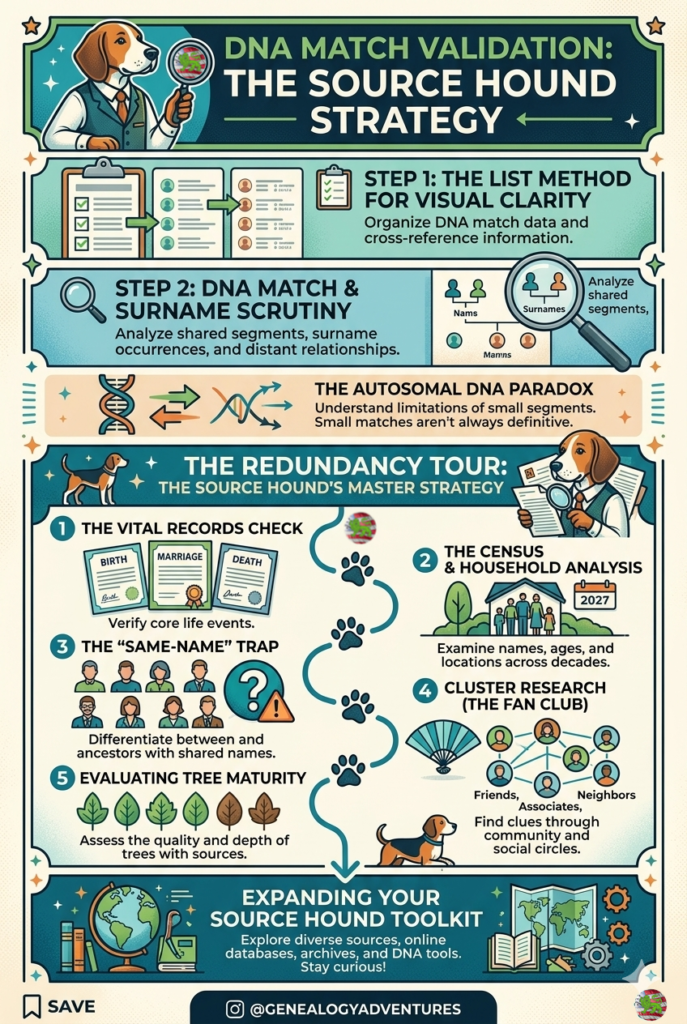
The Source Hound Strategy is the research methodology I developed and use across all of my genealogical work — including every time I sit down to evaluate Ancestry ThruLines matches. I introduced it fully in my Ultimate Beginners Guide to Professional Genealogy Research Online, and it is the framework that underpins everything I publish on this blog and YouTube channel.
The core principle is this: every claim needs a source, and every source needs to be evaluated. Not accepted, not dismissed — evaluated.
When it comes to working with these DNA suggestions, the Source Hound Strategy means treating each one as the beginning of a research trail, not the end of one. The tool hands you a lead. You are the hound. Your job is to follow that lead through the records until you either confirm it or rule it out. 🔍
A good Source Hound never trusts a dotted box without sniffing it out first. Here is exactly how that looks — step by step.
Step-by-Step: How to Verify Every Ancestry ThruLines Match
These steps will walk you through the Source Hound approach to any suggested connection, whether you are looking at a close match or a distant one.
Step 1 — Evaluate the Shared DNA First 🧬
Before you touch any tree information, look at the shared centimorgan (cM) figure between you and your match. This number is your anchor.
Use the shared cM to determine the range of possible relationships. Tools like the DNA Painter Shared cM Project are excellent references. Ask yourself: does the proposed relationship fall within the expected cM range for that connection?
If the suggestion says this person is your 3rd cousin and you share 280 cM — that is well above the expected range for a 3rd cousin (typically 0–173 cM). Something may be wrong with the tree path, or there may be a closer relationship not yet identified.
The DNA does not lie. The tree interpretation might. Always start with the cM. 📊
Step 2 — Examine the Match’s Tree 🌳
Click through to your match’s actual tree — not just the Ancestry ThruLines display, but the full tree itself. Look at the generations closest to you first, then work backward toward the proposed common ancestor.
Ask yourself:
- How well-sourced is this tree?
- Are there original records attached, or just unsourced names and dates?
- Does the tree extend at least 4 generations with verifiable information?
A tree built on sourced documents is a completely different level of evidence than one built on hints accepted without review. A Source Hound distinguishes between the two immediately. 🧐
Step 3 — Search for the Common Ancestor in Primary Records 📜
This is where your verification work becomes real. Go to Ancestry.com directly and search for the proposed common ancestor using historical records — census, vital records, land records, military records, church records. Do not rely on tree entries from other users. Go to the original documents.
If the proposed common ancestor is meant to be your great-great-grandmother born in 1855 in Ohio, you want to find her in the 1860, 1870, and 1880 census. You want a death record. You want a marriage record. You want at least three independent primary sources confirming her existence, location, and family connections — before that dotted box earns the right to become a solid one.
Our Free Genealogy Forms Bundle includes a Research Log template and a Source Citation form that are perfect for tracking every document you find during this process. Do not skip the paperwork — it will save you enormous time later. 📝
Step 4 — Cross-Verify Using FamilySearch 🌐
FamilySearch is free, vast, and completely independent of Ancestry ThruLines. If the proposed ancestor and their family relationships are real, you should be able to find corroborating evidence there — census records, vital records, probate records, and more.
I cover the full power of FamilySearch in my deep-dive Ancestry vs FamilySearch: 7-Category Search Engine Super Showdown, and I highly recommend reading it alongside this guide if you are building a dual-platform verification habit.
Finding the same ancestor confirmed independently on FamilySearch is a significant step toward establishing a reliable connection. Every Source Hound knows that one pillar of evidence alone is not enough to hold the ceiling. 🏛️
Step 5 — Check Your Shared Matches 👥
Back on Ancestry, use the Shared Matches feature to see which other DNA matches you and your match have in common. If the proposed relationship is genuine, you should see a cluster of shared matches who all connect through the same ancestral line.
A genuine family group tends to cluster together. If you and your match share 18 people in common and most trace back through the same county in the same time period, that is meaningful corroboration. If the shared matches scatter randomly with no coherent pattern, treat that as a yellow flag and dig deeper before proceeding. 🚩
This is one of the most underused verification steps in the entire workflow — and one of the most powerful.
Step 6 — Evaluate Before You Add ✅
Only after completing Steps 1 through 5 should you consider moving a dotted ancestor box into your tree as a confirmed solid entry. And even then, attach your sources directly to the profile. Use Ancestry’s Notes tool to record your reasoning.
The moment you add an unverified suggestion to your tree without documentation, you become part of the problem you started this journey trying to solve. A Source Hound never does that. 🐾
The Family History Foundation Newsletter
It’s Not About You, It’s About Documenting Before It Disappears
Join 500+ family historians getting Franklin’s Source Hound weekly research breakthroughs — real case studies, source hacks, and the exact strategies that turn brick walls into discoveries.
Free. No fluff. Straight from the Source Hound’s desk to yours.
Your privacy is sacred — almost as sacred as a primary source. Read our Privacy Policy.
Using FamilySearch to Cross-Verify
FamilySearch deserves its own section because it is genuinely one of the most powerful tools in the Source Hound’s verification toolkit — and it is completely free. 🎁
It gives you access to records from a different indexing system, different digitisation projects, and in many cases, original images that Ancestry does not carry. Finding your proposed ancestor’s baptism record on FamilySearch — when all you have from the suggestion is a tree-based claim — is the kind of independent corroboration that transforms a hypothesis into a documented conclusion.
The FamilySearch Wiki is also an outstanding starting point for understanding which records exist for a specific county, state, or country during a given time period.
For Australian and New Zealand researchers: BDM (Births, Deaths and Marriages) registries vary by state and territory, and many are available free directly from government portals. These primary sources should always form part of your verification sweep.
For European researchers: Civil registration records, parish records, and notarial archives across Germany, France, Italy, the Netherlands, and Scandinavia are increasingly digitised and searchable. A suggestion pointing to a European ancestor deserves verification in European records — not just in American-sourced trees.
For American researchers: The census is your best friend at Step 3 and Step 4. My post on the 1830 Census and how to calculate ancestor birth years precisely is a practical companion when your proposed common ancestor lived in early 19th-century America. 📅
When Ancestry ThruLines Gets It Right — and When It Doesn’t
It would be unfair — and inaccurate — to present Ancestry ThruLines as unreliable across the board. When the trees involved are well-sourced, when the proposed relationship is within 4 to 5 generations, and when the shared cM aligns with the expected range, the tool can be a genuinely impressive research accelerator.
I have personally used it to confirm 2nd and 3rd cousin relationships that I had already partially documented through records. In those cases, the feature provided a useful visual map that matched my own research exactly. That is the tool working as intended — and working beautifully. 🌟
The further back you go, the more caution is required. A suggestion tracing a connection through a 6th great-grandparent involves a chain of trees so long, and DNA so distant, that errors compound quickly. Approach those deep suggestions as interesting hypotheses worth investigating — not as family history you can rely on.
The key variable is always the quality of the trees involved. A suggestion built on sourced trees with original records attached is a very different research animal from one built on trees that are themselves built on other trees with no primary documentation anywhere in the chain. A Source Hound learns to tell the difference every single time. 🐕
Related Reading on This Blog
If you are building your DNA research skills systematically, these articles pair directly with what you have learned today:
- 15 Ancestry Tools Hidden in Plain Sight — Many of these tools directly support the verification process, including Notes, Tree Tags, and the Shared Matches features that are central to Steps 2 and 5 above.
- How to Animate Old Photos with MyHeritage Deep Nostalgia — Once you have verified a match and confirmed a new ancestor, bringing their photograph to life is one of the most moving things you can do with that discovery. 📸
Source Hound Verification Checklist
Print this out, bookmark this page, or save it to your desktop. Run every suggestion through every item on this list before adding anything to your tree.
✅ Does the shared cM fall within the expected range for the proposed relationship?
✅ Have I examined the match’s actual tree — not just the Ancestry ThruLines display?
✅ Are there sourced, original records attached to the key ancestors in that tree?
✅ Have I searched for the proposed common ancestor in at least 3 independent primary sources?
✅ Have I cross-checked on FamilySearch or another independent platform?
✅ Have I reviewed the shared matches cluster for coherent grouping?
✅ Have I considered whether a step-ancestor or second marriage could explain the connection differently?
✅ Have I attached my source citations and research notes before adding anyone to my tree?
Check every box and you have done the job properly. That dotted box in Ancestry ThruLines has earned the right to become a solid one. 🎉
Join the Family History Foundation Source Hound Community
Our family history is disappearing every day, join the Source Hound community and join our pledge to be the protector of your family history. The lives and voices of our ancestors are depending on it for our future generations.
Celebrate Family History Fridays with us across our social media and community platforms!
📬 Subscribe to the Newsletter — tips, active challenges, and deep-dive case studies. Never an overloaded inbox, always something you can use this weekend.
 Like & Subscribe on YouTube — every Friday, a video companion to the week’s article. Watch these techniques demonstrated rather than described.
 Pin Us on Pinterest — printable question sheets, research charts, and visual guides to save for your next session.
 Podcasting on Spotify! — podcasting now on Spotify, you can find all of the latest episodes on any of your favourite podcast platforms, starting with Spotify.
 Podcasting on Amazon! — If you are not on Spotify we are also on Amazon Podcasts so you can listen while you drive and work. Every episode is curated just for you to binge your favourite episodes.
 Podcasting on Audible! — Audible is an alternative offshoot of Amazon Podcasts to listen while search for your next favourite book. Ready for your next “audible?” Set, Go!
Let’s make Family History a household word. 🏠
Watch the Full Episode on YouTube
I walked through this complete verification process — including live screen examples of Ancestry ThruLines in action — in a dedicated episode on the Family History Foundation YouTube channel. If you are a visual learner (and many of us are!), watching this alongside reading will lock the methodology in far more effectively. 📺
▶️ Watch: Ancestry ThruLines — Taking the Guesswork Out of Potential Matches
The Family History Foundation Newsletter
Our Family History Is Disappearing Every Day!
Join the quest with 500+ family historians getting Franklin’s Source Hound weekly research breakthroughs — real case studies, source hacks, and the exact strategies that turn brick walls into discoveries.
Free. No fluff. Straight from the Source Hound’s desk to yours.
Your privacy is sacred — almost as sacred as a primary source. Read our Privacy Policy.
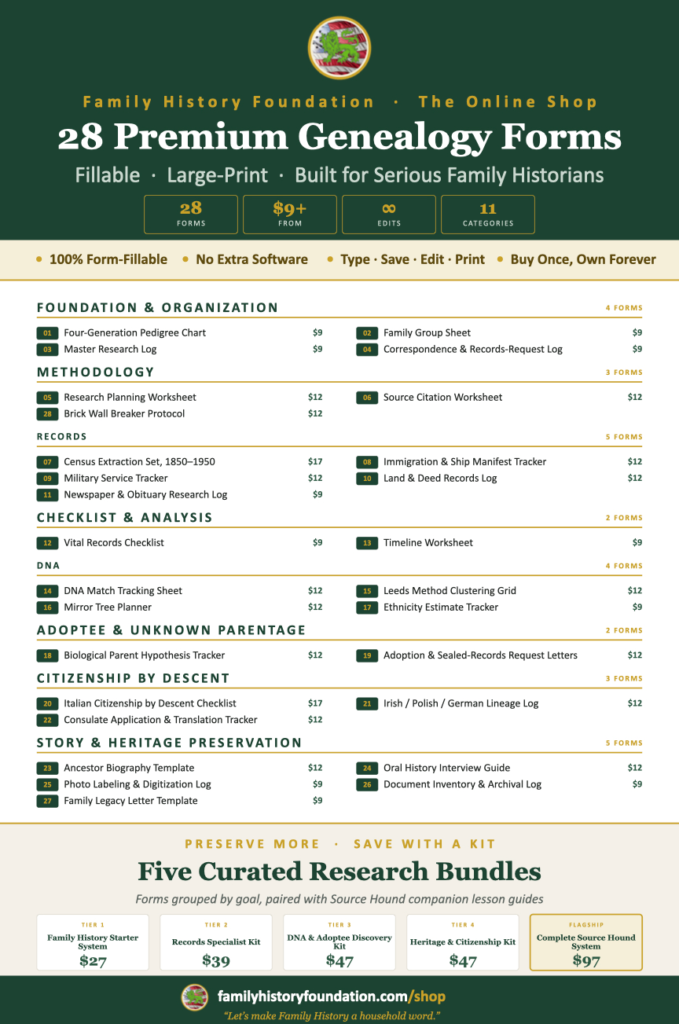
Shop Premium Genealogy Forms
About the Author
Hi there, my name is Franklin, the founder and author of The Family History Foundation.
Our family stories are disappearing every day and it’s crucially important that the next generation is able to learn and appreciate their family history. It is up to you to take up the mantle of responsibility to ensure that how you research today will be passed on tomorrow with the highest standards possible.
I believe that genealogy is not just about names and dates, it’s about your stories and how those stories inform your identity.
With a penchant for storytelling and a background in research, the insights and techniques you learn on The Family History Foundation will help you uncover the incredible stories and identities hidden within the tapestry of your ancestry.
My mission is “Let’s make Family History a household word.”
My motto is “The Past ‘Relative’ to the Future.”
Frequently Asked Questions
Q: Is Ancestry ThruLines based on DNA or family trees?
A: It is based on both — but not equally. The shared DNA figure is real and scientifically measured. The relationship path suggesting how you and your match are connected is built from linked family trees, including trees that neither you nor your match may own. This is why verification against primary records is always necessary before accepting any suggestion as fact.
Q: What does a dotted box mean in the ThruLines display?
A: A dotted box around an ancestor means that person is not currently in your tree. Ancestry ThruLines is suggesting them as a potential ancestor based on other searchable trees in its database. A dotted box is a research lead, not a confirmed fact — and it should never be added to your tree without proper verification.
Q: How many centimorgans should I share with a Ancestry ThruLines match to trust the connection?
A: There is no single magic number, but the higher the shared cM, the more confident you can be that a real DNA connection exists. The relationship path still requires verification regardless of the cM amount. For connections below 20 cM, be especially cautious — false matches become statistically common at that range.
Q: My result shows someone as a half-sibling. Does that mean we share only one parent?
A: Not necessarily. The algorithm sometimes displays “half” relationships when it misreads a tree — for example, failing to recognise a marriage properly and treating one spouse as unrelated to the other’s descendants. Before concluding you are actually half-related, verify the tree data carefully and compare your shared cM against what is expected for both a full and a half relationship. This could also indicate a cousin!
Q: Can I use the Source Hound Strategy for other genealogy platforms, not just Ancestry?
A: Absolutely — and you should. The Source Hound Strategy is a research philosophy, not a platform-specific tool. Evaluating every source, cross-referencing with independent records, and never accepting a suggestion as fact applies equally to MyHeritage, 23andMe, FamilyTreeDNA, and any other platform that offers automated relationship suggestions.
Q: How do I find records to verify a match for ancestors outside the United States?
A: Start with FamilySearch for a free, comprehensive search across international record collections. For Australian and New Zealand ancestors, BDM registries and the National Archives of Australia are excellent starting points. For European ancestors, check the relevant national or regional archives — many are now digitised and freely searchable. Our genealogy research guide covers international source strategies in detail.
Q: Does having a larger family tree improve my results in Ancestry ThruLines?
A: Yes — significantly. The feature works best when both you and your matches have trees that extend at least 4 generations, with accurate names, dates, and locations. However, a larger tree containing errors will generate more suggestions, not better ones. Quality always beats quantity.