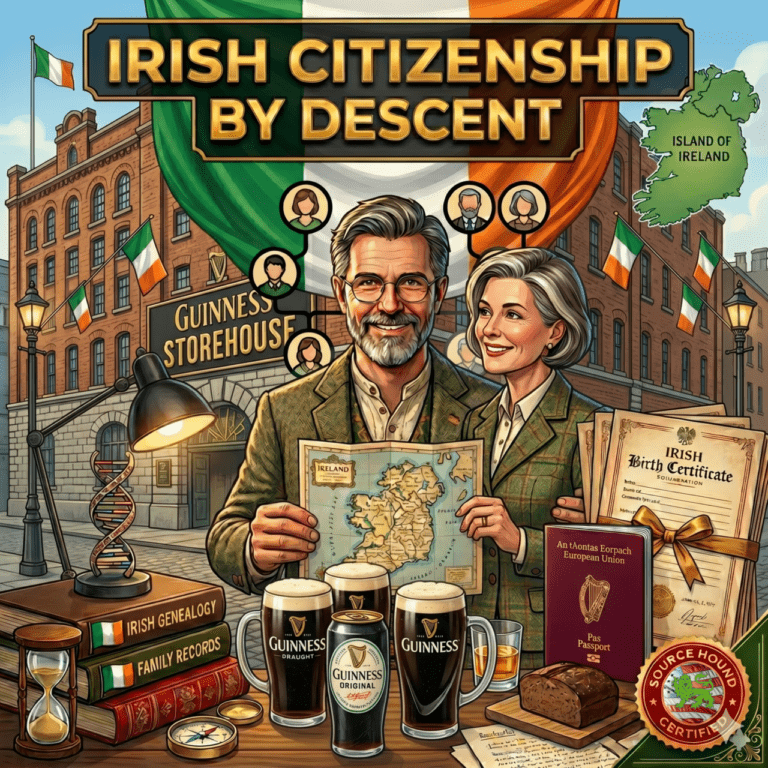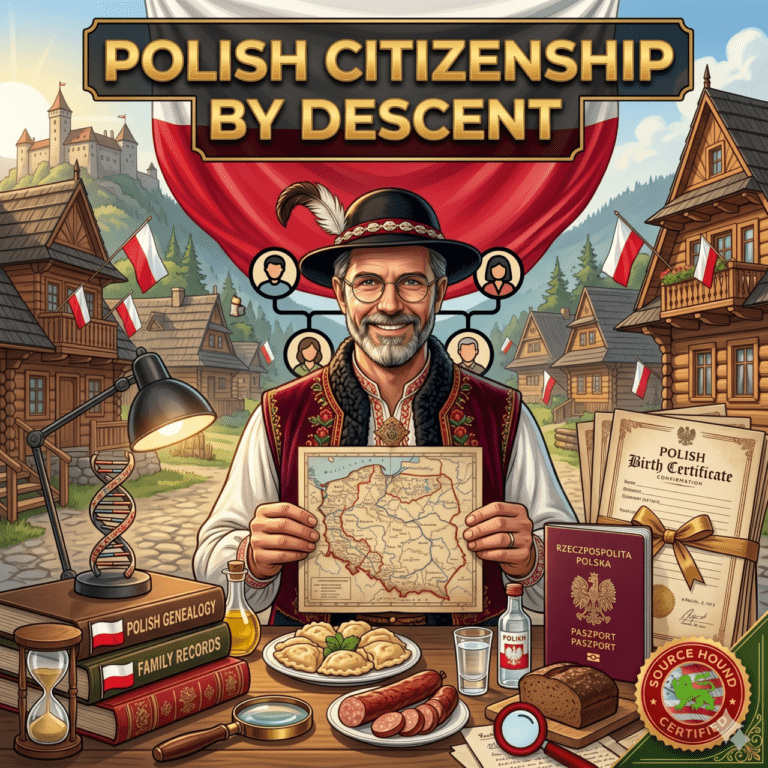
Here is the alt text for the image: A complex illustrative poster titled in large gold letters: "POLISH CITIZENSHIP BY DESCENT". In the foreground, a smiling middle-aged man with a grey beard, wearing a traditional Goral hat and embroidered vest, holds a vintage map of Poland. He is behind a table laden with items: pierogi, kielbasa, bread, a bottle of Polish vodka, a DNA double helix lamp, stacked books titled "POLISH GENEALOGY" and "FAMILY RECORDS", an hourglass, a compass, and a magnifying glass. To the right, a detailed "POLISH BIRTH CERTIFICATE" with a gold ribbon, a dark Polish passport with the national eagle emblem, and a "SOURCE HOUND CERTIFIED" seal. The background depicts a traditional Polish village with unique wooden architecture and a large Polish castle on a hill, all under a blue sky, with numerous Polish flags. A symbolic family tree chart connects figures around the man's head. The entire image has a detailed, illustrative art style.

Polish Citizenship by Descent: The Complete 2026 Confirmation Guide

Polish Citizenship by Descent begins with a remarkable premise: if your ancestor was a Polish citizen and the chain of citizenship was never legally broken, Poland already considers you a citizen — you simply need the paperwork to prove it. 🇵🇱 This is one of the most generous nationality frameworks in Europe, and unlike most […]

Polish Citizenship by Descent: The Complete 2026 Confirmation Guide Read the full story →

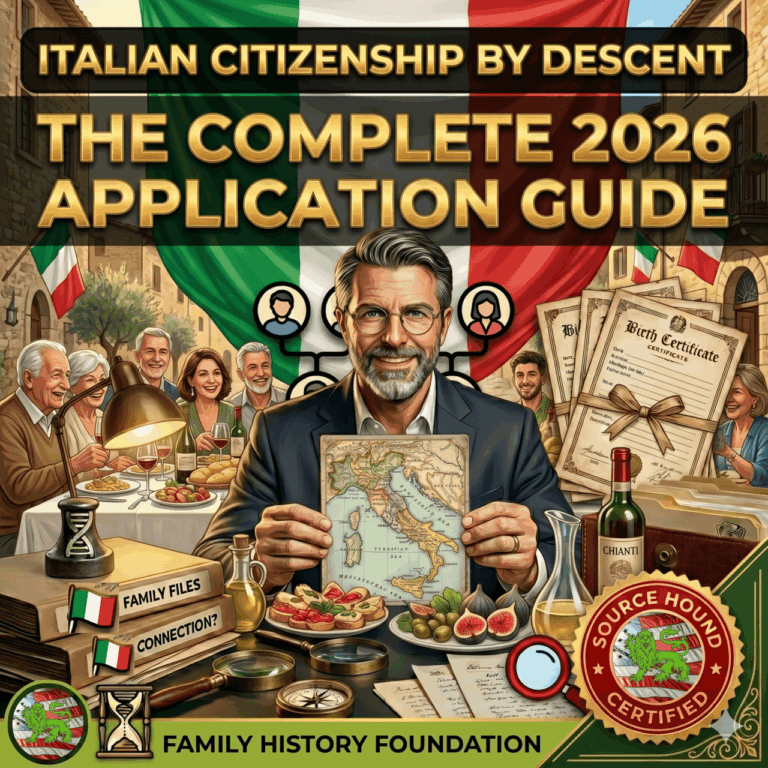
A professional genealogist sits at a table in an outdoor Italian setting, holding a vintage map of Italy. He is surrounded by other people enjoying food, wine, and conversation. The scene includes stacks of documents labeled "Family Files," birth certificates, and various genealogical research tools like a magnifying glass. The background features a large Italian flag, and the text overlay at the top reads: "ITALIAN CITIZENSHIP BY DESCENT: THE COMPLETE 2026 APPLICATION GUIDE," with a "Source Hound Certified" seal in the bottom right corner.

Italian Citizenship by Descent: The Complete 2026 Application Guide

Italian Citizenship by Descent has not been abolished — but it has been profoundly reformed, and if you have Italian heritage, what you believed to be true about your eligibility before March 2025 may no longer apply. 🇮🇹 Millions of Americans, Australians, Canadians, and New Zealanders have spent years building their family trees, tracing their

Italian Citizenship by Descent: The Complete 2026 Application Guide Read the full story →

A visually striking still life photograph on a wooden desk, featuring a collection of European and South American passports fanned out like a bouquet, radiating with a soft glow from within an open vintage leather-bound journal titled "FAMILY HISTORY NOTES." Above the passports, the text "YOUR ANCESTRAL PASSPORT IS WAITING" is prominently displayed. Below, a deep purple banner with a gold trim carries the title "A Genealogist’s Guide to Citizenship by Descent." Surrounding this centerpiece are various old-world tools for exploration and historical research: * Two pairs of antique reading spectacles * Two vintage brass compasses * Three magnifying glasses * An aged parchment map showing a partial family tree with a prominent tree motif and names, one of which is "Treer." * Old books and documents blurred in the background. Visible passports include Italy (REPUBBLICA ITALIANA), Ireland (ÉIRE IRELAND), and Poland, each featuring their national coat of arms. The composition is warm and rich, using tones of wood, aged paper, and dark leathers. At the bottom edge, the URL "[https://familyhistoryfoundation.com/](https://familyhistoryfoundation.com/)" is included.

Citizenship by Descent: How to Claim Your Ancestral Passport in 2026

Citizenship by Descent could be the most valuable discovery you make this year — and if you have been quietly building your family tree, you may already have everything you need to claim it. 🌍 Across the United States, Australia, Canada, and New Zealand, millions of people carry ancestry from Ireland, Italy, Lithuania, Germany, and

Citizenship by Descent: How to Claim Your Ancestral Passport in 2026 Read the full story →

Newspapers-com Genealogy. A man in a brown tweed jacket with an engaged, surprised expression holds a tablet in a promotional image titled 'WHAT NEWSPAPERS.COM GENEALOGY FOUND THAT ANCESTRY COULDN'T'. He points a red arrow towards a virtual screen displaying a 'Newspapers.com' browser window comparing 'ANCESTRY FINDINGS' and 'NEWSPAPERS.COM DISCOVERIES', which highlights unique social announcements and personal obituaries. A specific newspaper clipping is circled in red, showing an obituary for Eleanor Vance with her maiden name and hometown listed. The bottom of the image has a website URL 'FAMILY HISTORY FOUNDATION.COM', logos for 'HONEST REVIEW CERTIFIED' and 'FAMILY HISTORY FOUNDATION'. The background is a blurred library of old books.

What Newspapers.com Genealogy Found That Ancestry Couldn’t: A Genealogist’s Honest Review

Newspapers.com Genealogy research changed the way I think about my ancestors — and I say that as someone who has spent decades working through census records, vital records, and DNA matches. 🗞️ Census records tell you where your ancestors lived. Vital records confirm when they were born and died. But neither of those sources can

What Newspapers.com Genealogy Found That Ancestry Couldn’t: A Genealogist’s Honest Review Read the full story →

Ancestry ThruLines Explained. A square featured image for a blog post titled "Beyond the Green Leaf: Verify ThruLines with the Source Hound Strategy." On the left, a man with glasses and a beard points toward a digital interface. The interface compares an "Unverified Suggestion" featuring a basic family tree branch and a "Verified ThruLine" which shows a multi-generational tree supported by icons for an 1880 Census, Birth Certificate, and Military Record. A "Source Hound Strategy" logo featuring a magnifying glass over a paw print sits at the bottom right, and the website URL "familyhistoryfoundation.com" is displayed at the bottom.

Ancestry ThruLines Explained: How to Stop Guessing and Start Verifying Your DNA Matches

Ancestry ThruLines is one of the most exciting — and most misunderstood — features ever released for DNA researchers on the platform. 🧬 If you have ever logged in and spotted a new ThruLines suggestion glowing on your screen, you already know that irresistible pull — the feeling that your family tree is about to

Ancestry ThruLines Explained: How to Stop Guessing and Start Verifying Your DNA Matches Read the full story →

1830 Census. An infographic on a parchment-textured background with a yellow border. The top title is "1830 CENSUS: HOW TO CALCULATE ANCESTOR BIRTH YEARS PRECISELY" in a red, glowing font. Below this, there's a list of points with key icons: "Unique 13-Part Age Structure", "Last Head-of-Household Census", "Last Head-of-Household Census", and "Tracks Families During Expansion". Adjacent to this is a column titled "THE COMPLETE 1830 AGE STRUCTURE" with a table of age brackets and corresponding stick-figure counts. The rest of the image is divided into several detailed sections: HOW TO CALCULATE BIRTH WINDOWS: With a magnifying glass over a video player icon, a notebook with a formula, and text detailing the calculation steps. APPLYING THE BIRTH WINDOW: Showing a flow with icons from "Vital Records" to "Birth Certificate" to "Death Record". CROSS-VERIFICATION: With a timeline and a series of linked year boxes centered around "1830". COMMON RESEARCH PROBLEMS: Listing items like "Boundary changes" and "Indexing errors". SPECIAL CONSIDERATIONS & MIGRATION: With a map of the United States and red arrows showing westward movement, accompanied by illustrations of a covered wagon and a steamboat. AFRICAN AMERICAN GENEALOGY: With a short text block. SEARCH THE 1830 CENSUS ON ANCESTRY: With a search bar and a stylized leaf icon. The entire composition is bounded by a red, glowing effect. A bottom scroll banner contains the website URL https://familyhistoryfoundation.com/ (Family History Foundation)

1830 Census: How to Accurately Calculate Ancestor Birth Years

The 1830 Census introduced 13 age brackets for free white persons—the most granular age tracking in any census before 1850. Most genealogists find their ancestor, note the age bracket, and move on. Here’s what they miss: those 5-year increments let you calculate birth years within narrow windows, transforming vague “early 1800s” estimates into targeted searches.

1830 Census: How to Accurately Calculate Ancestor Birth Years Read the full story →

Scroll to Top